
Male to Female Ratio in Cannabis Seeds Explained
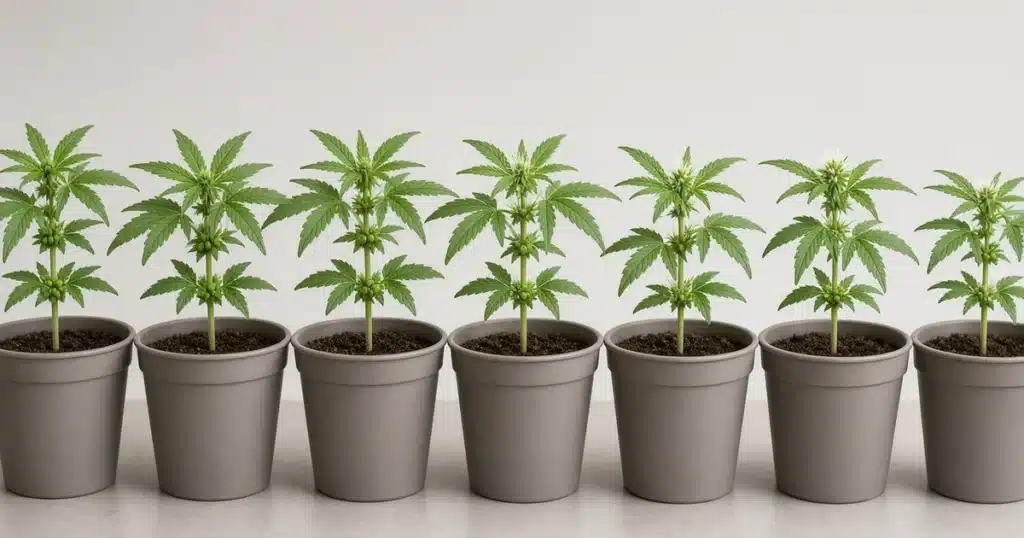
Regular cannabis seeds, made by crossing a male and a female plant, grow roughly half male and half female plants on average. Any single pack can land well off that average. In one study, crossed seed lots ranged from about even to mostly female, so growers usually start extra seeds to end up with enough females.
Why is the ratio about 50/50?
Cannabis sex is usually determined by sex chromosomes, which is why regular seeds tend to split close to half male and half female. A female passes one type, a male passes either type, so on average half the seeds are male.
Each seed gets its own draw. That is why a small pack can lean male or lean female even though the long-run average stays near half and half.
In more detail, cannabis has 20 chromosomes in each cell: nine pairs of regular chromosomes plus one pair of sex chromosomes. Females carry two X chromosomes (XX), and males carry one X and one Y (XY). Every egg from the mother carries an X. Each pollen grain from the father carries either an X or a Y, which is what makes the split close to even.
What did research find?
Punja and Holmes used a DNA test to sex seedlings grown from crossed seeds and from hermaphrodite flowers.
| Seed lot | Male seedlings | Female seedlings |
|---|---|---|
| Moby Dyck, male x female cross | 5 | 7 |
| Blue Deity, male x female cross | 9 | 5 |
| Healer, seed from outdoor cultivation | 2 | 14 |
| Hermaphrodite flowers (two strains) | 0 | All tested |
Source: Punja and Holmes, Frontiers in Plant Science, 2020 (Figure 10). Small sample sizes, so single lots vary a lot.
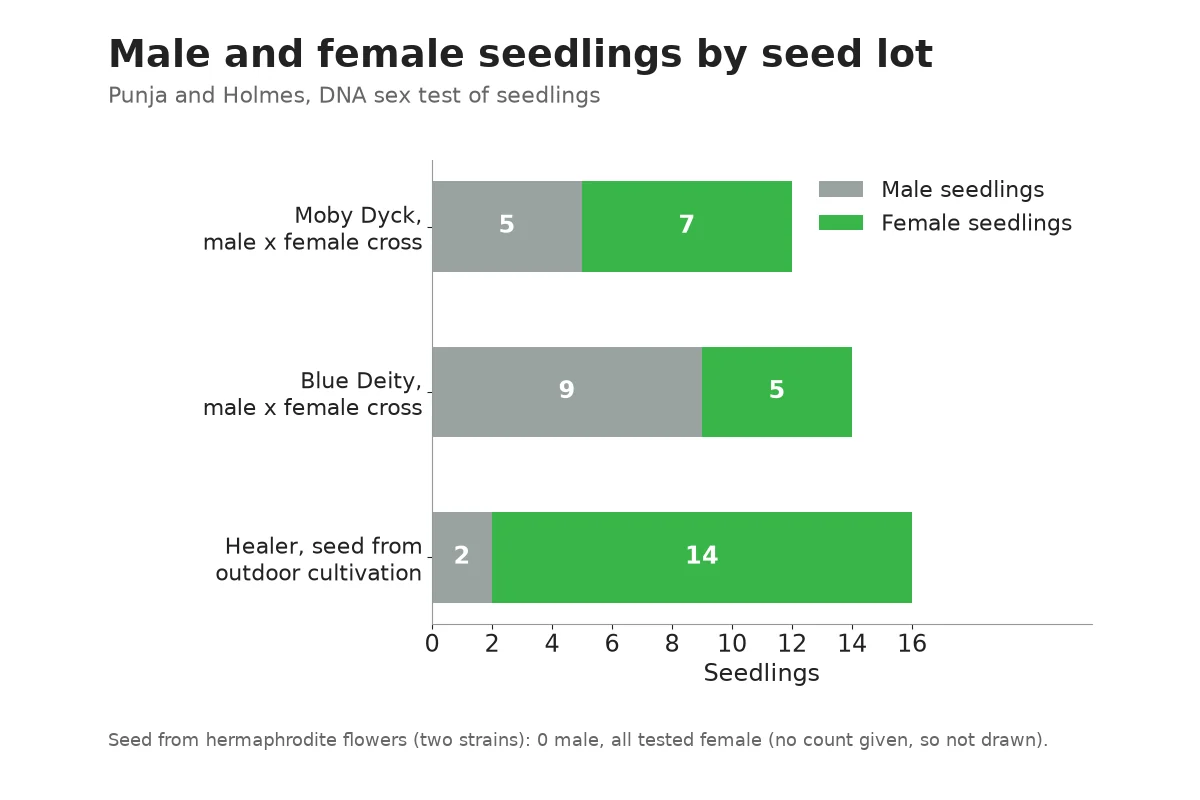
The authors described the crossed seeds as about 1:1 overall, even though each small lot swung above or below that. Seeds from hermaphrodite flowers were all genetically female.
The crossed lots show how wide the swing can be. Moby Dyck came out close to even, with 5 males and 7 females. Blue Deity leaned male, with 9 males and 5 females. Healer, grown from outdoor seed rather than a controlled cross, leaned strongly female, with 2 males and 14 females. The authors suggested its two males most likely came from pollen of a male plant.
The same study germinated its seeds in a moist coco and vermiculite mix at 23 to 25 °C. Seeds from hermaphrodite flowers sprouted at a rate of 90 to 95 percent within 10 to 14 days. That matters for planning, because a seed that never sprouts is a plant you never get to sex.
How many regular seeds should you start?
Plan on about half turning male, then add a few extra.
For example, if you want four females, start about eight regular seeds and add one or two for losses. The list below walks through the same math.
- Decide how many female plants you want.
- Start about twice that number.
- Add one or two extra for losses.
- Sex plants as early as possible. See how to determine the sex.
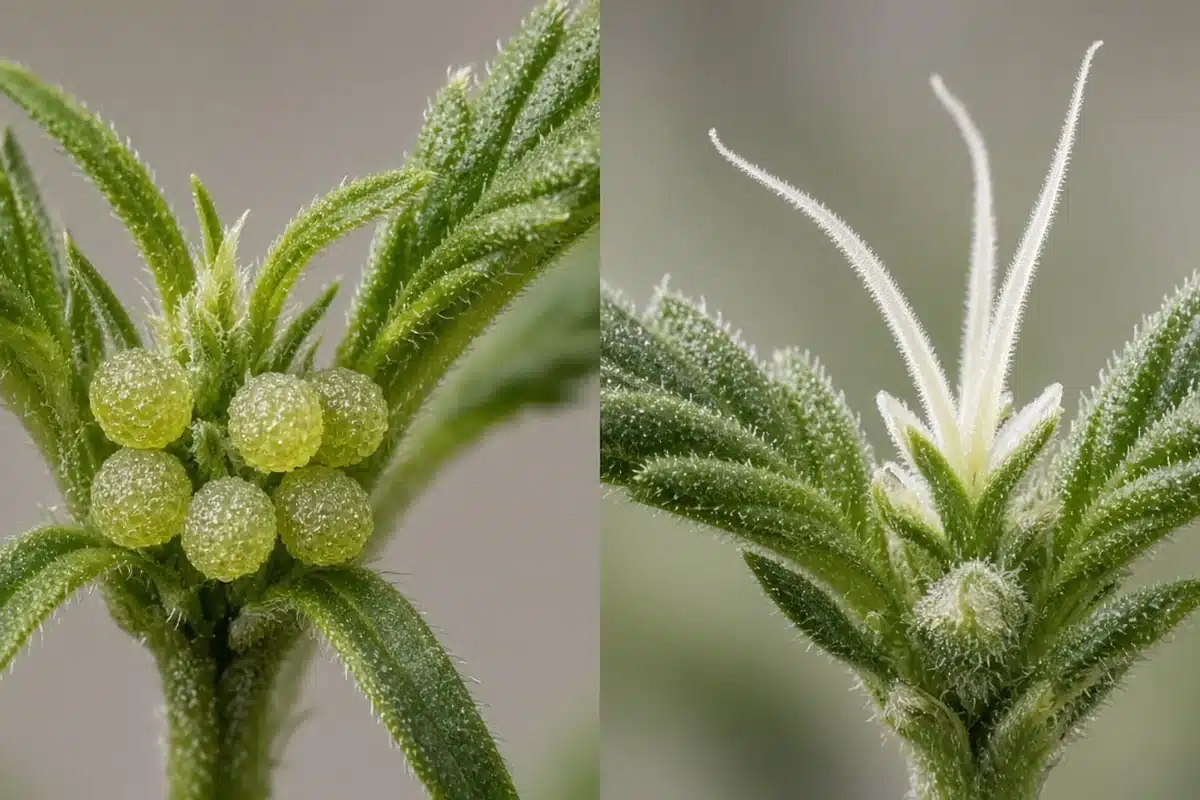
Males show small round pollen sacs at the branch joints, and females show paired white pistils. Catching males before full flowering keeps them from pollinating the rest.
Males are not wasted. See things to do with male plants.
What happens at each stage of a regular seed grow?
Germination. Sex is already set inside the seed, but you cannot see it yet. Treat every seed the same and label each one with a number as it goes into soil.
Seedling stage. Seedlings look alike. Use this time to keep conditions steady so every plant reaches the point where it can show its sex.
Late vegetative growth. Research on female plants found that single flowers form at the leaf joints even under long days, before the switch to flowering. This is why branch joints are the place to look. Check them with a magnifier every few days.
Early flowering. After the switch to 12 hours of light, plants that were unclear usually make their sex obvious. In one study of a single cultivar, female flowers with visible pistils were fully formed 5 days after plants moved to short days.
Mid flowering. Remove any males you missed before their sacs open. Punja and Holmes observed male plants releasing pollen over 2 to 4 weeks, so a missed male can seed a whole room.
Males often give themselves away by growth before flowers. In the Punja and Holmes work, male and female plants from one Blue Deity seed batch were planted at the same time and grown under 24 hours of light for 4 weeks. The males grew faster into taller, slimmer plants, which the authors note helps them shed pollen onto the shorter females. Outdoors, pollen from male plants can travel up to 3 to 5 km depending on wind, so a missed male is a risk well beyond its own pot.
Can you tell a seed’s sex before it grows?
Not by looking at it. Male and female seeds look the same, and size, color or shape do not reveal sex. Labs can test young plants instead. Punja and Holmes used a PCR test in which one DNA fragment showed up only in male plants, while a second fragment showed up in both sexes as a check. Tests like this work on seedling leaves, so they can sort plants weeks before flowers appear.
For most home growers, watching the branch joints is the simpler route. A DNA test makes the most sense when space is tight and every plant slot counts.
Where exactly should you look?
Research on female plants describes the basic unit of a cannabis stem. At each joint there is one fan leaf, a side shoot, and two small bracts at the base of the leaf stem. Each bract holds one solitary flower. That spot, where the leaf stem meets the main stem, is where the first sign of sex shows.
On a male, the same spot grows small round sacs instead of a bract with hairs. Look at the upper joints first, since they tend to show earliest, and use a magnifier.
What should you do once you know the sex?
- Females: keep growing as planned and keep checking now and then for male flowers.
- Males: move them out before any sac opens. Even a single open sac can release pollen across a tent.
- Unclear plants: keep them apart from females until they show clearly.
Plan the space for this from the start. If half your seeds may turn male, you will free up about half your room partway through veg, so starting in small pots and moving only females to larger ones saves soil and space.
Keep a simple log as you go: seed number, date planted, date sex showed, and male or female. Over a few grows, that record shows how your own seed lots tend to split.
What are the signs that a plant is male or female?
- Male: small round sacs that hang on short stems at the branch joints, often in clusters.
- Female: a small teardrop-shaped bract with one or two white hairs (pistils) coming out of it.
- Unclear: if a joint shows nothing yet, wait a few days and check again rather than guessing.
Why do feminized seeds give mostly females?
Feminized seeds come from pollen made by a female plant, so they carry female genetics. The hermaphrodite seed lots in the research point the same way. For the trade-offs, see regular or feminized seeds. With regular seeds, Kind Seed Co suggests a label on every seedling so you can track which ones turn male. Even with feminized seeds, a look at branch joints during late veg is time well spent. A small share of plants may still grow some male flowers later on.
What are common mistakes with regular seeds?
- Starting exactly as many seeds as plants you want. With a roughly even split, half of them may turn out male.
- Expecting every pack to hit 50/50. Small lots swing widely, as the 2 to 14 split in one seed lot shows.
- Waiting too long to check. A male caught after its sacs open has already shed pollen.
- Skipping labels. Without labels, it is hard to tell which plants you already checked.
- Assuming stress makes more females. Sex is set mainly by chromosomes, so plan the count rather than trying to steer it.
Sources
- Punja ZK, Holmes JE. Hermaphroditism in Marijuana (Cannabis sativa L.) Inflorescences: Impact on Floral Morphology, Seed Formation, Progeny Sex Ratios, and Genetic Variation. Frontiers in Plant Science. 2020;11:718. https://pmc.ncbi.nlm.nih.gov/articles/PMC7329997/
- Spitzer-Rimon B, Duchin S, Bernstein N, Kamenetsky R. Architecture and Florogenesis in Female Cannabis sativa Plants. Frontiers in Plant Science. 2019;10:350. https://pmc.ncbi.nlm.nih.gov/articles/PMC6454139/
FAQ
What percentage of regular cannabis seeds are female?
On average about half, since sex follows a roughly 1:1 pattern. Small batches vary a lot. In one study, three crossed seed lots gave 7 of 12, 5 of 14 and 14 of 16 female seedlings. Starting about twice as many seeds as the females you need covers most of that swing.
Can growing conditions change how many seeds turn female?
Sex in cannabis is set mainly by its chromosomes. Growers often report that stress can change how plants flower, and plant hormones are linked to sex changes. Even so, conditions do not reliably turn a male seed into a female plant, so it makes sense to plan your seed count around the 1:1 average.
When can you tell male from female plants?
Many plants show their sex at branch joints a few weeks into growth, before full flowering. Males show small round pollen sacs, and females show paired white pistils. Checking with a magnifier every few days during late veg helps catch males early.
Are feminized seeds 100 percent female?
Feminized seeds carry female genetics, and in research, seeds from hermaphrodite flowers grew only genetically female seedlings. A small share of plants may still grow some male flowers later in bloom. Checking plants during flowering is a good habit with any seed type, feminized or regular.


