
Light Bleaching Cannabis: Why Top Buds Turn White
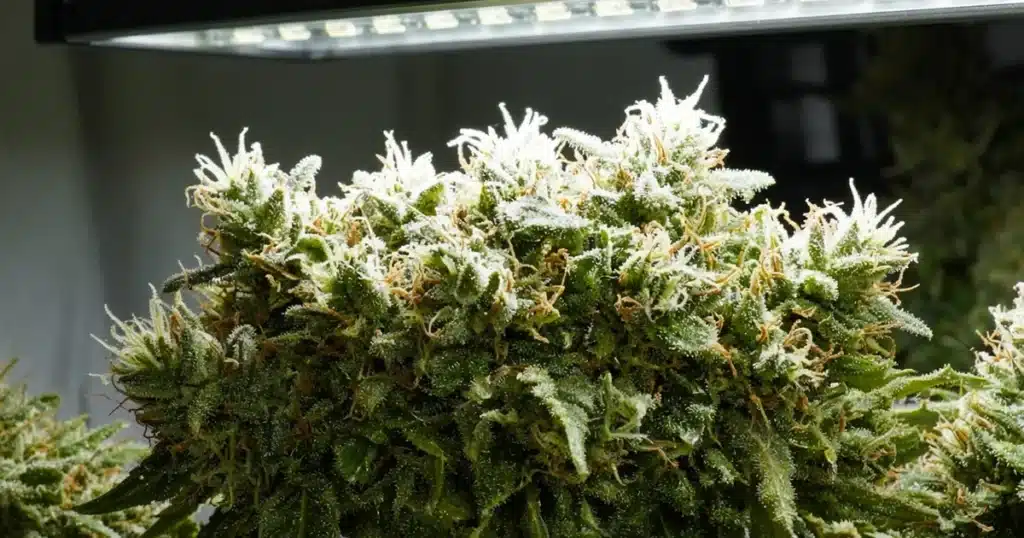
Light bleaching is when the buds and leaves closest to a grow light turn white or pale yellow. It happens when the top of the canopy gets more light than those tissues can handle, often under strong LEDs hung too low. The bleached parts do not turn green again, but the rest of the plant keeps growing once the light is adjusted.
What does light bleaching look like?
Bleaching starts at the very top of the plant. The pistils, sugar leaves and bud tips nearest the lamp lose color first, while lower buds stay green.
- White or pale yellow bud tips on the top colas.
- Upper leaves that look washed out but stay flat.
- A clear line where color returns a few inches lower.
- No spotting pattern on lower leaves, which helps rule out a feeding issue.
Bleaching is easy to confuse with two other problems. Nitrogen shortage yellows the older, lower leaves first, the opposite end of the plant. Mold can also look pale, but it brings fuzz, soft spots or a musty smell. Bleached tissue stays firm and dry.
How much light can cannabis use?
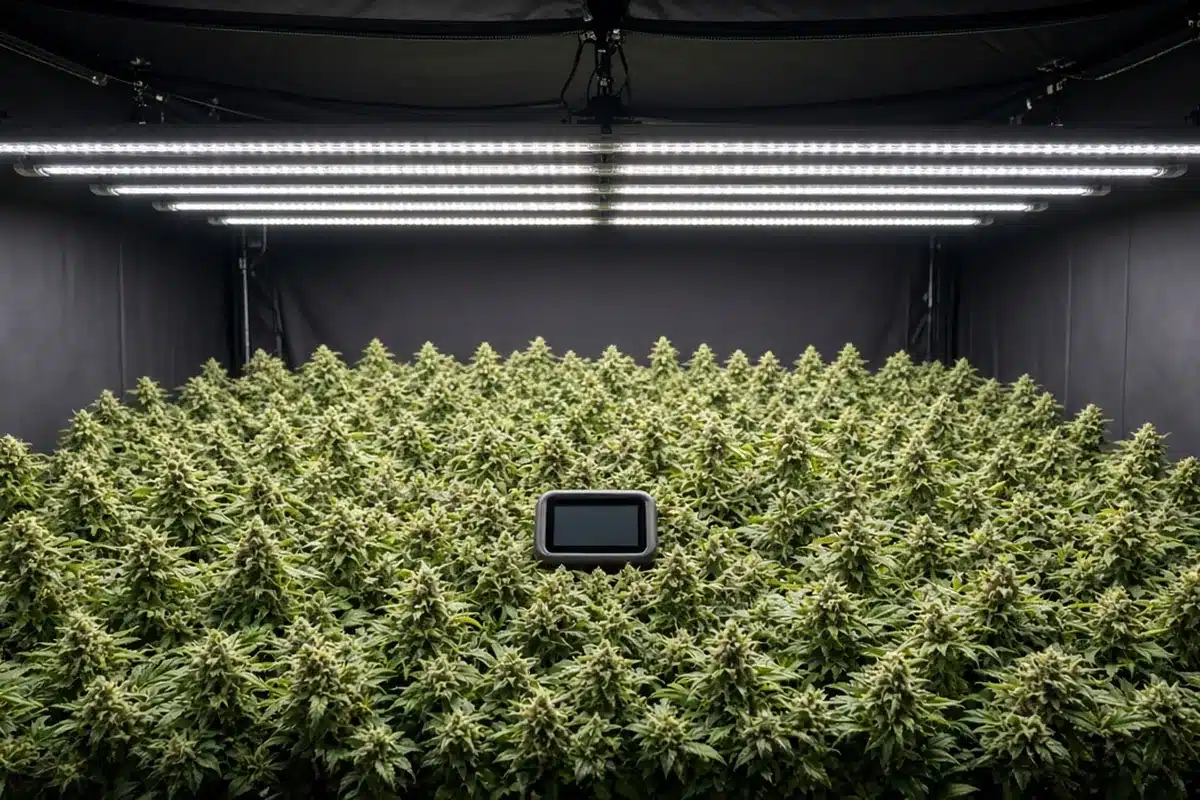
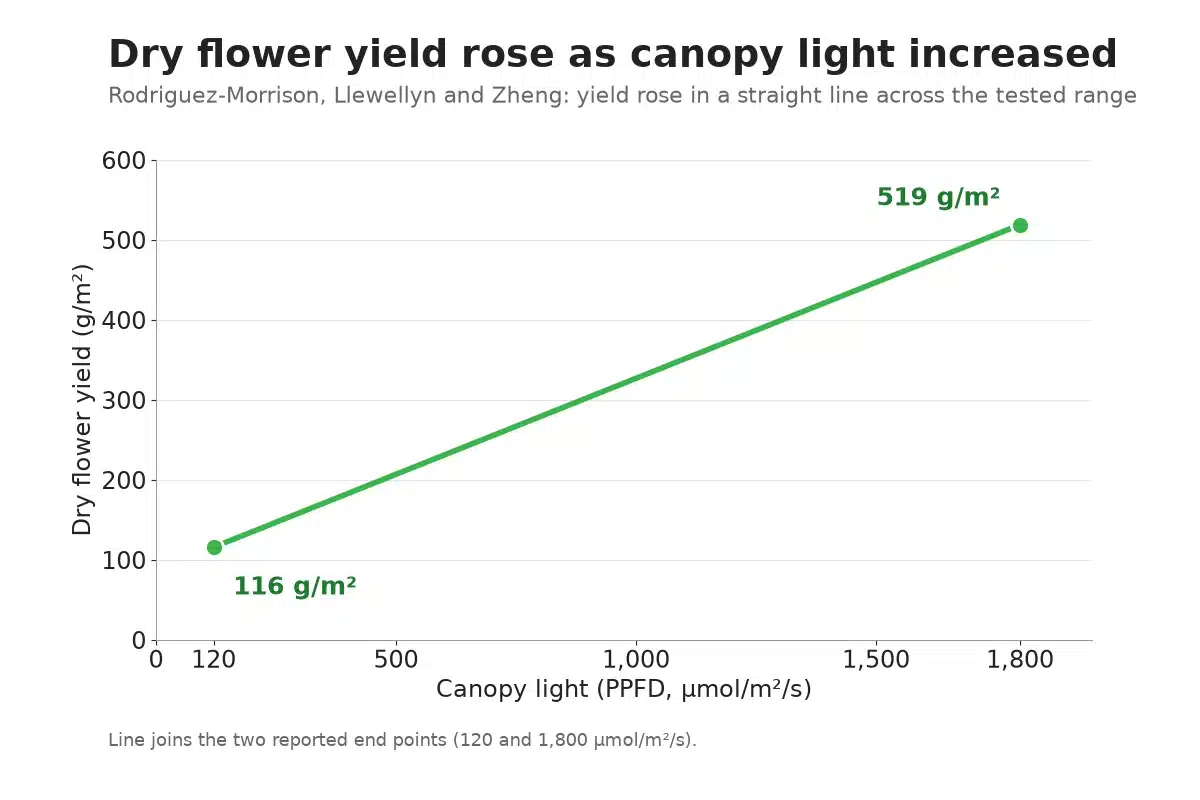
In one indoor cannabis study, dry flower yield kept rising as canopy light rose across the whole tested range. In that study by Rodriguez-Morrison, Llewellyn and Zheng, dry flower yield rose in a straight line as canopy light went from 120 to 1,800 µmol/m²/s. Leaf-level photosynthesis leveled off well below 1,800, so a whole plant kept responding after single leaves had peaked.
| Canopy light (PPFD, µmol/m²/s) | Dry flower yield (g/m²) |
|---|---|
| 120 | 116 |
| 1,800 | 519 |
Source: Rodriguez-Morrison et al., Frontiers in Plant Science, 2021. Plants grew 12 weeks on a 12-hour photoperiod under LEDs. Yield rose about 4.5 times across the range, and cannabinoid potency did not change.
That study raised light gradually and kept other conditions controlled. A home tent is different. A lamp hung too close puts a hot spot on the tallest bud, well above the average across the canopy, and bleaching is usually that hot spot.
So a canopy can look fine on average and still bleach in one place. The tallest cola takes the most light and often the most heat too, and the two stresses stack on the same tissue.
The same study found more than yield. As light rose from 120 to 1,800 µmol/m²/s, the top bud got about 1.3 times denser and the share of plant weight in flowers rose from 0.56 to 0.73. The top light level equals a daily light integral of about 78 mol/m²/day on a 12-hour day. The researchers also noted that doubling light to the top level raised yield by 70 percent while lowering energy efficiency by about 15 percent.
Why does a plant bleach if cannabis likes so much light?
High average light and a single hot spot are not the same thing. In research rooms, light is measured at the top of the tallest plant and kept even across each plot. In a tent, light is strongest directly under the center of the lamp and weaker at the edges. A cola that sits close to the center and close to the lamp can get far more light than the reading at the corners suggests.
Plants also need time to adjust. A second University of Guelph trial grew plants for 45 days at 600, 800 and 1,000 µmol/m²/s in flowering. Flower yield at 1,000 was 1.6 times the yield at 600, with no change in cannabinoid levels. Those plants were set at a steady level for the whole trial, not hit with a sudden jump.
How do you measure light at the top bud?
- Turn on the light and let it run for a few minutes.
- Hold the meter or phone sensor flat at the top of the tallest bud, facing the lamp.
- Take a reading at the center of the canopy, then at each corner.
- Write down the highest and lowest numbers.
- If the top bud reads far above the rest, lower that bud or raise the light.
A big gap between center and corners points to uneven coverage rather than a light that is simply too strong.
One finding from the 2021 study explains why the top bud deserves its own reading. The researchers concluded that the way a single leaf responds to light is not a reliable guide to how the whole plant will yield. Leaf-level photosynthesis leveled off well below the highest light level, yet flower yield kept climbing. A single pale tip tells you about that one spot, not about the light the rest of the canopy can use.
Research shows how closely light needs tracking. In the Rodriguez-Morrison trial, plants spent 2 weeks in veg at about 425 µmol/m²/s on an 18-hour day before flowering. During the stretch, light at the top of the tallest plant was measured twice a week and the fixtures were raised each time to hold the target. Even so, about a third of the plants got less total daily light in flowering than in veg, because the day got shorter. Light per second and light per day are not the same thing.
What causes light bleaching?
The usual cause is uneven light: one or two colas grow much closer to the lamp than the rest. Other causes add to it.
- Light hung below the maker’s recommended height. See LED light distance for cannabis.
- Light turned up too fast in flowering. See when to increase light intensity in flowering.
- Tall plants that stretched after the switch to 12/12.
- High heat at the canopy, which adds stress to the same tissue.
How do you fix and prevent bleaching?
Spread the light evenly and lower the peak at the tallest buds. Damaged tips stay pale, but new growth below them will color normally.
- Raise or dim the light and measure again at the top bud.
- Tie down or train tall colas to level the canopy.
- Increase intensity in steps over several days, not all at once.
- Match light levels to the stage. For targets, read the best PAR for cannabis from Kind Seed Co.
- Keep canopy temperature in check, since heat and light stress stack.
Plants keep changing height through the stretch, so check the tallest bud each week with a light meter or app.
How much light fits each growth stage?
Seedlings and clones. Young plants have little leaf area and are the easiest to overdo. Keep light gentle and raise it as true leaves form. No research figure for seedling bleaching was found, so go by how the plants look.
Vegetative growth. A University of Guelph trial grew young plants for 21 days on a 16-hour day at 135 to 1,430 µmol/m²/s. About 900 gave compact, sturdy plants, and about 600 gave taller, more open plants. Plants at 900 had about 15 percent more dry weight and about 6 percent thicker stems than at 600.
Early flowering. Plants stretch for several weeks after the switch to 12 hours of light. In the Rodriguez-Morrison trial, height growth stopped about 5 weeks after the switch, and light was rechecked twice a week until then. Raise the lamp as plants stretch.
Mid to late flowering. Yield kept rising up to 1,800 µmol/m²/s in research, but the top buds are also where bleaching shows. Raise light in small steps and stop if tips start to pale.
What are common light bleaching mistakes?
- Measuring at the wrong spot. A single reading at the tent center or the corner says little about the tallest bud. Measure at the top of the tallest cola.
- Turning the dimmer up all at once. Big jumps leave no time for plants to adjust.
- Forgetting the stretch. A lamp set right at the flip can be far too close two weeks later.
- Blaming nutrients. Feeding changes will not fix a light hot spot, and they can cause new problems.
- Ignoring heat. A lamp that is too close adds heat as well as light, so check both.
Sources
- Rodriguez-Morrison V, Llewellyn D, Zheng Y. Cannabis Yield, Potency, and Leaf Photosynthesis Respond Differently to Increasing Light Levels in an Indoor Environment. Frontiers in Plant Science. 2021;12:646020. https://pmc.ncbi.nlm.nih.gov/articles/PMC8144505/
- Rodriguez-Morrison V, Llewellyn D, Zheng Y. Indoor grown cannabis yield increased proportionally with light intensity, but ultraviolet radiation did not affect yield or cannabinoid content. Frontiers in Plant Science. 2022;13:974018. https://pmc.ncbi.nlm.nih.gov/articles/PMC9551646/
- Moher M, Llewellyn D, Jones M, Zheng Y. Light intensity can be used to modify the growth and morphological characteristics of cannabis during the vegetative stage of indoor production. Industrial Crops and Products. 2022. Preprint opened and checked: https://pdfs.semanticscholar.org/98d2/4468c4b9cb43abd4da11e7ad25bc7a9c4a94.pdf
FAQ
Are bleached buds still worth keeping?
Bleached tips are buds that lost pigment from too much light. Color alone cannot rule out mold or rot, so check any pale area closely for fuzz or soft spots. Many growers trim the whitest tips at harvest because they look and dry differently from the rest of the cola.
Can bleached buds turn green again?
No. Tissue that has already bleached keeps its pale color. Once the light is raised or dimmed, new growth below the bleached tip develops normal color. Fixing the light early keeps the damage limited to a small area at the top of the tallest colas.
Is light bleaching the same as light burn?
Growers often use the terms for the same thing: damage from too much light at the top of the canopy. Bleaching describes the white or pale color, while light burn is a broader term that can include crispy, yellowed leaves. In both cases the fix is to lower the light reaching the top.
Do autoflowers bleach more easily?
There is no clear evidence that autoflowers bleach more easily than photoperiod plants. Bleaching depends on how close the tops are to the lamp and how strong the light is. Autoflowers are often shorter, so their tops may sit farther from a fixed light, but a low-hung lamp can bleach any plant.


