Phototropism: Why Cannabis Bends Toward Light
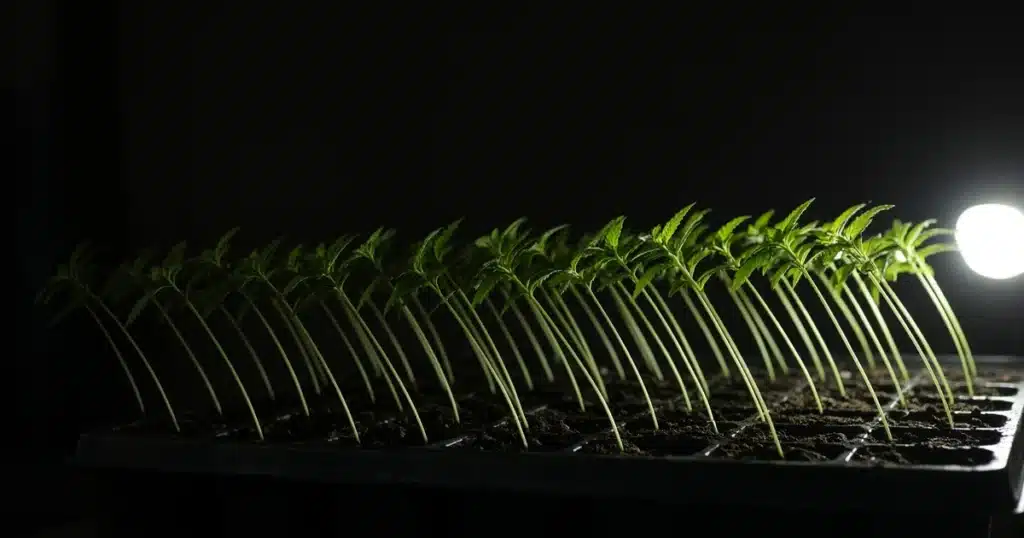
Quick answer: Phototropism is the way a plant bends its shoots toward a light source. A University of Minnesota horticulture textbook explains that the growth hormone auxin gathers on the shaded side of the shoot tip, so cells on that side grow longer and the tip curves toward the brighter side. Cannabis does the same thing when its light comes from one direction, such as a window or a lamp hung off center. The fix is usually simple: put the light straight above the plants or turn the pots so every side gets a share.
What Is Phototropism?
The name comes from two Greek roots meaning light and turning. It describes growth that changes direction in response to where light comes from. The Science of Plants, a University of Minnesota open textbook, defines it as a shoot curving or growing in the direction of light, and it ranks this among the chief growth responses driven by auxin.
A plant does not move the way an animal moves. Nothing swivels at a joint. The stem curves because one side grows faster than the other, and that difference is locked into the new tissue. A seedling that leaned for a few days keeps a slight kink in its stem even after the light is fixed.
The response is strongest in young, soft growth. Seedlings and the newest tips on older plants bend most easily, while woody lower stems hardly shift at all. So a cannabis seedling on a windowsill can tilt noticeably within a couple of days, while a mature plant changes slowly at the top.
How Does Auxin Make Cannabis Bend?
Auxin is a plant hormone made mainly in growing tips. In the Minnesota text, a diagram shows the natural auxin called IAA shifting from the sunny side of a shoot tip to the shady side. The extra auxin on the shaded flank makes those cells lengthen more, and the tip bends toward the light.
Oregon State Extension puts the same effect first among auxin responses. Its guide to how hormones and growth regulators affect plants names bending toward a light source as the first effect on its list of auxin responses.
NC State Extension has a neat way to picture it. In its Extension Gardener Handbook chapter on botany, the authors point out that people describe plants as growing toward the light, yet what really happens is the cells on the darker side stretch. The plant is, in a sense, growing away from darkness.
When light falls evenly from above, auxin stays evenly spread and the stem grows straight up. That is what you want indoors.
The edges of the beam matter too. Indoor fixtures send most of their output straight down, but the edges of the beam fall off quickly. A plant sitting at the rim of that beam sees bright light on its inner side and dimmer light on its outer side, which is all auxin needs to start a curve. The difference does not have to be dramatic. A steady, small imbalance over several days is enough to tilt young shoots.
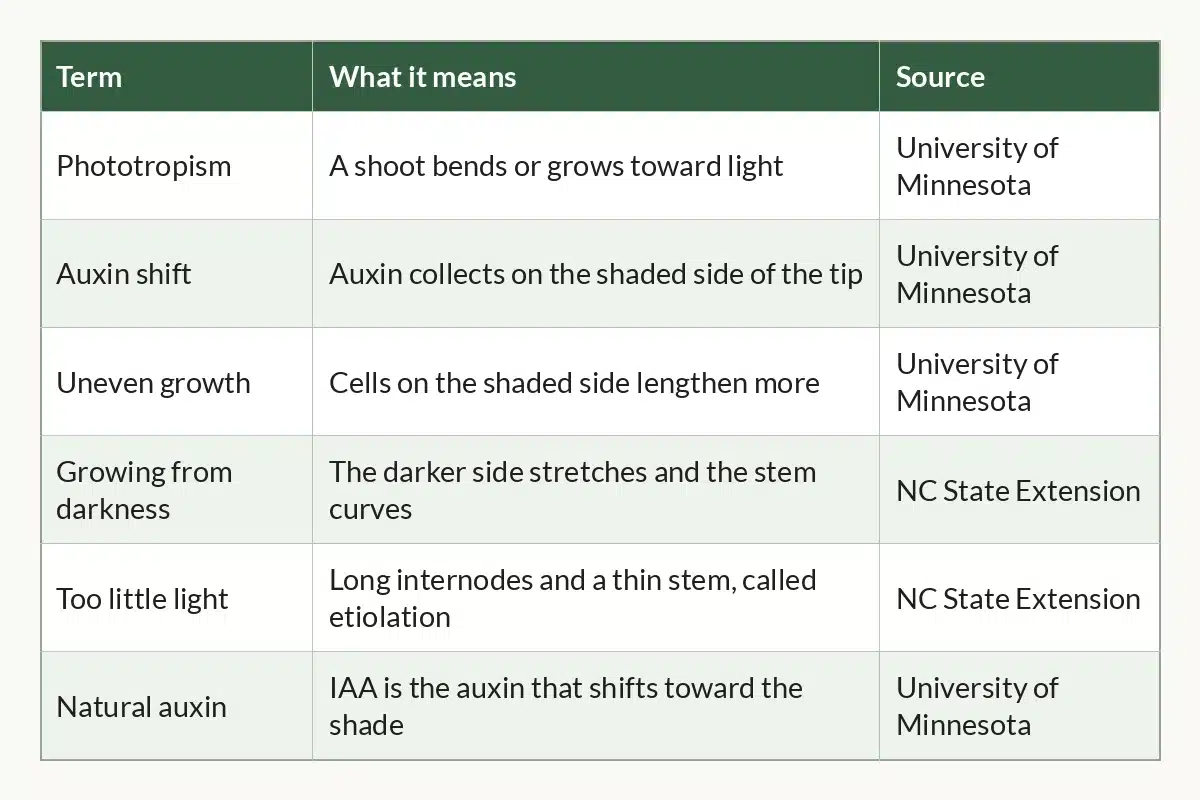
Phototropism at a Glance
| Term | What it means | Source |
|---|---|---|
| Phototropism | A shoot bends or grows toward light | University of Minnesota |
| Auxin shift | Auxin collects on the shaded side of the tip | University of Minnesota |
| Uneven growth | Cells on the shaded side lengthen more | University of Minnesota |
| Growing from darkness | The darker side stretches and the stem curves | NC State Extension |
| Too little light | Long internodes and a thin stem, called etiolation | NC State Extension |
| Natural auxin | IAA is the auxin that shifts toward the shade | University of Minnesota |
Why Do Cannabis Plants Lean in a Grow Tent?
A lean almost always points at the brightest spot. Common causes indoors include a light hung toward one corner, a fixture smaller than the canopy, or plants at the edge of the footprint where light arrives at an angle. Seedlings started near a window lean hard toward the glass. Young plants in that spot often stretch too. The leggy cannabis seedlings guide explains how to rescue one that has grown tall and thin.
Leaning and stretching often show up together, but they are different responses. NC State Extension explains that too little light causes long internodes and a spindly stem, a pattern known as stretching or etiolation. A plant can stretch straight up under a weak light, or it can stretch and lean together when the light is both weak and off to one side. Our guide to controlling stretch in cannabis plants covers the stretching side in detail.
Outdoor plants bend too, especially along a fence, wall or tree line that blocks part of the sky. The plant reaches for the open side. The guide to how cannabis uses sunlight explains why direction and hours of direct sun matter so much outside.
Reflections can help or hurt. Bright walls bounce light back toward the shaded side of a plant and reduce the imbalance that drives the bend. A dark wall or a gap in a tent lets light escape on one side, so plants near it tilt away toward the brighter interior. Closing gaps and keeping walls clean and reflective evens out the light around each plant.
Does Phototropism Hurt Cannabis Growth?
A slight lean does little harm. A strong lean is a warning sign that light is uneven, and uneven light means uneven growth. Branches on the bright side grow faster while those on the shaded side lag.
The costs are practical ones. A tilted seedling has a thin, curved stem that may flop when watered. In a full tent, plants on the edges lean inward, crowd the center and shade each other. In flower, tops that bend toward a lamp can end up too close to it.
The bend itself is not a disease or a deficiency. It is the plant responding normally to the light it has. Correct the light and new growth straightens on its own, though older curved sections stay as they are.
A lean can even work in your favor. Because the newest tips point toward the brightest light, a quick look across the canopy shows where light is strong and where it is weak. Many growers use that as a free light map before they move a fixture or buy a new one.
How to Keep Cannabis Growing Straight
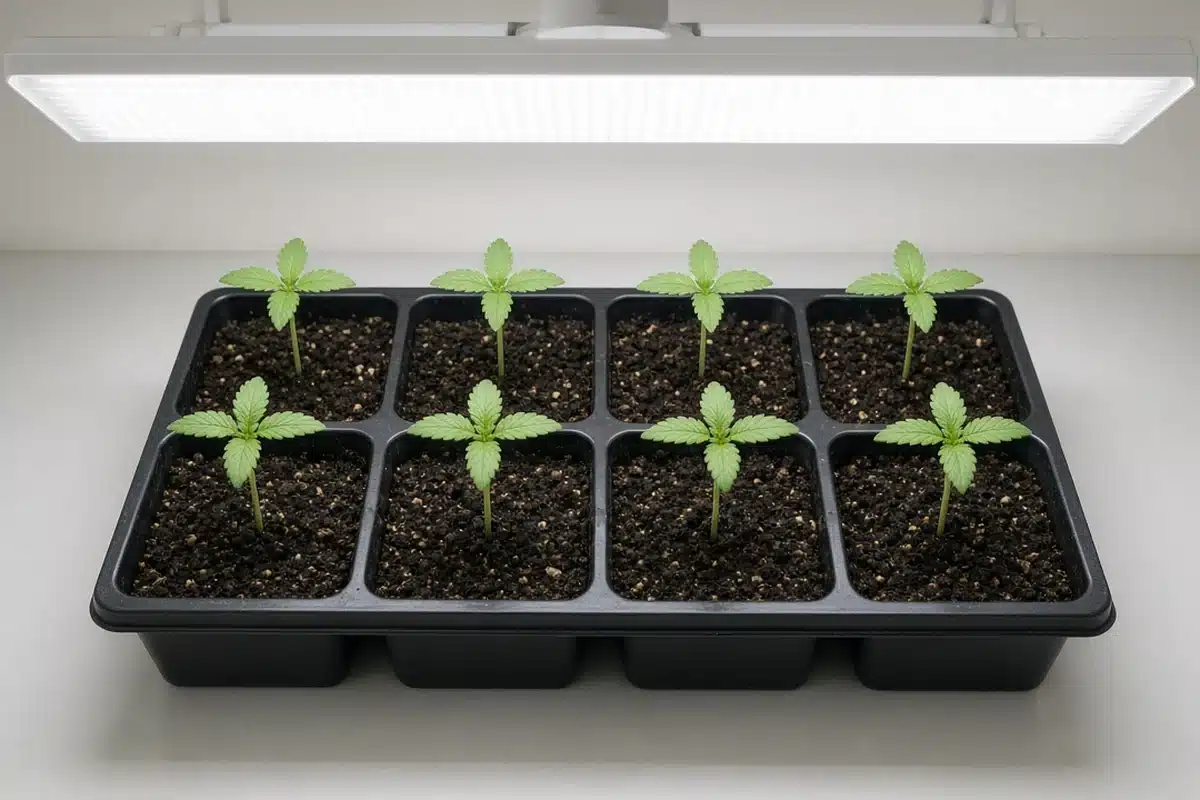
- Center the light. Hang the fixture right above the group so light arrives from above, not from the side.
- Match the footprint. Use a light that covers the whole canopy so edge plants do not reach inward.
- Set a sensible height. A lamp too high spreads weak light and invites stretch. Our guide to LED light distance for cannabis gives distance ranges by stage.
- Turn window plants often. University of Wyoming Extension advises giving potted plants near a window a turn about once a week so all sides get light.
- Rotate plants at the tent edges. Swap edge plants with center plants every few days if light is uneven.
- Support thin stems. Prop a leaning seedling gently with soil or a small stake while new growth straightens.
- Watch the newest growth. If fresh tips still lean, the light is still off balance.
The Wyoming advice was written for flowering potted plants, not cannabis, but the logic carries over to any plant grown beside a window. Its guide to flowering potted plants notes that a weekly turn keeps a plant from becoming one sided.
Troubleshooting Phototropism Problems
Seedlings bend sharply to one side. Light is coming from the side, often a window. Move them under an overhead light or turn the tray daily.
Plants at the tent edges lean inward. The fixture is smaller than the canopy or hung off center. Recenter it or rotate plants.
Stems are long, thin and leaning. Light is weak as well as one sided. Lower or upgrade the light and support the stems.
Tops bend toward the lamp in flower. Even small offsets show up in tall plants. Recenter the light and spread the tops by training.
The stem stays curved after fixing the light. Older tissue keeps its shape. Only new growth will grow straight.
Sources
- University of Minnesota, The Science of Plants, 4.2 Plant Hormones: https://open.lib.umn.edu/horticulture/chapter/4-2-plant-hormones/
- NC State Extension, Extension Gardener Handbook, Chapter 3 Botany: https://content.ces.ncsu.edu/extension-gardener-handbook/3-botany
- Oregon State University Extension, How Hormones and Growth Regulators Affect Your Plants (EM 9902): https://extension.oregonstate.edu/catalog/em-9902-how-hormones-growth-regulators-affect-your-plants
- University of Wyoming Extension, Flowering Potted Plants (B1146R): https://wyoextension.org/publications/html/B1146R/
FAQ
Why is my cannabis seedling leaning?
It is following the brightest light. Center an overhead light above the seedlings or turn the container so each side gets light.
Is phototropism the same as stretching?
No. Phototropism is bending toward light. Stretching is long internodes from too little light, though both can happen together.
Will a leaning plant straighten itself?
New growth straightens once light comes from above. The curved older stem stays curved.
Which hormone controls phototropism?
Auxin. It collects on the shaded side of the shoot tip and makes those cells lengthen more.
How fast does a seedling bend toward light?
Young, soft seedlings can tilt noticeably within a couple of days when light comes from one side.