
Soil Moisture by Feel: When to Water Outdoor Cannabis
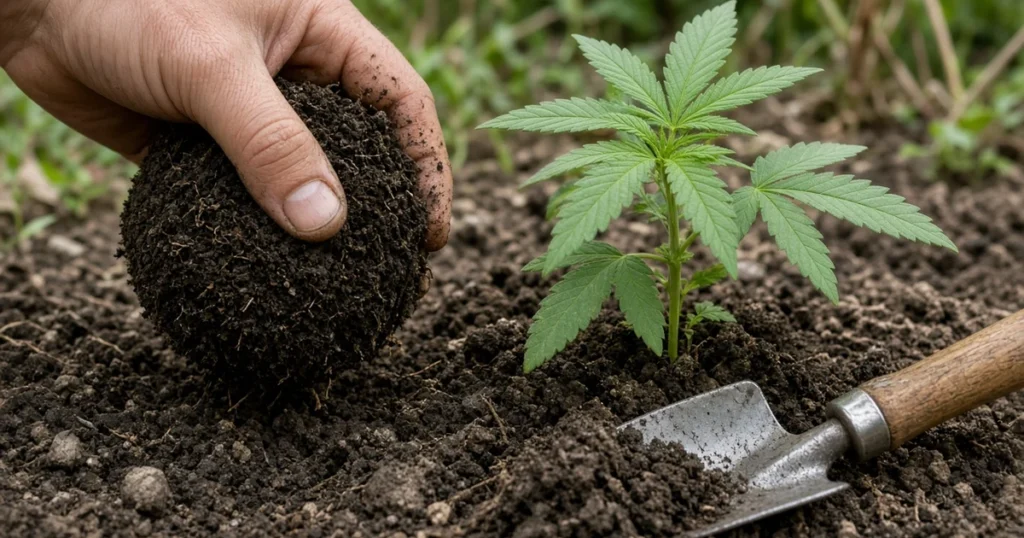
No gadget is needed to know whether an outdoor cannabis bed needs water. A shovel and your hand will do. The USDA Natural Resources Conservation Service guide to estimating soil moisture by feel and appearance, hosted by Texas A&M AgriLife, calls the method simple and low cost. Texas A&M AgriLife Research and Extension Center at San Angelo describes it as an alternative to soil moisture probes. Here you will learn why the method works, where and how deep to take samples, how to read the ball and ribbon in each soil texture and how to use what you feel to decide when to water.
What the feel method tells you
The NRCS guide says evaluating soil moisture by feel and appearance can be used to:
- Estimate the water available in the root zone before planting or watering.
- Estimate how much water to apply.
- Find out how deep irrigation water has soaked in.
There is a bonus. The NRCS guide notes that while collecting samples, you get a chance to spot restrictive layers caused by compaction, along with problems such as weeds, insects and nutrient deficiencies.
Texas A&M AgriLife San Angelo explains why the information matters. Knowing how much water is available in the soil helps guide important decisions through the growing season. If soil moisture drops to the point where plants are still wilted early in the morning, plant development will suffer. It advises applying water, where available, to keep plants from reaching that point of permanent wilt.
Know your soil texture first
The feel of moist soil depends on what the soil is made of. The NRCS guide says that before sampling, you need to know the soil type and texture, meaning the relative amounts of sand, silt and clay. Texture plays an important role in how much water a soil holds. The share of soil water plants can readily use is called the available water capacity.
The NRCS guide gives typical available water capacity, in inches of water per foot of soil, for four texture groups:
- Coarse, such as fine sand and loamy fine sand: 0.6 to 1.2 inches.
- Moderately coarse, such as sandy loam and fine sandy loam: 1.3 to 1.7 inches.
- Medium, such as sandy clay loam, loam and silt loam: 1.5 to 2.1 inches.
- Fine, such as clay, clay loam and silty clay loam: 1.6 to 2.4 inches.
Texas A&M AgriLife San Angelo gives similar figures. Sand holds 0.5 to 1.0 inch of water per foot, sandy loam 1.0 to 1.5 inches, silt or clay loam 1.5 to 2.0 inches and clay 2.0 to 2.5 inches.
The NRCS guide notes that soil maps, texture and available water capacity for each soil type can be found in published soil survey reports from the USDA Natural Resources Conservation Service.
Where and how deep to sample
Moisture near the surface can mislead you. The NRCS guide explains that soil moisture is usually sampled midway through each 1-foot layer in uniform soils, or midway through each natural soil layer in the profile. In its example, a soil with 14 inches of fine sandy loam over clay would be sampled first at 7 inches deep, then in 1-foot steps after that to the bottom of the root zone.
The NRCS guide also says that three or more sampling sites per field should be checked, depending on the crop, field size, irrigation method and how much the soil varies. In a garden, that means checking more than one spot rather than trusting a single hole.
To collect a sample, the NRCS guide says to use a probe, an auger or a shovel to reach the chosen depth.
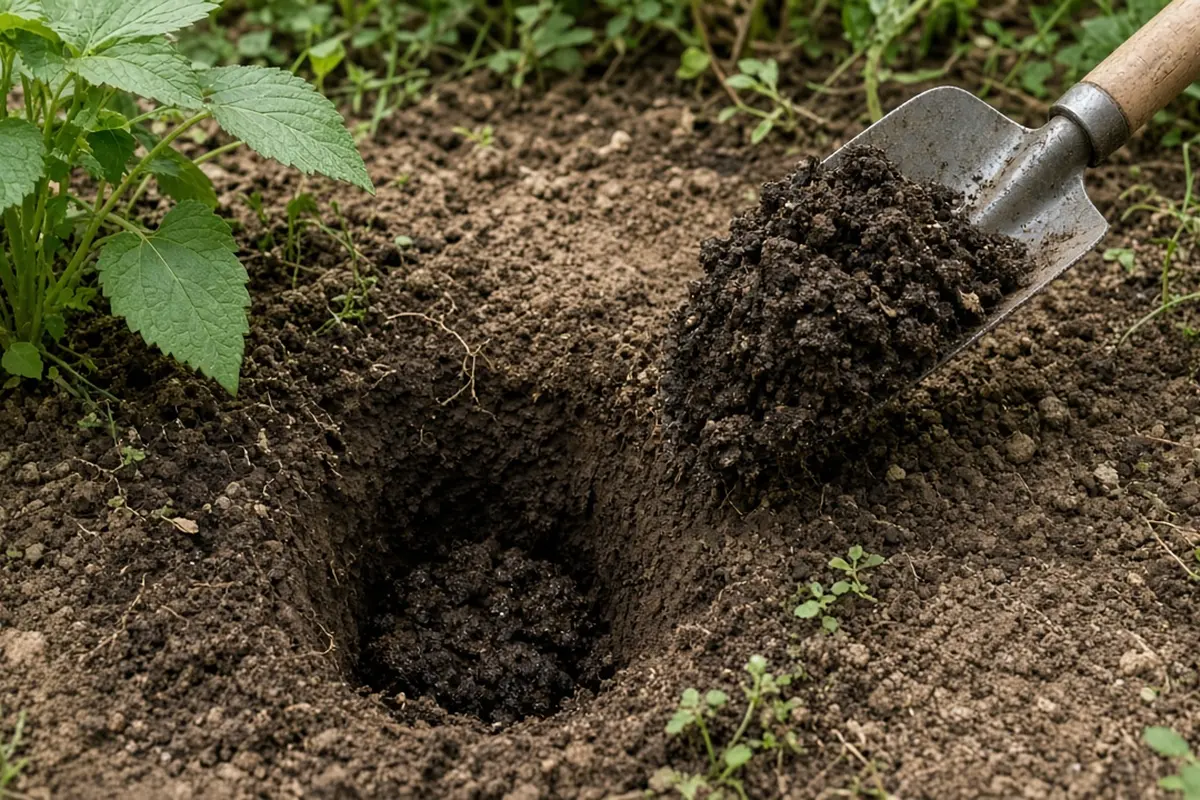
How to do the feel test
The NRCS guide describes the test in three steps:
- Take a soil sample from the chosen depth.
- Squeeze it firmly in one hand several times to form an irregular ball.
- Look at how well it forms a ball, whether it ribbons, whether loose particles fall away, whether soil or water stains your fingers and what color it is.
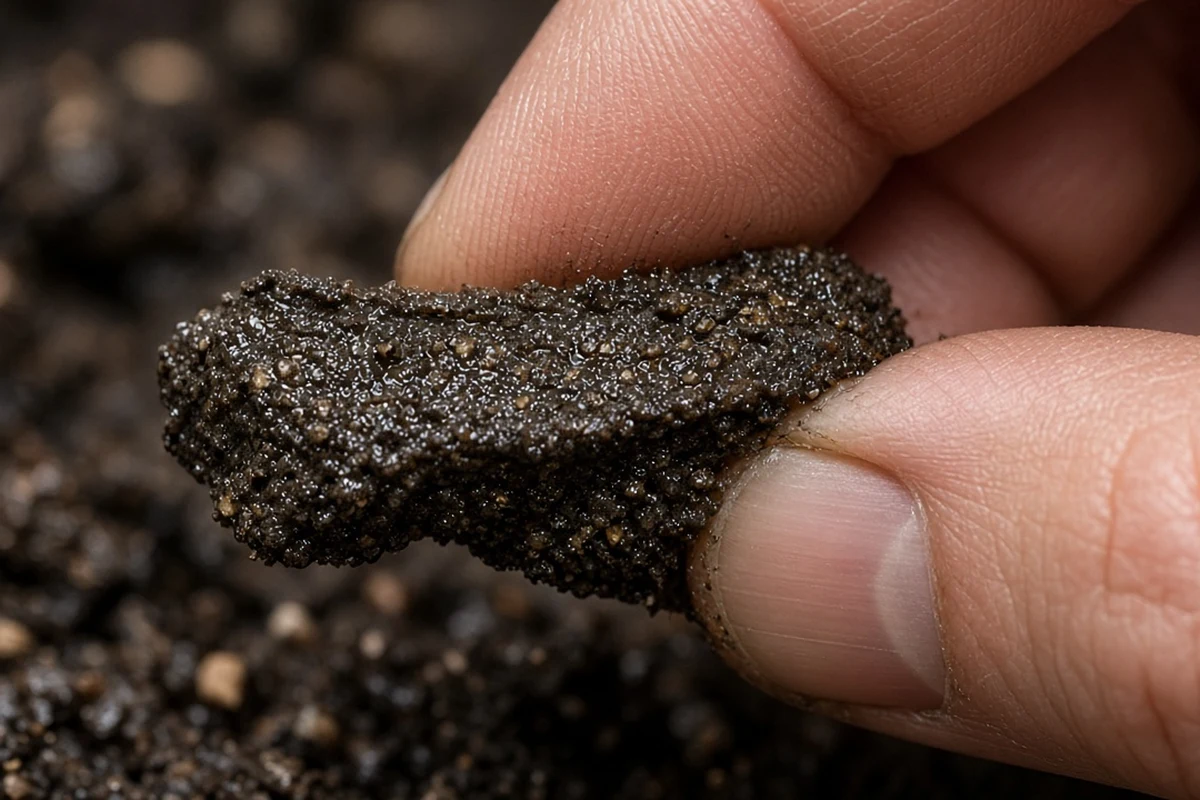
It explains that a ribbon forms when soil is squeezed out of the hand between the thumb and index finger. It also explains how to judge ball strength. A very weak ball falls apart after one bounce in the hand, and a weak ball falls apart after two or three bounces.
Texas A&M AgriLife San Angelo gives a simpler version. Take a small amount of soil, squeeze it in your hand to form a ball and compare the feel to a chart. It notes that the ball is formed by squeezing a handful of soil very firmly with your fingers.
Reading the ball and ribbon by soil texture
The NRCS guide describes what soil feels like at different levels of available moisture. Here is how it reads for each texture group.
Fine sand and loamy fine sand:
- 0 to 25 percent available: dry and loose, holds together only if not disturbed, with loose sand grains on your fingers.
- 25 to 50 percent: slightly moist, forms a very weak ball with well-defined finger marks.
- 50 to 75 percent: moist, forms a weak ball, darkened color, moderate water staining, will not ribbon.
- 75 to 100 percent: wet, weak ball, heavy water staining, will not ribbon.
Sandy loam and fine sandy loam:
- 0 to 25 percent: dry, forms a very weak ball, and soil grains break away easily.
- 25 to 50 percent: slightly moist, weak ball with defined finger marks, no water staining.
- 50 to 75 percent: moist, forms a ball with defined finger marks and very light staining.
- 75 to 100 percent: wet, leaves a wet outline on your hand and makes a weak ribbon.
Sandy clay loam, loam and silt loam:
- 0 to 25 percent: dry, clods crumble with pressure, no staining.
- 25 to 50 percent: slightly moist, weak ball with rough surfaces, no staining.
- 50 to 75 percent: moist, forms a pliable ball with very light staining and a weak ribbon.
- 75 to 100 percent: wet, ball with well-defined finger marks, ribbons between thumb and forefinger.
Clay, clay loam and silty clay loam:
- 0 to 25 percent: dry, clods are hard to crumble.
- 25 to 50 percent: slightly moist, weak ball, clods flatten with pressure.
- 50 to 75 percent: moist, smooth ball with light staining, ribbons between thumb and forefinger.
- 75 to 100 percent: wet, ribbons easily, with medium to heavy coating on your fingers.
For every texture, the NRCS guide describes soil at 100 percent as wet, forming a soft ball, with free water appearing briefly on the surface after squeezing or shaking, except in fine sands, where a wet outline of the ball stays on your hand. Texas A&M AgriLife San Angelo adds that free water appears when the wettest soil is bounced in the hand.
Deciding when to water
The feel test is only useful if it leads to a decision. Texas A&M AgriLife San Angelo says that for most crops, irrigation should start when about 50 percent of the available moisture in the root zone is used up. On the NRCS charts, that is the line between the 25 to 50 percent and 50 to 75 percent descriptions.
So, in practice:
- If the sample matches the 50 to 75 percent or wetter descriptions for your soil texture, the root zone still holds good moisture.
- If it matches the 25 to 50 percent description or drier, it is time to water.
The NRCS guide also shows how to turn the reading into an amount. In its example, a 48-inch root zone holds 6.8 inches of available water when full. With an estimated 3.7 inches remaining, the net irrigation need is 3.1 inches. You can do the same arithmetic using the available water capacity for your soil texture and the depth you are watering.
After you water, the feel method can check your work. The NRCS guide names finding how deep the water has soaked in as one of the method’s main uses. After watering, dig again and feel the soil at each depth.
In dry spells, this routine matters even more. Stretching water through heat and drought is explained in the post on watering cannabis during drought.
Feel method or meter?
Texas A&M AgriLife San Angelo notes that most producers who irrigate track soil moisture with probes, and presents the feel method as an alternative. The NRCS guide calls it simple and low cost. To compare the options, read Kind Seed Co’s post on soil moisture meters for cannabis.
Troubleshooting
The surface is dry but you are not sure about the root zone. Sample deeper. The NRCS guide samples midway through each foot of soil, not at the surface.
Two spots in the same bed feel different. That is normal variability. The NRCS guide recommends three or more sampling sites.
Sandy soil never forms a ribbon. That is expected. The NRCS guide notes that fine sands will not ribbon even when moist or wet, so judge them by ball strength and staining.
Plants are wilted early in the morning. Texas A&M AgriLife San Angelo says this means soil moisture has dropped too far, and water should be applied to keep plants from reaching permanent wilt.
Unsure how much water to add. Use the NRCS example. Subtract the estimated water remaining from the available water capacity of the root zone.
Sources
- USDA Natural Resources Conservation Service, hosted by Texas A&M AgriLife Nutrient Management. Estimating soil moisture by feel and appearance. https://nutrientmanagement.tamu.edu/wp-content/uploads/sites/25/legacy-files/content/tools/estimatingsoilmoisture.pdf
- Texas A&M AgriLife Research and Extension Center at San Angelo. How to estimate soil moisture by feel. https://sanangelo.tamu.edu/agronomy/agronomy-publications/how-to-estimate-soil-moisture-by-feel/
FAQ
How do you check soil moisture by feel?
Dig a sample from the root zone with a shovel, trowel or probe. The USDA NRCS guide says to squeeze it firmly several times to form a ball, then note whether it holds together, ribbons between thumb and forefinger, stains your fingers and how dark it is, and compare with the chart for your soil texture.
How deep should I sample soil moisture?
The NRCS guide says to sample midway through each 1-foot layer in uniform soil, or midway through each natural soil layer. For example, 14 inches of sandy loam over clay would be sampled first at 7 inches. It also recommends three or more sampling sites rather than a single hole.
When should I water based on soil feel?
Texas A&M AgriLife San Angelo says irrigation should start for most crops when about 50 percent of available soil moisture is used up. On the NRCS charts, a sample matching the 25 to 50 percent description for your soil texture, or drier, signals that it is time to water.
Why does soil texture matter for the feel test?
Texture controls how much water soil holds and how it feels. The NRCS guide gives available water capacity from 0.6 to 1.2 inches per foot in fine sand up to 1.6 to 2.4 inches in clay. Moist sand will not ribbon, while moist clay ribbons between thumb and forefinger.


