Eucalyptol Terpene in Cannabis: What Growers Know

What is eucalyptol in cannabis?
The eucalyptol terpene, also called 1,8 cineole, is a minor cannabis terpene with a cool, camphor like smell. It belongs to the monoterpenoid group. That means it is built from ten carbon atoms, like other light terpenes. Unlike pinene or limonene, it carries one oxygen atom locked inside a ring.
The name comes from eucalyptus. Eucalyptus leaves hold a lot of it. You also find it in rosemary, bay leaf, sage and cardamom. In cannabis it shows up only in small amounts. It plays a supporting role in the aroma.
Its formula is C10H18O and its molecular weight is about 154. The ten carbons form a compact cage with one oxygen bridge. The cage keeps the molecule stable. It also gives it a sharp scent.
Most cannabis terpenes are made in the glandular trichomes on flowers and sugar leaves. Eucalyptol is one of the many minor terpenes made there. A 2022 review of minor cannabis terpenes gathered data from many published studies. The review is Chacon and colleagues 2022 in Biomedicines. It sorts cannabis into chemotypes by cannabinoid balance. Type I is THC dominant. Type II has a mix of THC and CBD. Type III is CBD dominant. The review lists eucalyptol in chemotypes II and III. Reported levels ran from about 0.01 to 0.14 milligrams per gram of dry flower.
What does eucalyptol smell like?
Eucalyptol smells cool, fresh and minty. Picture a eucalyptus leaf crushed between your fingers. Plenty of people notice a camphor note too. The PubChem record for eucalyptol from the National Library of Medicine lists the odor as camphor like.
In a cannabis jar the note is rarely loud. It usually sits under louder terpenes like myrcene or caryophyllene. Where it is present, it gives the top of the aroma a clean, cooling lift.
Aroma is a team effort. Smell also changes as flowers dry and cure. Even a minor terpene can change how a bud smells. Our noses read the whole blend at once. Eucalyptol and pinene often travel together in herbs like rosemary. That is why their smells can blur together.
Why do lab reports show little eucalyptol?
Many lab reports list a terpene panel next to cannabinoid results. Eucalyptol may appear under that name or as 1,8 cineole. Often the number is very low or missing. There are two main reasons.
Below quantification limits
The first reason is simple. Cannabis makes very little of it. The review above puts levels at or below about 0.14 milligrams per gram. The same review lists myrcene, beta caryophyllene, limonene and alpha pinene among the most prominent cannabis terpenes. Eucalyptol is not one of them.
Every lab method has a lowest amount it can measure with confidence. That point is the limit of quantitation, or LOQ. Amounts below it print as LOQ or ND. A 2022 study measured terpenes in commercial cannabis flower and extracts in Israel. Eucalyptol was below the level the lab could measure in every sample. That study is Raz, Eyal and Davidson 2022 in Molecules.
Volatility
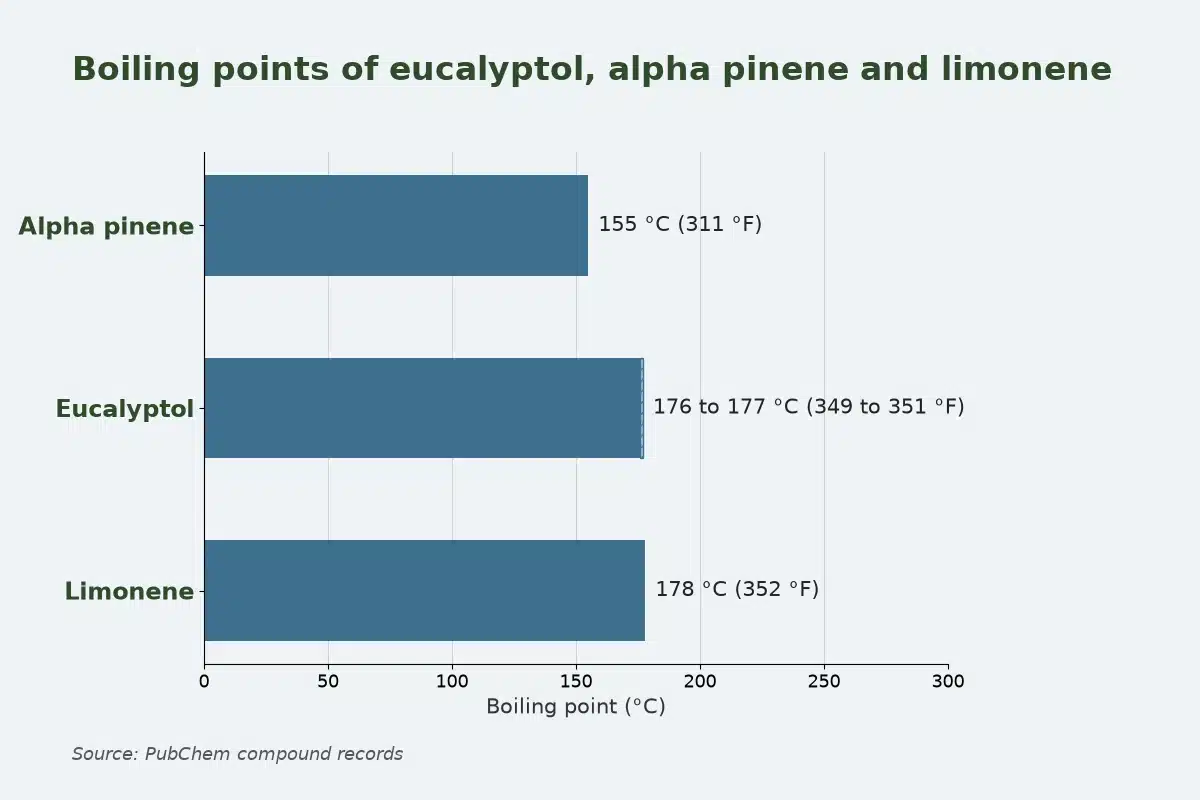
The second reason is volatility. Eucalyptol boils at about 349 to 351 °F (176 to 177 °C). That sounds hot. Yet light terpenes still drift off at room temperature over days and weeks. More of it escapes in warm drying rooms and open jars before a sample reaches the lab.
Here is how to read the eucalyptol line on a report:
- Check the unit. Labs report terpenes as a percent of weight or in milligrams per gram. One percent equals ten milligrams per gram.
- Look for LOQ or ND. Either one means the amount was too low to measure.
- Compare it with the top terpenes. If eucalyptol sits far below myrcene, it is a minor note.
- Remember that results describe one sample. Two harvests of the same strain can differ.
A report that shows ND does not mean the strain never makes eucalyptol. That batch held less than the lab could measure.
Timing matters too. A sample pulled right after the dry can show more light terpenes than one pulled after months on a shelf. When you compare two reports, check the harvest and analysis dates. A gap of a few months can explain a lot of the difference in minor notes like this one.
How is eucalyptol different from other terpenes?
The table below sets eucalyptol next to two terpenes you may know. It sticks to smell and basic chemistry.
| Terpene | Main smell | Oxygen in the molecule | Boiling point | Common plant sources |
|---|---|---|---|---|
| Eucalyptol | Cool, minty, camphor like | Yes, one atom | About 349 to 351 °F (176 to 177 °C) | Eucalyptus, rosemary, bay leaf |
| Alpha pinene | Pine needles, fresh wood | No | About 311 °F (155 °C) | Pine trees, rosemary |
| Limonene | Lemon peel | No | About 352 °F (178 °C) | Lemon and orange peel |
Source for the table: PubChem compound records from the National Library of Medicine.
All three have ten carbons. Pinene boils a little lower. It fades even faster. Eucalyptol stands apart because of its oxygen bridge. That bridge gives it a cool, sharp edge in smell that pinene and limonene lack. You can learn more about its cousin on our page about pinene terpene strains.
Can growers raise eucalyptol levels?
You cannot pour eucalyptol into a pot and expect more of it in the bud. Genetics set the terpene recipe. Growing conditions then decide how much of that recipe survives to the jar.
Genetics first
Start with the seed. If the genes do not code for a terpene, no feed, light or additive can create it. Read strain descriptions for fresh, minty, herbal or camphor notes. Those hints point to plants that may carry more of the cool terpenes. The review above also links eucalyptol with chemotypes that carry CBD. A CBD rich or balanced strain may be a better bet for this note than a pure THC strain.
Temperature, harvest timing and cure
Once the plant is growing, your job is to protect what it makes.
- Keep the late flower room from running very hot. Heat drives off light terpenes before harvest.
- Harvest when trichomes look mostly cloudy. The top notes can dull if you wait far past peak.
- Dry slowly in a cool, dark room with gentle airflow.
- Cure in sealed glass jars. Open them briefly at first, then less often.
- Store finished jars somewhere cool and dark. Light and heat keep wearing terpenes down after the cure.
What it means for home growers
Eucalyptol is a minor note in cannabis. It brings a cool, fresh lift. It rarely leads the aroma. Do not chase a high number on a lab report. Most strains will show a small amount or ND.
Focus on the things you control. Pick genetics whose descriptions mention minty or herbal notes. Keep late flower temperatures moderate. Dry slowly. Cure in sealed jars kept cool and dark. Volatile notes like eucalyptol are the first to fade. A careful dry and cure gives them the best chance to stay. Our guide on maximizing terpenes covers each of these steps in more depth.
Keep simple notes for each harvest. Write down the strain, the late flower temperatures, the dry time and how the jar smells after two and six weeks. Over a few runs you will learn which habits keep the cool, fresh notes alive.
Learning the minor terpenes also sharpens your nose. If a strain is sold as minty and fresh, eucalyptol and pinene are likely part of that story. At Kind Seed Co, we read a minty note as a clue, not a lab result. For a full tour of major and minor terpenes, read our ultimate terpenes guide.
Sources
- Eucalyptol, PubChem CID 2758, National Library of Medicine: https://pubchem.ncbi.nlm.nih.gov/compound/2758
- Chacon F T and colleagues, “Secondary Terpenes in Cannabis sativa L.: Synthesis and Synergy”, Biomedicines, 2022: https://pmc.ncbi.nlm.nih.gov/articles/PMC9775512/
- Raz N, Eyal A M and Davidson E M, “Optimal Treatment with Cannabis Extracts Formulations Is Gained via Knowledge of Their Terpene Content and via Enrichment with Specifically Selected Monoterpenes and Monoterpenoids”, Molecules, 2022: https://pmc.ncbi.nlm.nih.gov/articles/PMC9608144/
FAQ
What is eucalyptol?
Eucalyptol is a ten carbon aroma molecule also called 1,8 cineole. It is common in eucalyptus and rosemary and shows up in small amounts in cannabis.
What does eucalyptol smell like?
It smells cool, fresh and minty with a camphor note.
Why does my lab report show ND for eucalyptol?
ND means the amount was below what the lab could measure. Cannabis makes very little eucalyptol and it fades during drying and storage.
Can I increase eucalyptol in my plants?
Genetics set the terpene recipe. You can protect what the plant makes with moderate late flower heat, a slow dry and a careful cure.
Is eucalyptol the same as pinene?
No. Both have ten carbons, but eucalyptol carries an oxygen bridge and smells cooler and more camphor like.