
Field Crickets in Cannabis Gardens: Seedling Damage and Cover
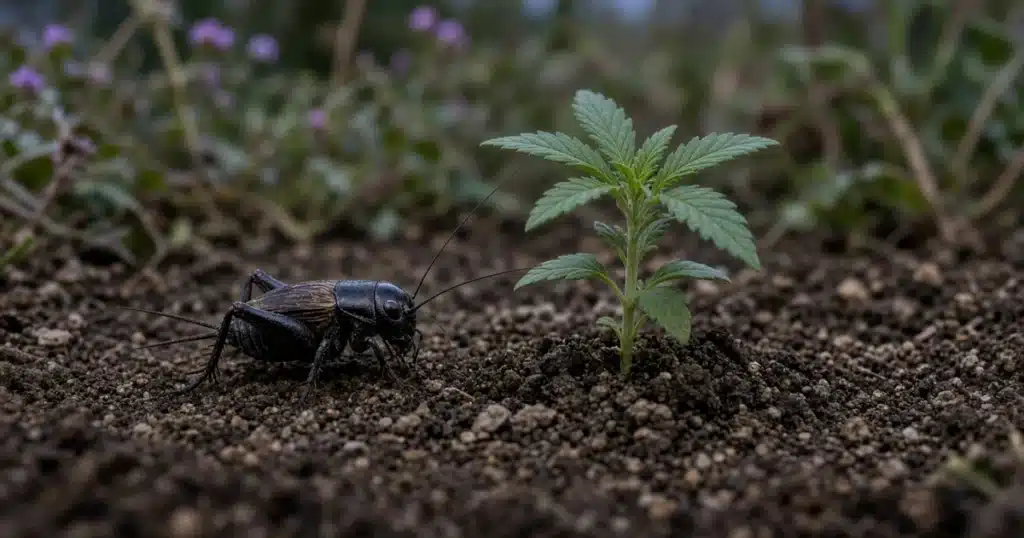
Quick answer: Field crickets are black or brown insects that hide by day and feed at night on plant debris, dead insects and sometimes young plants. UC IPM says they are rarely serious enough to need control in gardens, and Kansas State University Research and Extension and Utah State University Extension describe them mostly as a nuisance. The risk is to seedlings when crickets move in from weedy ground that is drying out. Protective cones or row covers, plus removing boards, debris and dense weeds where they hide, are the main tools.
Do Field Crickets Eat Cannabis Plants?
They can chew young plants, but serious damage is uncommon. UC IPM says crickets now and then invade gardens and damage vegetables, usually after leaving nearby weeds that are drying out. It adds that the damage normally lasts only a short time, but a large group can wipe out a few rows of seedlings within one or two days.
Kansas State calls field crickets scavengers that eat plant debris and other organic matter, including dead insects. It also notes that they are plant eaters capable of destroying field and vegetable crops when they reach outbreak numbers. Utah State says crickets feed on living or decaying plants, fungi and other organic material. None of the three names cannabis, so think of crickets as a seedling risk in mixed gardens rather than a common cannabis pest.
What Does a Field Cricket Look Like?
It is a shiny dark insect with long antennae and big jumping legs. UC IPM describes adults as shiny black or brown and about 0.6 to 1 inch long. Kansas State says field crickets are all black or mostly black with coppery brown highlights.
Utah State explains how to tell crickets from their relatives. Grasshoppers have short antennae and rounder bodies. Crickets have long antennae, flattened bodies and short wings. Kansas State adds that females carry a long egg laying tube at the tip of the abdomen, which males lack, and that females are the larger of the two.
When Are Field Crickets Active?
Mostly at night and mostly from early summer to fall. UC IPM says crickets are nocturnal and need shelter during the day. Utah State gives June to September as the active season for field crickets and notes that nymphs and adults are drawn to lights and can gather in large numbers in late summer.
Kansas State explains the yearly cycle. Eggs spend the winter in the soil, nymphs hatch in spring and grow through summer, and adults mate in early fall. Utah State says each female lays anywhere from 200 to 2,000 eggs in fall, in soil or wood, and that field crickets prefer moist soil for egg laying. There is one generation per year, according to both.
Why Do Crickets Move Into Gardens?
They follow food and cover. UC IPM says crickets usually arrive from nearby weedy areas as those areas dry up. A watered garden full of tender seedlings is an easy next stop.
Kansas State notes that crickets look for hiding places such as loose bricks, boards, wood piles, tarps and debris. Utah State lists piles of bricks, stones and rotting wood among the spots that shelter them. A garden edge with stacked lumber and tall weeds offers exactly the daytime cover crickets need.

How to Protect Cannabis Seedlings From Crickets
- Watch weedy borders in late summer. UC IPM says crickets usually arrive as nearby weeds dry out, so check seedlings near those edges first.
- Cover young plants. UC IPM recommends protective cones or row covers for seedlings. Our guide to row covers for cannabis explains how to set them up.
- Remove hiding spots. Kansas State advises getting rid of loose boards, bricks, wood piles, tarps and other debris.
- Cut back dense weeds. Kansas State and Utah State both say removing weeds and dense plants reduces cover.
- Mow nearby grass. Utah State lists mowing lawns as part of reducing cricket habitat.
- Limit bright lights. Utah State says crickets are pulled in from far away by bright white, neon and mercury vapor lighting. Our post on night lighting and outdoor cannabis covers other reasons to keep the garden dark.
- Skip outdoor insecticides. Utah State says outdoor cricket control does not call for insecticides.

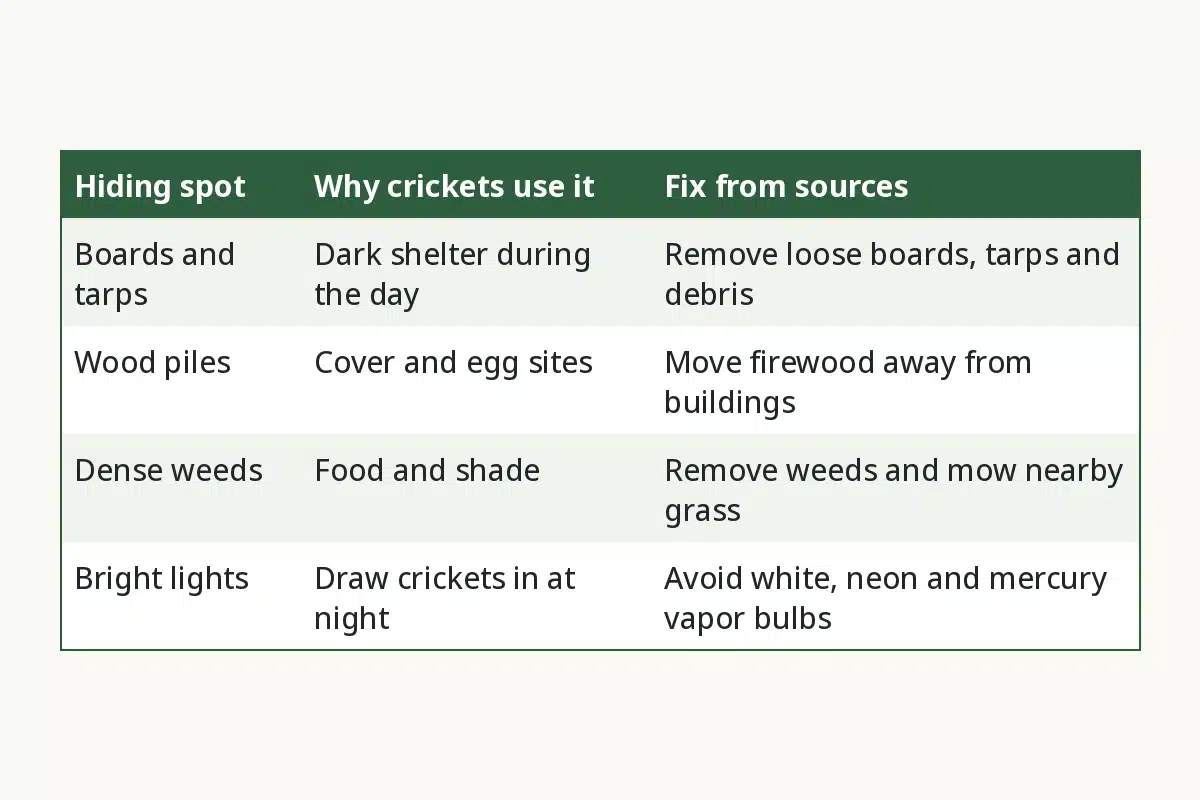
Cricket Hiding Spots and Fixes
| Hiding spot | Why crickets use it | Fix from sources |
|---|---|---|
| Boards and tarps | Dark shelter during the day | Remove loose boards, tarps and debris |
| Wood piles | Cover and egg sites | Move firewood away from buildings |
| Dense weeds | Food and shade | Remove weeds and mow nearby grass |
| Bright lights | Draw crickets in at night | Avoid white, neon and mercury vapor bulbs |
Kansas State also suggests rethinking wood chip mulch, crushed stone and plastic weed barriers placed against foundations, since they shelter crickets near buildings. Utah State advises keeping garbage cans away from buildings and setting needed containers on wood blocks.
Are Other Crickets Garden Pests?
Some relatives can be. Kansas State notes that the northern mole cricket feeds underground on grass roots, plant roots and tubers, and has been reported feeding on strawberries. It also says camel crickets, which are not true crickets, can make lawns lumpy when their numbers are high.
Utah State points out that false crickets such as mole crickets, Jerusalem crickets and Mormon crickets cause far more economic damage to turf, crops and pasture than true crickets do. Identify the insect before deciding it is a field cricket.
Will Crickets Come Indoors From the Garden?
Field crickets may, but they do not last. Kansas State says field crickets gather on warm buildings as fall cools and slip inside through cracks and gaps, then die after moving indoors. House crickets differ because they can live and breed inside.
Kansas State and Utah State both advise sealing cracks with caulk, adding weather stripping to doors and screening other openings. Kansas State notes that crickets indoors may chew fabrics and paper.
Can Cricket Chirps Tell You the Temperature?
One kind can. Utah State explains that only male crickets chirp, making the sound by rubbing their forewings together, and that warmer weather usually speeds up the chirping. It describes Dolbear’s Law for the snowy tree cricket. Count the chirps in 12.5 seconds and add 38 to estimate the temperature in degrees F.
Utah State lists four song types: a loud calling song, a quiet courting song, an aggressive song aimed at other males and a song after mating. Kansas State notes that the chirping of males is often the first sign that crickets have arrived near a home in fall.
Troubleshooting Cricket Problems
Seedlings were chewed overnight in late summer. Check for nearby weedy areas that have dried out. UC IPM says crickets move in from those spots. Cover the seedlings.
Crickets hide under pots and saucers. Lift containers onto blocks, a step Utah State suggests for reducing hiding sites.
Crickets pile up near a porch light. Utah State says bright white, neon and mercury vapor lights draw crickets. Switch the bulb or turn it off.
The pest has short antennae. It may be a grasshopper. Utah State explains that grasshoppers have shorter antennae and rounder bodies than crickets.
Lawn next to the garden feels lumpy. Kansas State links this to camel cricket burrowing when populations are high.
Sources
- UC Statewide IPM Program, University of California, Crickets, Home and Landscape: https://ipm.ucanr.edu/home-and-landscape/crickets/
- Kansas State University Research and Extension, Crickets (MF749): https://www.thomas.k-state.edu/lawnandgarden/docs/crickets.pdf
- Utah State University Extension, Crickets (ENT 129 08): https://extension.usu.edu/planthealth/uppdl/files/factsheet/crickets_08.pdf
FAQ
Are field crickets harmful to cannabis?
Rarely. UC IPM says crickets are seldom serious enough to need control in gardens, though large numbers can harm seedlings.
When do crickets lay eggs?
In fall. Kansas State and Utah State both say females lay eggs in soil after mating.
Do crickets need insecticides outdoors?
No. Utah State says outdoor crickets do not call for insecticide sprays.
Why do crickets chirp?
To find mates. Utah State says only males chirp, rubbing their wings to attract females.
Can field crickets live indoors?
Not for long. Utah State says field crickets are unable to survive or breed inside, so any that wander in die over winter.


