
Termites and Garden Mulch: Safe Spacing for Cannabis Beds

Quick answer: Bagged or shredded mulch is a poor way for termites to travel, and it is safe to use around cannabis beds in the yard. The real risk is to the house. Specialists at University of Florida IFAS Extension and at Mississippi State warn against piling mulch, soil or wood against a foundation. Keep mulch thin near the house, leave a visible gap above the soil line and place raised beds and wood away from the walls.
Does Mulch Bring Termites Into the Garden?
Rarely. UF IFAS says termites can turn up in mulch, but they survive poorly. The chipping process kills many, those separated from their colony do even worse, and termites living on mulch have much lower survival, according to research the authors cite. UF IFAS concludes that termites already living on your property pose a greater risk than any stragglers in a bag of mulch.
Mississippi State agrees that organic mulches, including pine straw, ground bark and dried leaves, are useful in the garden for weed control and moisture. Its advice boils down to this: use it, just not against the house. Our mulch guide for cannabis growers compares materials for the beds themselves.
Do Termites Harm Cannabis Plants?
Neither source describes termites attacking live garden plants. UF IFAS and Mississippi State focus on the danger to buildings. Mississippi State explains that termites found in a rotting log far from the house are where they belong and doing their normal work, and that trying to kill all the termites in a landscape is neither practical nor environmentally sound.
For a grower, that shifts the focus to the house. Both sources center their advice on keeping soil, mulch, wood and water away from the foundation.
How Close to the House Can Mulch Go?
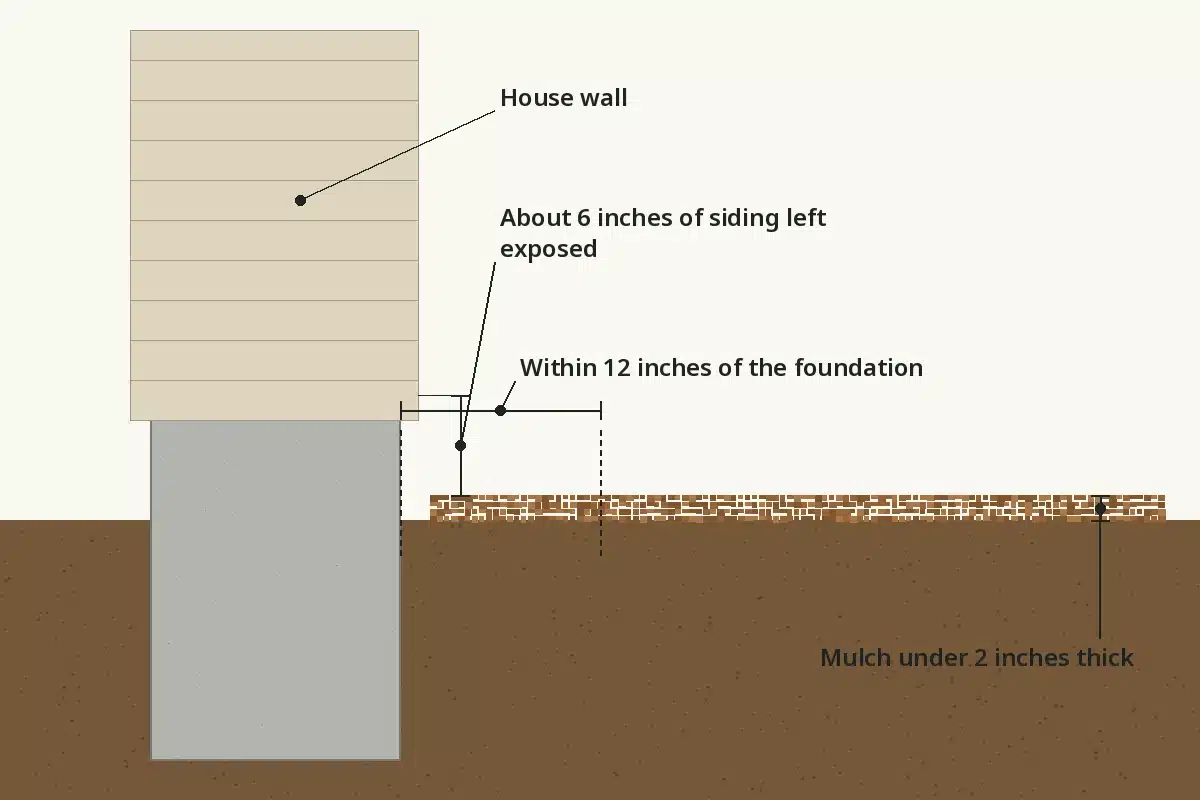
Keep a gap and keep it thin. UF IFAS recommends a layer under 2 inches thick within 12 inches of the foundation, so the soil beneath can dry out. It notes that dry conditions are the termite’s worst enemy. Mississippi State suggests going further and keeping a strip about 2 feet wide next to the foundation free of mulch. Gravel or another inorganic cover can fill that strip.
UF IFAS also calls for an inspection space of about 6 inches between the top of the mulch or soil and the siding. It says the building code requires at least 6 inches so that anyone can spot termite mud tubes running up the wall. Mulch deeper than 4 to 6 inches can hide that space and keep soil moist and mild, which helps termites already present.
Is Gravel Safer Than Wood Mulch?
Not necessarily. UF IFAS cites research in which termites ate more cardboard in stations under pea gravel than under shredded hardwood bark, pine bark nuggets or eucalyptus bark. Inorganic covers look good in dry landscapes, UF IFAS says, but they do not replace termite protection for the house.
Where the mulch sits and how deep it is matter more than what it is made of.
How to Place Cannabis Beds and Mulch Near a House
- Set beds away from the walls. Mississippi State lists raised flower beds built against the outer wall of a building as a risk factor.
- Leave a bare strip. Mississippi State suggests a strip about 2 feet wide next to the foundation with no organic mulch.
- Keep mulch thin near the house. UF IFAS recommends less than 2 inches within 12 inches of the foundation.
- Leave 6 inches of siding exposed. UF IFAS says this inspection gap lets you see mud tubes.
- Aim water away from the walls. UF IFAS advises against watering next to foundation walls. Mississippi State lists excess irrigation, leaky faucets and downspouts among risk factors.
- Store mulch off the ground. UF IFAS recommends avoiding wood to ground contact, including bags of stored mulch.
- Stack wood away from the house. Mississippi State lists firewood or lumber stacked against a building as a risk.
- Use a licensed company for house protection. UF IFAS advises a licensed, reputable pest control company, and Mississippi State says to call a pest control company for an inspection.
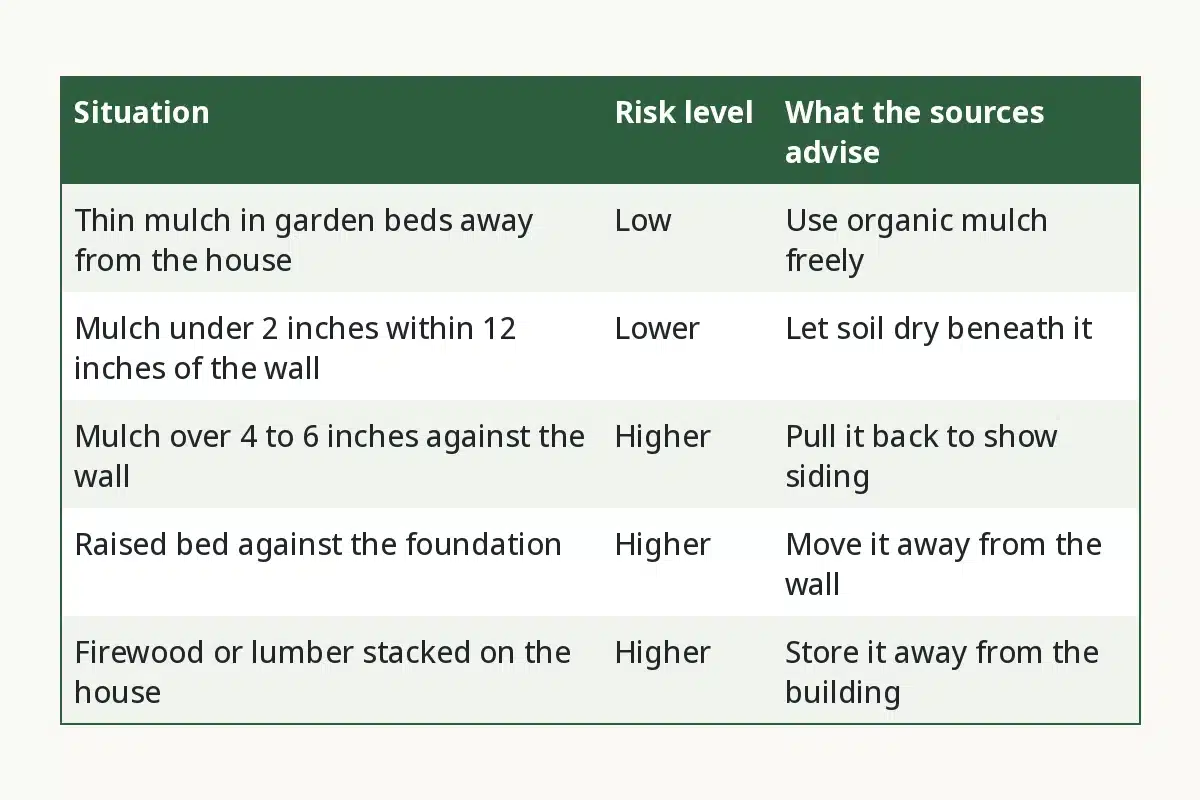
Mulch and Termite Risk at a Glance
| Situation | Risk level | What the sources advise |
|---|---|---|
| Thin mulch in garden beds away from the house | Low | Use organic mulch freely |
| Mulch under 2 inches within 12 inches of the wall | Lower | Let soil dry beneath it |
| Mulch over 4 to 6 inches against the wall | Higher | Pull it back to show siding |
| Raised bed against the foundation | Higher | Move it away from the wall |
| Firewood or lumber stacked on the house | Higher | Store it away from the building |
For building raised beds in the open yard, our guide to raised beds for cannabis covers size and layout.
How Can You Tell Termites From Ants?
Look at the antennae, waist and wings. Mississippi State explains that termite swarmers have straight, beadlike antennae, no pinched waist and front and back wings of equal length. Ants have elbowed antennae, a narrow waist and front wings clearly longer than the back wings.
Both groups shed their wings soon after swarming, Mississippi State notes, so look closely at bodies on windowsills. A hand lens makes it easier. If you find ants in the garden instead, see our post on ants on cannabis.

What Should You Do if Termites Swarm Indoors?
Call a professional for an inspection. Mississippi State says a swarm of termites inside the home means the building has an active infestation, even if the swarmers are dead. It advises contacting a pest control company, describing what you saw and arranging an inspection.
Do not rely on spraying the swarmers. Mississippi State notes that killing them with an aerosol does not solve the problem in the walls.
Which Garden Habits Raise the Risk?
Extra moisture and wood touching the house raise it most. Mississippi State lists many risk factors, including:
- Soil, mulch or leaves touching siding or wood on the house
- Digging or tilling in the soil band right next to the foundation
- Trellises or steps built from plain, unprotected wood
- Wooden stakes or form boards left in the soil
- Shrubs or beds planted so close that inspections are hard
- Water pooling against the foundation
UF IFAS adds that sprinklers aimed at walls create moist conditions that termites favor. Our guide to drip irrigation for cannabis shows how to send water only where plants need it.
Troubleshooting Termite and Mulch Concerns
Termites showed up in a bag of mulch. UF IFAS says survival in mulch is poor. Spread it in beds away from the house and keep a thin layer near the wall.
You found termites in an old stump in the yard. Mississippi State says these are normal in landscapes. Use the find as a reminder to check that the house is protected.
Mulch has crept up against the siding. Rake it back to leave 6 inches of siding showing, as UF IFAS describes.
A raised bed sits against the house. Mississippi State lists this as a risk factor. Move it out into the yard.
Sprinklers wet the foundation. Adjust heads so water stays at least 1 foot from the wall. UF IFAS notes that Florida code requires irrigation to sit 1 foot or more from a building sidewall.
Sources
- University of Florida IFAS Extension, The Facts About Termites and Mulch (ENY 832): https://ask.ifas.ufl.edu/publication/IN651/pdf
- Mississippi State University Extension, Common Questions about Termites and Termite Control: https://extension.msstate.edu/insects/termites/common-questions-about-termites-and-termite-control
- Mississippi State University Extension, Conducive Conditions (Common Termite Risk Factors): https://extension.msstate.edu/insects/termites/conducive-conditions-common-termite-risk-factors
- Mississippi State University Extension, Are These Termites or Ants?: https://extension.msstate.edu/insects/termites/are-these-termites-or-ants
FAQ
Is pine straw safe near a house?
Yes, if it stays off the foundation. Mississippi State lists pine straw as a useful mulch but warns against piling any organic mulch on the house.
How deep should mulch be near a foundation?
Under 2 inches within 12 inches of the wall, according to UF IFAS.
Do termites in yard logs need control?
No. Mississippi State says termites in a log 50 yards from the house are doing their job.
Are flying ants and termites the same?
No. Mississippi State says ants have elbowed antennae and narrow waists, while termite swarmers have straight antennae and no pinched waist.
Can termites travel in mulch bags?
A few may, but they fare poorly. UF IFAS says chipped mulch is a poor way for termites to spread.


