
Crane Fly Larvae in Cannabis Beds: Leatherjackets and Wet Soil
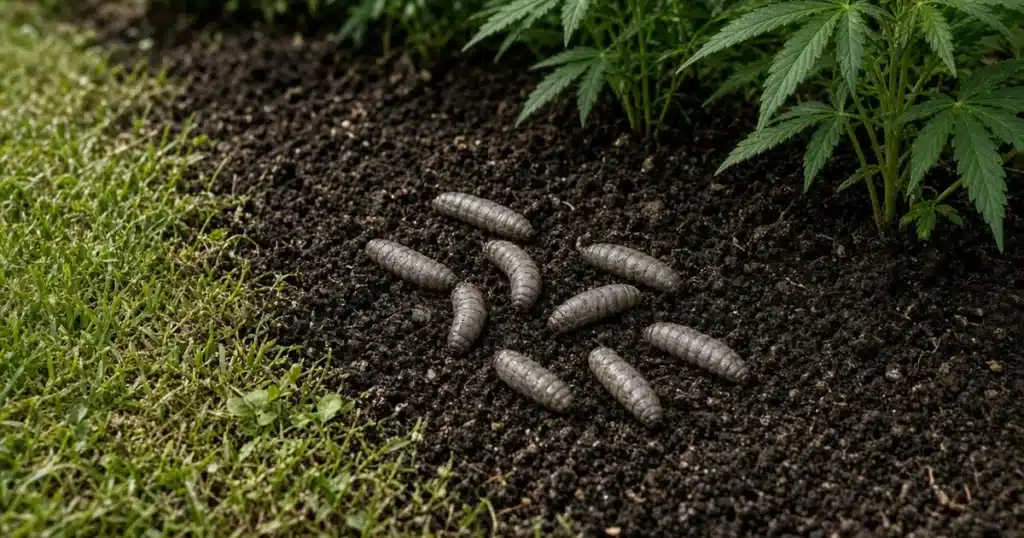
Quick answer: Crane fly larvae, often called leatherjackets, are gray brown, legless grubs that live in damp soil and feed on roots and crowns, mostly of grasses. UC IPM, Oregon State University Extension and the University of Maine all tie damage to wet ground. For a cannabis bed next to a lawn, the main steps are to improve drainage, cut back watering around Labor Day, when adults lay eggs, and dig small soil samples to count larvae before doing anything else.
Are Crane Fly Larvae a Threat to Cannabis?
Usually a minor one, but they deserve a look in wet beds. The damage described by all three sources is to turfgrass and clover. The UC turf guide adds that on damp, warm nights the larvae come up to feed on the leaves and stems of many kinds of plants, not only grass.
Maine notes that most of the more than 1,600 crane fly species in North America feed on decaying organic matter and are little more than a nuisance. Only a few, mainly the European crane fly and the marsh crane fly, feed on grass roots. If your cannabis bed borders a soggy lawn where these species are active, young transplants are the plants most likely to notice.
What Do Leatherjackets Look Like?
They are tough skinned, legless grubs. Maine describes them as gray brown and wormlike, with small fingerlike projections at the rear end. Oregon State adds that they have no well defined head and grow to 1 to 1 1/2 inches long by December.
Their leathery skin is where the leatherjacket name comes from. Maine compares the bare or brown lawn patches some species cause to the damage done by white grubs of scarab beetles, so it pays to identify what you dig up. Our posts on white grubs in cannabis soil and wireworms in cannabis soil describe two other soil pests you may find in the same sample.
What Do Adult Crane Flies Look Like?
They look like giant mosquitoes, but they are harmless. The UC turf guide says adults have very long legs and do not bite or sting. Maine notes that adults are not known to feed and are medically harmless, and Oregon State says they only drink water, though they are drawn to lights at night. Oregon State describes them as about 1 inch long and tan, with long wings and legs.
Oregon State notes that nicknames like mosquito hawk are misleading, since crane flies do not eat mosquitoes.
What Is the Crane Fly Life Cycle?
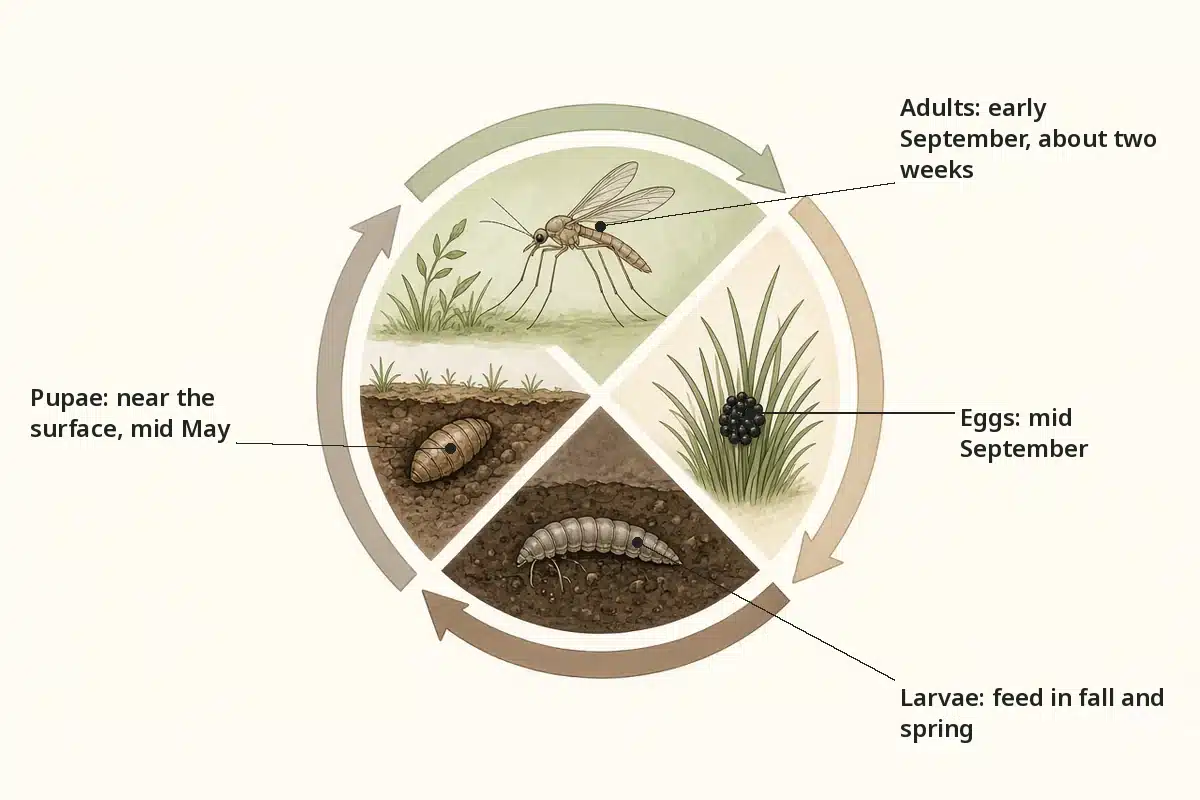
Most of the year is spent underground as a larva. Oregon State says adults of the European crane fly live above ground for about two weeks in early September and lay eggs in low, moist spots by mid September. Eggs hatch in early October, and larvae stay underground until the next September.
The UC turf guide says larvae feed on roots and crowns in fall, pause for winter and resume feeding when spring warms. They enter a nonfeeding pupal stage around mid May just under the soil surface and emerge as adults in late summer. The UC turf guide describes one generation per year, while Oregon State and Maine note that the marsh crane fly can have several.
Why Does Wet Soil Matter So Much?
Because wet ground is where crane flies do best. The UC turf guide states plainly that crane flies thrive in wet soils. Oregon State explains that eggs and young larvae survive best in rainy fall weather and wet soil, and that dry conditions at that stage increase their death rate.
That makes drainage the strongest tool a home grower has. Our guide to running a soil drainage test for cannabis beds walks through checking how fast water leaves a bed.
How to Check for and Manage Crane Fly Larvae
- Scout in late fall or early spring. Oregon State recommends scouting from November through January. The UC turf guide suggests spring checks starting around March.
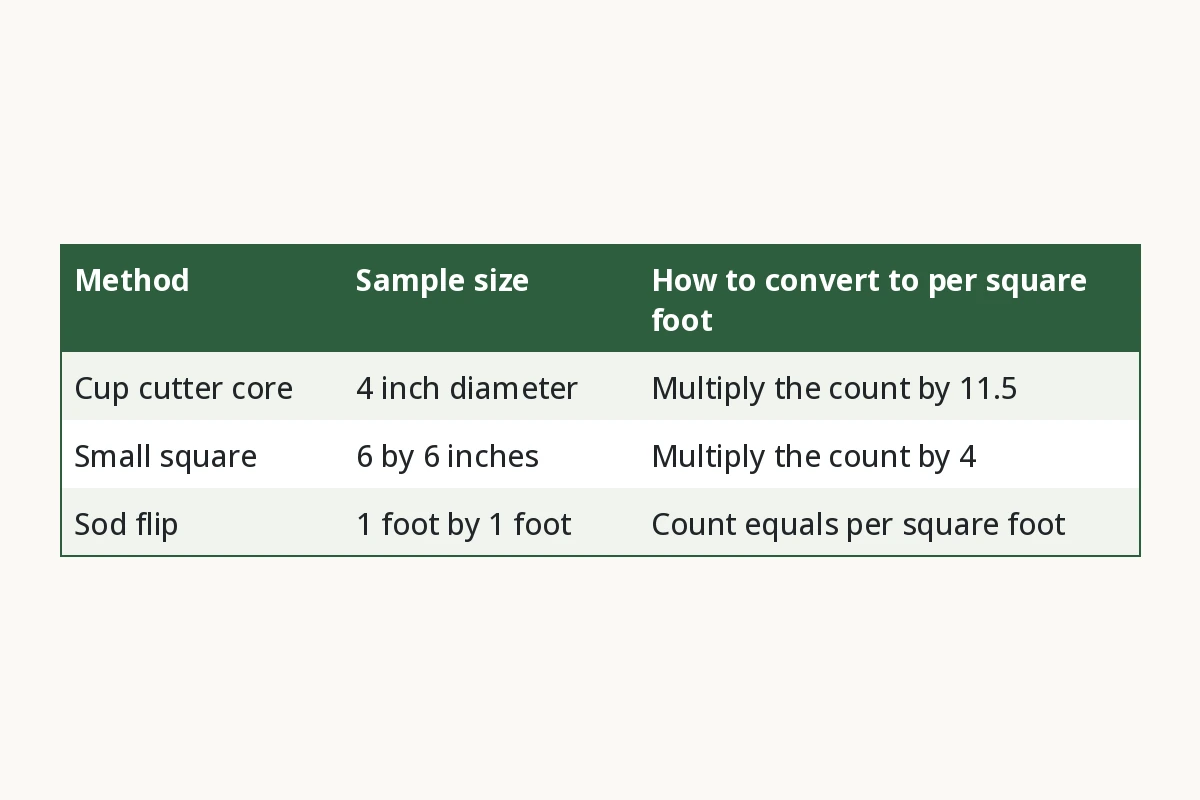
- Dig a sample. Oregon State describes cutting a square of sod 1 foot on each side and 1 inch deep, then flipping it to count larvae. The UC turf guide suggests a 6 by 6 inch square dug 1 to 2 inches deep.
- Do the math. The UC turf guide says to multiply larvae from a 6 by 6 inch sample by 4 to get the count per square foot. Sample three or four spots and average them.
- Sample the edge of damage. The UC turf guide advises digging at the edge of a damaged patch, not the bare center, where larvae may have moved on.
- Improve drainage. The UC turf guide recommends better drainage for chronically wet areas. Oregon State mentions French drains and drain tile for saturated soil.
- Cut back fall watering. Oregon State advises reducing or stopping irrigation around Labor Day, when adults look for wet soil to lay eggs.
- Thin out thatch and dense cover. The UC turf guide says excess thatch makes ideal habitat for larvae.
- Put cultural steps first. Oregon State says mowing, watering, fertilizing and drainage come before any insecticide, and that some insecticides require a state applicator license.

Crane Fly Sampling Methods Compared
| Method | Sample size | How to convert to per square foot |
|---|---|---|
| Cup cutter core | 4 inch diameter | Multiply the count by 11.5 |
| Small square | 6 by 6 inches | Multiply the count by 4 |
| Sod flip | 1 foot by 1 foot | Count equals per square foot |
The UC turf guide notes that well kept turf has handled about 40 larvae per square foot, while weak turf can show damage with as few as 15. Oregon State suggests taking action when well maintained turf has more than 25 larvae per square foot. The UC turf guide cites a Washington threshold of 25 to 50.
Can Healthy Plants Outgrow the Damage?
Often, yes. The UC turf guide says vigorous, well maintained turf can recover from crane fly feeding even when larval numbers are fairly high, and it lists proper fertilizing and watering as key factors. It also suggests aerating soil to encourage root growth and help water and nutrients soak in, and reseeding bare spots so weeds do not move in.
Oregon State adds that crowns and roots hurt over winter and spring need regular summer water to recover.
Do Natural Predators Help?
Yes, a great deal. The UC turf guide reports that birds, predatory ground beetles and other natural causes have cut larval numbers by as much as 50 percent in winter and spring. Oregon State notes that birds, skunks and raccoons dig for larvae in infested areas, though their digging can add damage of its own.
The UC turf guide also describes drenches of beneficial nematodes, which may give up to a 50 percent reduction when applied properly. Use only products labeled for your crop and state.
Troubleshooting Crane Fly Problems
Larvae show up every spring in the same low spot. Oregon State says adults return to the same wet areas each September. Fix the drainage in that spot first.
Birds are tearing up the lawn beside the bed. Oregon State lists bird foraging as a clue to high larval numbers. Dig a sample to confirm.
No larvae were found in a bare patch. The UC turf guide explains that larvae leave bare spots. Sample the edge of the patch instead.
The bed stays soggy after rain. The UC turf guide recommends better drainage and less irrigation for chronically wet areas. If you use a thick layer of organic cover, our guide to choosing a cannabis mulch can help you pick a lighter option.
Adults keep flying indoors at night. Maine notes that they are drawn to lights and are harmless, so dimming outdoor lights near doors may cut down on visits.
Sources
- UC Statewide IPM Program, University of California, Crane Flies, Turfgrass: https://ipm.ucanr.edu/agriculture/turfgrass/crane-flies/
- Oregon State University Extension Service, Managing Crane Fly in Lawns (EM 9296): https://extension.oregonstate.edu/sites/extd8/files/catalog/auto/EM9296.pdf
- University of Maine Cooperative Extension, Crane Flies: https://extension.umaine.edu/home-and-garden-ipm/fact-sheets/common-name-listing/crane-flies/
FAQ
Do crane flies bite people?
No. The UC turf guide says adults do not bite or sting.
When do crane fly larvae do the most damage?
In spring. Oregon State says larvae cause the greatest damage to grass shoots, crowns and roots in spring.
Do crane flies eat mosquitoes?
No. Oregon State says the mosquito hawk nickname is misleading.
Can I stop crane flies by watering less?
It helps. Oregon State says reducing irrigation around Labor Day keeps adults from laying eggs and lowers egg survival.
How many generations do crane flies have?
The European crane fly has one a year, according to Oregon State and Maine. The marsh crane fly has more than one.


