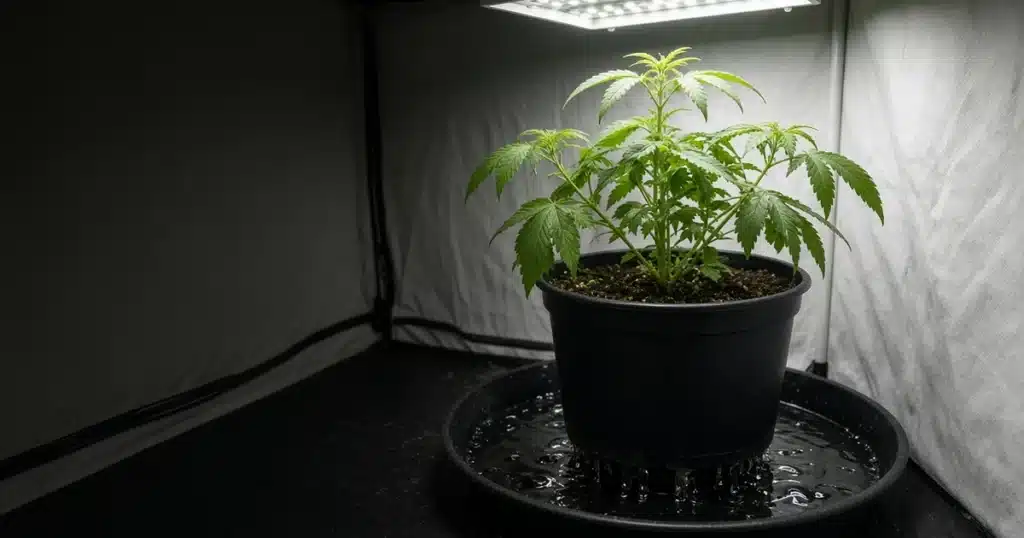
Fluoride in Tap Water and Cannabis Plants
Quick answer: Many public water systems add small amounts of fluoride, and some plants collect it in their leaf tips. University of Missouri IPM names fluoride, along with too much fertilizer and poor watering, among the three main causes of leaf tip browning in houseplants. Arkansas Extension notes that perlite, some peat and superphosphate fertilizer also contain fluoride, and that keeping mix pH around 6.0 to 6.5 limits uptake. Cannabis is not among the plants these sources list as most sensitive, so most growers can use tap water without worry. If tips brown despite good feeding and watering, rinse perlite, check pH and try rainwater or filtered water.
Where Does Fluoride in Plant Water Come From?
Fluoride gets into a container garden from several places, not only the tap.
Missouri IPM writing on brown leaf tips on houseplants notes that many public water supplies carry trace amounts of fluoride. Over enough time, sensitive plants can gather enough from that water to show damage.
An Arkansas Extension plant clinic newsletter says fluoridated tap water is the usual source for sensitive houseplants, but adds three more: superphosphate fertilizer, perlite and some peats. Missouri agrees that perlite contains fluoride, which is why some soilless mixes come without it.
For cannabis growers using perlite heavy mixes and city water, those sources can add up in a pot.
How Does Fluoride Affect Plant Leaves?
Arkansas explains that fluoride builds up in the tips of leaves and keeps the stomata, the tiny pores on leaves, from closing properly. The signs it describes include dead spots, leaf tip browning and yellowing along the edges, followed by browning of the leaf.
Missouri stresses that tip browning is not a disease. No fungus, bacterium or virus causes it. It is a growing problem, and once a leaf tip turns brown, it cannot return to green. You can trim the brown tip for looks, but prevention is the real fix.
Arkansas also notes that fluoride damage is seldom severe enough to lose the plant. It mostly affects appearance and leaf area.
Are Cannabis Plants Sensitive to Fluoride?
The plants that react most, according to Arkansas and Missouri, are tropical houseplants such as dracaena, peace lily, spider plant, palms and members of the lily family. Cannabis does not appear on those sensitivity lists.
That suggests most cannabis growers do not need to worry about the small amount of fluoride in city water. Leaf tip browning on cannabis is far more often caused by too much fertilizer or uneven watering, the other two causes Missouri lists.
Still, if you have ruled those out and tips keep browning, fluoride is worth considering, especially in perlite heavy mixes with low pH.
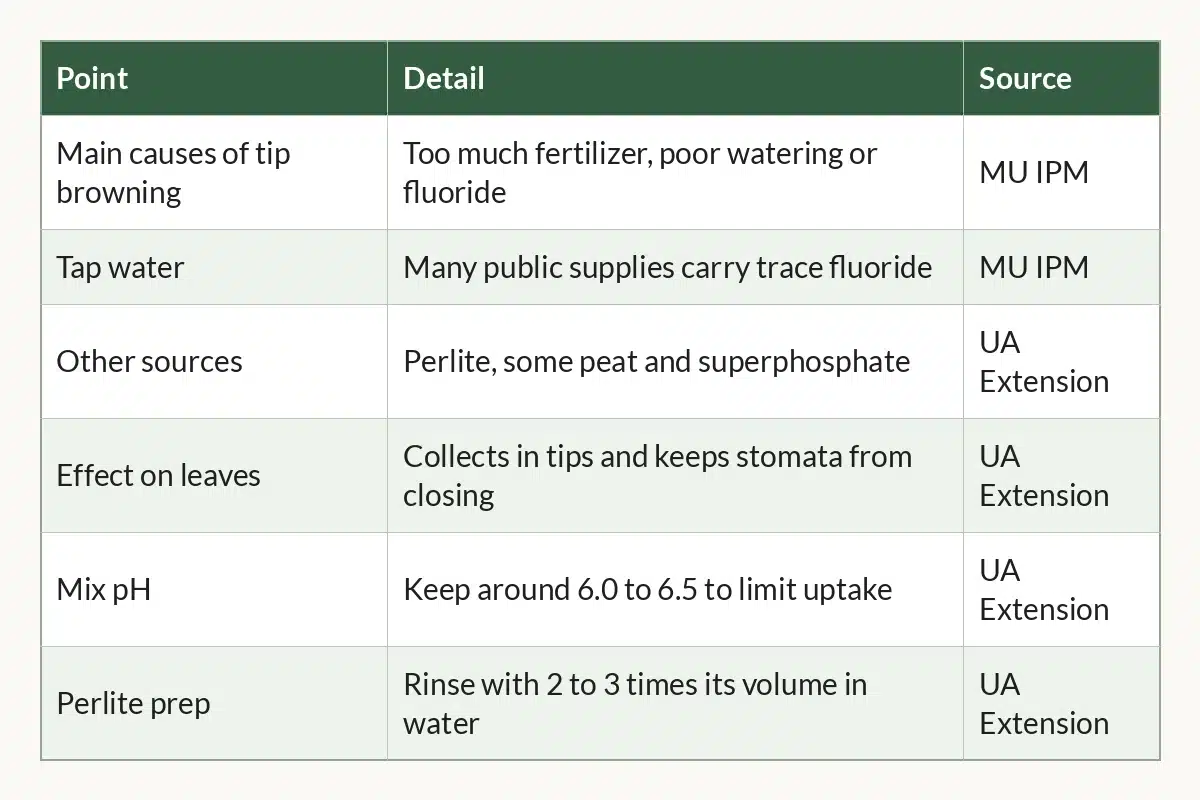
Fluoride and Plants at a Glance
| Point | Detail | Source |
|---|---|---|
| Main causes of tip browning | Too much fertilizer, poor watering or fluoride | MU IPM |
| Tap water | Many public supplies carry trace fluoride | MU IPM |
| Other sources | Perlite, some peat and superphosphate | UA Extension |
| Effect on leaves | Collects in tips and keeps stomata from closing | UA Extension |
| Mix pH | Keep around 6.0 to 6.5 to limit uptake | UA Extension |
| Perlite prep | Rinse with 2 to 3 times its volume in water | UA Extension |
How Do You Tell Fluoride From Fertilizer Problems?
Since Missouri names three main causes of tip browning, rule out the common two first.
Too much fertilizer. Missouri advises following label rates. Salt buildup from heavy feeding causes brown tips that look much like fluoride damage. A white crust on the pot or mix surface points to salts.
Uneven watering. Missouri notes that letting mixes dry too far, or keeping them too wet, also browns leaf tips. Modern soilless mixes hold some water that roots cannot use, so keep them evenly moist but not wet.
Fluoride. If feeding and watering are steady and tips still brown, especially on older leaves, look at your water source and the amount of perlite in the mix.
Our article on irrigation water alkalinity for cannabis covers other tap water factors that affect pH and mineral balance.
How Does pH Affect Fluoride Uptake?
Missouri explains that fluoride becomes less available as the pH of the growing mix rises, so keeping pH somewhat higher reduces the problem. Arkansas recommends holding soil pH between 6.0 and 6.5.
That range happens to suit cannabis well in soil and soilless mixes. If your mix runs acidic, bringing it up into that range helps with fluoride and with general nutrient uptake.
How Can You Reduce Fluoride Exposure?
Arkansas and Missouri give several practical steps:
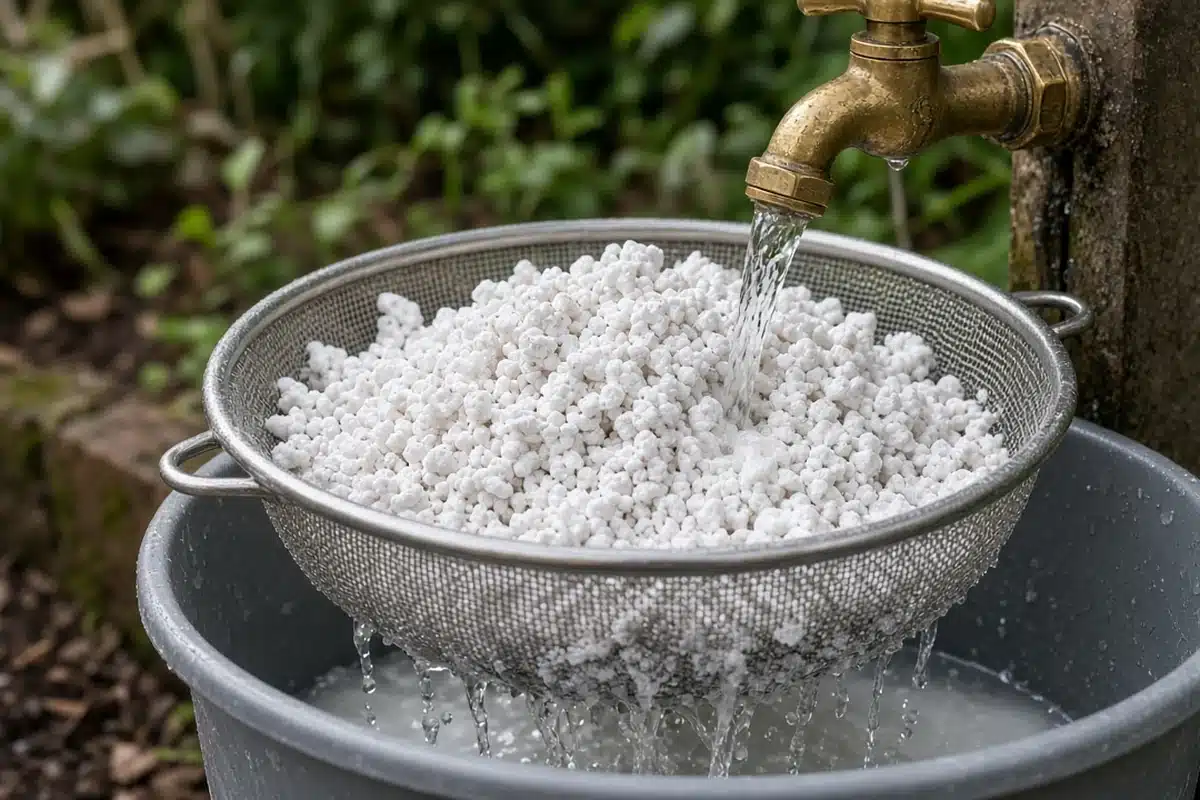
- Rinse perlite. Arkansas suggests rinsing perlite with 2 to 3 times its volume in water before mixing it into potting soil.
- Choose perlite free mixes if you suspect fluoride, as Missouri suggests for sensitive plants.
- Use a different water source. Missouri recommends rainwater or distilled water for sensitive plants. Our guide to rainwater for cannabis covers collection and storage.
- Swap superphosphate. Arkansas recommends triple superphosphate or soluble phosphates instead of regular superphosphate.
- Keep pH in range. Aim for 6.0 to 6.5.
Reverse osmosis filters remove most dissolved minerals, including fluoride. Our article on how reverse osmosis helps home cannabis growers compares filtered water options.
Can You Test Water for Fluoride?
Yes. Most public water utilities publish an annual water quality report that lists fluoride along with hardness and other minerals. Search your utility’s website or call and ask for the latest report. If you use a private well, a certified water lab can test for fluoride as part of a standard mineral panel.
Testing the potting mix is harder, since fluoride from perlite and fertilizer builds up slowly. For most home growers, the water report and a look at the mix ingredients give enough information to decide whether fluoride is worth chasing.
Does Fluoride Affect Seedlings and Clones Differently?
Young plants have few leaves, so any tip browning stands out more. They also sit in small pots of fresh mix, which often contains a good share of perlite for drainage. If seedlings or clones show brown tips early, rinse the perlite in your next batch of mix and check pH before blaming the water. Keep feeding light at this stage, since too much fertilizer is still the more likely culprit.
Should You Stop Using Tap Water?
For most cannabis growers, no. The fluoride level in public water is low, and cannabis is not a known sensitive plant. Switching water costs money and effort, and low mineral water means your feed must supply all the calcium and magnesium.
Consider a change only if leaf tip browning persists after you have adjusted feeding, watering and pH. Even then, rinsing perlite and nudging pH up a little may be all it takes.
How to Check and Reduce Fluoride Effects on Cannabis
- Look at the pattern. Note whether browning starts at leaf tips and which leaves show it.
- Review feeding. Compare your rates to the fertilizer label.
- Review watering. Keep the mix evenly moist, not soggy or bone dry.
- Check pH. Aim for 6.0 to 6.5 in the mix.
- Rinse perlite. Use 2 to 3 times its volume in water before mixing.
- Check your fertilizer. Avoid regular superphosphate if you suspect fluoride.
- Try another water source. Use rainwater or filtered water on a few plants to compare.
- Watch new growth. Old brown tips will not recover, so judge by new leaves.
Troubleshooting Leaf Tip Browning
Tips brown and a crust forms on the pot. Salts are building up. Flush the mix and reduce feeding.
Tips brown after the mix dries out. Watering is uneven. Keep your watering more consistent.
Tips brown with steady care. Fluoride or low pH may be involved. Rinse perlite and raise pH.
Only new leaves show damage. The cause is likely recent. Review any changes in feeding or water.
Brown tips do not recover. That is to be expected. Trim them if desired and watch new growth.
Sources
- University of Missouri IPM, Missouri Environment and Garden article on brown leaf tips of houseplants (2021): https://ipm.missouri.edu/meg/2021/1/leafTipburn-DT/index.cfm
- University of Arkansas Cooperative Extension, Plant Clinic Newsletter, Issue 11, May 2014: https://www.uaex.uada.edu/yard-garden/plant-health-clinic/docs/2014_Plant_Health_Clinic_Newsletters/Plant%20Health%20Clinic%20Newsletter-Issue%2011.pdf
FAQ
Does tap water fluoride harm cannabis?
Cannabis is not on known sensitivity lists, so most growers see no effect.
What causes leaf tip browning most often?
Missouri lists too much fertilizer, poor watering and fluoride as the main causes.
Does perlite contain fluoride?
Yes. Arkansas suggests rinsing it with 2 to 3 times its volume in water.
What pH limits fluoride uptake?
Arkansas recommends a mix pH between 6.0 and 6.5.
Will brown leaf tips turn green again?
No. Judge your progress by the new leaves instead.