
Graywater for Cannabis Gardens: Is Laundry Water Safe to Use?
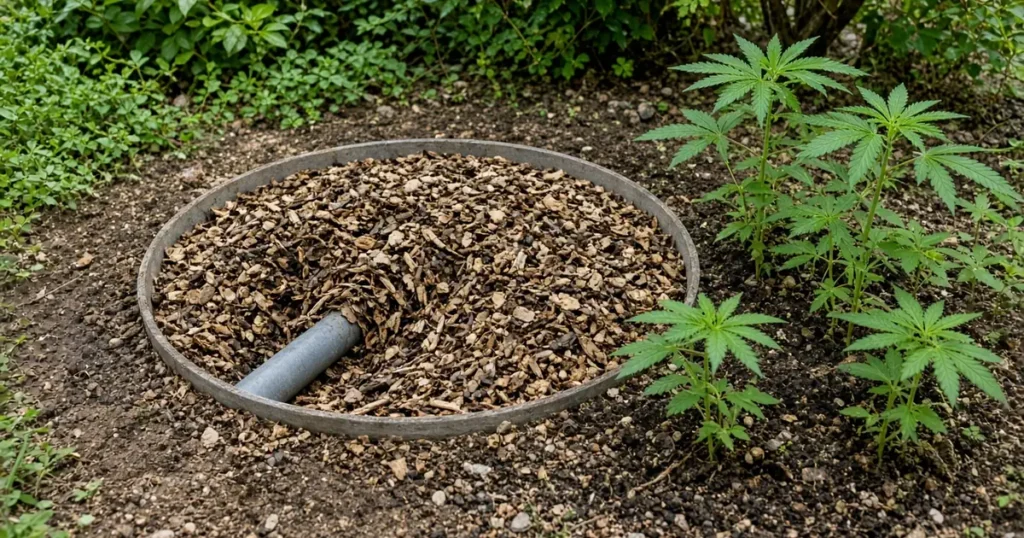
Quick answer: Graywater is used household water from showers, baths, bathroom sinks and washing machines. UC Master Gardener programs in California say it works well for ornamental shrubs and fruit trees, but they set strict limits on plants people consume. The San Luis Obispo County program says not to use it on edible plants or potted plants at all. If you still plan to use graywater near cannabis, the sources agree it must go into the soil below a cover layer, never sprayed on plants, and only with sodium, boron and chlorine free products.
What Counts as Graywater?
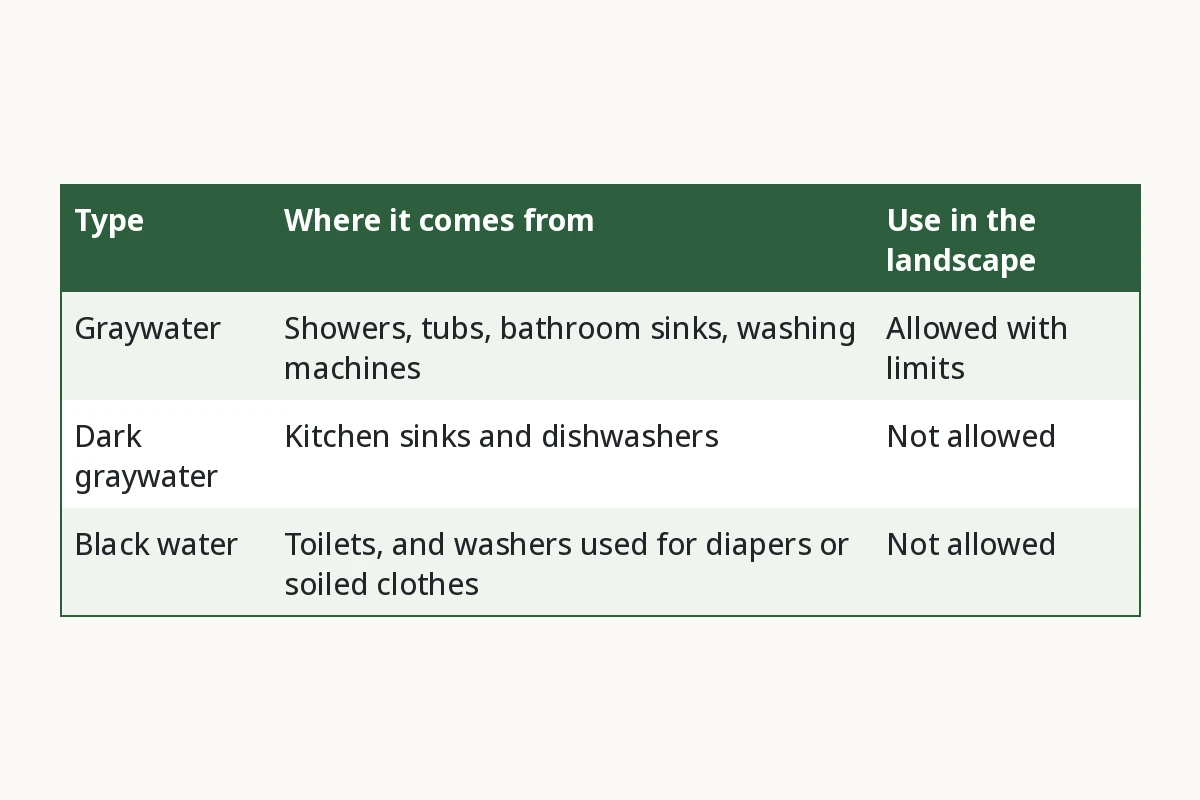
It depends on the source of the water. The Contra Costa County UC Master Gardener program defines graywater as untreated, non disinfected household wastewater that contains no toilet waste. It may come from showers, baths and washing machines.
The sources draw clear lines between types:
| Type | Where it comes from | Use in the landscape |
|---|---|---|
| Graywater | Showers, tubs, bathroom sinks, washing machines | Allowed with limits |
| Dark graywater | Kitchen sinks and dishwashers | Not allowed |
| Black water | Toilets, and washers used for diapers or soiled clothes | Not allowed |
The Marin Master Gardeners explain that kitchen water can carry a lot of organic matter that encourages bacteria to grow. The San Luis Obispo County program adds that washers used for clothes stained with paint, hair dye or automotive fluids also produce black water.
Can You Use Graywater on Cannabis?
The UC guidance is cautious. The San Luis Obispo County program is the strictest. It says not to use graywater on edible plants, root crops or the edible parts of any plant, and not to use it on potted plants. Its bottom line is to avoid eating any plant or fruit that has touched graywater on its surface or in its soil.
The Contra Costa County program is a little more flexible. It says graywater should not be used on vegetables whose edible part may touch the soil, but that crops held off the ground, such as staked tomatoes, peppers and eggplants, should be fine. The Marin program limits graywater to fruit trees, ornamental shrubs and food plants that stay off the ground.
None of the sources address cannabis directly. Since cannabis flowers are consumed, the safest path is to keep graywater on ornamental plantings and use fresh water on your cannabis. Our guide to rainwater for cannabis covers another way to stretch your supply.
Why Not Use Graywater in Pots?
Containers are a poor fit. The San Luis Obispo County program says outright not to use graywater on potted plants. Its guidance also says graywater should not linger on the surface where people or pets might touch it, and a pot of wet mix sits close to hands at every watering.
Salts are a second concern. The UC Master Gardener sources note graywater tends to be alkaline and can carry sodium, chlorine and boron. Our post on salt buildup in cannabis soil shows how salts collect in containers over time.
How Does Graywater Affect Soil and Plants?
It can raise pH and add salts. The San Luis Obispo County program says graywater is often alkaline and high in sodium, chlorine and boron, which can harm plants. It lists acid loving and salt sensitive plants as the least tolerant. The Contra Costa program warns that sodium compounds, bleach and boron can lead to an alkaline soil that suppresses healthy soil life.
Watch for warning signs. The San Luis Obispo County program says to monitor plants for yellow or bronze leaves and browning along leaf edges and tips. Both the Contra Costa and Marin programs suggest alternating graywater with fresh water to limit salt buildup. If you see tip burn on any plant you water this way, our guide to understanding pH and cannabis plants shows why a high pH causes trouble.
Steps for Using Graywater Safely in a Garden
- Check local rules. The UC Cooperative Extension publication on graywater notes that cities and counties can set stricter rules than the state.
- Use only true graywater. Keep kitchen sink, dishwasher and toilet water out, as all three UC sources advise.
- Pick the right products. The Marin program calls for biodegradable, pH balanced laundry products free of sodium, boron and chlorine.
- Prefer rinse water. The Marin program says rinse cycle water is better than wash cycle discharge.
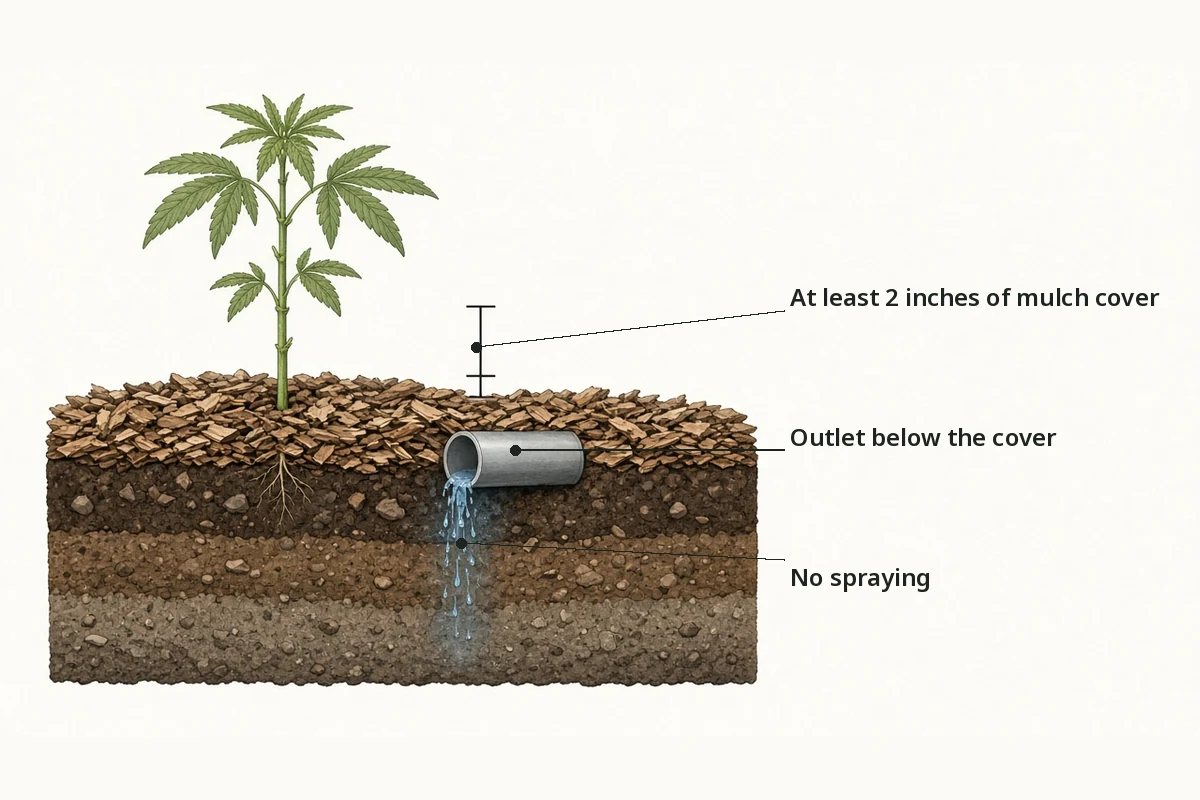
- Send it into the soil. The Marin program says graywater must discharge under at least 2 inches of cover material.
- Never spray it. The San Luis Obispo County program says not to use graywater in sprinklers, to avoid spreading fine droplets.
- Use it within a day. The Contra Costa program says to use graywater within 24 hours to limit bacterial growth.
- Alternate with fresh water. Both the Contra Costa and Marin programs suggest this to reduce salt buildup.
- Keep it off skin. The San Luis Obispo County program recommends wearing gloves.
Which Soaps and Detergents Work With Graywater?
Choose simple, salt free products. The San Luis Obispo County program says to look for boron free, chlorine free, pH balanced products. It notes liquid detergents contain less sodium than powders, and it lists dyes, bleach, whiteners, softeners, fragrances and enzyme products as things to avoid.
It also lists ingredients to skip, including borax and borate, salts and sodium, chlorine, peroxygen and petroleum distillates, and it says products with hydrogen peroxide can be used. The program adds that detergent phosphates do no harm to plants and may even feed them. Water from a sodium chloride water softener is too high in sodium for irrigation, but a softener that uses potassium chloride produces graywater that is not toxic to plants.
What Is a Laundry to Landscape System?
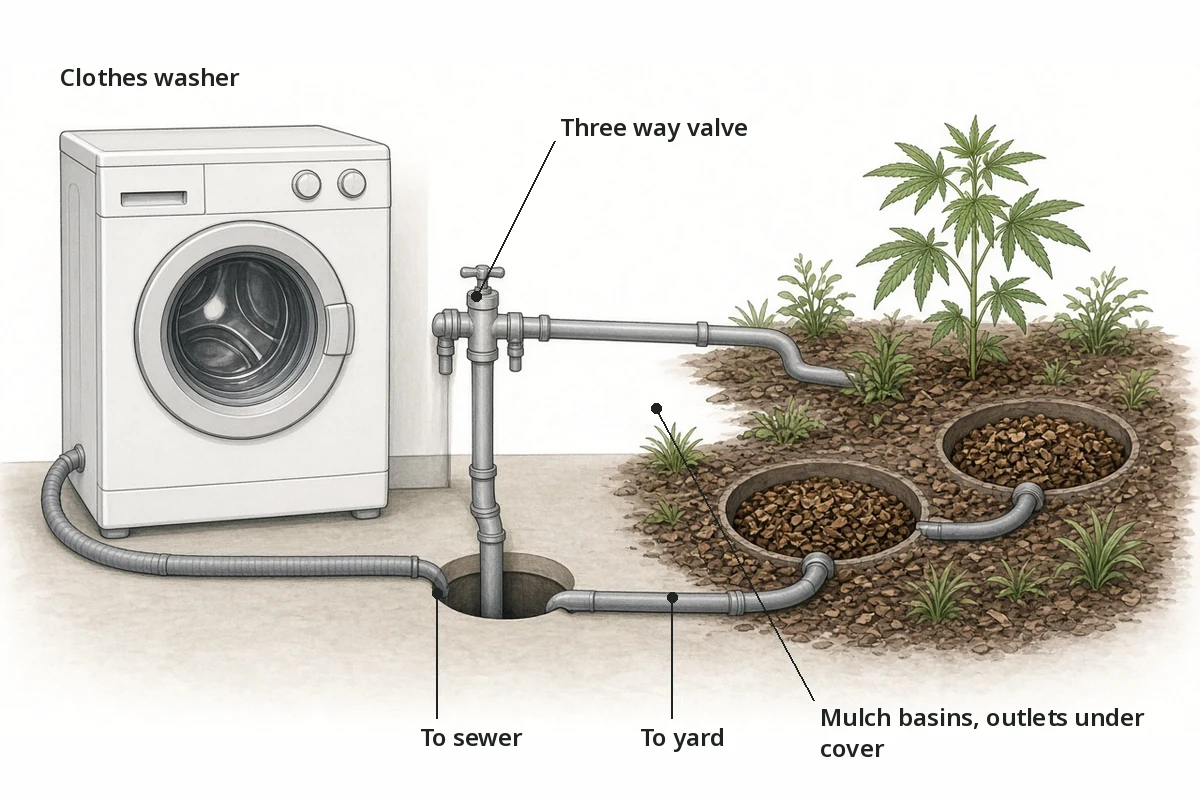
It is the simplest home graywater setup. The Marin program describes it as a system that uses discharge water from a single clothes washer in a one or two family home to irrigate the yard below the surface. The UC Cooperative Extension publication explains that a valve on the washer hose lets you send water either to the yard or to the sewer.
That valve matters. The UC publication says all water can go to the sewer when bleach or powder detergents are used or after rain raises the groundwater. It notes that the simplest systems send water into mulch basins, and that a mulch basin must be sized to prevent pooling. For drip lines, the San Luis Obispo County program says a filter may be needed to stop hair and lint from clogging emitters. Our guide to drip irrigation for cannabis covers emitters for fresh water systems.
Troubleshooting Graywater Use
Leaf tips are browning on irrigated shrubs. Salt or boron may be building up. The San Luis Obispo County program lists leaf tip burn among the signs. Switch to fresh water for a while and review your detergent.
The mulch basin is pooling. It may be too small for your soil. The UC publication says slower draining clay soil needs a larger basin than sandy soil.
The drip line keeps clogging. Add a filter, as the San Luis Obispo County program suggests, or use a mulch basin instead.
You have a water softener. Check whether it uses sodium chloride. If so, the San Luis Obispo County program says the graywater is not usable for irrigation.
Water smells bad by the next day. It has been stored too long. The Contra Costa program says to use graywater within 24 hours.
You want to water cannabis during a drought. Use fresh water on cannabis and graywater on ornamentals. Our post on watering cannabis during drought has ways to save water.
Sources
- UC Master Gardeners of San Luis Obispo County, University of California Agriculture and Natural Resources, Graywater Irrigation: https://ucanr.edu/site/uc-master-gardeners-san-luis-obispo-county/graywater-irrigation
- UC Master Gardener Program of Contra Costa County, Graywater: https://ucanr.edu/blog/hort-coco-uc-master-gardener-program-contra-costa/article/graywater
- UC Marin Master Gardeners, Starting a graywater system: https://ucanr.edu/site/uc-marin-master-gardeners/article/starting-graywater-system
- UC Cooperative Extension, Hartin and Faber, Use of Graywater in Urban Landscapes in California: https://www.ucanr.edu/sites/default/files/2015-08/218057.pdf
FAQ
Is graywater the same as rainwater?
No. Graywater is used household water, while rainwater is collected from roofs or the sky. The UC sources only cover graywater.
Can I use dishwater in the garden?
No. The Marin and Contra Costa programs both say kitchen sink and dishwasher water is dark graywater and should not be reused in landscapes.
Do I need a permit for laundry to landscape?
Usually not for a simple laundry to landscape system in California. The Marin program says a simple laundry to landscape system needs no permit, but local rules vary.
How much graywater does a washer make?
Roughly 10 to 40 gallons a load. The UC publication estimates 10 to 25 gallons per load for a front loader and about 40 gallons for a top loader.
Can I store graywater in a barrel?
Not for long. The San Luis Obispo County program says not to store it more than 24 hours.
Is graywater safe on lawns?
It is not a good fit. The Marin program says lawns are not the best use, and the San Luis Obispo County program advises against using it on turf.


