
Water Alkalinity for Plants: Hard Water and Cannabis
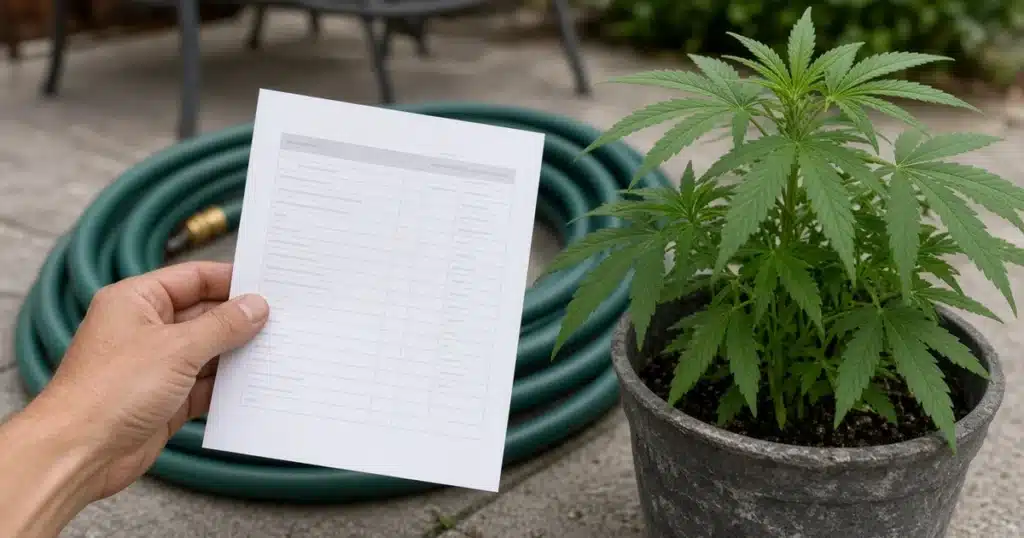
Water alkalinity for plants is one of the most overlooked reasons a cannabis grow drifts out of balance. Many growers test pH and stop there, but pH and alkalinity are not the same thing. Alkalinity measures how much acid the water can neutralize. Water with high alkalinity acts a little like dissolved lime: every watering pushes the pH of the root zone higher, even when the pH of the water itself looks fine. Read on for what alkalinity is, how to read a water test, when it becomes a problem in pots and beds, and how home growers can manage it.
What is water alkalinity?
University of Kentucky Extension defines alkalinity as the water’s ability to neutralize acids, including the acids found in fertilizers and growing substrates. It comes mainly from dissolved bicarbonates and carbonates of calcium, magnesium and sodium. Those carbonate and bicarbonate ions neutralize hydrogen ions, which raises the pH of the solution around the roots over time, and in some cases very quickly.
UMass Amherst Extension adds that an alkalinity test measures bicarbonates, carbonates and hydroxides, and that results are usually reported as ppm of calcium carbonate (CaCO3). Some labs report milliequivalents per liter (meq/L) instead, so check which unit is on your report before comparing numbers.
How are pH and alkalinity different?
pH is a snapshot of how acidic or basic the water is right now. Alkalinity is the water’s reserve, its buffering power against change. UMass Extension makes the key point clearly: a pH test by itself is not an indication of alkalinity. Water with high alkalinity always has a pH of about 7 or above, but water with a high pH does not always have high alkalinity.
That is why two growers with the same pH reading can see very different results. One may have water with a high pH but little alkalinity, which a small amount of acid or an acidic nutrient mix easily pulls down. The other may have high pH and high alkalinity, which resists change and keeps raising root zone pH week after week. UMass Extension notes that in the second case, the water acts as a dilute application of limestone every time it is used.
What alkalinity levels are a problem?
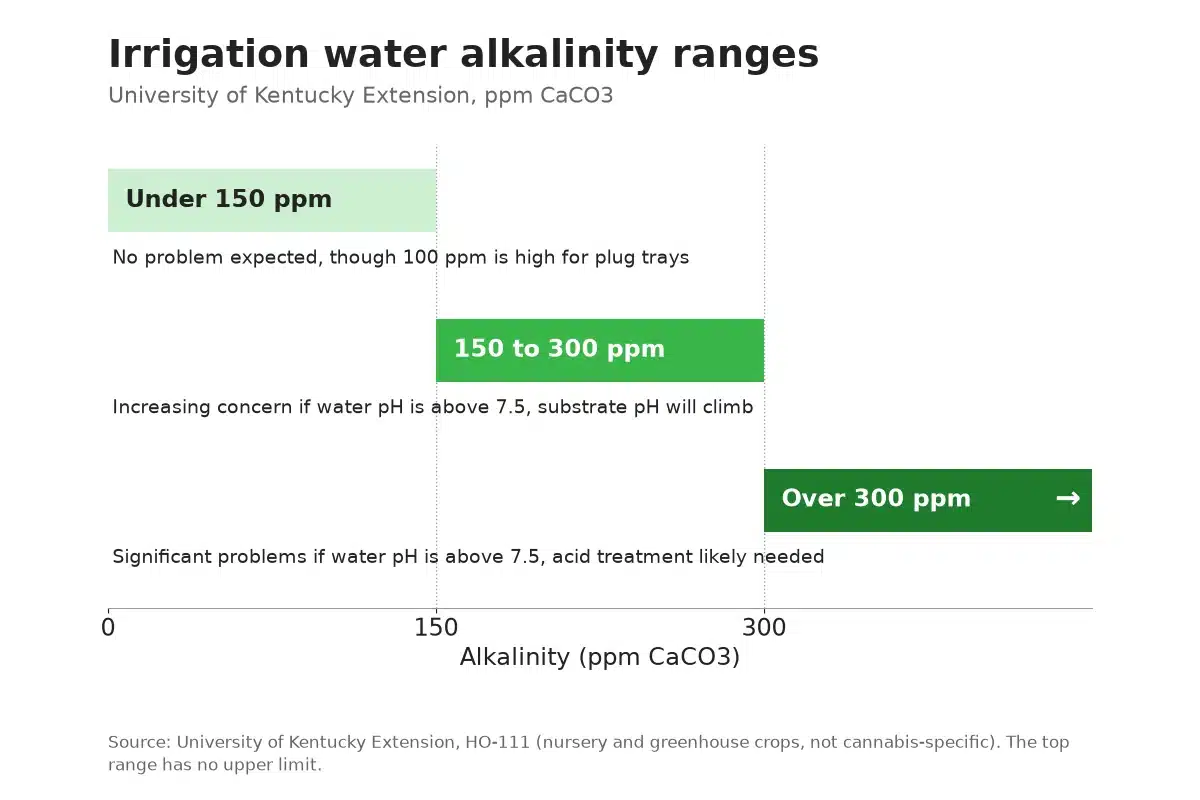
Container size matters most. University of Kentucky Extension explains that the larger the substrate volume, the more buffering capacity it has, so pH changes much more slowly in large containers than in small pots or plug cells. Inert media such as those used in hydroponic systems offer almost no buffering, so problems can start at an alkalinity as low as 50 to 75 ppm. For plants in 4-inch or larger containers that are not especially pH sensitive, up to 150 ppm is manageable.
UMass Extension gives 0 to 100 ppm CaCO3 as the desirable range for irrigation water and considers 30 to 60 ppm optimum for most plants. Some alkalinity is useful, because it steadies pH.
| Alkalinity (ppm CaCO3) | What University of Kentucky Extension expects |
|---|---|
| Under 150 | No problem expected, though 100 ppm is high for plug trays |
| 150 to 300 | Increasing concern if water pH is above 7.5, substrate pH will climb |
| Over 300 | Significant problems if water pH is above 7.5, acid treatment likely needed |
Source: University of Kentucky Extension, HO-111 (nursery and greenhouse crops, not cannabis-specific).
What are the signs of high-alkalinity water?
High alkalinity rarely shows up as one clear sign. It works slowly through rising root zone pH. Watch for these patterns:
- Runoff or substrate pH that keeps creeping upward over several weeks while your feed pH stays the same.
- Pale or yellow new growth between the veins, a common sign that trace elements such as iron are harder for roots to take up at high pH.
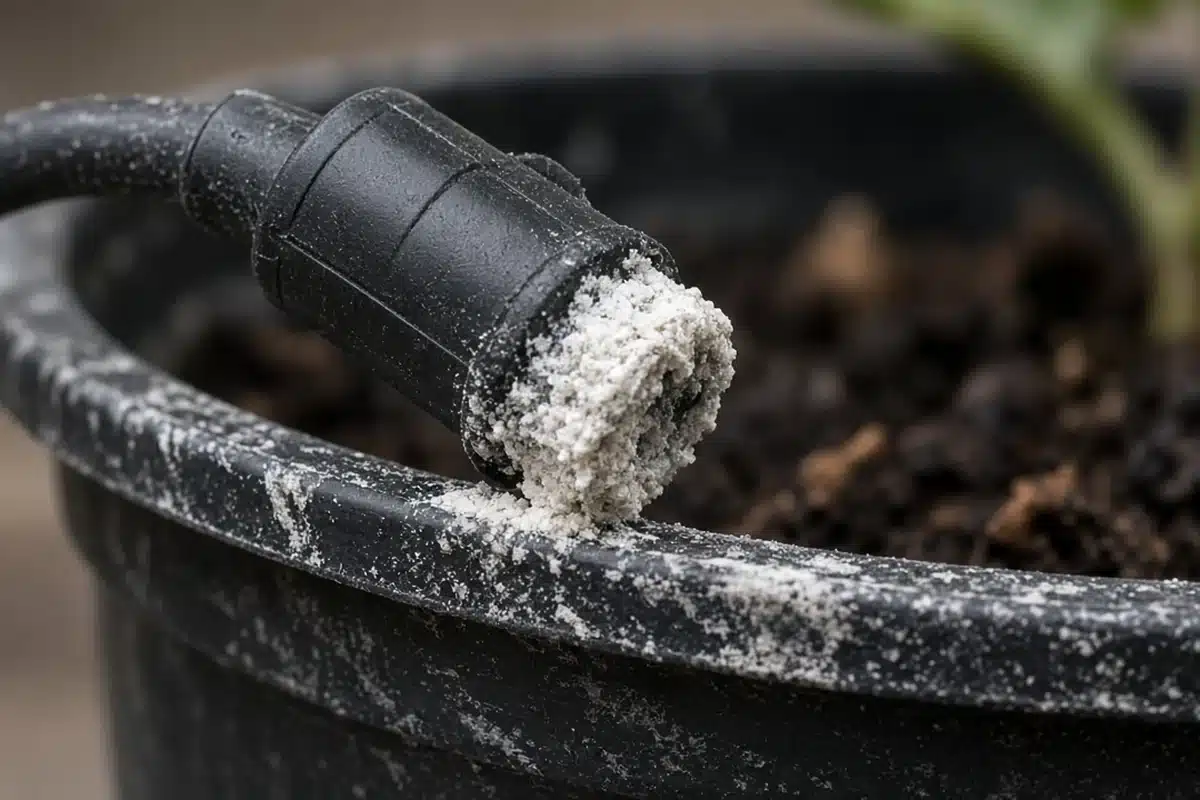
- Crusty white or tan scale on pots, drip emitters and spray nozzles.
- Seedlings and young plants in small cells struggling first, since small volumes have the least buffering.
- Nutrient adjustments that seem to stop working after a few weeks.
UMass Extension links irrigation with high alkalinity water to trace element deficiencies and to calcium and magnesium imbalances, and notes that bicarbonates and carbonates can clog sprayer nozzles and drip tubing. Overfeeding, root problems or a faulty meter can produce the same signs, so confirm with a water test before treating.
How do you test your water?
- Find out where your water comes from. City water reports often list pH, hardness and sometimes alkalinity. Private well water needs its own test.
- Ask a soil and water testing lab for an irrigation water test that includes both pH and alkalinity. Many state extension services offer this or can refer you to a lab.
- Collect the sample from the tap or hose you actually use, after letting it run for a minute.
- Compare the alkalinity figure with the ranges above, and note the unit on the report.
- If you treat the water, retest the treated water to confirm the result.
- Track runoff pH over time with a calibrated meter. Readings only stay honest if the meter does, which is why pH meter calibration is worth a look.
Home alkalinity test kits are also sold through greenhouse and scientific suppliers. They are useful for routine checks between lab tests.
Is hard water the same as high alkalinity?
Not exactly. University of Kentucky Extension describes hardness as a measure of dissolved minerals, usually calcium and magnesium. These minerals are often paired with carbonates, so hard water and high alkalinity tend to go together. But calcium and magnesium can also be present as chlorides, which makes water hard without adding any alkalinity.
Hard water can still cause trouble on its own, because minerals can build up as sediment that clogs irrigation lines. The same extension bulletin warns that water from a home water softener should never be used for irrigation. Softeners replace calcium and magnesium with sodium, and sodium can harm roots.
How do you manage high-alkalinity water?
Start with the least effort that fixes the problem. University of Kentucky Extension describes fertilizer choice as one way to manage moderate alkalinity. Every fertilizer has a listed potential acidity or basicity, and a more acidic formula can offset moderately high alkalinity and keep substrate pH in range. If you use this approach, check substrate or runoff pH regularly.
For high alkalinity, extension guidance points to acid treatment. University of Kentucky Extension says acid injection will likely be necessary at 300 ppm or more to make water suitable for soilless production. Phosphoric, sulfuric, nitric and citric acids are all used. Phosphoric and nitric acids also add phosphorus or nitrate, so the feeding plan may need adjusting. UMass Extension notes that acid is always added before fertilizer and other materials.
Acid safety is not optional. Wear eye protection and acid-resistant gloves, always add acid to water and never water to acid, and stir after adding because acids sink. Many home growers buy a ready-made pH down product instead of handling concentrated acid. Add it in small steps and recheck.
Other options include collecting rainwater or blending in filtered water. Rain as a water source has its own post, rainwater for cannabis. University of Kentucky Extension notes that reverse osmosis removes nearly all alkalinity but is expensive to install and run.
What changes by stage and setup?
Seedlings and clones. Small cells have the least buffering, so alkalinity hits them hardest. Watch pH closely and consider lower-alkalinity water for this stage.
Vegetative growth in containers. As plants drink more, more alkalinity reaches the root zone. Check runoff pH every week or two and adjust before it drifts far. Collecting a clean sample is shown step by step in cannabis runoff.
Flowering. Long-running containers carry a whole season of alkalinity. A slow rise in pH late in the grow is common with hard well water.
Hydroponics and coco. These media buffer very little, so the water and nutrient solution set the pH almost entirely. Adjust the solution every time you mix.
In-ground beds. Native soil buffers far more than a pot. Effects of alkaline water outdoors are harder to predict and depend on the soil, but a soil test every year or two helps track pH changes.
What are common mistakes?
- Testing pH only and assuming the water has no alkalinity.
- Treating the water with acid when alkalinity is already low, which can drop pH too far.
- Using softened water for plants.
- Adding acid without retesting the result.
- Ignoring slow pH creep in runoff until new growth turns pale.
- Handling concentrated acids without eye and hand protection.
Write your water test results in your grow log. Knowing your baseline makes every later problem easier to pin down. pH and nutrient uptake go hand in hand, a link Kind Seed Co digs into with understanding pH.
Sources
- UMass Amherst Center for Agriculture, Food and the Environment. Water Quality: pH and Alkalinity. https://www.umass.edu/agriculture-food-environment/greenhouse-floriculture/fact-sheets/water-quality-ph-alkalinity
- University of Kentucky Cooperative Extension. HO-111, Understanding Irrigation Water Test Results and Their Implications on Nursery and Greenhouse Crop Management. https://publications.mgcafe.uky.edu/files/HO111.pdf
FAQ
What is the difference between water pH and alkalinity?
pH shows how acidic or basic the water is at one moment. Alkalinity measures how much acid the water can neutralize, mainly from carbonates and bicarbonates. Water with high alkalinity keeps pushing root zone pH up over time, while water with high pH but low alkalinity is easy to correct.
What alkalinity is too high for container plants?
It depends on container size. University of Kentucky Extension reports problems in small cells and inert media from 50 to 75 ppm, while plants in 4-inch or larger pots can usually handle up to 150 ppm. Above 300 ppm with a pH over 7.5, significant problems are expected.
Can I use softened water on cannabis plants?
No. Home water softeners swap calcium and magnesium for sodium, and University of Kentucky Extension advises never using softened water for irrigation. Sodium can build up in the root zone and damage roots. Use a separate unsoftened tap, rainwater or filtered water for your plants instead.
How do I lower alkalinity in my water at home?
Most home growers use a ready-made pH down product added in small steps, then retest. Mild cases can be handled with a more acidic nutrient formula. Rainwater or filtered water can be blended in to dilute alkalinity. Always add acid to water, never the reverse, and wear eye protection.


