Rainwater for Cannabis Plants: Collecting and Using Rain Barrel Water
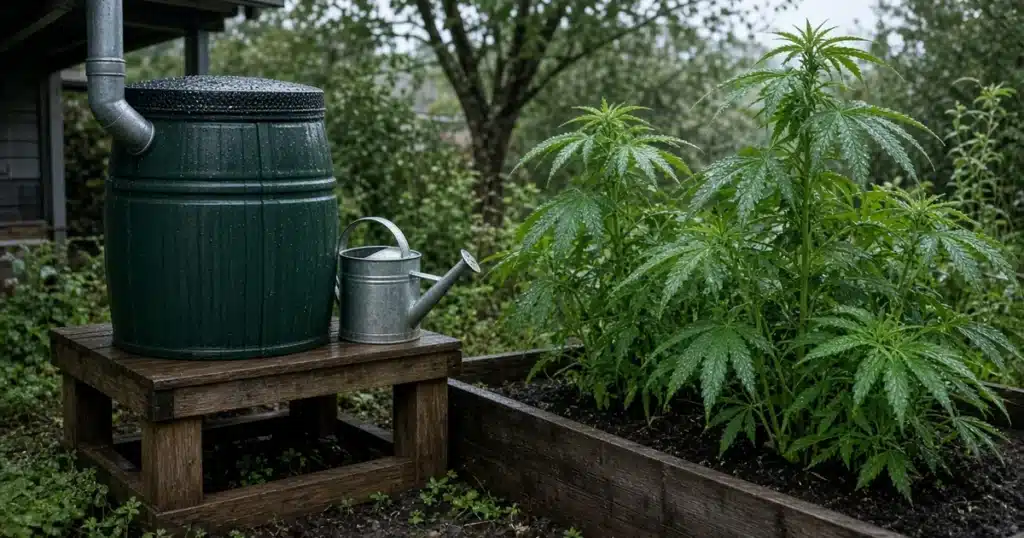
Quick answer: Rainwater for cannabis works well because it is soft and low in dissolved minerals. Collect it in a screened, covered rain barrel under a clean roof, and divert the first flush off the roof. Keep the barrel clean, and apply the water to the soil at the base of the plant rather than over the leaves or buds.
A rain barrel is one of the simplest upgrades for an outdoor or greenhouse garden. It turns the water running off your roof into a supply you can use on dry days, and it takes very little upkeep once it is set up well. This guide covers how much water a roof collects, how to set up a barrel step by step, what testing has found in rain barrel water, and how to keep the water clean through the season.
Is Rainwater Good for Cannabis Plants?
For most outdoor and greenhouse growers, yes. Rutgers Cooperative Extension describes rain barrel water as usually soft, meaning free of dissolved minerals, and slightly acidic. University of Nebraska-Lincoln Extension adds that municipal drinking water can contain sodium or other chemicals that rainwater does not carry. Every gallon you collect is also a gallon you don’t have to draw from the tap.
If you adjust pH when feeding, see how pH affects cannabis plants before you switch sources, since soft water can read differently from your tap.
Rainwater doesn’t change the basics of watering. Plants still need deep, infrequent watering rather than constant sips, and our guide to watering cannabis plants covers the rhythm. Too much water of any kind causes trouble, and our overwatering guide explains how to spot and fix it.
How Do You Set Up a Rain Barrel for a Garden?
University of Nebraska-Lincoln Extension explains that each barrel needs a cover, a screen or filter, an inlet, an outlet and an overflow outlet. A basic setup has five parts: a downspout feeding a first-flush diverter, a screened inlet on the barrel lid to keep out leaves and mosquitoes, the barrel itself, an overflow hose that sends extra water away from the house foundation, and a spigot near the bottom.
Follow these simple steps:
- Pick the downspout and the spot. Choose a downspout near where you grow, on a flat, secure surface, and think about where the overflow water will go. Check your state and local rules on collecting rainwater before you start.
- Choose a dark or opaque barrel. Light colored barrels let in sunlight, which encourages algae.
- Build a solid, raised base. University of Nebraska-Lincoln Extension notes that a 55 gallon barrel weighs over 450 lb when full. A sturdy platform gives you room for a watering can under the spigot and adds a little water pressure.
- Fit the first-flush diverter on the downspout, so the dirtiest water runs off before the barrel starts to fill.
- Fit the screened inlet and a secure lid. Covers keep out mosquitoes, leaves, debris, pets and wildlife, and a secure lid stops children from climbing in.
- Connect the overflow hose. The overflow opening should be about the same size as the downspout, and the hose should carry extra water well away from the foundation, ideally to a planted area.
- Fit the spigot near the bottom and anchor the barrel to the building or another secure object with a strap.
The EPA’s Soak Up the Rain program collects further rain barrel guides if you want more setup ideas.
Even a small roof collects more water than most people expect. The University of Nebraska-Lincoln Extension guide G2220 uses a simple formula: roof area in square feet × inches of rain × 0.623 = gallons.
| Roof area | Gallons from 1 inch of rain |
|---|---|
| 250 sq ft | about 156 |
| 500 sq ft | about 312 |
| 1,000 sq ft | about 623 |
| 1,500 sq ft | about 935 |
That is why the overflow hose matters. One good storm can fill a barrel several times over. If you need more storage, the same guide suggests linking two or more barrels, with the last one still fitted for overflow.
What Is a First-Flush Diverter?
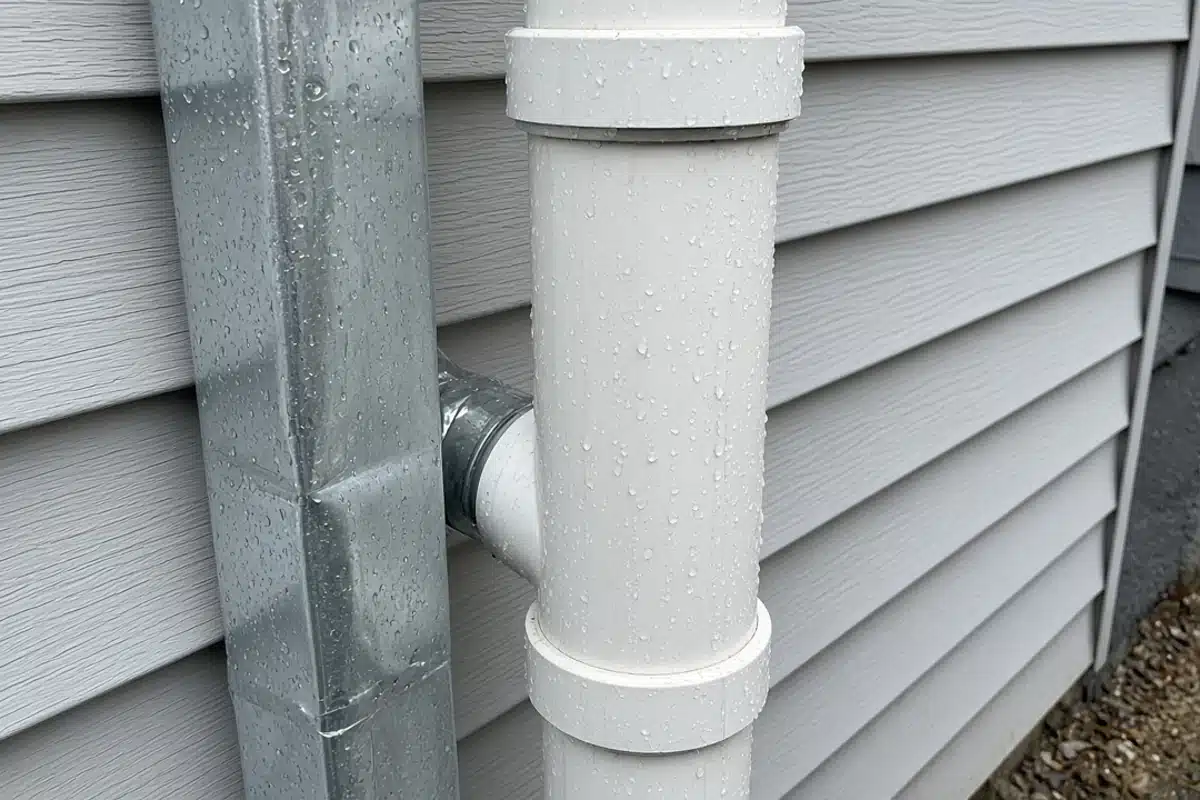
The first rain to come off a roof carries much of the dust, pollen, leaf bits and bird droppings that built up since the last storm. Rutgers Cooperative Extension notes that this first flush has been shown to carry the highest levels of contaminants, and UConn Extension explains that contaminants build up on the roof between rains. A first-flush diverter is a short pipe chamber on the downspout. It fills first and holds that early water. Once it is full, cleaner water flows on into the barrel. A small drain hole lets the chamber empty slowly so it is ready for the next rain.
Your roof itself matters too. University of Nebraska-Lincoln Extension lists chemicals in roof runoff that can come from asphalt roofing, redwood or cedar shakes, chemically preserved wood shingles, roofing materials containing asbestos, lead solder or lead based paints, and zinc from galvanized flashing, as well as moss killers. If your roof includes any of these, factor that into where and how you use the water.
What Did Testing Find in Rain Barrel Water?
Rutgers Cooperative Extension reports a New Jersey study of 12 rain barrels installed in 2011 on homes with asphalt shingle roofs. In that study, lead and zinc did not exceed federal irrigation standards in any sample, and PAHs were not detected in any sample. E. coli was above the irrigation standard in 9% of the samples collected.
Extension guidance on edible gardens differs. University of Nebraska-Lincoln Extension says rain barrel water is not recommended for watering fruit and vegetable gardens and recommends it for non-potable uses such as ornamental plants. Rutgers Cooperative Extension and UConn Extension describe applying harvested water to the soil only, keeping it off the plant itself. Across these guides, soil only watering is the common practice, and none of them is a guide to cannabis specifically.
How Do You Keep Rain Barrel Water Clean?
Start with a clean roof and a screened barrel. Keep these habits:
- Clear the gutters in spring and fall.
- Keep the lid closed and the screen intact, and clean the screen after each rain.
- Use an opaque barrel. Light inside a clear barrel encourages algae.
- Limit leaves and sediment entering the barrel, because they feed algae.
- Empty and rinse the barrel once a year, ideally in late fall before freezing weather.
- In cold areas, disconnect the barrel for winter so ice doesn’t split it.
University of Nebraska-Lincoln Extension notes that mosquitoes need 7 to 10 days of standing water to develop from egg to adult. A closed barrel with tight fittings and fine mesh over every opening keeps them out, and using the water within that window also helps. A few inches of water can remain after you empty a barrel, so keep the screens intact even when it looks dry.
How Should You Store and Apply Rainwater?
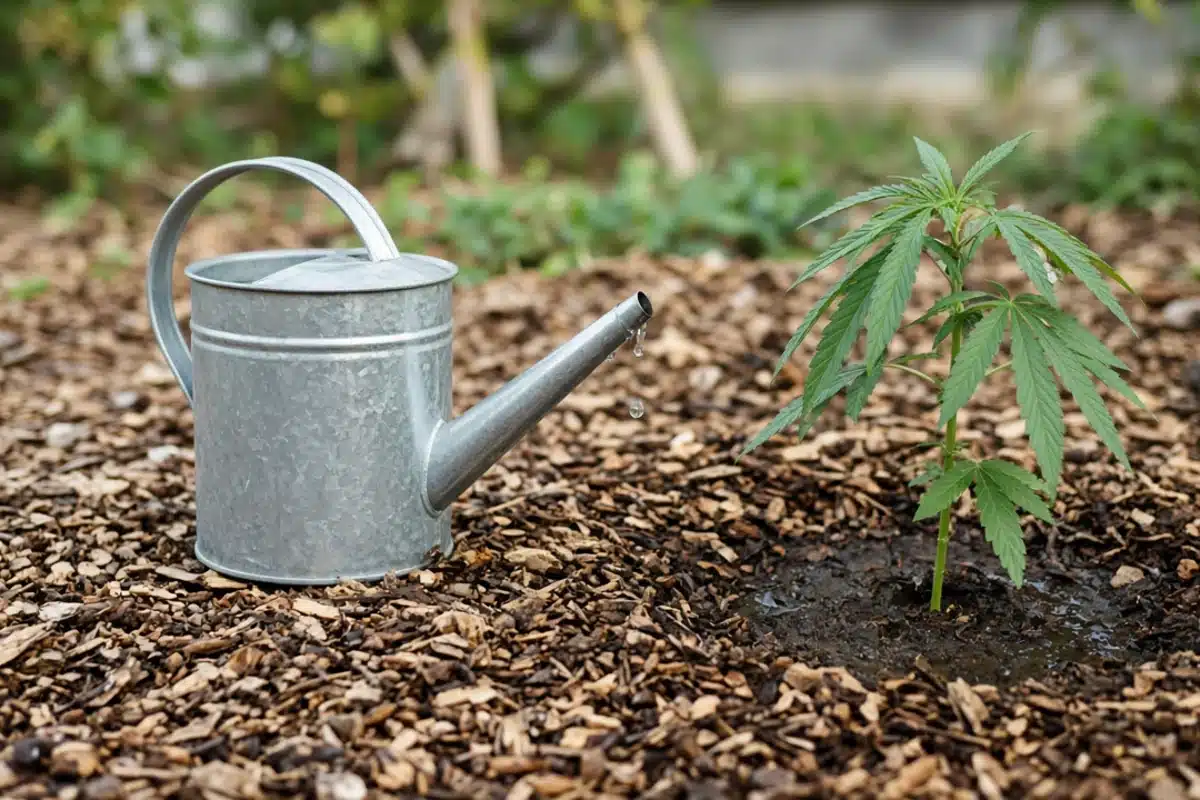
Use stored water during the growing season, and try to keep the barrel in shade if you can.
Apply it to the soil, not the plant. Pour slowly at the base of the stem and let it soak in, keeping the leaves and buds dry. That is the practice Rutgers Cooperative Extension and UConn Extension describe for harvested rainwater in gardens, and Rutgers adds that water should be applied in the morning.
A rain barrel gives low pressure compared with an outdoor tap. University of Nebraska-Lincoln Extension notes that sprinklers generally don’t work well from a barrel, while very low pressure soaker hoses may. A watering can is the simplest option, and our guide to soaker hoses for cannabis covers a slower, hands free setup.
Troubleshooting
Green or slimy water. Algae needs light and nutrients. Use an opaque barrel, keep the lid closed, clear debris from the screen and gutters, and clean the barrel at the end of the season.
Mosquito larvae in the barrel. Look for gaps in the lid, a torn screen or an unscreened overflow. Fit fine mesh over every opening and use the water within 7 to 10 days.
A bad smell. Leaves and sediment break down in standing water. Clean the screen after rain, keep debris out, and empty and rinse the barrel.
Overflow pooling near the house. Make sure the overflow opening is about the size of the downspout and run the hose well away from the foundation, to a planted area or a second barrel.
Only a trickle from the spigot. Raise the barrel on a sturdy platform and check the screen and spigot for clogs.
The barrel runs dry mid season. Add a second linked barrel or collect from another downspout so more roof area drains into storage.
Sources
- University of Nebraska-Lincoln Extension, NebGuide G2220, Rainwater Harvesting with Rain Barrels: https://extensionpubs.unl.edu/publication/g2220/na/html/view
- Rutgers Cooperative Extension (NJAES), FS1218, Rain Barrels Part IV: https://njaes.rutgers.edu/fs1218/
- UConn Extension, Can I Water Vegetables with My Rain Barrel Water?: https://extension.uconn.edu/2018/05/18/can-i-water-vegetables-with-my-rain-barrel-water/
- U.S. EPA, Soak Up the Rain: Rain Barrels: https://www.epa.gov/soakuptherain/soak-rain-rain-barrels
FAQ
Why do growers use rainwater for cannabis?
Rain barrel water is usually soft and slightly acidic, per Rutgers Cooperative Extension, and University of Nebraska-Lincoln Extension notes that it lacks the sodium that municipal water can carry. It also reduces how much tap water you use. Apply it to the soil at the base of the plant.
How much water does a roof collect per inch of rain?
About 0.623 gallons per square foot of roof for each inch of rain, per University of Nebraska-Lincoln Extension. A 1,000 sq ft roof collects about 623 gallons from a 1 inch rain, and a 500 sq ft roof about 312. That is far more than one barrel holds, so fit an overflow hose.
Do mosquitoes breed in rain barrels?
Yes, mosquitoes can breed in rain barrels if they get in. University of Nebraska-Lincoln Extension notes they need 7 to 10 days of standing water to develop. A fine mesh screen over every opening, including the overflow, keeps them out. Empty and rinse the barrel once a year.
Can you use rainwater for seedlings?
Yes. Rain barrel water is usually soft, and it lacks the sodium that municipal water can contain, per University of Nebraska-Lincoln Extension. Water gently at the soil line so small stems don't get knocked over, and keep the leaves dry.
Can you mix rainwater with nutrients?
Yes. Mix nutrients into rainwater the same way you would with any other water, following the product directions. Rutgers Cooperative Extension describes rain barrel water as soft, meaning free of dissolved minerals. Pour the mix slowly at the base of the stem and keep the leaves dry.