
Gravel in the Bottom of Pots: Why It Hurts Drainage
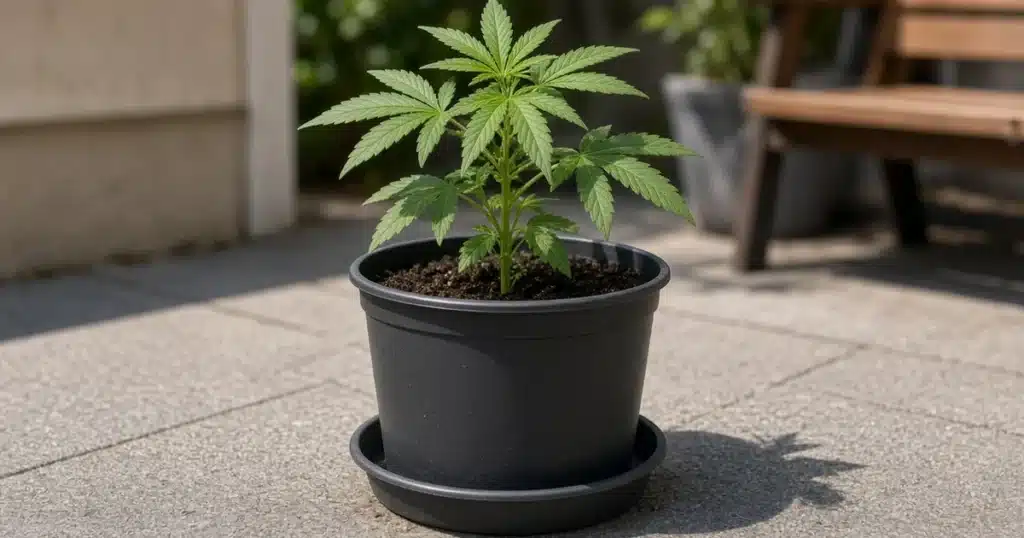
Gravel in the bottom of a pot is one of the most repeated pieces of container advice, and one of the least helpful. The idea sounds logical. Coarse stones drain fast, so a layer of them under the mix should pull water away from the roots. Extension horticulturists have been pushing back on this for years. Illinois Extension calls the gravel layer a myth, and Linda Chalker-Scott of Washington State University describes it as a myth that refuses to die. For cannabis in containers, where overwatering is already a common problem, the gravel layer can quietly make things worse.
Where the drainage layer idea comes from
Chalker-Scott notes that nearly every book or website on container gardening recommends placing coarse material at the bottom of containers. The usual materials are sand, gravel, pebbles and broken pot pieces. Other claimed benefits include keeping creatures from crawling in through the drain hole and making the container more stable.
Some of this advice is very precise. She quotes a 1960s book that called for a curved piece of broken flowerpot over the hole, a half inch to one inch of pot chips over that, and then a thin layer of coarse organic material before the soil. Advice that specific sounds scientific, and that is part of why it has lasted so long. We know roots need air, and we know water moves through coarse material faster than fine material. Put those two facts together and a gravel layer seems to make sense.
The problem is that water does not behave the way the advice assumes when two different materials meet inside a pot.
What a perched water table is
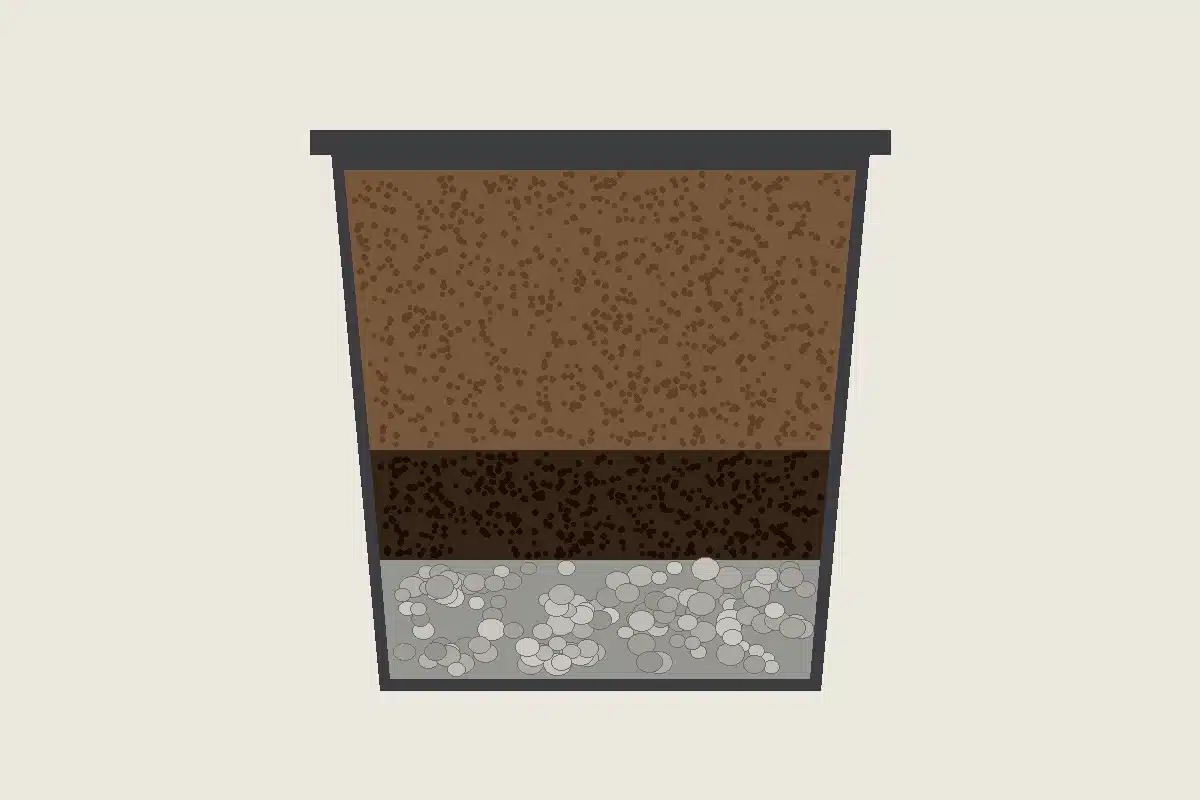
Illinois Extension explains what really happens. Instead of extra water draining straight into the gravel, the water perches, or gathers, in the soil just above the gravel. It keeps gathering there until no air space is left in that lower layer of mix. Only once all the available air space in the soil is filled does excess water finally drain into the gravel below.
That saturated layer of mix is called a perched water table. Every container has some wet zone at the bottom after watering, because gravity pulls water down and it collects where the mix ends. A gravel layer does not remove that zone. It lifts it higher in the pot, into the space where roots would otherwise grow. Illinois Extension sums it up plainly. Gravel in the bottom does little to keep the soil above it from being saturated by overwatering.
In practice, you lose root room twice. The gravel itself takes up volume that could have held mix, and the wet zone now sits on top of it. A deep pot can give up a surprising share of its usable space this way, and a shallow one can lose even more.
Why coarse layers make it worse, not better
Chalker-Scott points to soil science going back nearly 100 years. Researchers showed that water does not move easily from a layer of finer material into a layer of coarser material. Later studies found the same result. One study even found that more moisture was held in soil sitting on gravel than in soil sitting on sand.
Her conclusion follows from that. The coarser the underlying material, the harder it is for water to cross the boundary between the two layers. Gravitational water will not move from the fine mix into the coarse layer until the fine mix is saturated. She points out the irony. The stated goal of drainage material is to keep soil from getting waterlogged, yet adding it creates the very condition it was meant to prevent. Imagine what happens in a container lined with broken pot shards, she writes.
This same layering effect shows up in garden beds too. Water slows wherever one texture meets a very different one. Inside a pot the effect is concentrated, because the column of mix is short and roots have nowhere else to go.
What actually keeps container roots healthy
Chalker-Scott’s bottom line is short:
- Planting containers must have drainage holes so roots get air.
- Drainage material added to containers will only hinder water movement.
- Use the same good growing mix all the way through the pot for the best water conditions and structure.
Illinois Extension adds why the hole matters so much. A hole at the bottom lets water in the soil drain freely so enough air is available for the roots. Few plants can tolerate sitting in stagnant water. Wet soils favor root rot because they leave little space for air to reach the roots, and Illinois Extension notes that plants rarely recover from root rot.
If you are already seeing drooping, heavy pots and slow growth, overwatering cannabis and how to diagnose it goes through the warning signs one by one.
Setting up a pot that drains, step by step
- Start with a container that has a drainage hole. If it does not have one, Illinois Extension suggests finding a way to make a hole, such as drilling one.
- Skip the gravel, rocks or shards in the bottom. Fill the whole pot with one consistent growing mix from bottom to top.
- Do not worry much about soil washing out. Illinois Extension notes that very little soil falls through a small hole. Some growers lay a coffee filter over a large hole to hold mix in, though Illinois Extension says this is not necessary.
- Water until some runs out of the hole, then let the pot drain fully before setting it back on a saucer.
- Empty any water left in the saucer so the mix has a chance to dry out somewhat between waterings.
- Lift the pot before watering again. A pot that still feels heavy usually still has plenty of water low in the mix.
The weight check is a grower’s habit, not an Extension rule. It works because the bottom of the pot, where the perched water sits, is the last part to dry and the part you cannot see.
Saucers, liners and double potting
Saucers are useful, but they can cause the same waterlogging that gravel does. Illinois Extension warns against pots with permanently attached saucers that are hard or impossible to empty. The author describes basil leaves turning black because the roots were waterlogged by an attached saucer. A pot with a detachable saucer is much better, as long as you empty the extra water.
Double potting means slipping a plain plastic pot liner inside a slightly larger decorative container. Illinois Extension recommends this for pots that have no drainage hole. Check that the liner never stands in water. If water collects in the outer container, lift out the inner pot and drain the outer one.
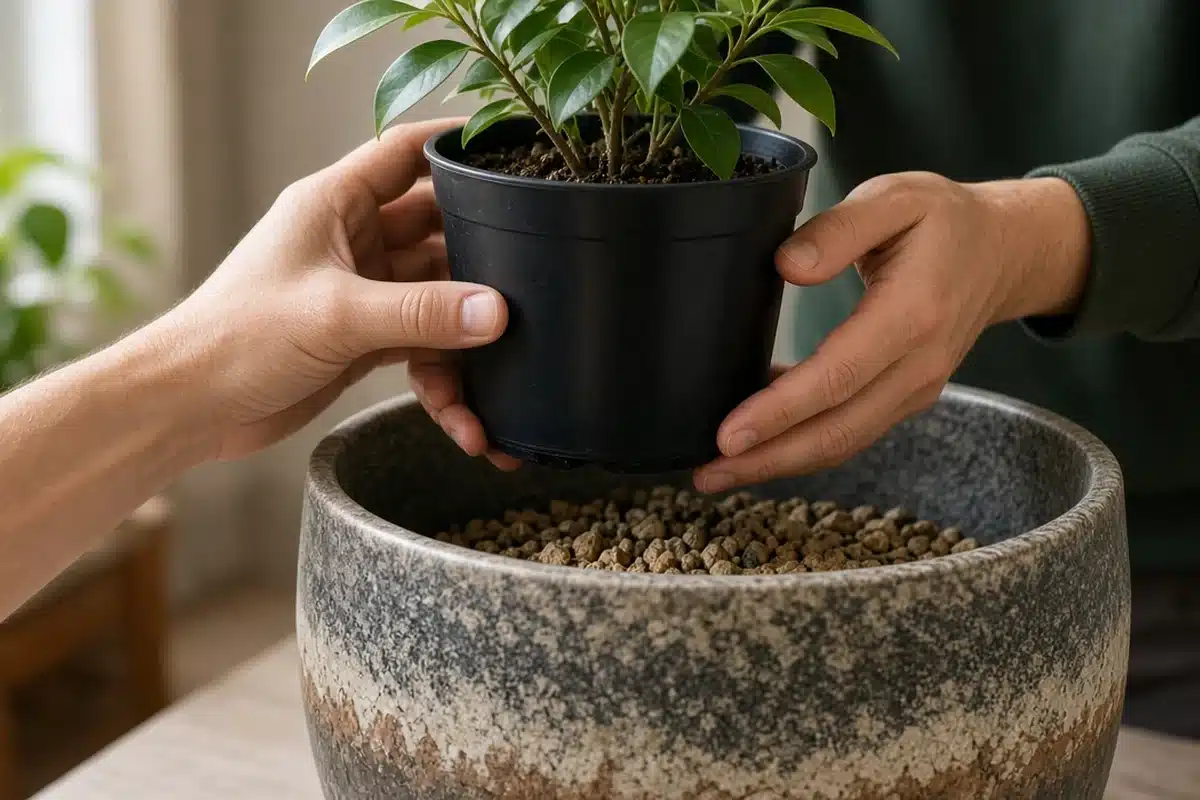
This is the one place where gravel helps. Illinois Extension suggests placing gravel in the bottom of the outer pot, if it is deep enough, so a little excess water can collect in the gravel without the roots standing in it. The key difference is that the gravel sits outside the liner, not under the mix inside it. Self-watering designs follow a similar idea of keeping a reservoir separate from the root zone, which we cover in self-watering pots for cannabis.
Gravel that belongs outside the pot
Illinois Extension notes that damp gravel placed in a saucer under the pot may raise humidity right around the plant as the water evaporates from the stones. The pot sits on top of the gravel, not in the water, so the roots stay out of it.
If a pot has no hole and you cannot make one, Illinois Extension describes a fallback. Take the plant to a sink, water it, wait a few minutes, then tip the pot on its side for a minute or two to let extra water drain out. It is more work than a pot with a hole, and it is best treated as a short-term fix.
Pot material also changes how fast the mix dries. Breathable containers lose water through their walls, which can help a grower who tends to water too often. Fabric pots are one breathable option, and the Kind Seed Co article on fabric pots for cannabis compares them.
Moving a plant out of a gravel-bottomed pot
If you already have cannabis growing over a gravel layer, you do not need to panic. Many plants grow fine in these pots when watering is careful. If the plant stays wet and slow, repotting is the cleanest fix. The steps below are general guidance for a careful transplant.
- Water lightly the day before so the root ball holds together.
- Tip the pot and slide the plant out with its root ball intact.
- Gently remove loose gravel from the bottom of the root ball. If gravel is stuck in the roots, leave it rather than tearing roots free.
- Fill the new pot partly with fresh mix, set the plant at the same depth it grew before and fill around it with the same mix.
- Water in slowly and let the pot drain fully.
Troubleshooting drainage problems
Water pools on top and drains slowly. The mix may be compacted or the hole may be blocked. Check that the hole is clear and that the pot is not sitting in a full saucer.
The pot stays heavy for days. The perched water zone is staying saturated. Water less often and check that nothing in the bottom of the pot is holding water up.
Lower leaves droop even though the mix looks dry on top. The surface can dry long before the bottom does. Check moisture deeper in the pot or lift it to judge weight before watering again.
Roots look brown and smell sour when you check them. This points to roots sitting in water for too long. Illinois Extension notes that plants rarely recover from root rot, so fix drainage early rather than waiting.
Decorative pot has no hole. Use a liner pot inside it, or drill a hole, and keep any gravel in the outer pot only.
Sources
- Illinois Extension. Container Drainage Options. https://extension.illinois.edu/container-gardens/container-drainage-options
- Washington State University Puyallup Research and Extension Center, Linda Chalker-Scott. The Myth of Drainage Material in Container Plantings. https://wpcdn.web.wsu.edu/wp-puyallup/uploads/sites/403/2015/03/container-drainage.pdf
FAQ
Should I put rocks in the bottom of my cannabis pots?
No. Illinois Extension calls the gravel layer a myth. Water does not drain straight into the rocks. It gathers in the mix just above them until that soil is saturated, which raises the wet zone into the root area. Fill the pot with one consistent mix and make sure it has a drainage hole.
What is a perched water table in a pot?
It is the layer of saturated mix that forms near the bottom of a container after watering. Water collects where the mix ends because it will not easily move into a coarser layer below. A gravel layer does not remove this wet layer. It pushes it higher into the pot, where the roots need air.
Do cannabis pots need drainage holes?
Yes. Washington State University horticulturist Linda Chalker-Scott says planting containers must have drainage holes for root aeration. Illinois Extension adds that few plants tolerate stagnant water and that wet soils favor root rot. If a pot has no hole, drill one or use it as a decorative outer pot with a liner inside.
Is it okay to leave water in the saucer?
Not for long. Illinois Extension warns that saucers you cannot empty can leave roots waterlogged, and it recommends detachable saucers that you empty after watering. Setting a pot on damp gravel in a saucer is fine, because the stones keep the pot above the water while adding a little humidity.


