
Greenhouse Benches for Cannabis: Layout, Height and Materials
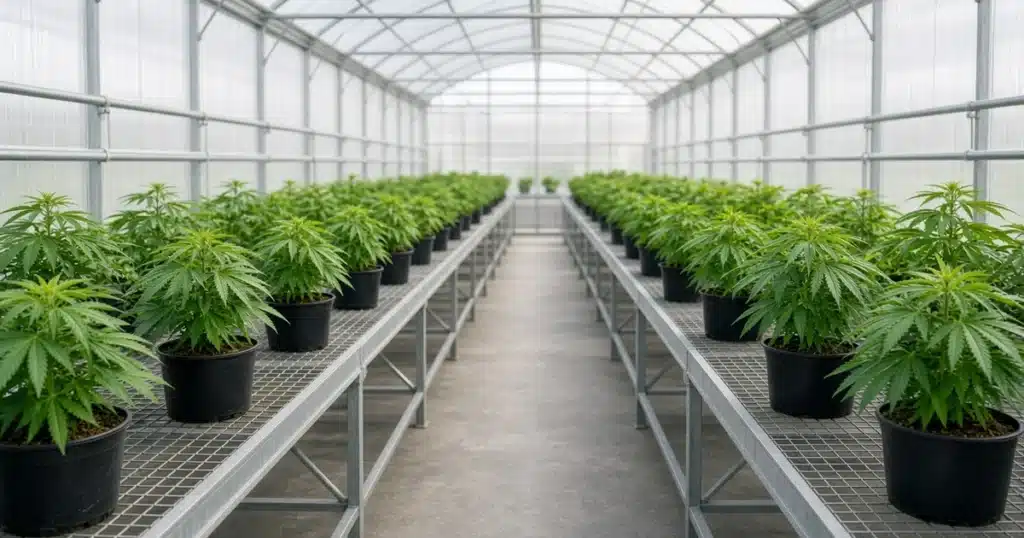
Quick answer: Greenhouse benches lift potted plants to working height, improve airflow and keep pots off wet floors. Oklahoma State Extension advises keeping benches no higher than 36 inches, keeping wall benches no wider than 36 inches and allowing freestanding benches up to six feet wide so you can reach from both sides. It also recommends an open bench top for air circulation and a frame strong enough to carry 25 pounds or more on each square foot. UMass Extension lists typical bench widths of 4 to 5 feet with side aisles of 20 to 30 inches. For cannabis in containers, sturdy open mesh benches at waist height make daily care and inspection much easier.
Why Use Benches for Cannabis in a Greenhouse?
Growing on the floor works, but it is hard on your back and harder on airflow. Benches bring plants up to a height where you can water, prune and check leaves without bending over.
UMass Extension, writing about increasing production space in greenhouses, notes that crops needing regular hands on work, such as pinching, pruning and repotting, are more convenient on benches because the plants sit at working height. Cannabis fits that description, with frequent training, defoliation and close checks for pests.
Raised benches also let air move under and around each pot. That moving air dries things out, so pots and lower leaves do not stay damp. Our green house growing basics page covers why air movement matters so much under cover.
How Wide and High Should Greenhouse Benches Be?
The Oklahoma State fact sheet on floors and benches gives clear limits. Whatever the material, benches against a wall should not exceed 36 inches high or wide, because you can reach them only from one side. Freestanding benches can run up to six feet wide since you can work from both sides, and they should also stay at or below 36 inches high.
UMass gives a slightly different range for commercial houses: typical bench widths of 4 to 5 feet, main aisles of 3 to 5 feet and side aisles of 20 to 30 inches.
The Oklahoma State hobby greenhouse guide adds a personal touch. Side benches should be no wider than your own reach, which might be two feet for one person and three feet for another. Measure your arm before you build.
Bench height also depends on how tall your plants get. A rooted clone may stand only a few inches tall, while a flowering plant in a large container can top five feet. Tall plants on a 36 inch bench can push into the roof, so many growers set benches lower, around knee to hip height, for big plants in large pots, and keep waist high benches for clones and young plants.
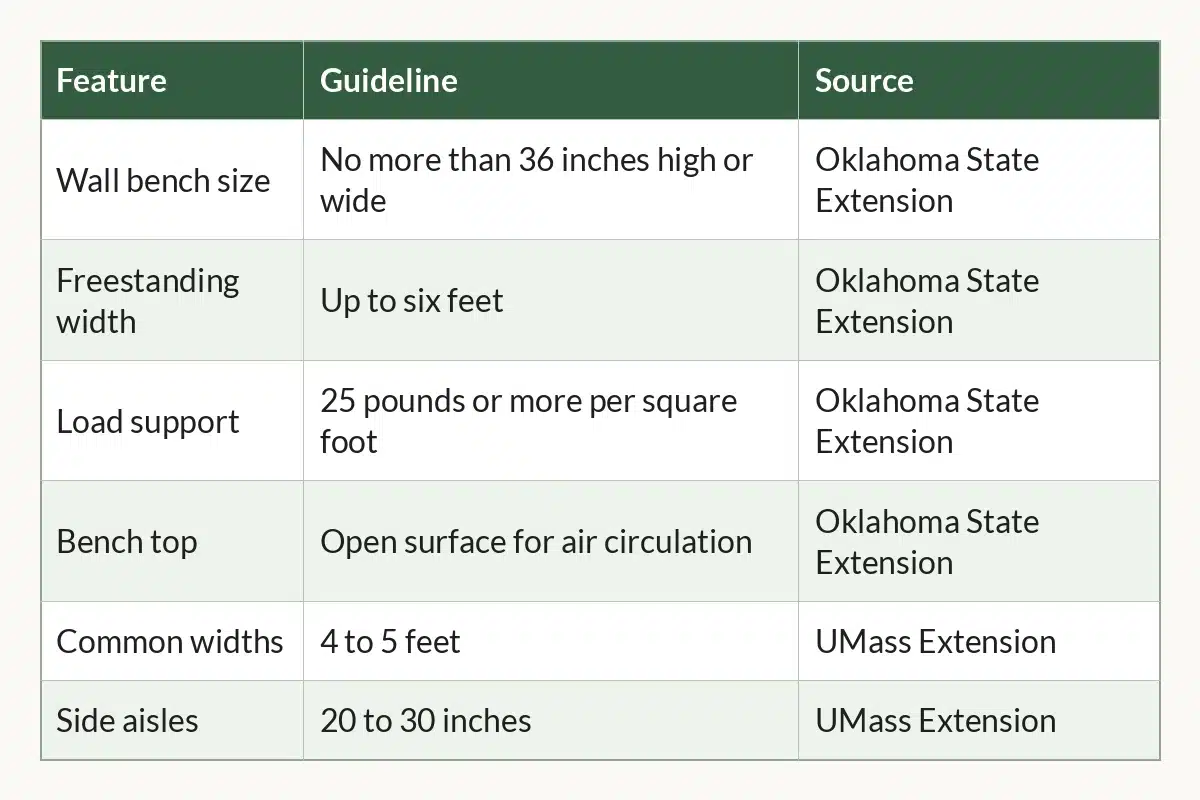
Greenhouse Benches at a Glance
| Feature | Guideline | Source |
|---|---|---|
| Wall bench size | No more than 36 inches high or wide | Oklahoma State Extension |
| Freestanding width | Up to six feet | Oklahoma State Extension |
| Load support | 25 pounds or more per square foot | Oklahoma State Extension |
| Bench top | Open surface for air circulation | Oklahoma State Extension |
| Common widths | 4 to 5 feet | UMass Extension |
| Side aisles | 20 to 30 inches | UMass Extension |
Which Bench Layout Saves the Most Space?
Your layout decides how much of the floor actually holds plants. Oklahoma State describes three main arrangements.
Longitudinal benches run the length of the house with aisles between them. Many growers find this the easiest way to water.
Peninsular benches stick out from the walls toward a central aisle, like teeth on a comb. The fact sheet says this design can give a greater growing area than a longitudinal layout and makes it easy to separate different plants. A North Carolina Extension note on peninsular benches says growers who switched reported 10 to 18 percent more room for plants.
Rolling benches sit on pipes so they slide sideways, opening a single aisle wherever you need it. Oklahoma State says rolling benches can put as much as nine tenths of the floor to work. UMass describes the same idea, with bench tops that shift 18 to 24 inches to create a work aisle.
For a hobby cannabis greenhouse, two side benches and a wide center bench, or a simple peninsular plan, usually beats rolling benches. Plants need daily attention, and Oklahoma State observes that movable benches suit crops you do not need to reach often.
What Materials Make the Best Benches?
Oklahoma State and UMass both stress that the top should be strong enough not to sag, should let water drain and should allow air through.
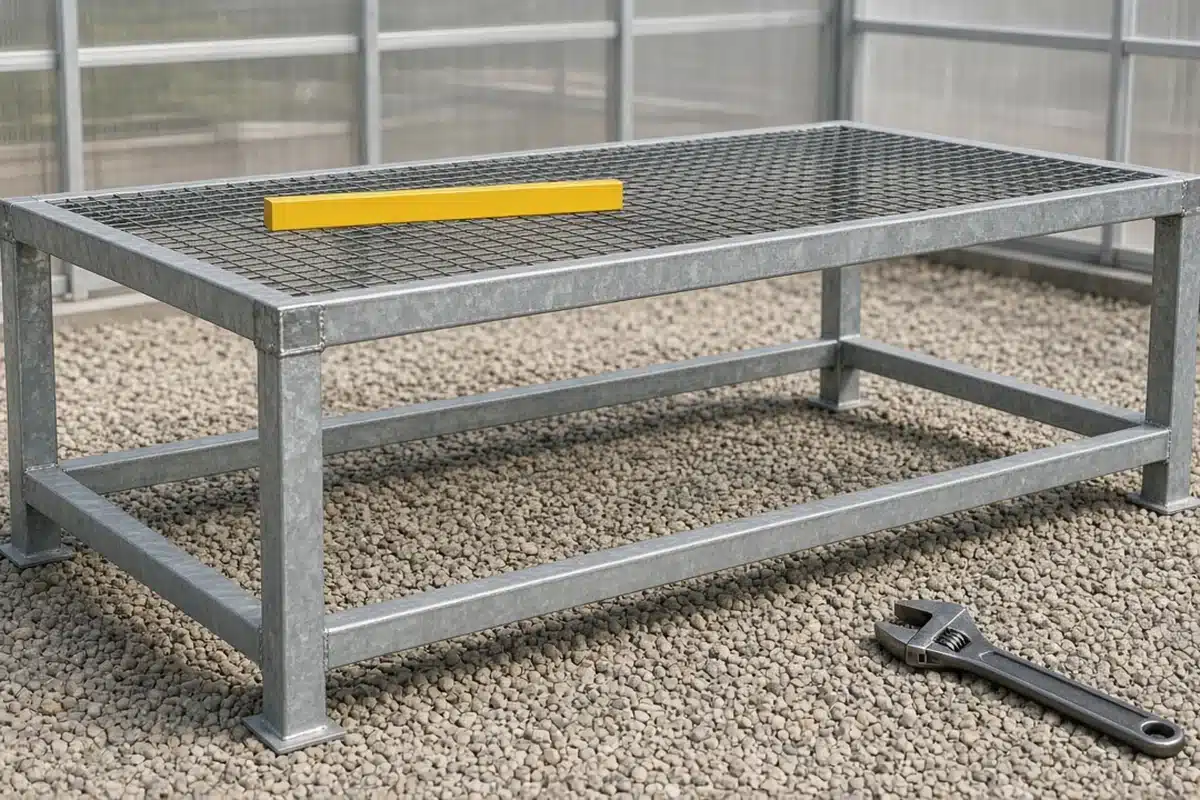
Welded wire or expanded metal tops. Oklahoma State mentions 14 gauge welded wire fabric and expanded metal, often with mesh of one inch or smaller. Expanded metal costs more but does not sag like welded wire.
Galvanized steel frames. UMass calls galvanized steel tubing the most common bench support, with a long life and easy assembly. The Oklahoma State sheet adds that metal resists rot and decay better than wood, though it costs more up front.
Wood. Cedar, redwood, locust and cypress resist decay. Oklahoma State warns that wood can warp and soaks up soil and residues that cannot be fully removed, so it needs more upkeep.
Concrete block bases. UMass lists concrete blocks with metal or wood runners as a cheaper base, with a separate top laid across.
Plastic trays. Ebb and flow trays flood from below and drain back to a tank. Oklahoma State reports that growers have cut water and fertilizer use by up to half with these systems.
How Much Weight Will a Cannabis Bench Carry?
Wet soil is heavy. A large fabric pot full of saturated potting mix can weigh far more than its dry bag suggested, and a row of them adds up fast. Oklahoma State’s guideline of 25 pounds or more on each square foot is a starting point for typical pot crops. For big cannabis containers, plan a stronger frame, add a center leg on long spans and set supports closer together.
Check the floor under each leg as well. Bench legs on soft gravel can sink unevenly over a season, which tilts the top and sends water to one end. Flat pavers or concrete blocks under the legs spread the load.
Can Benches Help With Watering?
Yes. Benches pair well with drip lines, since tubing can run along the bench edge to each pot. Our guide to drip irrigation for cannabis covers emitters and layouts.
Flood benches take it a step further and water from below. Oklahoma State observes that foliage stays dry in these systems and plants can be spaced closely. The catch is that every plant on a bench gets the same watering, so group plants with similar needs. Our article on bottom watering cannabis explains how wicking from below works in single pots.
Building Cannabis Benches Step by Step
- Measure the house. Note width, length and eave height.
- Pick a layout. Side benches plus a center bench suit most hobby houses.
- Set bench height for plant size. Lower benches for tall plants in big pots, higher ones for clones.
- Leave aisles. Plan at least 20 inches for side aisles and wider for a main path.
- Choose an open top. Wire mesh or expanded metal lets air and water through.
- Check the load. Build for 25 pounds or more on each square foot, and more for large wet pots.
- Level everything. Sagging tops tip pots and pool water.
- Run irrigation along the benches. Clip drip lines to the frame for tidy watering.
Troubleshooting Greenhouse Bench Problems
Pots tip or slide. The top is sagging. Add cross supports or switch to expanded metal.
Plants hit the roof. Benches are too high for the crop. Lower them or move tall plants to the floor.
Water pools on the bench. The top is solid or not level. Use mesh or drill drain holes.
Mold on lower leaves. Air is not moving under the plants. Space pots wider and keep the area below benches clear.
Wood benches look stained and soft. Residues and moisture are soaking in. Seal or replace the boards with metal.
Sources
- Oklahoma State University Extension, Greenhouse Floors and Benches (HLA 6703): https://extension.okstate.edu/fact-sheets/print-publications/hla/greenhouse-floors-and-benches-hla-6703.pdf
- UMass Extension, Increasing Production Space in Greenhouses: https://www.umass.edu/agriculture-food-environment/greenhouse-floriculture/fact-sheets/increasing-production-space-in-greenhouses
- Oklahoma State University Extension, The Hobby Greenhouse: https://extension.okstate.edu/fact-sheets/the-hobby-greenhouse-2.html
- NC State Extension, Peninsular Benches: https://hortscans.ces.ncsu.edu/uploads/p/e/peninsul_53a0a99fb9e93.pdf
FAQ
How tall should greenhouse benches be?
Oklahoma State suggests no more than 36 inches, though lower benches suit tall cannabis.
Are wire mesh benches good for cannabis?
Yes. With an open top, air circulates and water drains away from the pots.
How wide should a center bench be?
Freestanding benches can be up to six feet wide if you can reach from both sides.
Does wood work for greenhouse benches?
Yes, but it warps and holds residues, so it needs more care than metal.
Do rolling benches make sense for a hobby grower?
Rarely. They suit crops you seldom touch, while cannabis needs daily attention.


