
Greenhouse Coverings: Poly Film vs Polycarbonate
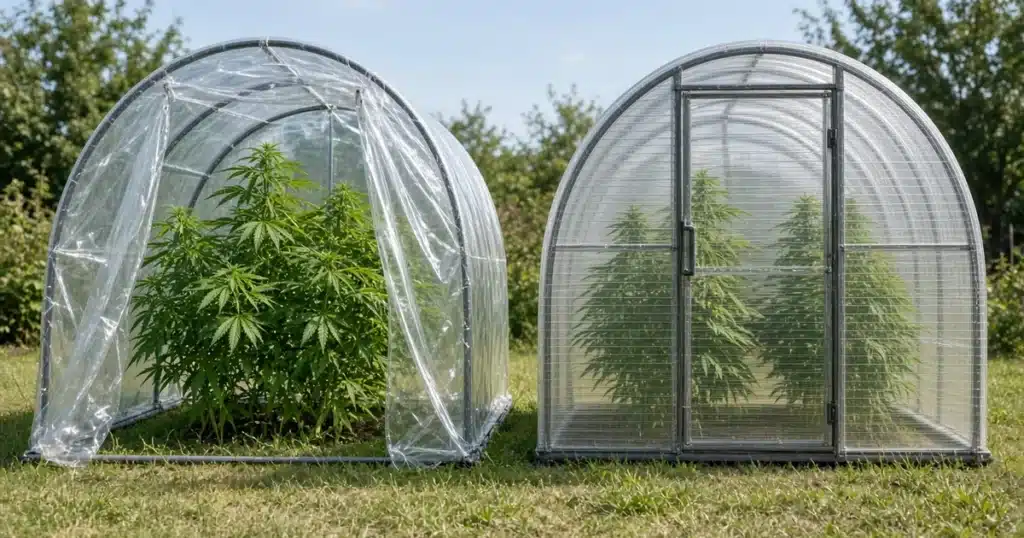
Quick answer: Poly film is cheap, light and easy to install, but it lasts only a few years. Polycarbonate panels cost more up front, resist sunlight damage and often last 20 years or longer. University of Arkansas greenhouse course material lists single layer poly film at 85 to 87 percent light transmission and twin wall polycarbonate at about 83 percent. UMass Extension notes that greenhouse grade film carries a warranty of four years or more and that film additives can reduce drips and nighttime heat loss. For a seasonal cannabis hoop, film usually wins on cost. For a permanent house in a cold or windy area, polycarbonate often pays off.
What Does a Greenhouse Covering Do for Cannabis?
The covering, often called glazing, decides how much sunlight reaches your plants, how much heat stays in at night and how well the house handles wind and hail. Virginia Tech Extension lists light transmission, strength, weight, cost, heat loss, upkeep and lifespan among the main factors to weigh when choosing one.
Cannabis is a sun loving plant, so light matters most. Virginia Tech points out that in northern areas and in winter, light often limits growth, so a covering that lets more through is worth having. In summer or in southern areas, the opposite can happen, and growers add shade.
The benefits of growing marijuana in a greenhouse page explains why controlling the growing environment helps, and the covering is the first layer of that control.
How Does Poly Film Perform?
Polyethylene film covers more greenhouses than any other material. The UMass Extension update on plastic greenhouse film credits its low cost, big sheet size, easy attachment and good light transmission.
Arkansas course material on greenhouse glazing materials gives single layer film a light transmission of 85 to 87 percent and double layer film 74 to 77 percent. Film bends easily, which makes it a natural match for curved hoop frames.
Lifespan is where film falls short. Arkansas says film with no additives lasts only two to three years, since sunlight breaks it down. Film made with sunlight resistant additives can last three to five years.
UMass describes two grades. Co poly is a low cost film good for one season, suitable for seasonal houses and high tunnels. Greenhouse grade poly carries a warranty of four years or more, costs about twice as much and contains a stabilizer that slows breakdown. UMass advises against construction grade plastic, which is weaker.
Thickness plays a part too. UMass notes that greenhouse grade film comes only in 6 mil. Arkansas adds that double layer setups usually pair 6 mil outside with 4 mil inside, with a little blower pushing air between the layers to form an insulating cushion.
How Does Polycarbonate Perform?
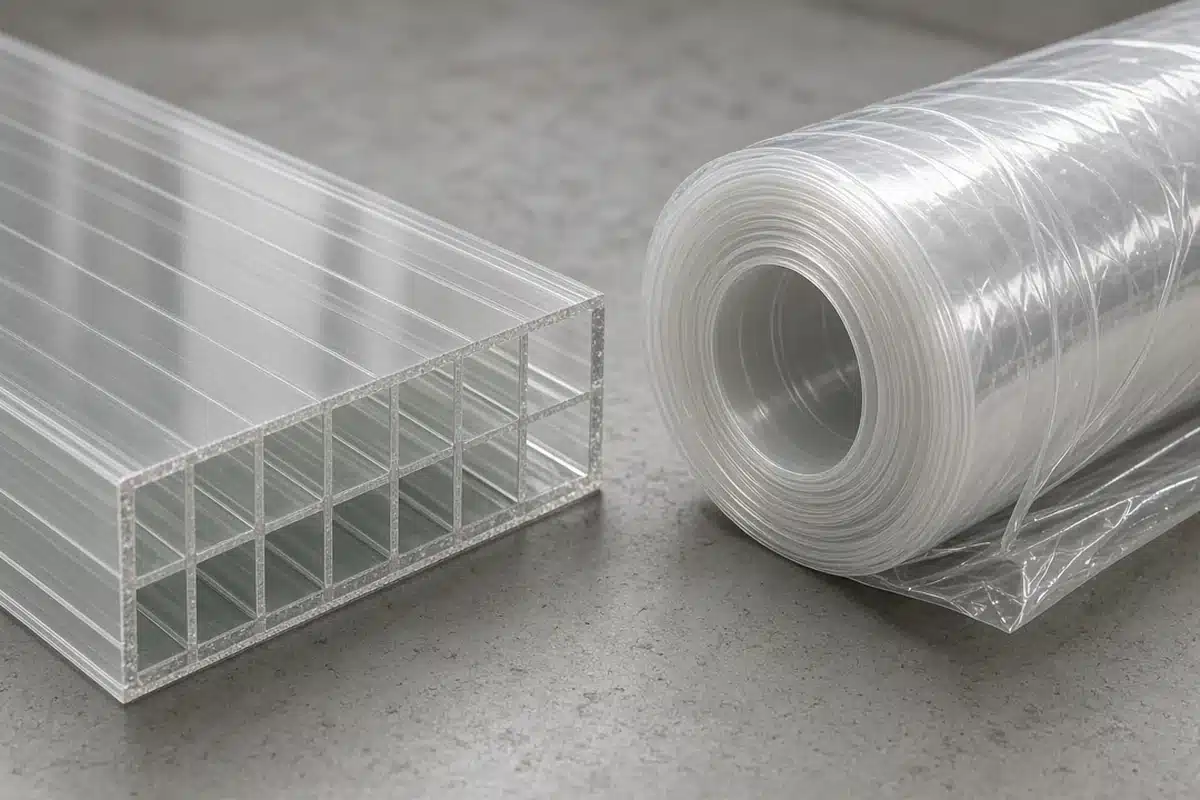
Polycarbonate comes as single wall corrugated sheets or as twin wall and triple wall panels with hollow channels. Arkansas lists single wall panels at about 94 percent light transmission and twin wall panels at about 83 percent.
Arkansas describes polycarbonate as strong, rigid and light. The panels resist sunlight damage, keep their clarity for around 10 years and typically last 20 to 25 years in twin wall form. They scratch easily but are far less likely to catch fire than acrylic or fiberglass panels.
One quirk is movement. Polycarbonate expands and shrinks a lot with temperature, so Arkansas notes it needs special anchors on the frame. Leave room for that movement when you build.
The hollow channels in twin wall panels hold still air, which slows heat loss at night. If you run a cannabis greenhouse into late fall or early spring, that insulation can lower heating costs.
Poly Film vs Polycarbonate at a Glance
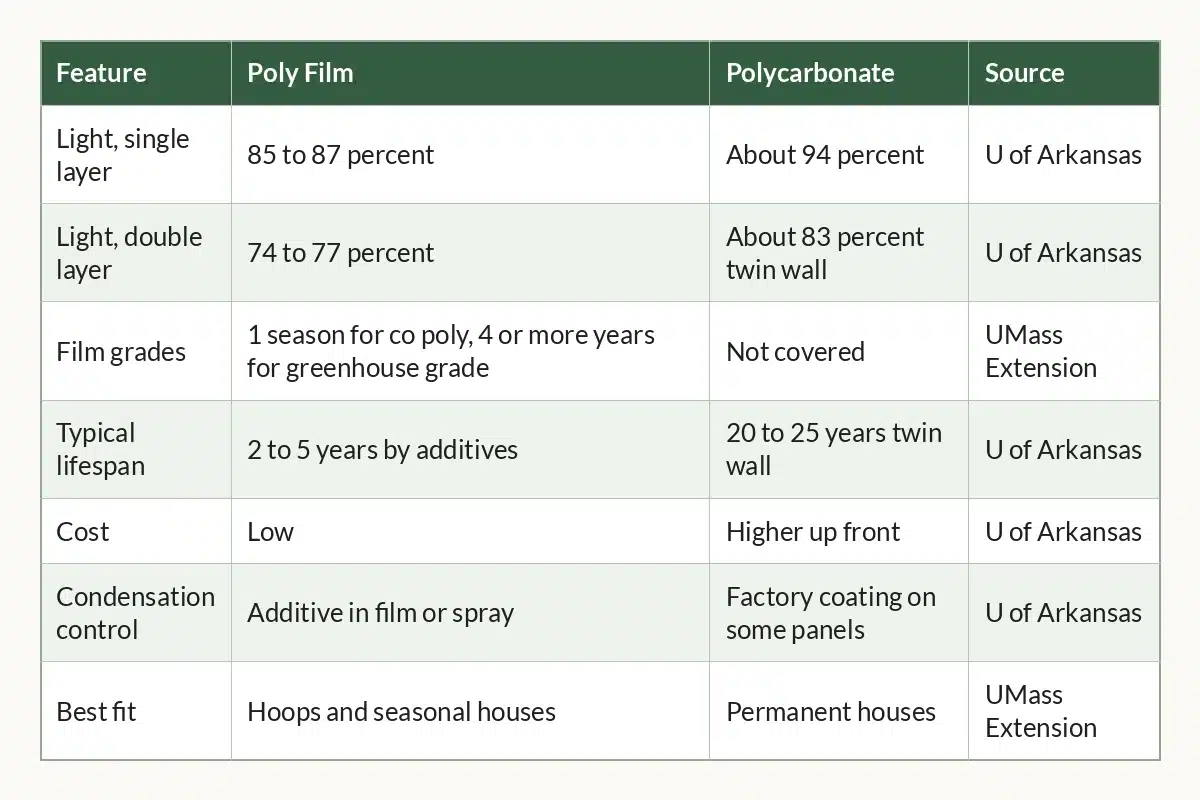
| Feature | Poly Film | Polycarbonate | Source |
|---|---|---|---|
| Light, single layer | 85 to 87 percent | About 94 percent | U of Arkansas |
| Light, double layer | 74 to 77 percent | About 83 percent twin wall | U of Arkansas |
| Film grades | 1 season for co poly, 4 or more years for greenhouse grade | Not covered | UMass Extension |
| Typical lifespan | 2 to 5 years by additives | 20 to 25 years twin wall | U of Arkansas |
| Cost | Low | Higher up front | U of Arkansas |
| Condensation control | Additive in film or spray | Factory coating on some panels | U of Arkansas |
| Best fit | Hoops and seasonal houses | Permanent houses | UMass Extension |
Which Covering Handles Condensation Better?
Drips from the roof are a real concern for cannabis, since water landing on dense flowers invites mold. Arkansas explains that plain poly film sheds water poorly. Moisture beads on the inner surface until heavy drops form and fall on the plants below, which can raise disease problems.
UMass describes an anti drip additive that lets condensation flow down the film in a sheet instead of forming drops. It can be sprayed on or built into the film and usually lasts a couple of years. UMass adds that droplets also cut light transmission.
Arkansas notes that polycarbonate panels can come with a factory coating that reduces condensation as well. Whichever covering you choose, ask for anti drip properties.
What Film Additives Help Cannabis Growers?
UMass lists several options worth knowing:
- Infrared film traps radiant heat inside at night. UMass reports savings of 10 to 20 percent in heated houses, and places it as the inner layer in double poly.
- Heat blocking film reflects part of the near infrared light, which plants do not use, and can lower inside temperature by up to 10 degrees F in strong sun.
- Diffusing film scatters light so more reaches lower leaves and less scorching occurs, especially in tall crops.
- UV blocking film reduces whiteflies, thrips and aphids, according to UMass.
UV blocking is a trade off for cannabis growers who value natural sunlight. Our guide to UV light for cannabis covers what UV does for the plant, which can help you decide.
How Do Coverings Lose Light Over Time?
Virginia Tech explains that coverings let through less light as they age, from scratches, dust and yellowing caused by sunlight. The listed transmission values apply to new, clean panels only.
Light at the plants can also run well below the panel rating once the frame, sun angle and dirt are counted. Virginia Tech cites one double poly house where only 45 percent of outside light reached the crop canopy.
UMass offers a useful rule of thumb: in winter or cloudy weather, each one percent gain in light gives about one percent more growth. That is why some growers replace film more often than strictly needed. Keep any covering clean, and read our page on understanding sunlight with your cannabis plants to plan around seasonal light.
Can You Mix Coverings on One Greenhouse?
Plenty of hobby growers mix materials. A common setup uses polycarbonate on the end walls, where doors and vents attach, and poly film over the curved roof. The rigid ends give a solid place to mount hardware, while the film keeps cost down on the largest surface.
Another approach adds a film liner inside a single wall panel house for winter, then removes it in spring. You get extra insulation in the cold months without losing light in summer. Just make sure both materials have room to shed condensation without dripping onto plants.
How to Choose a Greenhouse Covering for Cannabis
- Decide how long the house will stand. One season favors co poly. Many years favors greenhouse grade film or panels.
- Look at your climate. Cold nights favor double layers or twin wall panels for insulation.
- Consider wind and hail. Rigid panels resist damage better than film.
- Match the frame. Curved hoops suit film, while flat walls suit panels.
- Ask for anti drip. Condensation control protects dense flowers.
- Plan for upkeep. Budget for film replacement every few years, or panel cleaning.
- Allow for expansion. Use proper anchors and gaps for polycarbonate.
- Avoid construction plastic. It lacks the strength and stabilizers of greenhouse grade film.
Troubleshooting Greenhouse Covering Problems
Water drips on plants. The covering lacks anti drip properties. Add a spray coating or replace with anti drip film.
Film turns cloudy and brittle. Sunlight has broken it down. Replace with greenhouse grade film.
Panels buckle in summer. Anchors are too tight. Refit with room for expansion.
Heating bills are high. A single layer loses heat quickly. Add a second layer or infrared film.
Light seems weak. Dust or scratches block it. Wash the covering and replace old film.
Sources
- University of Arkansas, Greenhouse Management: Glazing Materials: https://greenhouse.hosted.uark.edu/Unit03/Section02.html
- UMass Extension, Plastic Greenhouse Film Update: https://www.umass.edu/agriculture-food-environment/greenhouse-floriculture/fact-sheets/plastic-greenhouse-film-update
- Virginia Tech Extension, Controlled Environment Agriculture Coverings and Glazing Materials (SPES 821): https://www.pubs.ext.vt.edu/content/dam/pubs_ext_vt_edu/spes/spes-821/SPES-821.pdf
FAQ
Is polycarbonate better than film for cannabis?
Polycarbonate lasts longer and insulates better, while film costs less and suits seasonal houses.
How long does greenhouse film last?
Co poly lasts about one season, while greenhouse grade film is warranted four years or more.
Does twin wall polycarbonate block too much light?
Arkansas lists it near 83 percent, close to double layer film.
Why does my greenhouse drip?
Moisture condenses on the covering, and plain film lets it form drops.
Can I use plastic sheeting from a hardware store?
UMass advises against construction grade plastic because it is weaker.


