Grow Tent Condensation: Why Walls Drip at Lights Off
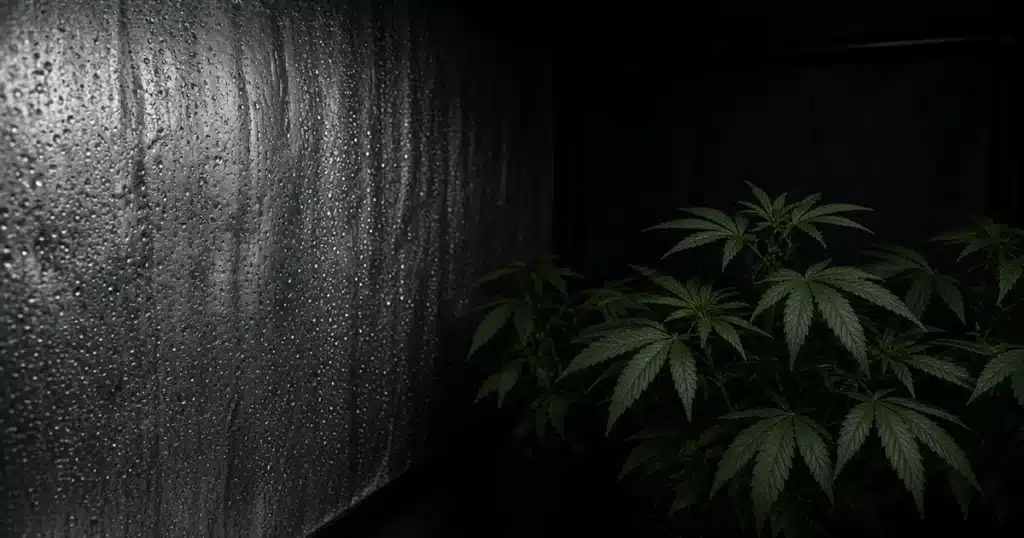
Quick answer: Tent walls drip at lights off because the air inside cools quickly while it still holds the moisture your plants gave off during the day. When that air cools to its dew point, water condenses first on whatever surface is coldest, usually the tent walls and then the leaves. The fix comes down to four levers: lower the humidity before lights off, keep air moving, ventilate moist air out and keep the temperature from dropping too fast. UMass and UConn Extension greenhouse guides explain the same mechanism, and a grow tent behaves like a very small greenhouse in this respect.
Why Does Grow Tent Condensation Form at Lights Off?
Condensation forms at lights off because the air cools quickly while the moisture stays, so the coldest surfaces fall below the dew point. During the light period, the tent is warm and the plants are busy giving off water. UConn notes that bright conditions raise transpiration from leaves and evaporation from wet surfaces, and grow lights drive that process indoors just as the sun does in a greenhouse. The UConn Extension guide to reducing greenhouse humidity explains that warm air holds that moisture as vapor. At night, as the air cools to its dew point, droplets form on cooler surfaces such as leaves and glazing.
A grow tent goes through the same cycle on a tighter schedule. The lights switch off, the heat source disappears and the air temperature falls within minutes. The moisture is still there, but the cooler air can no longer hold all of it.
The UMass Extension guidance for reducing greenhouse humidity explains that condensation forms on surfaces at or below the dew point, and that the coldest surfaces collect it first. In a greenhouse, it lists piping, door knobs and the roof before the plants. In a tent, the thin fabric walls touching cooler room air are usually the first surfaces to drip.
How Much Does Temperature Change Humidity?
A lot. Both guides give the same rule of thumb for greenhouses. UMass explains that air at 70°F holds about twice the moisture of air at 50°F, and that within normal greenhouse temperatures every 20°F rise doubles the air’s capacity for water and cuts relative humidity in half. The reverse is also true. A falling temperature pushes relative humidity up fast, even when no water is added.
UMass puts numbers on it with a greenhouse example. At 85 percent relative humidity and 60°F, condensation forms on leaves cooler than 55°F. At 95 percent and 60°F, a leaf only one degree cooler than the air will get wet. Those numbers come from greenhouse conditions, not from tent testing, but they show how little room there is once humidity is high.
Our VPD chart for cannabis shows how temperature and humidity combine, and why a small night drop can push a tent toward saturation.
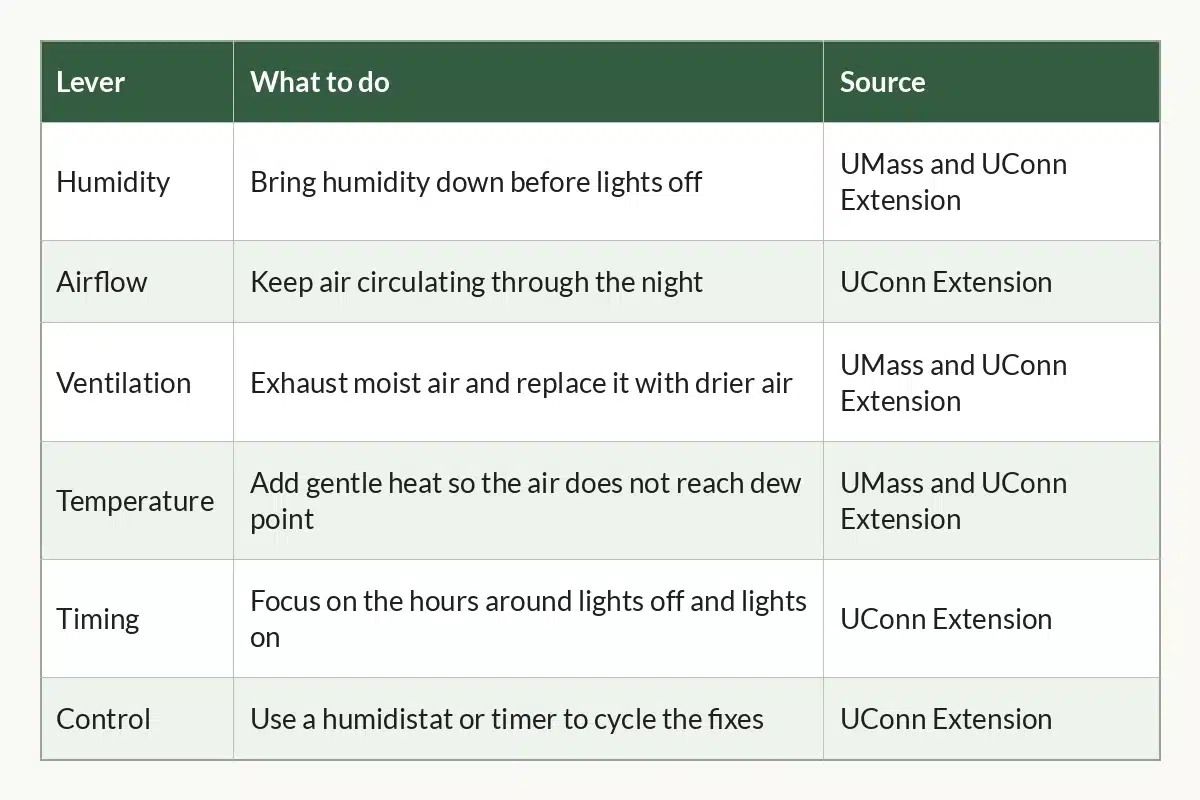
Grow Tent Condensation Fixes at a Glance
| Lever | What to do | Source |
|---|---|---|
| Humidity | Bring humidity down before lights off | UMass and UConn Extension |
| Airflow | Keep air circulating through the night | UConn Extension |
| Ventilation | Exhaust moist air and replace it with drier air | UMass and UConn Extension |
| Temperature | Add gentle heat so the air does not reach dew point | UMass and UConn Extension |
| Timing | Focus on the hours around lights off and lights on | UConn Extension |
| Control | Use a humidistat or timer to cycle the fixes | UConn Extension |
Why Does Condensation Matter for Plants?
Wet leaves give fungi an opening. UConn explains that the moisture from nighttime condensation helps fungal spores such as gray mold and powdery mildew get started. UMass names the same diseases and says the goal is to keep the canopy dry from dusk to dawn.
Walls that drip also drip onto something. A single damp night may do little harm, but the same pattern repeated through weeks of flowering gives fungi many chances to take hold in dense buds. Water running down the fabric collects at the tent floor and adds more moisture to the air. Drops falling from the roof of the tent can land directly on the canopy.
Dense plants add to the problem. UConn reports that in dense greenhouse canopies, relative humidity can run 20 to 40 percent above the air higher up, because the air stratifies into layers. The leaves inside a thick canopy may stay wet even when the walls look dry.
How Do You Stop Grow Tent Condensation?
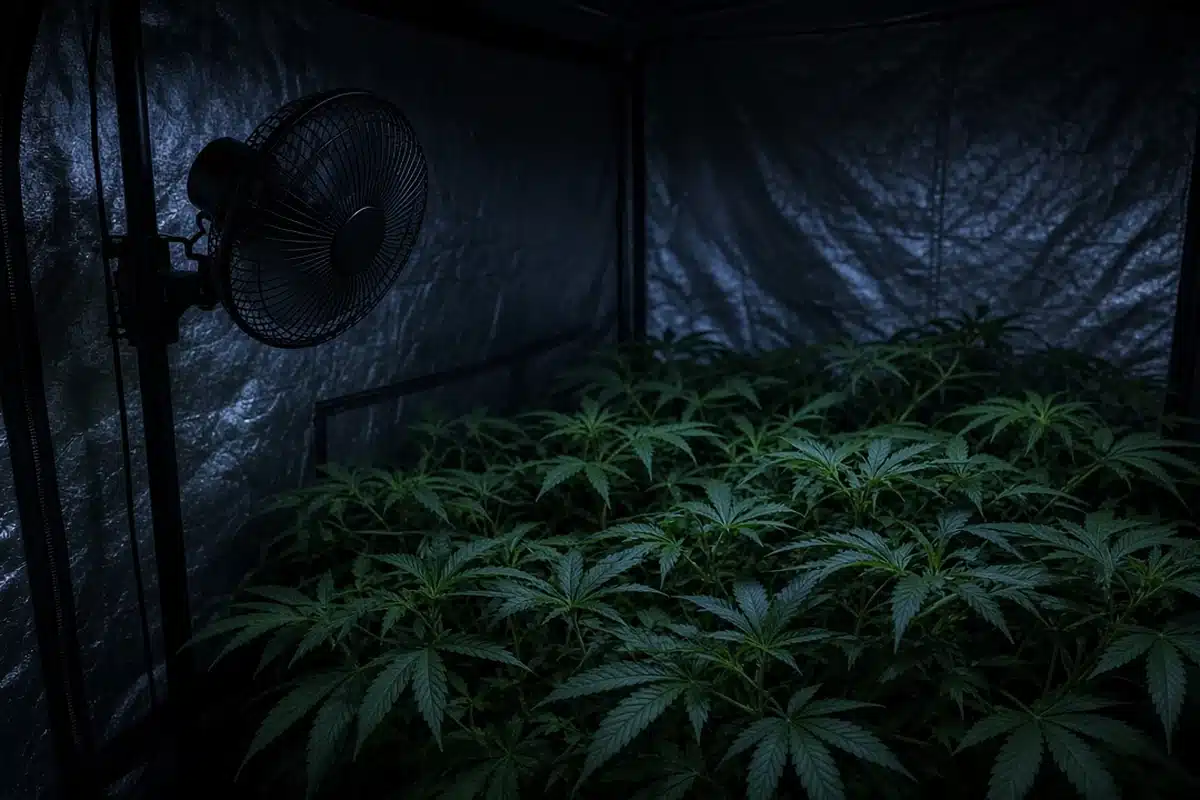
Work the four levers together. Each one alone helps a little. Combined, they keep the air above its dew point through the night.
Humidity, airflow, ventilation and temperature are the controls both Extension sheets describe, and they are the ones a tent grower can adjust with ordinary equipment. Start with whichever lever is easiest in your setup and add the next one later. Watch the walls for a few nights after each change, since the pattern of drips tells you whether the air still reaches its dew point and at what hour.
- Lower humidity before lights off. Bring the tent down toward the lower end of your range in the last hour or two of the light period, so there is less moisture to condense when the air cools.
- Keep air moving all night. UConn says continuous air circulation reduces stratification and keeps leaf temperature higher. Our guide to using an oscillating fan in a tent covers placement.
- Ventilate moist air out. UConn calls exhausting humid air and replacing it with cooler, drier air one of the most effective methods.
- Add gentle heat after venting. UConn advises running fans for a few minutes and then heating the new air. UMass says venting and heating together is the most effective way to lower humidity.
- Target the critical hours. UConn says greenhouse growers usually cycle venting and heating a few times an hour after sunset and again at sunrise. In a tent, the matching windows are the first hour after lights off and the hour before lights on.
- Automate it. UConn notes that cycling with a time clock or humidistat is more efficient than leaving vents open all night.
- Avoid a sharp temperature drop. The smaller the gap between day and night temperatures, the less the relative humidity jumps at lights off.
Why Is Ventilating Before Heating Effective?
Because cooler outside air becomes drier once it warms. UConn explains that when humid inside air is exhausted and replaced with cool, dry air, that new air absorbs more moisture as it warms, which lowers the humidity. UMass agrees and says the combination of ventilation and heating is the best approach.
In a tent, the outside air is the room air around it. A tent is a small greenhouse in this sense: an enclosed space with its own humid microclimate sitting inside a larger, usually drier one. If that room is cooler and drier than the tent, a short burst of exhaust at lights off swaps damp air for drier air. A small heater or the remaining warmth of the room then lifts the temperature so the new air stays above its dew point.
If the room itself is humid, ventilation cannot help as much. Then the humidity lever matters most, and a grow room dehumidifier does the heavy lifting. Our day and night climate targets page lists the numbers to target.
Troubleshooting Grow Tent Condensation
Walls drip within minutes of lights off. The temperature is dropping fast while humidity is high. Lower humidity before lights off and add gentle heat.
Leaves are wet but walls are dry. Humidity is trapped inside a dense canopy. UConn describes humid air layering inside thick greenhouse foliage. Improve circulation through the plants.
Condensation appears near lights on instead. The tent may be coldest just before sunrise. UConn recommends cycling venting and heating early in the morning too.
Ventilation makes it worse. The room air may be just as humid as the tent. Lower humidity in the room before relying on exhaust.
The humidistat never turns the fan on. Check the sensor and its setting. UConn says humidistat accuracy depends on good sensor maintenance.
Sources
- UMass Extension, Reducing Humidity in the Greenhouse: https://www.umass.edu/agriculture-food-environment/greenhouse-floriculture/fact-sheets/reducing-humidity-in-greenhouse
- UConn Extension, Reduce Greenhouse Humidity: https://ipm.cahnr.uconn.edu/reduce-greenhouse-humidity/
FAQ
Is grow tent condensation normal?
It is common, but it is a sign the air reached its dew point. UMass explains that the coldest surfaces in the space collect water first.
Will an oscillating fan stop tent condensation?
It helps. UConn says continuous air circulation reduces stratification and keeps leaves warmer. Pair it with humidity and temperature control.
Should I run the exhaust fan at lights off?
A short burst often helps if the room air is drier than the tent. UConn calls venting humid air one of the most effective methods.
Why does my tent drip when the lights turn off?
The air cools fast while still holding the day's moisture. Cooler air holds less water, so the extra condenses on walls and leaves.
Is condensation a mold risk?
Yes. UConn and UMass both link nighttime condensation to gray mold and powdery mildew.