Under Canopy Lighting for Cannabis: Is It Worth It?
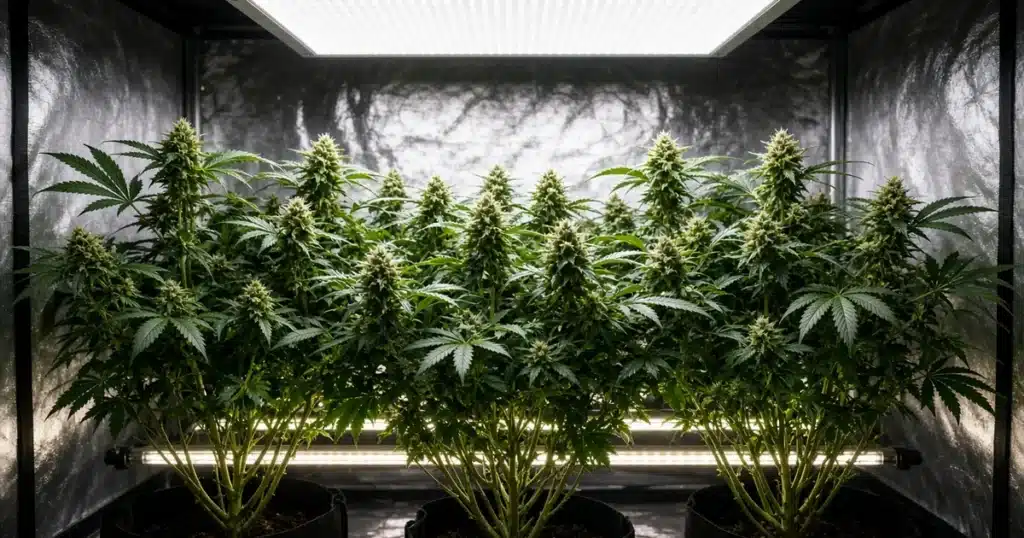
Quick answer: Under canopy lighting adds slim light bars below or beside the plant tops, so lower bud sites get light that the main fixture cannot reach. Oklahoma State University Extension describes LED inter lights that give plants light from the side as well as from above. A Purdue University study in Indiana found that LED towers placed inside a greenhouse tomato crop matched the fruit yield of overhead lamps while using far less lighting energy. For a home grower, extra bars make the most sense in tall, dense plants where the lower canopy stays shaded. In a short, flat canopy, they add cost and heat without much to light.
What Is Under Canopy Lighting?
Under canopy lighting is any light source mounted below the plant tops instead of above them. Most setups use thin LED bars fixed low on the tent frame and aimed up or sideways into the lower branches. The main fixture still does most of the work, and the bars just fill the shaded zone that overhead light struggles to reach.
The LED grow light fact sheet from Oklahoma State University Extension sorts LED devices into types. Toplights hang above the crop. Inter lights sit among the plants, so leaves receive light both horizontally and vertically. The fact sheet lists inter lights for crops that grow upward, such as tomatoes and cucumbers, and it names grow rooms and growth chambers among the indoor spaces where these module systems are used.
The same idea goes by a few names. Subcanopy lighting usually means bars under the canopy pointing up. Inter canopy or intracanopy lighting usually means bars placed among the branches at one or more heights, pointing inward. Side lighting is a looser term for bars mounted on the tent walls.
LEDs are a good fit here because of the way they shed heat. Oklahoma State explains that an LED moves heat out through a heat sink instead of from the light surface, which allows the fixture to sit close to plants. An older lamp that runs hot at the face would be hard to fit inside a canopy at all.
Why Do Lower Buds Get Less Light?
Leaves block light. Every layer of foliage soaks up part of the light that lands on it and passes less to the layer below. By the time it reaches the lowest branches, much of that light has already been used up.
Garrido and colleagues describe the problem in their 2025 indoor cannabis study from Spain, published in the journal Plants. They note that lighting from above only causes shading and leaves strong gradients in light between the upper and lower canopy. Their own measurements showed a clear drop in the light reaching deeper parts of the plants when top light was used alone.
That shading is one reason lower branches often finish with small, airy buds. Our post explaining why popcorn buds form walks through the other causes, including plant shape and spacing. Training and pruning shape the plant so more of it sits near the top. Under canopy lighting takes the opposite route and brings the light down to the buds that stay low.
Plant height plays a part as well. A short plant with a flat top has little lower canopy to shade. A tall plant with stacked branches has a deep zone in the middle and at the base where the main light rarely reaches.
What Did Research Find on Cannabis?
One indoor study found that added lower canopy light spread light more evenly and raised dried flower yield, at a higher lighting energy cost. The Garrido study compared three setups in an indoor grow room. One used top lighting only. A second added subcanopy bars mounted along each row and aimed upward. A third added inter canopy units at two heights on each side of the rows, aimed inward at the middle and lower canopy. The added lights were switched on in the fourth week after planting, and the inter canopy units were raised as the plants grew.
Both added setups spread light more evenly through the plants. In that study, dried flower yield came out about 25 percent higher with subcanopy bars and about 30 percent higher with inter canopy units than with top light alone. The flowers also varied less from plant to plant in both added setups.
The extra light came at a cost. Lighting energy rose by about 13 percent with subcanopy bars and about 23 percent with inter canopy units. The authors found the subcanopy setup gave the most dried flower per unit of energy, while the inter canopy setup gave the largest total gain in that trial.
These numbers belong to that one study, with its own cultivar, room and fixtures. They show what added light did in that setup and are not a promise for a home tent.
Purdue research points the same way in a different crop. Celina Gomez and Cary Mitchell at Purdue University compared LED towers set inside a greenhouse tomato crop with overhead high pressure sodium lamps in West Lafayette, Indiana. The Purdue University summary of the tomato study reports that both lighting setups gave similar gains in fruit number and yield over plants with no added light. The towers used 75 percent less lighting energy in one trial and 55 percent less in the other. That was tomato research, not cannabis, but it shows that light placed inside a canopy can do work that overhead light does from far above.
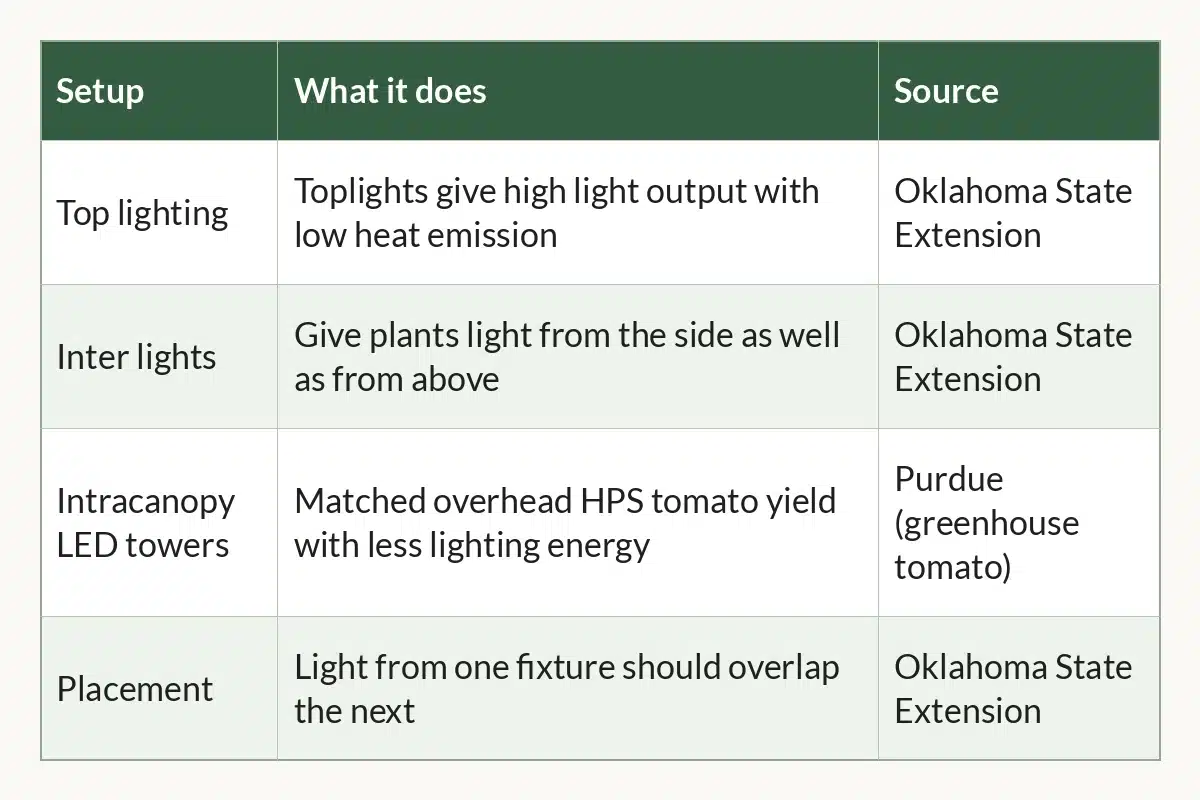
Under Canopy and Top Lighting at a Glance
| Setup | What it does | Source |
|---|---|---|
| Top lighting | Toplights give high light output with low heat emission | Oklahoma State Extension |
| Inter lights | Give plants light from the side as well as from above | Oklahoma State Extension |
| Intracanopy LED towers | Matched overhead HPS tomato yield with less lighting energy | Purdue (greenhouse tomato) |
| Placement | Light from one fixture should overlap the next | Oklahoma State Extension |
When Is Under Canopy Lighting Worth It?
It is most likely to help when there is a real lower canopy to light. Tall plants, dense bushes and grows with several stacked branches all leave a shaded middle and base. A single row of short plants under a strong light usually does not.
Start with the main light. Under canopy bars fill a gap below the top, but they do not replace a fixture that is too weak for the space. Our guide to PAR and PPFD for cannabis explains how growers judge whether the main light is doing its job.
Then there is cost. Oklahoma State names a higher upfront price and a smaller coverage area as LED downsides in general. Bars also add heat and power draw to a closed tent. More light meant more energy in the Garrido study, so the question is whether any gain at the base would justify the added running cost in your space.
Pruning is the low cost alternative. Removing small lower shoots lets the plant send its energy to the top, where the main light is strongest. Our guide to lollipopping your plants shows how growers do it. Some growers do both and keep a few strong lower branches lit by bars.
Timing deserves a thought as well. In the Garrido study, the added lights came on after the plants had grown tall enough to shade themselves. If you plan to raise the main light during flower, our post on when to increase light intensity in flowering covers that side of the schedule.
Where Should Under Canopy Lights Go?
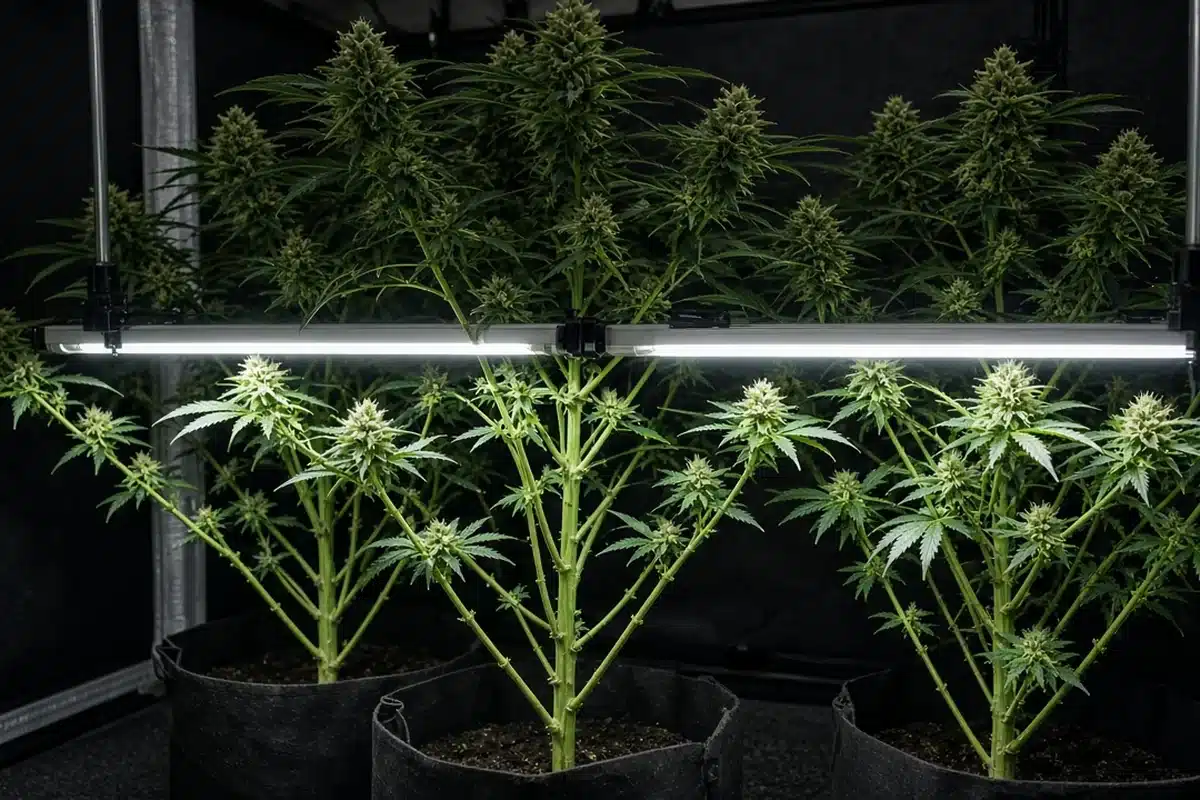
Put them along the sides of the plants or below them, aimed into the shaded lower canopy, with the light from each bar overlapping the next. The steps below cover equipment and placement only.
- Pick bars made for the job. Look for slim LED bars sold as under canopy or side lights, with a mounting method that fits your tent frame. As Oklahoma State notes, LEDs shed heat through a heat sink, which is why they can sit near leaves.
- Choose the direction. Bars under the plants aim upward into the canopy. Bars among the branches aim inward from the sides. Garrido and colleagues tested both layouts in separate setups.
- Mount them along the sides. Fix the bars to the tent poles or a light frame along each side of the plants, so light reaches the middle of the canopy instead of only the outer leaves.
- Spread the coverage. Oklahoma State advises placing LED fixtures so the light from one overlaps the light from the next. Even coverage avoids bright spots and dark gaps.
- Plan for growth. The Garrido team moved the inter canopy units up as the plants grew taller. Leave room on the frame to raise bars that sit among the branches.
- Start them when the canopy fills in. Bars do little in a small plant with no shade below. The study team waited to switch theirs on until the plants had grown tall.
- Run them on the main light timer. Plug the bars into the same timer as the main fixture so the dark period stays dark.
- Watch heat and humidity. Check the tent climate after the bars go in, since every fixture adds some heat.
Troubleshooting Under Canopy Lighting
Lower leaves look pale or faded near the bars. The bars sit too close to those leaves. Move them back or angle them away from the nearest foliage.
Nothing seems to change. The plants may be too short or too sparse to have a shaded zone. Bars earn their place in tall, dense plants.
The tent runs warmer. More fixtures mean more heat. Check your exhaust and airflow once the bars are in.
Light spills onto the walls instead of the plants. Turn the bars inward so they face the branches, and close any gaps along the sides.
Lower branches still make small buds. Light is only one factor. Spacing, plant shape and the strength of the main light all play a part.
Sources
- Oklahoma State University Extension, LED Grow Lights for Plant Production (HLA-6450): https://extension.okstate.edu/fact-sheets/led-grow-lights-for-plant-production
- Purdue University HLA Happenings, Gomez and Mitchell, LED towers vs high pressure sodium lamps for greenhouse tomatoes (abstract): https://www.purdue.edu/hla/sites/hla-happenings/article/2013-ashs-growth-chambers-and-controlled-environments-oral-competition-winners/
- Garrido et al. 2025, Plants 14(10):1469 (extra context): https://pmc.ncbi.nlm.nih.gov/articles/PMC12115249/
FAQ
Does under canopy lighting increase yield?
In one 2025 indoor cannabis study from Spain, dried flower yield was higher with added subcanopy or inter canopy light than with top light alone. That was one study, and a home tent may not see the same result.
Are under canopy lights worth it in a small tent?
Often not. They help most when tall or dense plants leave a shaded lower canopy.
Which way should under canopy lights face?
Bars below the plants face up. Bars among the branches face inward from the sides, and the light from each bar should overlap the next.
Can under canopy lights replace a main grow light?
No. They fill the shaded zone below the top. The main fixture still supplies most of the light.
Do under canopy lights use much electricity?
They add to the power bill. In the Spain study, lighting energy rose by about 13 to 23 percent depending on the setup.