
Filaree in Cannabis Gardens: Storksbill Weed Guide
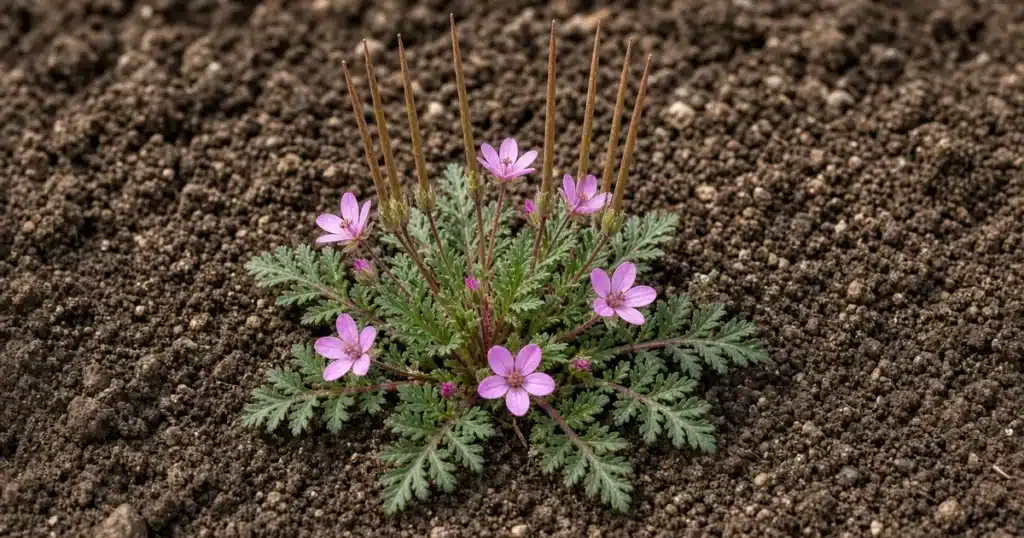
Quick answer: Filaree, also called storksbill, is a low winter annual with fernlike, hairy leaves, small pink to purple flowers and long, beaklike fruits. UC IPM says it reproduces by seed. USU Extension says to hand pull plants before seed matures, hoe young plants shallowly and keep mulch about 3 inches deep on planting beds.
What Is Filaree?
A low, cool season weed in the geranium family. The University of California Statewide IPM Program (UC IPM) says filarees are low growing, common winter annual and sometimes biennial broadleaves. It describes three species, redstem, whitestem and broadleaf filaree, and lists roadsides, pastures, crop fields, landscaped areas and other disturbed sites as habitat.
Utah State University (USU) Extension says redstem filaree commonly grows in planting beds and lawn areas. Washington State University (WSU) Hortsense says it is common in ornamental plantings, lawns, pastures and waste places on dry soils. Our overview of weed control in outdoor cannabis covers the general plan.
How Do You Identify Filaree?
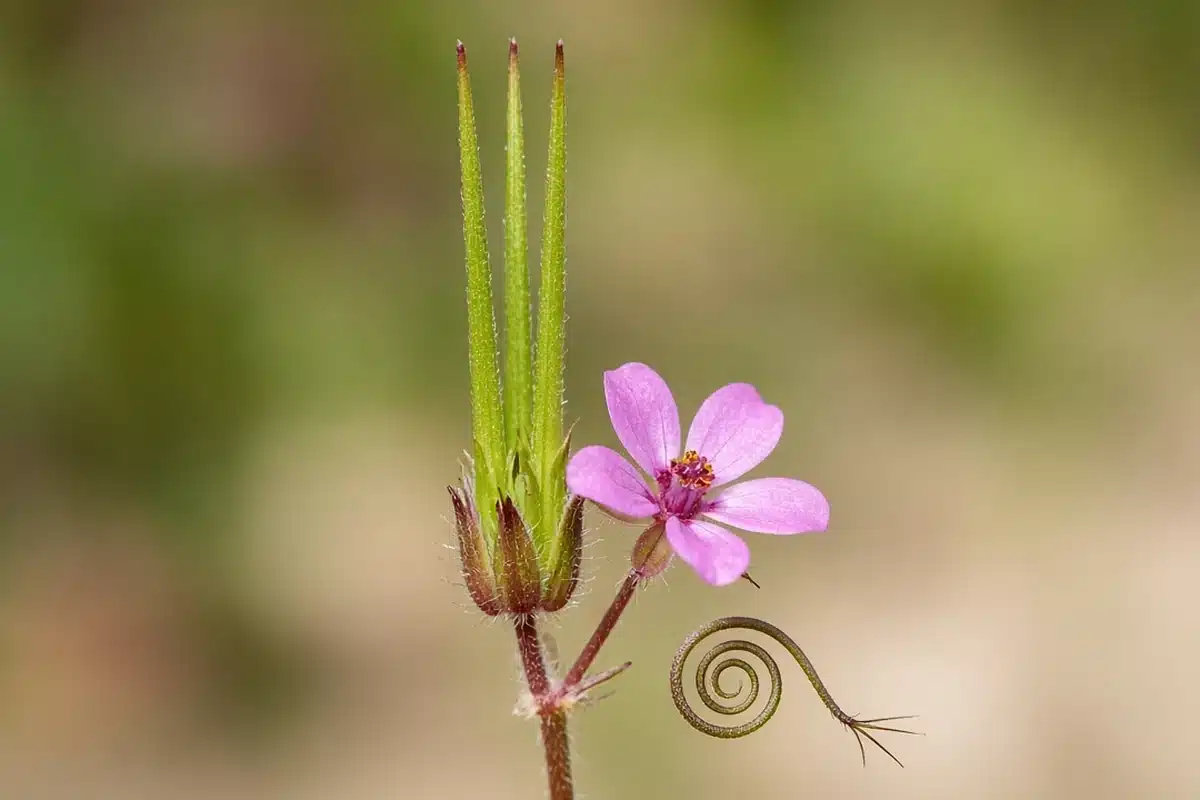
Look closely for the beak. UC IPM says the long, needlelike immature fruit resembles a stork’s head and beak. Other features from UC IPM, USU and WSU:
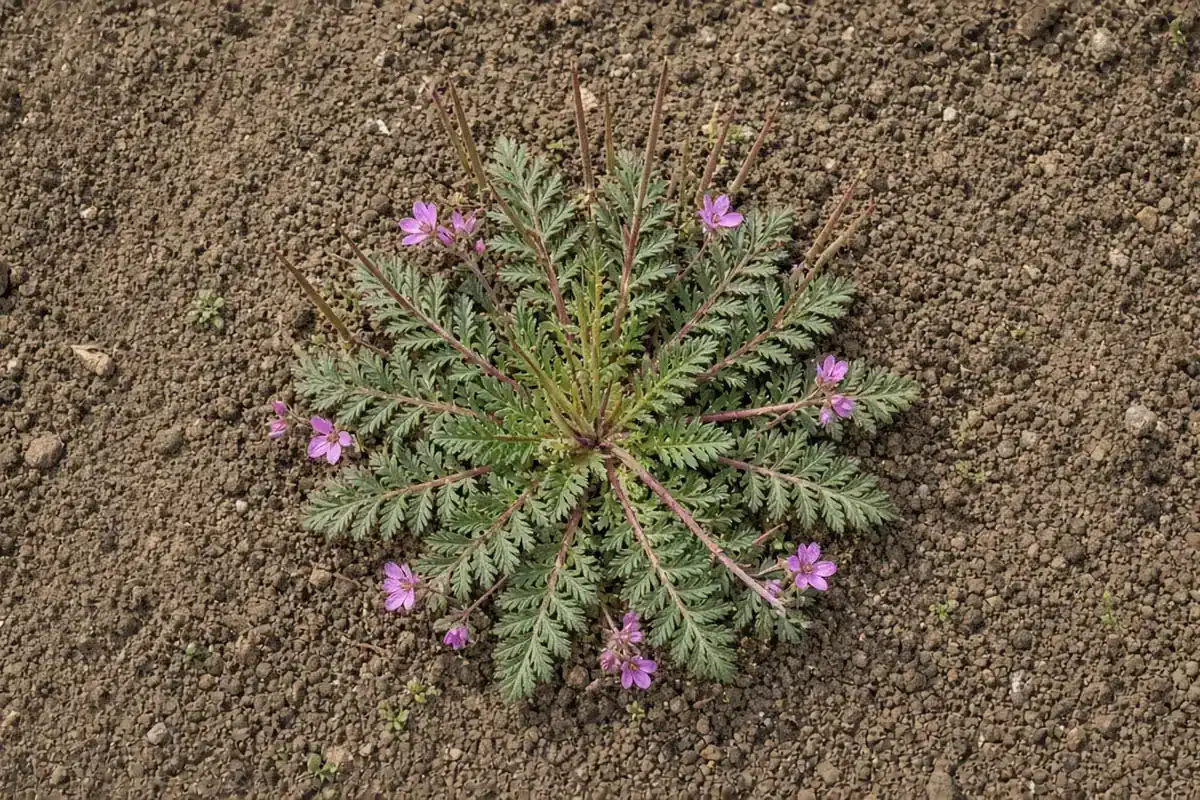
- Rosette. USU describes a low growing, densely matted plant with fernlike leaves in a rosette.
- Leaves. WSU says the leaves are finely divided into feathery segments, and both leaves and stems are hairy.
- Stems. UC IPM says redstem filaree stems are often reddish, while whitestem stems are pale.
- Length. WSU says stems run one to two feet and may be low and spreading or erect. UC IPM gives 2 to 3 feet, depending on the species.
- Flowers. Five pink to purple petals. USU says each stalk carries two to twelve flowers.
USU notes that other common names include cranesbill, heronsbill and storksbill, because the flower and fruit resemble a bird’s head.
How Do the Three Filarees Differ?
The leaves tell them apart. UC IPM says the rosette leaves of whitestem and redstem filaree are fully divided into leaflets, but whitestem leaflets are less deeply cut. Broadleaf filaree has lobed rosette leaves that are not fully divided.
Stem color helps too. UC IPM says whitestem filaree stems are pale and redstem filaree stems are often reddish. In a garden, all three are managed the same way. Pull or hoe them while they are young rosettes, before the beaked fruits ripen.
Why Does Filaree Matter Near Cannabis?
It actually plants its own seed. UC IPM says that at maturity the fruit splits into five parts, each with a tail that coils as the seed dries. The coils tighten in dry conditions and loosen in humid ones, which drills the seed into the soil. WSU describes the same spirally twisted tail on each seed.
USU says it commonly grows in planting beds and lawn areas, so the soil around your cannabis is exactly where it likes to be. Removing plants before seed forms is the way to stop the cycle.
When Does Filaree Grow?
Mostly in the cool season. USU says it germinates in moist soil when temperatures are between about 40 and 70 degrees F, from spring to fall. Seedlings that sprout late in the year stay as dormant rosettes over winter, then resume growth in early spring and flower from mid spring to mid summer.
UC IPM’s landscape guide says the best time to look for winter annual weeds is mid to late winter. Scout resting beds then, and again in early spring. Our guide to fall garden cleanup after cannabis harvest lines up with the first fall seedlings. If you also find a mint family weed then, see our guide to henbit in cannabis beds.
Does Mulch Stop Filaree?
It helps. USU recommends a mulch layer 3 inches deep on planting beds to reduce seed germination. WSU says organic mulches such as bark, compost, grass clippings or straw, applied two to several inches thick, are effective for weed management.
USU adds that competition for light from taller plants can help control weedy patches. Once your cannabis canopy fills in, filaree has a harder time. Until then, keep the soil between young plants covered and pull any rosette that pokes through.
How to Control Filaree in a Cannabis Garden
- Learn the beaked fruit. UC IPM says the immature fruit looks like a stork’s head and beak.
- Scout in late winter. USU says late seedlings sit as dormant rosettes over winter.
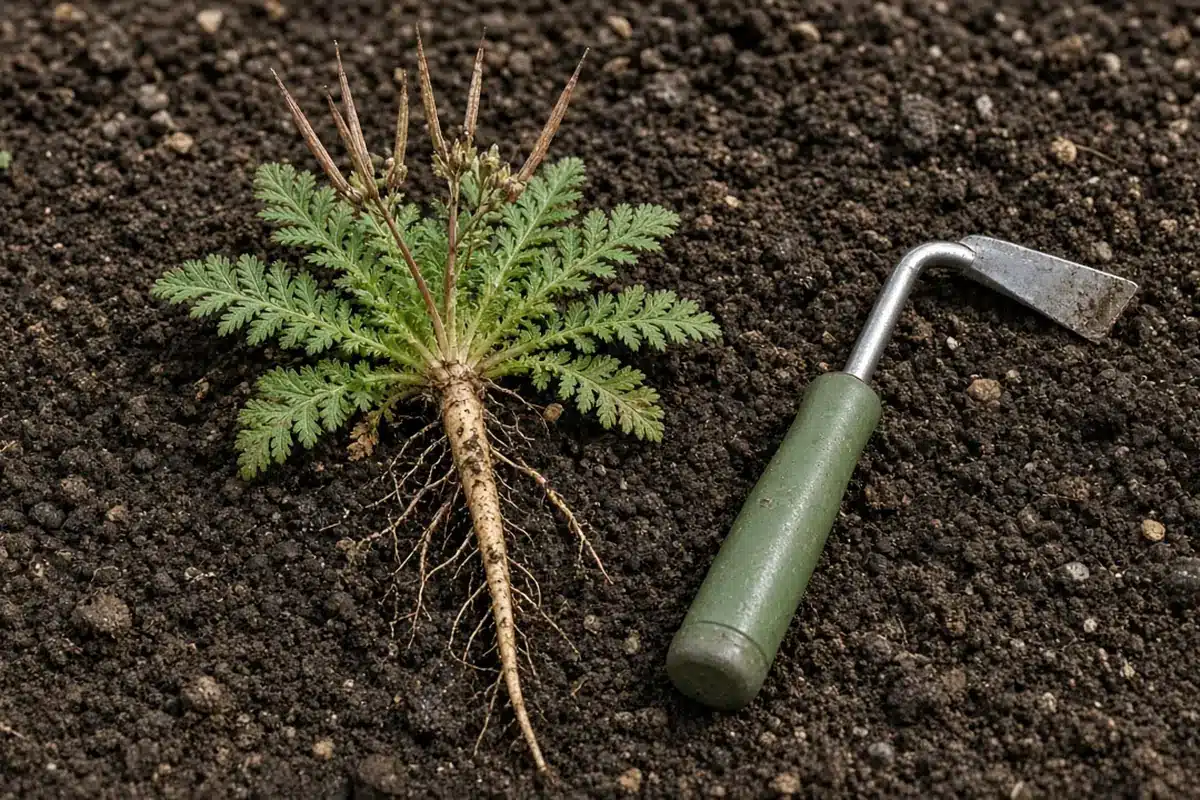
- Pull before seed matures. USU says to hand pull plants in planting beds before seed matures.
- Hoe young plants. USU says shallow tillage or hoeing controls young plants.
- Bag plants with fruit. Bag them, since UC IPM says the coiling seed tails drill seed into the soil.
- Shade the soil. USU says competition for light from taller plants can help.
- Mulch planting beds. USU recommends mulch 3 inches deep. Our guide to mulch for cannabis compares materials.
Filaree at a Glance
| Subject | Extension finding | Attribution |
|---|---|---|
| Life cycle | Winter annual, sometimes biennial | UC IPM, USU, WSU |
| Leaves | Fernlike, hairy | USU, WSU |
| Flowers | Five pink to purple petals | UC IPM, USU |
| Fruit | Long beak, splits into five parts | UC IPM, WSU |
| Germination | Moist soil, about 40 to 70 degrees F | USU |
| Reproduction | By seed | UC IPM |
Should You Use Herbicides Near Cannabis?
No. Pull, hoe shallowly and mulch. Remember that EPA has not registered any herbicide for use on marijuana, and state rules vary, so check with your state agriculture department. UC IPM says home gardeners who hand weed and mulch should not need herbicides. Before you plant cannabis outdoors, check your state’s home grow law.
Troubleshooting Filaree
Rosettes appear all winter. USU says late seedlings stay as dormant rosettes. Pull them in late winter.
It returns in the same bed. UC IPM says the coiling tails drill seed into the soil. Remove plants before fruit forms.
You are not sure which filaree it is. UC IPM says leaf shape and stem color separate the three. Manage all of them the same way.
Mulch is thin and plants poke through. USU recommends mulch 3 inches deep. Top it up.
Patches fill gaps between small plants. USU says competition for light from taller plants helps. Keep soil covered until the canopy closes.
At Kind Seed Co, we like to pull filaree rosettes on a damp winter day, when the soil is soft.
Frequently Asked Questions
Is filaree the same as storksbill?
Yes. USU says other common names for redstem filaree include cranesbill, heronsbill and storksbill, because the flower and fruit resemble a bird’s head. WSU lists stork’s bill and crane’s bill as other names. UC IPM describes the long, needlelike immature fruit as looking like a stork’s head and beak.
Is filaree an annual?
Mostly. UC IPM calls filarees common winter annual and sometimes biennial broadleaves. USU says redstem filaree is a winter annual or biennial, and that late seedlings stay as dormant rosettes through winter, then resume growth in early spring. WSU agrees it is typically a winter annual, sometimes a biennial.
How do I get rid of filaree?
USU recommends hand pulling plants in planting beds before seed matures, shallow tillage or hoeing for young plants and a mulch layer 3 inches deep to reduce germination. WSU adds that hand pulling and cultivation will eliminate plants. Bag any plants carrying the long, beaked fruits.
How does filaree plant its seed?
UC IPM says the fruit splits into five parts at maturity, each with a tail that coils as the seed dries. The coils tighten in dry conditions and loosen in humid ones, which drills the seed into the soil. WSU describes the same spirally twisted tail, with hairs on the inner side.
When does filaree grow?
USU says it germinates in moist soil when temperatures are between about 40 and 70 degrees F, from spring to fall. Late seedlings overwinter as rosettes, resume growth in early spring and flower from mid spring to mid summer. Scout cannabis beds in late winter and pull rosettes before they flower.
Sources
- UC Statewide IPM Program, Filarees, Weed Gallery: https://ipm.ucanr.edu/weeds-identification-gallery/filarees/
- Utah State University Extension, Redstem Filaree: https://extension.usu.edu/planthealth/ipm/ornamental-pest-guide/weeds/w_redstem-filaree
- Washington State University Hortsense, Weeds: Redstem filaree: https://hortsense.cahnrs.wsu.edu/fact-sheet/weeds-redstem-filaree-erodium-cicutarium/
- UC Statewide IPM Program, Weed Management in Landscapes: https://ipm.ucanr.edu/home-and-landscape/weed-management-in-landscapes/


