
How to Sanitize Pruning Shears for Cannabis Grows

Every cut you make with pruning shears opens a small wound on the plant. If the blades carry sap, soil or pathogens from the last plant, that wound is an easy way in. It is one of the quieter ways disease spreads through a garden, and one of the easiest to stop.
Iowa State University Extension states that proper cleaning and sanitizing of pruners and other garden tools is important to prevent the spread of disease. Topics include the difference between cleaning and disinfecting, the main options for home growers, how to use each one safely and how often to sanitize while you prune or harvest. Only cutting tools are discussed. For pots and trays, turn to cleaning and disinfecting pots for cannabis.
Cleaning and disinfecting are two different steps
University of Florida IFAS Extension explains that cleaning and disinfecting are two distinct steps. Cleaning means physically removing soil and debris, and it always comes first. Disinfecting comes after.
The reason is simple. UF/IFAS notes that soil and other organic residue reduce how well disinfectants work. A disinfectant applied over a layer of dried sap or dirt may never reach the metal underneath. Iowa State Extension gives the same advice: always remove dirt, sap and other debris from pruning tools before disinfecting them.
Step one: clean before you disinfect
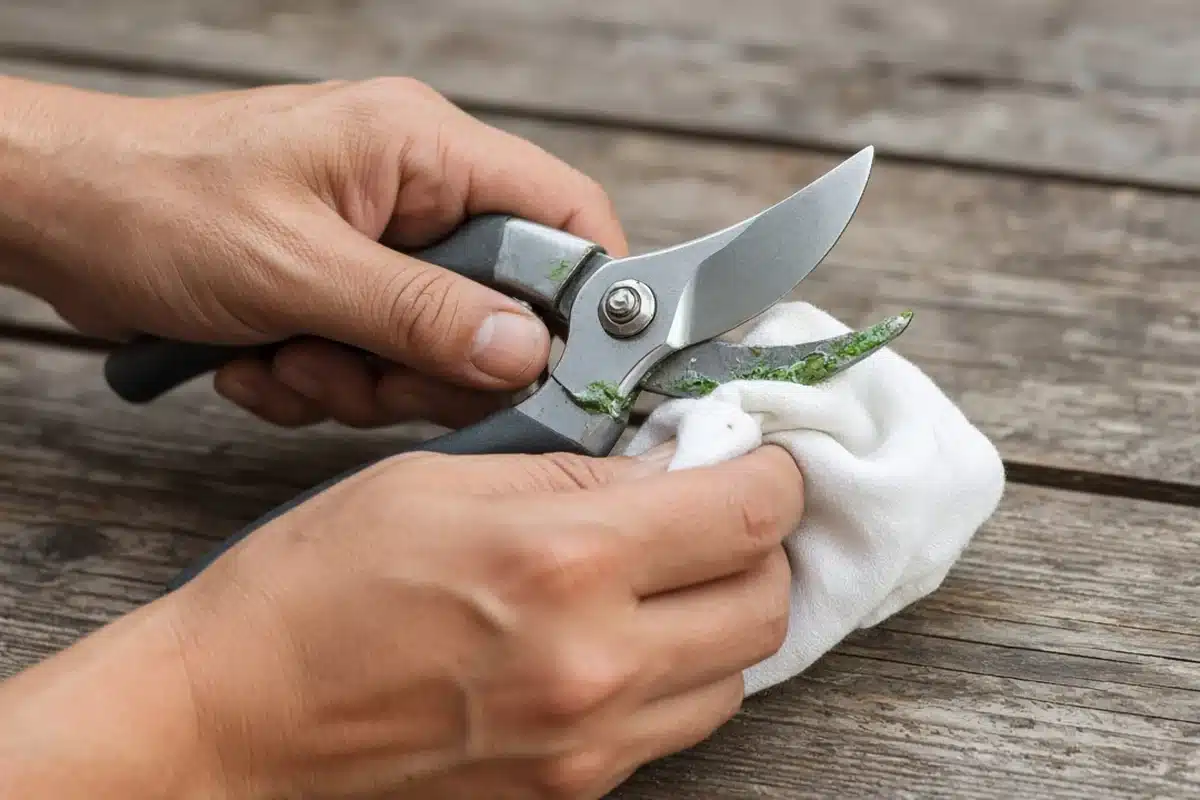
UF/IFAS suggests wiping tools with a damp cloth or paper towel to remove dirt, debris or sap before disinfecting. For cannabis, sap is the main concern. Resin builds up on blades during pruning and especially at harvest, and it can be sticky and stubborn.
A simple cleaning routine:
- Wipe the blades with a damp cloth to remove loose soil and plant matter.
- Scrub stubborn sap and resin until the metal surface is clear.
- Open the shears fully and clean the inner faces of both blades and around the pivot.
- Dry the blades before moving on to disinfecting.
UF/IFAS also notes that a longer soak may be needed for cutting surfaces that are not smooth. Pruners with textured or pitted blades need extra attention during both steps.
Option one: rubbing alcohol
Iowa State Extension describes alcohol as one of the easiest ways to sanitize pruning tools. You can use ethanol or isopropyl alcohol, and rubbing alcohol at 70 percent can be used straight from the container with no dilution. UF/IFAS notes that a solution of 70 to 100 percent alcohol works as a wipe or a dip.
How to use it:
- Wipe the clean blades with alcohol or dip them in a small container of it.
- No long soak is needed. Iowa State Extension notes that a wipe or dip is enough.
- UF/IFAS notes that alcohol does not need to be rinsed off and works right away.
Iowa State Extension explains why alcohol is the preferred choice for most home gardeners. It is easy to use, easy to find, fairly inexpensive, does not need a long soak and is less corrosive to tools than bleach.
There are two cautions. UF/IFAS warns that alcohols are very flammable, so keep them away from open flames and heat. Iowa State Extension also notes that some studies have shown rubbing alcohol may not fully disinfect tools against certain plant pathogens. For a known, serious disease problem, bleach may be the better choice.
Option two: household bleach
Both sources describe a 10 percent solution of household chlorine bleach, made with one part bleach to nine parts water. Iowa State Extension advises always adding bleach to water, not water to bleach, to avoid splashing, and protecting skin and clothing.
The two sources differ on soak time. Iowa State Extension says to soak blades for at least 10 minutes. UF/IFAS describes a 30 minute soak. Either way, the steps are similar:
- Mix one part bleach with nine parts water in a container.
- Soak the clean blades in the solution.
- Rinse the tools with clean water afterward to prevent corrosion.
- Dry them fully before storing or using them.
Bleach solution does not last. Iowa State Extension advises using it within two hours of mixing. UF/IFAS notes that its effectiveness is cut in half after two hours, so make a fresh batch for each round of cleaning.
UF/IFAS lists the drawbacks too. Bleach is corrosive, can give off harmful fumes and is not as effective against viruses as some other options. Mix and use it in a well ventilated spot and never combine it with other cleaners.
Other options and why they are less common at home
Both sources mention a few other choices, each with tradeoffs:
- Household disinfectant sprays and wipes. Iowa State Extension notes they are very effective against germs on surfaces but have not been well tested against plant pathogens on garden tools. UF/IFAS adds that little research has been done and that they cost more than other options.
- Trisodium phosphate cleaners. Both sources describe a 10 percent solution with a soak of at least three minutes. Both also warn that it is very corrosive, and Iowa State Extension notes it is not widely recommended for home gardeners.
- Pine oil cleaners. UF/IFAS notes these are less corrosive than some products but also less effective.
In most home gardens, alcohol for routine work and bleach for serious disease problems covers nearly every need.
How often to sanitize
Iowa State Extension says that, at minimum, pruners should be disinfected between plants when you are removing diseased material. Ideally, it says, they would be disinfected between each cut. UF/IFAS agrees that disinfecting after every plant is ideal, though it admits this is often not practical.
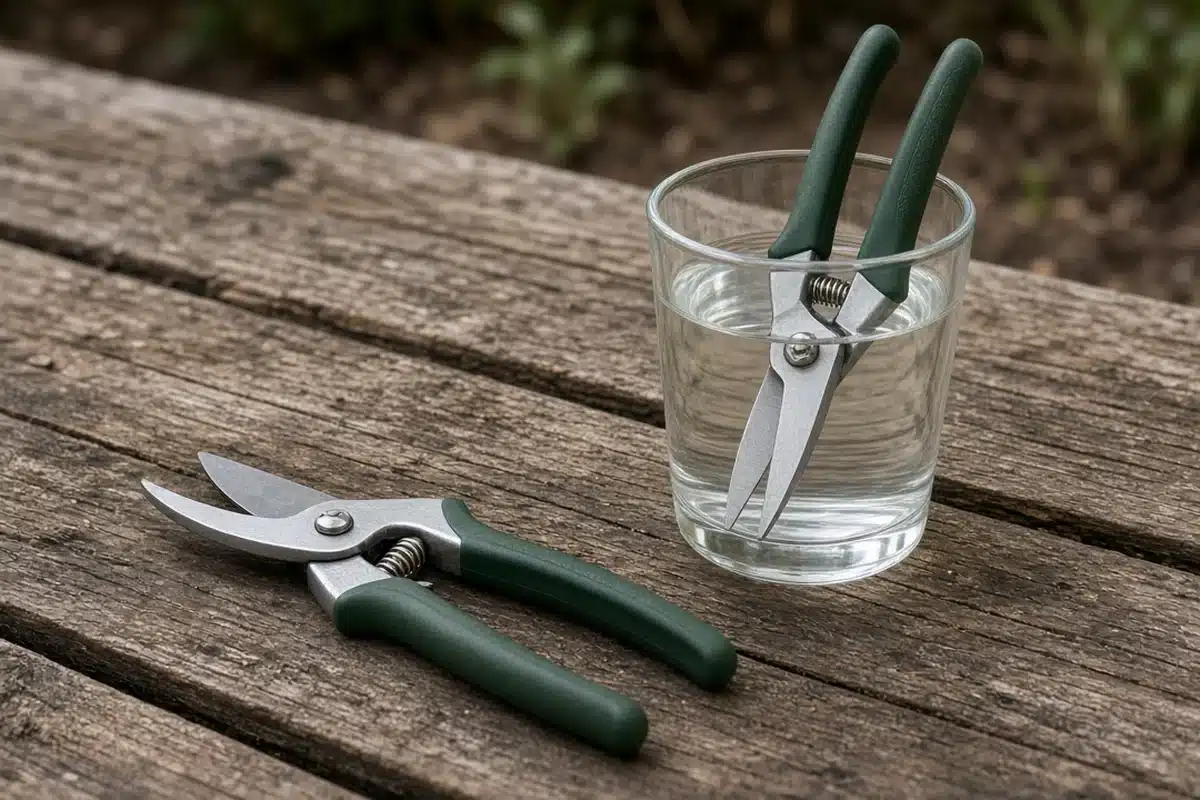
UF/IFAS offers a useful trick: rotate between several tools. While you work with one pair, the other can be disinfected. Here is how to set that up:
- Keep two or three pairs of pruners at hand.
- Set a small container of alcohol beside your work area.
- Cut with one pair while another rests in the alcohol.
- Switch pairs between plants, or between cuts on a plant that shows disease.
After dipping, UF/IFAS advises wiping off excess disinfectant so it does not harm the next plant. That matters with bleach in particular.
When to sanitize in the cannabis season
Think about the times when tools move between many plants in a short time. Pruning, training and removing lower leaves all create fresh wounds. One job where many cuts happen in a single session has its own Kind Seed Co post, cannabis defoliation. Harvest is another, since the same shears may touch every plant in the garden in one day.
Good moments to clean and sanitize:
- Before the first cut of any session.
- Between plants, and between cuts on any plant that shows spots, mold or wilting.
- After working on a plant with a known problem, before touching a healthy one.
- At the end of the day, before you store the tools.
Protecting your tools
Disinfectants can be hard on metal. Iowa State Extension notes that bleach and trisodium phosphate are more corrosive to tools than alcohol, and both sources advise rinsing after bleach. Dry tools completely after cleaning and store them in a dry place. Sharp, clean blades also make cleaner cuts, which close more easily than ragged ones.
A small kit makes the routine easy to keep. Store a clean cloth, a sealed container of alcohol and a spare pair of pruners together, so you are never tempted to skip a step in the middle of a job. Label any container of mixed bleach solution with the time you mixed it, and pour it out once it is past its useful window.
Troubleshooting
Sap will not come off the blades. Keep scrubbing with a damp cloth before you disinfect. Disinfectant cannot work well through residue.
Blades are rusting after cleaning. Rinse with clean water after bleach, dry fully and switch to alcohol for routine sanitizing.
You forgot to sanitize between plants. Clean and sanitize now, then watch the plants you pruned for any new spots or wilting over the next few weeks.
The bleach mix seems weak. It may be too old. Mix a fresh batch, since it loses strength within a couple of hours.
Disease keeps spreading despite alcohol wipes. Switch to a bleach soak for tools used on affected plants and sanitize between every cut.
Sources
- Iowa State University Extension and Outreach, Yard and Garden. How do I sanitize my pruning shears? https://yardandgarden.extension.iastate.edu/faq/how-do-i-sanitize-my-pruning-shears
- University of Florida IFAS Extension, Gardening Solutions. Disinfecting Your Garden Tools. https://gardeningsolutions.ifas.ufl.edu/care/tools-and-equipment/disinfecting-tools/
FAQ
What is the best way to sanitize pruning shears?
For most home growers, rubbing alcohol is the simplest choice. Clean off sap and soil first, then wipe or dip the blades. Iowa State Extension notes 70 percent rubbing alcohol works straight from the bottle with no soak and is less corrosive than bleach. Use a bleach soak for serious disease problems.
Is alcohol or bleach better for pruning tools?
Each has a role. Iowa State Extension prefers alcohol for home use because it is easy, quick and gentle on tools, but notes it may not stop certain pathogens. Bleach at one part to nine parts water is strong but corrosive, so rinse after soaking. Mix fresh bleach solution every time.
How long should I soak pruners in bleach?
Iowa State Extension advises soaking blades for at least 10 minutes in a 10 percent bleach solution, while University of Florida IFAS describes a 30 minute soak. Rinse with clean water afterward to prevent corrosion and dry fully. Use the solution within two hours, since it loses strength quickly after mixing.
How often should I sanitize pruning shears?
Iowa State Extension says to disinfect pruners between plants at minimum when removing diseased material, and ideally between each cut. University of Florida IFAS suggests rotating between several pairs so one soaks while you use another. Always sanitize before starting and after working on any plant that shows disease.


