
Spiders in Cannabis Gardens: Friends or Problem?
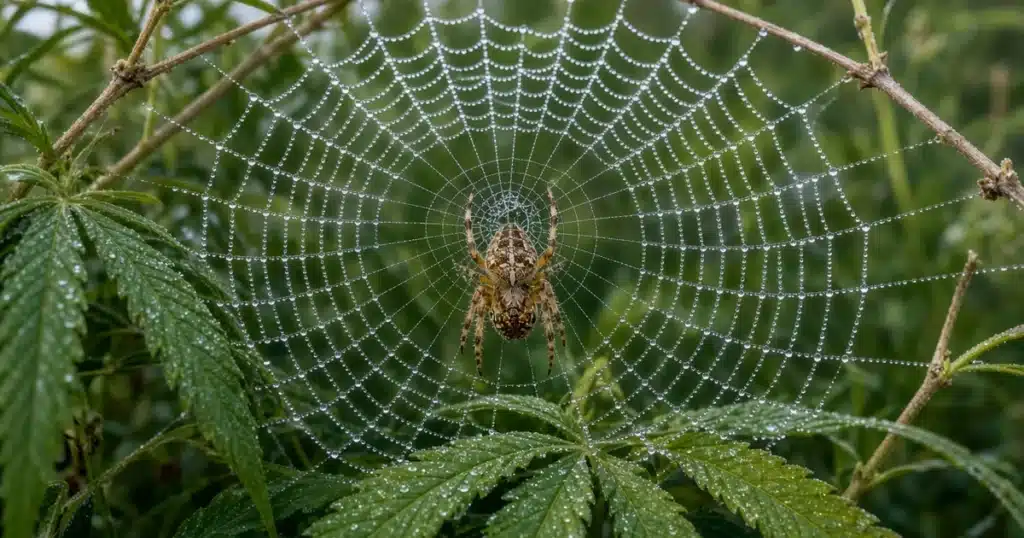
Walk through an outdoor garden on a late summer morning and you will likely see webs glinting between leaves. Many growers react with a flinch. It is worth taking a second look, though, because a spider on your plant is usually doing you a favor. Spiders are predators, and most of what they catch in a garden is insects.
Washington State University’s Hortsense fact sheet puts it strongly. It says the pest control service spiders provide is enormous and greatly under appreciated. Coming up: how spiders differ from insects, the common types you may find around cannabis, what they eat and how to keep them working in your garden.
Spiders are not insects
University of Wisconsin Madison Extension explains the key differences. Spiders have eight legs, not six. They have two body regions instead of three, and they have no wings or antennae. They also have special organs called spinnerets under the abdomen, which let them make silk throughout their lives.
UW Madison Extension notes there are more than 35,000 named species of spiders in the world, with about 3,000 in North America. WSU Hortsense adds that an average home garden without pesticides is likely home to perhaps 20 to 25 species.
It also helps to know what is not a spider. UW Madison Extension notes that harvestmen, often called daddy long legs, are not true spiders. They have no silk glands, cannot make webs and are often scavengers rather than strict predators. Spider mites are a different animal again. They are tiny plant feeding mites, not true spiders, and preventing and controlling spider mites explains how to deal with them.
Three ways spiders hunt
Both sources group garden spiders by how they catch prey:
- Web builders spin a web and wait on or near it for prey to get caught. UW Madison Extension notes this is the largest group.
- Hunting spiders are active and mobile. They track down prey instead of waiting for it, though they may build a silk shelter.
- Ambush spiders sit still until prey comes close, then pounce.
WSU Hortsense notes that web builders are perhaps the least threatening to people because they stay in one place. Hunting spiders patrol constantly, with some working the ground, others roaming over plants and others hunting on fences and buildings.
Common garden spiders you may find
UW Madison Extension describes several spiders that are common in gardens:
- Argiope spiders, including the black and yellow garden spider, are seen on shrubs and tall flowers in late summer and fall. Their webs can be up to one foot across, with a white zigzag of silk down the center.
- Barn spiders are brownish web spinners that reach up to one inch at maturity. They spin webs in shaded spots around buildings.
- Grass spiders build funnel shaped webs around foundations, on low shrubs and in lawns. Their threads are not sticky, so the funnel directs prey to the waiting spider.
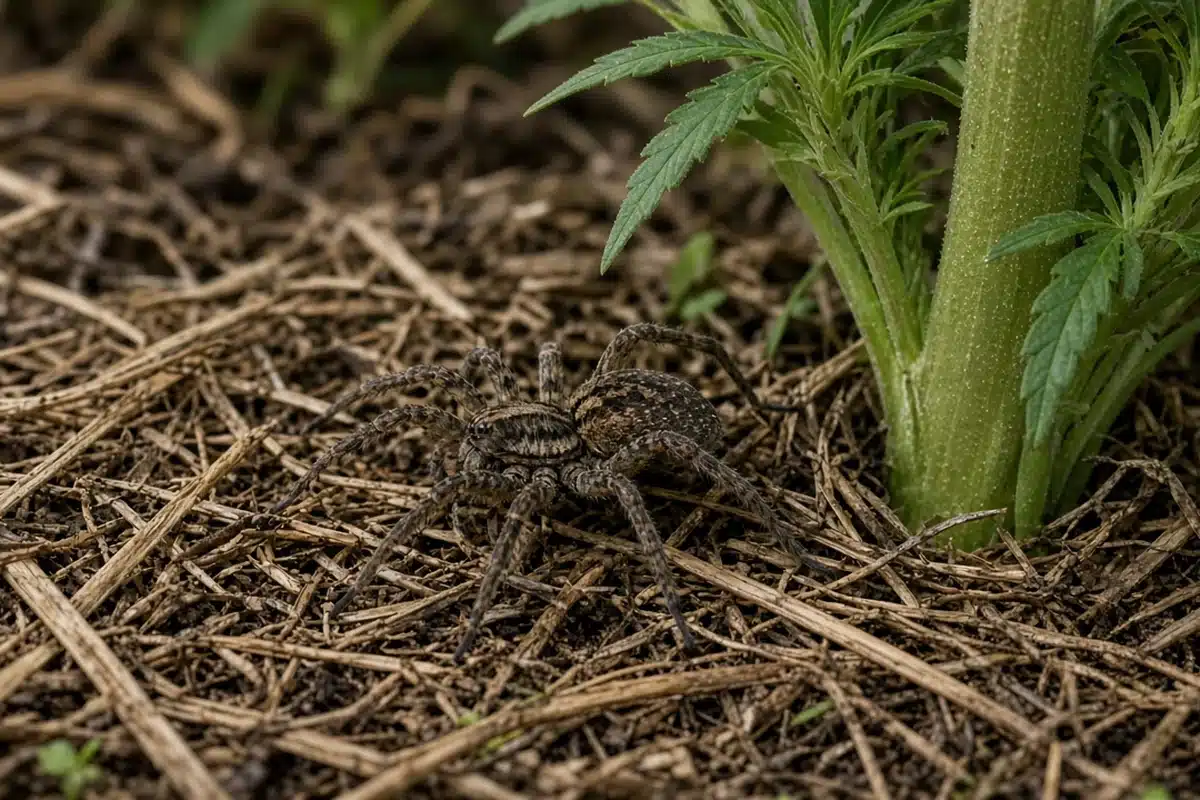
- Wolf spiders are large, brown or gray, hairy hunting spiders that live on the ground and may hunt by day or night. Many burrow or hide under rocks.
- Crab spiders hold their front legs out like a crab and can walk sideways. They ambush insects, often sitting hidden in flowers.
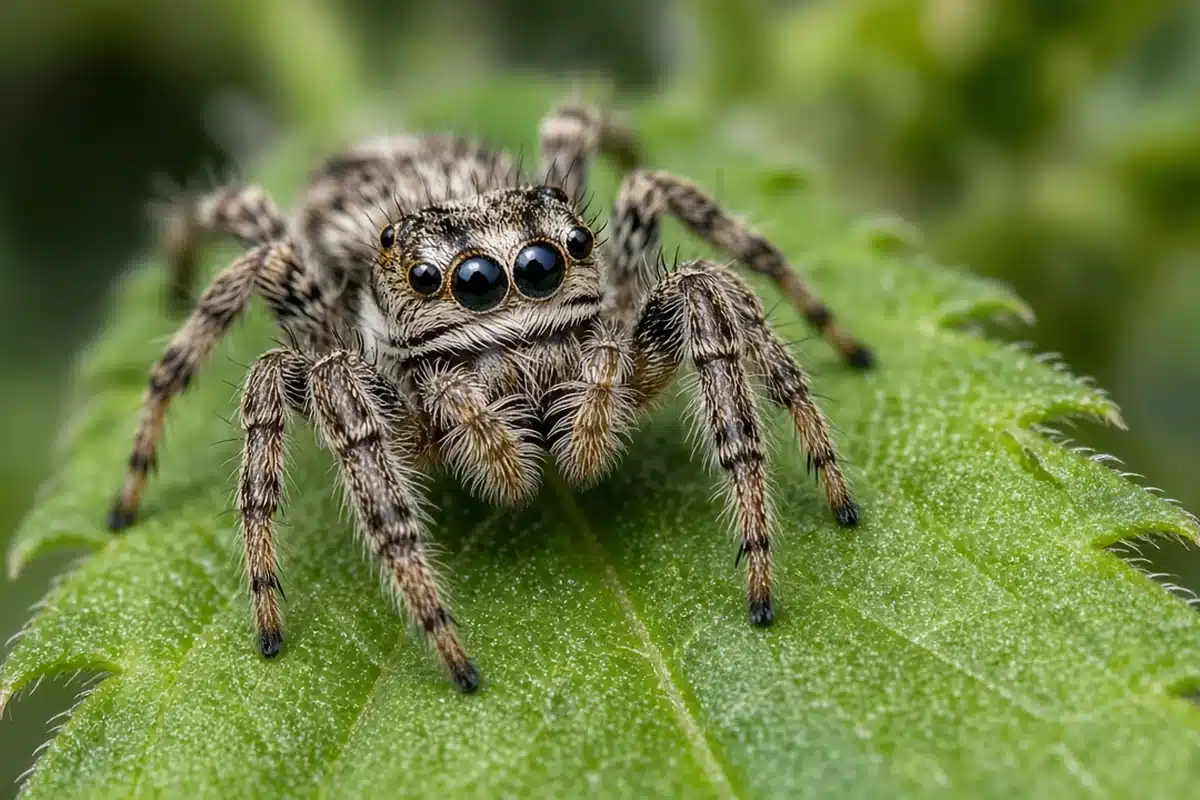
- Jumping spiders are compact and often brightly colored. They move in quick, jerky hops and have the best vision of all spiders.
WSU Hortsense adds that jumping spiders and crab spiders are often about a quarter inch to half an inch long, and that crab spiders usually match the color of what they sit on. On a cannabis plant, the ones you are most likely to notice are web builders strung between branches and small jumping or crab spiders moving over leaves.
What spiders eat in a garden
UW Madison Extension notes that spiders feed on a wide variety of insects, and that they are considered beneficial when they eat pests such as aphids, caterpillars, cucumber beetles, flies, grasshoppers, leafhoppers, plant bugs and thrips. WSU Hortsense lists prey including aphids, mites, caterpillars, flies, beetles, grasshoppers, leafhoppers, whiteflies, thrips, mealybugs and moths.
There is a catch. UW Madison Extension points out that most spiders are opportunists that eat whatever they catch rather than targeting particular pests, and that they may also catch helpful insects such as bees or parasitic flies. Spiders are not a precise pest control tool. They are a steady background predator that keeps many small insect numbers in check.
Spiders are not the only allies. Kind Seed Co rounds up others in the best bugs for a cannabis grow.
Are garden spiders a risk to people?
UW Madison Extension notes that although most spiders are venomous, they are harmless to people with a few exceptions. It adds that most spiders do not have mouthparts able to break human skin, that spiders rarely attack unless provoked, and that they are more likely to flee than fight. It also notes people often blame spiders for bites that were really caused by other pests.
Practical habits keep encounters calm:
- Wear gloves when reaching into dense growth or moving pots and debris.
- Look before you grab, especially under leaves and around the base of plants.
- Give any spider you cannot identify a little space and let it move away.
- Brush webs aside with a stick rather than your hand when you need to pass.
A spider’s year in the garden
UW Madison Extension explains that most spiders complete one generation a year. Egg masses are laid in debris in the fall, and the female dies after laying them. The eggs or the young spiderlings stay protected in the egg mass over winter. In spring, spiderlings leave the overwintering site by crawling or by ballooning, which means letting out a silk thread and riding the wind.
That life cycle explains why garden cleanup habits matter. Removing every bit of cover in fall also removes places where egg masses spend the winter.
How to keep spiders working for you
UW Madison Extension says garden spiders should be conserved because of their generally beneficial nature. It gives clear steps:
- Avoid broad spectrum insecticides, which kill spiders along with pests.
- Leave part of the garden covered in organic mulch.
- Consider a cover crop in part of the garden to give egg masses a place to overwinter.
WSU Hortsense adds related advice for keeping natural enemies around. It notes that native plants provide important resources and overwintering sites, and it advises avoiding regular use of synthetic broad spectrum pesticides. It also notes that large lawns are not good habitat for natural enemies.
A good balance for a cannabis bed is to keep the growing area clean of diseased debris while leaving a mulched edge or a planted border where spiders can shelter and overwinter.
When spiders seem like a problem
Sometimes webs build up on plants, especially late in the season. A web across a bud site can collect debris, and some growers simply do not want spiders on plants they handle. In most cases, a light touch works:
- Brush webs off plants with a soft brush or stick when needed.
- Leave spiders on nearby fences, borders and mulch where they are out of the way.
- Avoid spraying to remove spiders, since that also removes the predators that keep pests down.
If you see many spiders on one plant, take a closer look at what they are eating. A busy web often means there are plenty of flying insects around that plant.
Troubleshooting
Webs are covering one plant. Check for an insect problem on that plant, then brush webs off gently if they get in the way.
You see fine webbing with tiny moving dots on leaf undersides. That may be spider mites rather than spiders. Look closely with a magnifier and treat it as a mite problem.
Spiders disappeared after a spray. Broad spectrum products kill spiders too. Switch to targeted methods and give spiders time to return from nearby cover.
You find egg sacs in fall debris. Leave the ones in mulched borders and remove only debris from diseased plants.
You cannot tell a spider from a harvestman. Spiders have two body regions and make silk. Harvestmen usually have very long legs for their size and no silk glands, so they never make webs.
Sources
- University of Wisconsin Madison Extension. Garden Spiders. https://hort.extension.wisc.edu/articles/garden-spiders/
- Washington State University Extension, Hortsense. Spiders. https://hortsense.cahnrs.wsu.edu/fact-sheet/spiders/
FAQ
Are spiders good for a cannabis garden?
Usually, yes. University of Wisconsin Madison Extension notes spiders eat many garden pests, including aphids, caterpillars, leafhoppers and thrips. They are opportunists that can also catch helpful insects, but WSU Hortsense calls their pest control service enormous. Most growers are better off leaving them in place than removing them.
Are spider mites a type of spider?
No. Spider mites are tiny plant feeding pests, not true spiders, even though they make fine webbing on leaves. True spiders are predators that eat insects. If you see fine webs with tiny moving dots on leaf undersides, look closely with a magnifier, because that pattern points to mites rather than spiders.
How do I attract spiders to my garden?
Leave part of the garden covered in organic mulch, keep a planted border and avoid broad spectrum insecticides. University of Wisconsin Madison Extension recommends mulch or a cover crop so egg masses have a place to overwinter. WSU Hortsense adds that native plants provide shelter and resources for natural enemies like spiders.
Will garden spiders bite me?
It is unlikely. University of Wisconsin Madison Extension notes most spiders cannot break human skin, rarely attack unless provoked and are more likely to flee. A few species are exceptions, so wear gloves when reaching into dense growth or debris, and give any spider you cannot identify space to move away.


