Cannabis Flavonoids: Cannflavins and Plant Color

What are flavonoids in cannabis?
Cannabis makes more than 20 flavonoids, and the cannflavins are a small group found mostly in this plant. Flavonoids are a large family of plant compounds. The name comes from the Latin word for yellow, a nod to the color of many of them. Some give flowers, fruit and leaves their color. Many play protective roles inside plant tissue. Some appear only when a plant is under stress.
Cannabis makes its own set. A 2021 review of cannabis flavonoids sums up what is known. It is Bautista, Yu and Tian 2021 in ACS Omega. It reports more than 20 flavonoids identified in Cannabis sativa. A later review counts more than 30. That review is Abdel Kader and colleagues 2023.
Flavones and flavonols
Most cannabis flavonoids fall into two groups. Flavones include apigenin and luteolin. Flavonols include kaempferol and quercetin. Many food plants hold these compounds too. Plants often attach sugars to them. That changes how they dissolve and where they are stored.
The cannabis versions can also carry extra carbon chains. The chemistry name for these is prenyl or geranyl groups. They can add methyl groups as well. The variety seen in the plant comes from these small changes. How each compound behaves changes with them too. Adding a sugar helps a flavonoid dissolve in water. With a carbon chain, it behaves more like an oil. That is one reason researchers use different solvents to pull different flavonoids from leaves.
What are cannflavins?
Cannflavins are the best known cannabis flavonoids. They are flavones with an added carbon chain. The 2021 review lists three of them, named cannflavin A, B and C. Cannflavin A carries a ten carbon geranyl chain. Cannflavin B carries a five carbon prenyl chain.
People often call them unique to cannabis. That is close but not exact. Cannflavin A has also been found in a desert flower called Mimulus bigelovii. Still, cannabis remains their main known source. Researchers first pulled them from dried cannabis leaves.
How the plant builds them
Cannflavins are built by the plant step by step. Each step is run by an enzyme.
- The amino acid phenylalanine enters the phenylpropanoid pathway.
- Enzymes turn it into a building block called p coumaroyl CoA.
- That block joins with three units of malonyl CoA to make naringenin chalcone.
- More steps close the ring and form the flavone luteolin.
- An enzyme called CsOMT21 adds a methyl group, turning luteolin into chrysoeriol.
- Lab work points to an enzyme called CsPT3 that adds a geranyl or prenyl chain. The result is cannflavin A or cannflavin B.
Knowing these genes lets scientists study why some plants make more than others. The 2023 review notes that natural cannflavin levels are low. It also covers how the same route runs from phenylalanine and malonyl CoA.
The early steps are shared with many other plants. Just the last two steps are unique to cannabis. That is why cannflavins are rare while apigenin and luteolin are common across the plant world.
Do flavonoids change plant color?
Yes, one branch of the flavonoid family does. Red, purple or blue flavonoid pigments are called anthocyanins. They give purple cannabis strains their color. They show up in leaves, stems and flowers.
Cold nights vs genetics
Many growers believe cold nights turn plants purple. That is only part of the story. A plant needs the right genes to make anthocyanins in the first place.
In plants that carry the trait, temperature can raise color. A 2025 study grew a purple cannabis line at steady temperatures from 33 to 72 °F (0.5 to 22 °C). It also used warm day and cold night rooms. Days ran at 72 °F (22 °C) and nights at 39 °F (4 °C). That study is the Journal of Cannabis Research temperature study on anthocyanins. The study used a line bred to turn purple. It did not include green strains. Anthocyanin levels peaked at a steady 46 °F (8 °C) and 59 °F (15 °C). They dropped at both 33 °F (0.5 °C) and 72 °F (22 °C). Rooms with warm days and cold nights made far less pigment than steady cool rooms. Flower weight and CBD tracked plant maturity instead.
So genetics decide whether color is possible. Temperature can then shift how much pigment forms. For more on color in stems, see our guide to cannabis purple stems.
Temperature is a guide, not a recipe. In the study, flower weight was lowest in the coldest rooms.
Purple color is also not a sign of quality on its own. Its shade alone does not make a purple bud taste better. It simply carries more pigment.
Flavonoids vs cannabinoids
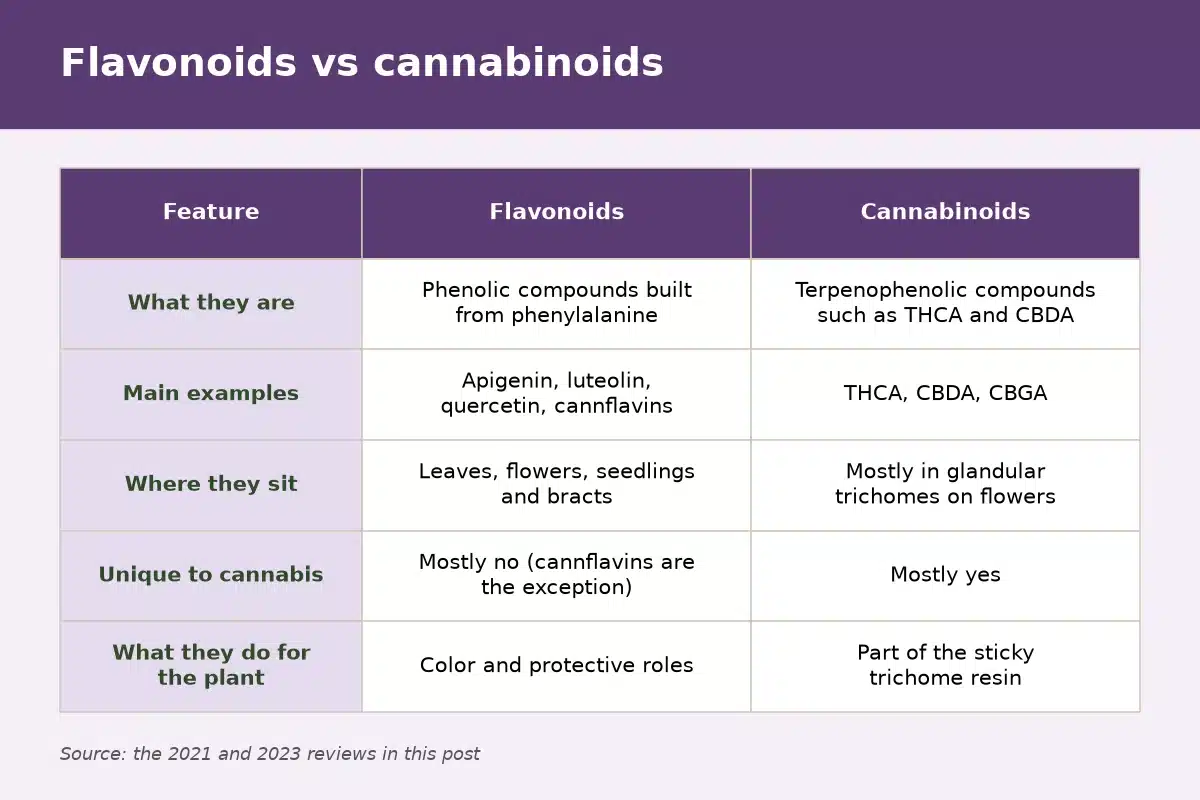
Flavonoids and cannabinoids are both made by cannabis. They are easy to mix up because both show up in research on the plant. They differ in build, location and job. The table below compares them.
| Feature | Flavonoids | Cannabinoids |
|---|---|---|
| What they are | Phenolic compounds built from phenylalanine | Terpenophenolic compounds such as THCA and CBDA |
| Main examples | Apigenin, luteolin, quercetin, cannflavins | THCA, CBDA, CBGA |
| Where they sit | Leaves, flowers, seedlings and bracts | Mostly in glandular trichomes on flowers |
| Unique to cannabis | Mostly no (cannflavins are the exception) | Mostly yes |
| What they do for the plant | Color and protective roles | Part of the sticky trichome resin |
Source for the table: the 2021 and 2023 reviews above.
The biggest gap is location. Cannabinoids pile up in the resin heads on the flower. Flavonoids spread more widely. They sit in leaf tissue too. That is why trimmed leaves carry a large share of the plant’s flavonoids.
Smell and flavor are also shaped by a third group, the terpenes. Read more in our ultimate terpenes guide.
Where flavonoids sit in the plant
Leaves vs flowers
Flavonoids are spread through most of the plant. The 2021 review lists them in seedlings, leaves, flowers and fruits. They were not detected in roots or seeds. Profiles in the bracts also change as the plant develops.
Leaves hold more than flowers. The 2023 review cites flavonoid content of 0.34 to 0.44 percent of dry weight in leaves. Flowers held 0.07 to 0.14 percent. That is part of why early researchers worked with leaves.
Low natural levels
Even in leaves, flavonoids make up well under one percent of dry weight. Cannflavins are only a small slice of that total. Some flavonoids may also appear only under stress, such as intense light or pests. That makes them hard to study and hard to measure on a standard lab report.
If a seller lists flavonoid numbers, ask how they were measured and on which part of the plant.
What it means for home growers
Flavonoids are real, but they are not something to chase. Most of their work happens out of sight.
- Color starts with genetics. If you want purple buds, choose a strain bred for it.
- Steady cool helped in one study. A purple line held at a steady 46 to 59 °F (8 to 15 °C) made the most pigment. Warm days with cold nights did not match it.
- Avoid stress chasing. Do not starve, freeze or burn plants to force color. Stress costs yield and can invite problems.
- Keep leaves healthy. Leaves hold the most flavonoids. Healthy leaves also feed the flowers.
- Judge color in the flowers. Purple stems alone do not prove a purple strain. Look at the buds across several plants.
Flavonoids are a good reminder that cannabis is more than THC and terpenes. The plant runs many chemical systems at once. Good growing supports all of them without targeting any single one.
A careful dry and cure protects the whole aroma and flavor profile. At Kind Seed Co, we give every harvest a slow dry for that reason. Our guide on maximizing terpenes covers those final steps.
Sources
- Bautista J L, Yu S and Tian L, “Flavonoids in Cannabis sativa: Biosynthesis, Bioactivities, and Biotechnology”, ACS Omega, 2021: https://pmc.ncbi.nlm.nih.gov/articles/PMC7931196/
- Abdel Kader and colleagues, “Chemistry and Biological Activities of Cannflavins of the Cannabis Plant”, Cannabis and Cannabinoid Research, 2023: https://pmc.ncbi.nlm.nih.gov/articles/PMC10714118/
- Kim S R, Basnet P, Kovaleski A P and Ellison S L, “Anthocyanin accumulation, inflorescence dry weight and total cannabidiol content have different temperature optima in Cannabis sativa”, Journal of Cannabis Research, 2025: https://doi.org/10.1186/s42238-025-00311-w
FAQ
What are cannabis flavonoids?
They are plant compounds in the same family that colors many fruits and flowers. Cannabis makes more than 20 of them.
What are cannflavins?
Cannflavins are flavones with an added carbon chain. Cannflavin A, B and C are found mainly in cannabis.
Why do some cannabis plants turn purple?
Purple color comes from anthocyanins, a type of flavonoid. The plant needs the right genes first. In one study, a purple line held at a steady 46 to 59 °F made the most pigment.
Do leaves or buds have more flavonoids?
Leaves hold more. One review cites about 0.34 to 0.44 percent of dry weight in leaves and 0.07 to 0.14 percent in flowers.
Are cannflavins only found in cannabis?
Mostly, but cannflavin A was also isolated from Mimulus bigelovii.