Crab Meal for Cannabis: Nitrogen, Calcium and Lime
Quick answer: Crab meal is made from crab shells and leftover body parts that seafood processors dry and grind. University of New Hampshire Extension lists it at about 6 percent nitrogen and 3 percent phosphorus with a large lime content near 25 percent, and it rates the release as medium. That combination makes crab meal a sensible base amendment for cannabis beds that need both nitrogen and a gentle pH lift. In soil that is already neutral or alkaline, the lime can push pH too high, so a soil test should guide its use.
What Is Crab Meal?
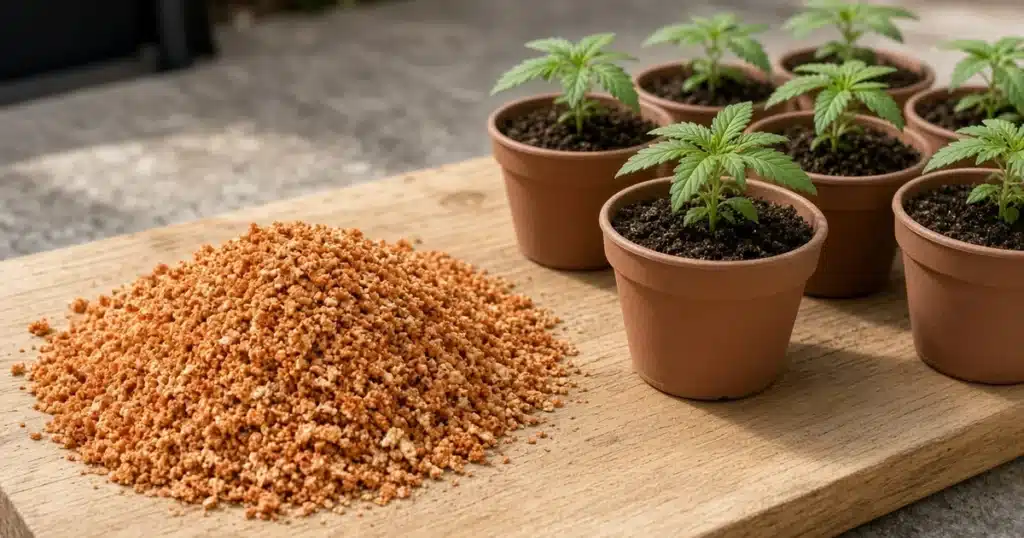
Crab processing leaves behind shells, legs and other parts that are not sold as food. Processors dry and grind this waste into a coarse meal that is often orange or tan and smells plainly of the sea. Most crab meal sold in the United States comes from Atlantic and Pacific coastal fisheries.
The shells are rich in calcium carbonate, the same compound that makes up limestone. The remaining protein supplies nitrogen. A little phosphorus comes along too. So crab meal acts as a mild fertilizer and a mild liming material in one bag.
An Oregon State Extension bulletin on liming western Oregon soils notes that coastal areas with fisheries sometimes supply shrimp and crab shells as liming materials. Its table gives shrimp and crab waste a calcium carbonate equivalent of 30 to 40 percent on a dry basis and a calcium content of 15 to 20 percent. The bulletin adds that the nitrogen in these byproducts caps how much can be applied.
Crab meal feeds and limes at once, and our guide explains which job each input does.
What Nutrients Does Crab Meal Provide?
Numbers vary by source. The University of New Hampshire Extension fertilizer chart lists crab meal at 6 percent nitrogen, 3 percent phosphorus and 25 percent lime. The chart suggests crab meal for a season long supply in soils that would also benefit from lime.
The Maine Soil Testing Service at the University of Maine uses a slightly different profile in its organic nutrient recommendation sheet. It lists crab meal at 6 percent nitrogen plus 6 percent phosphate and 25 percent lime. A fertilizer table from Iowa State gives a lower nitrogen figure of about 4.3 percent. The spread is normal for byproducts that vary with species, season and processing.
Grind size shifts the numbers as well. A finely ground meal exposes more shell and protein to microbes, so it gives up its nutrients sooner than a chunky grind with visible pieces of leg and shell. Potassium is low in every version. Crab meal is a nitrogen and calcium input first, with phosphorus as a bonus.
For cannabis, nitrogen fuels leafy vegetative growth, and calcium supports cell walls and new root tips. Our overview of calcium and cannabis plants explains how that nutrient moves through the plant.
If nitrogen is the only goal, compare crab meal with feather meal.
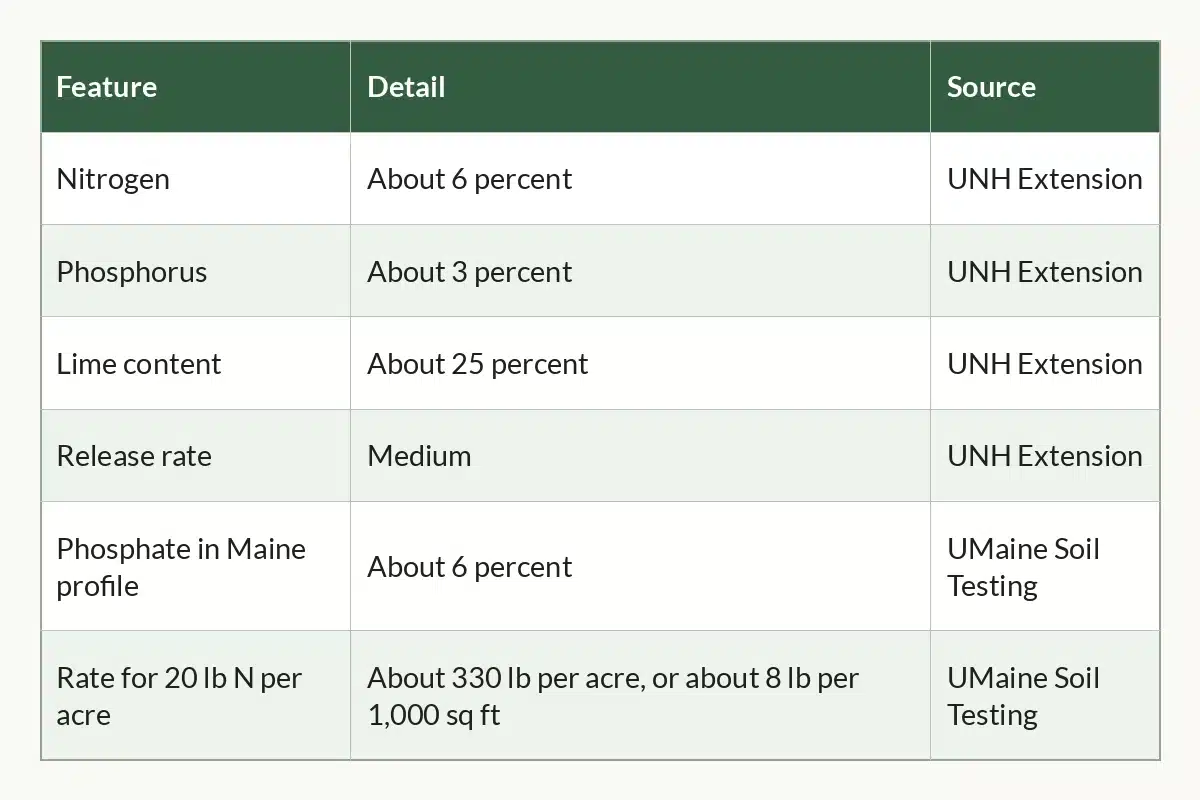
Crab Meal at a Glance
| Feature | Detail | Source |
|---|---|---|
| Nitrogen | About 6 percent | UNH Extension |
| Phosphorus | About 3 percent | UNH Extension |
| Lime content | About 25 percent | UNH Extension |
| Release rate | Medium | UNH Extension |
| Phosphate in Maine profile | About 6 percent | UMaine Soil Testing |
| Rate for 20 lb N per acre | About 330 lb per acre, or about 8 lb per 1,000 sq ft | UMaine Soil Testing |
How Fast Does Crab Meal Release Nutrients?
The New Hampshire chart rates crab meal as medium release. A footnote explains that medium release materials become available over a few months. Even the rapid ones take days to weeks before roots can use them. Warm soil speeds things up.
Moisture plays a part as well. Microbes that break down the protein need damp, airy soil, and they slow sharply in a dry pot or a waterlogged bed. A pace like that is what you want from a base application. Mixed into a bed or potting soil a few weeks before planting, crab meal starts feeding as young plants settle in and keeps going through much of the vegetative stage. It is too slow to rescue a plant that is already pale and hungry.
The lime portion works on its own schedule. Shell particles react with soil acidity gradually, and coarse pieces take longer. Fine meal works faster than chunky meal on both counts.
Is Crab Meal Good for Cannabis?
It can be, in the right soil. Crab meal fits acidic soils where both nitrogen and calcium are welcome. It also suits organic growers who want to build a soil mix from natural ingredients, often alongside compost, other meals and mineral powders. Our recipe for making super soil for cannabis plants shows how meals like this fit into a blend.
The main risk is pH. Because about a quarter of crab meal acts like lime, repeated doses in an already neutral or alkaline soil can push pH above the range cannabis likes. Micronutrients such as iron and manganese then become harder for roots to take up.
Crab meal also suits outdoor beds on the coast, where acidic, rain washed soils are common and local supply keeps the price down. Smell and pests are small worries. Fresh crab meal can attract animals if left on the surface, so mix it in well. Indoors, the sea smell fades once it is buried and moist.
If you are weighing organic meals against bottled feeds, our comparison of organic vs synthetic fertilizer for cannabis covers the tradeoffs in speed, control and soil biology.
How Much Crab Meal Should You Use?
The University of Maine sheet works per acre and says to divide by 40 to get a rate per 1,000 square feet. To supply 20 pounds of nitrogen per acre, it calls for about 330 pounds of crab meal. That works out to roughly 8 pounds per 1,000 square feet, or a little under a pound for a 100 square foot bed. Supplying more nitrogen scales the rate up in step.
Iowa State takes a fertility based approach. It suggests 150 pounds per 1,000 square feet for low fertility soil, 100 pounds for medium and 50 pounds where fertility is adequate. Those are much higher figures, which shows why a soil test matters. The two universities are answering different questions, one based on a nitrogen target and the other on general fertility.
Both schools land in the same place. Start with a test, match the rate to a real need and cut back when the material has been used several years in a row. In containers, keep the dose small. A few tablespoons mixed through a large pot of potting soil is a reasonable start. Watch pH in the runoff over time.
How to Use Crab Meal on Cannabis
- Test pH first. Crab meal is best for acidic or slightly acidic soil.
- Choose a fine grind if possible. Smaller particles release nutrients and lime faster.
- Pick a rate. Use the Maine nitrogen based rates or the Iowa State fertility rates as a guide, then scale down for containers.
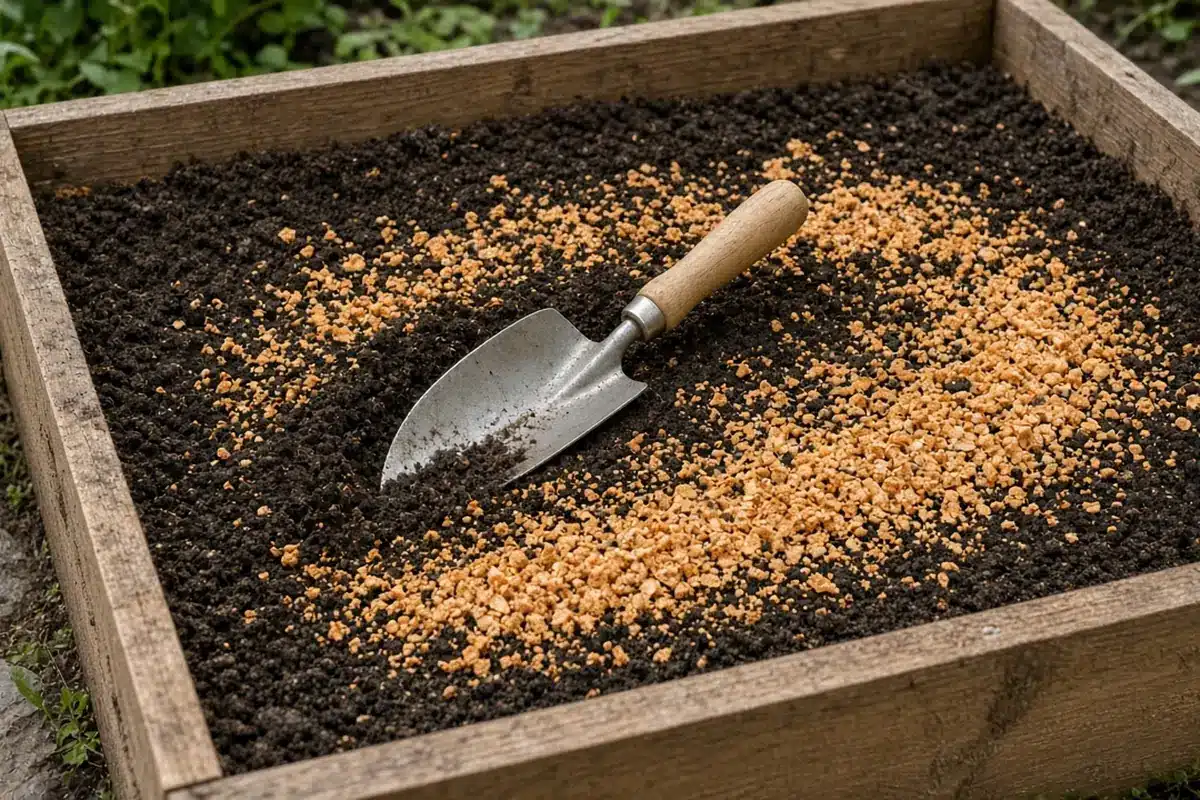
- Mix it deep. Bury it several inches down so it stays moist and out of reach of animals.
- Apply ahead of planting. Give it a few weeks to start breaking down.
- Skip extra lime. Do not add separate lime in the same season unless a test calls for it.
- Retest yearly. Track pH so repeated use does not raise it too far.
Troubleshooting Crab Meal Problems
pH keeps rising. The lime in crab meal is adding up. Stop using it and switch to a nitrogen source without lime.
Animals dig in the bed. The meal was left near the surface. Mix it deeper and cover with mulch.
Strong odor indoors. Bury the meal fully and keep the soil evenly moist rather than soggy.
Plants still pale after a few weeks. Release may be slow in cool soil. Wait for warmth or add a faster nitrogen source.
New leaves look pale between the veins. High pH may be limiting iron. Test pH and stop adding liming materials.
Sources
- University of New Hampshire Extension, Organic and Natural Fertilizers for the Home Ground and Garden: https://extension.unh.edu/sites/default/files/migrated_unmanaged_files/Resource003737_Rep5330.pdf
- University of Maine, Maine Soil Testing Service, Commercial Organic Nutrient Recommendations: https://umaine.edu/soiltestinglab/wp-content/uploads/sites/227/2016/07/ORGNUT.pdf
- Oregon State University Extension, Applying Lime to Raise Soil pH for Crop Production (Western Oregon), EM 9057: https://extension.oregonstate.edu/sites/extd8/files/documents/em9057.pdf
- Iowa State University Extension and Outreach, Selecting and Using Organic Fertilizers: https://yardandgarden.extension.iastate.edu/how-to/selecting-and-using-organic-fertilizers
FAQ
What is the NPK of crab meal?
Extension charts list about 6 percent nitrogen and 3 to 6 percent phosphorus, with very little potassium.
Does crab meal raise soil pH?
Yes. Roughly a quarter of it acts like lime, so it raises pH over time.
Can I use crab meal in containers?
Yes, in small amounts mixed into the potting soil. Check pH now and then over the season.
Is crab meal fast acting?
No. Extension charts rate it as medium release, over a few months.
Is crab meal good for alkaline soil?
Usually not, because its lime content can push pH even higher.