Humic and Fulvic Acids for Cannabis: What Research Shows
Quick answer: Humic and fulvic acids are complex carbon compounds that form when plant and animal residues break down into humus. They are sold as granules and liquids that claim to improve nutrient uptake. A Utah State University study found some benefits for maize and tomato at very high rates but little effect at the low rates growers can afford. University of Nebraska Extension notes that these acids are already part of the stable organic matter in good soil, built up over decades. For cannabis, building organic matter with compost does more than a bottle of humic acid in most cases.
What Are Humic and Fulvic Acids?
Soil organic matter is a mix of materials at different stages of decay. University of Nebraska Lincoln Extension describes it in a publication on raising soil organic matter as a continuum. At one end sit simple molecules that microbes break down in days. In the middle are partly decayed plant pieces. At the far end lies humus, the most stable portion, which includes fulvic acids, humic acids and humin.
Nebraska gives rough timelines for each pool, based on how quickly microbes can digest the material. Fulvic and humic acids persist for decades to centuries, and humin can last for centuries to millennia. That staying power is part of why humus matters so much. It holds nutrients and water, binds soil particles together and resists quick loss.
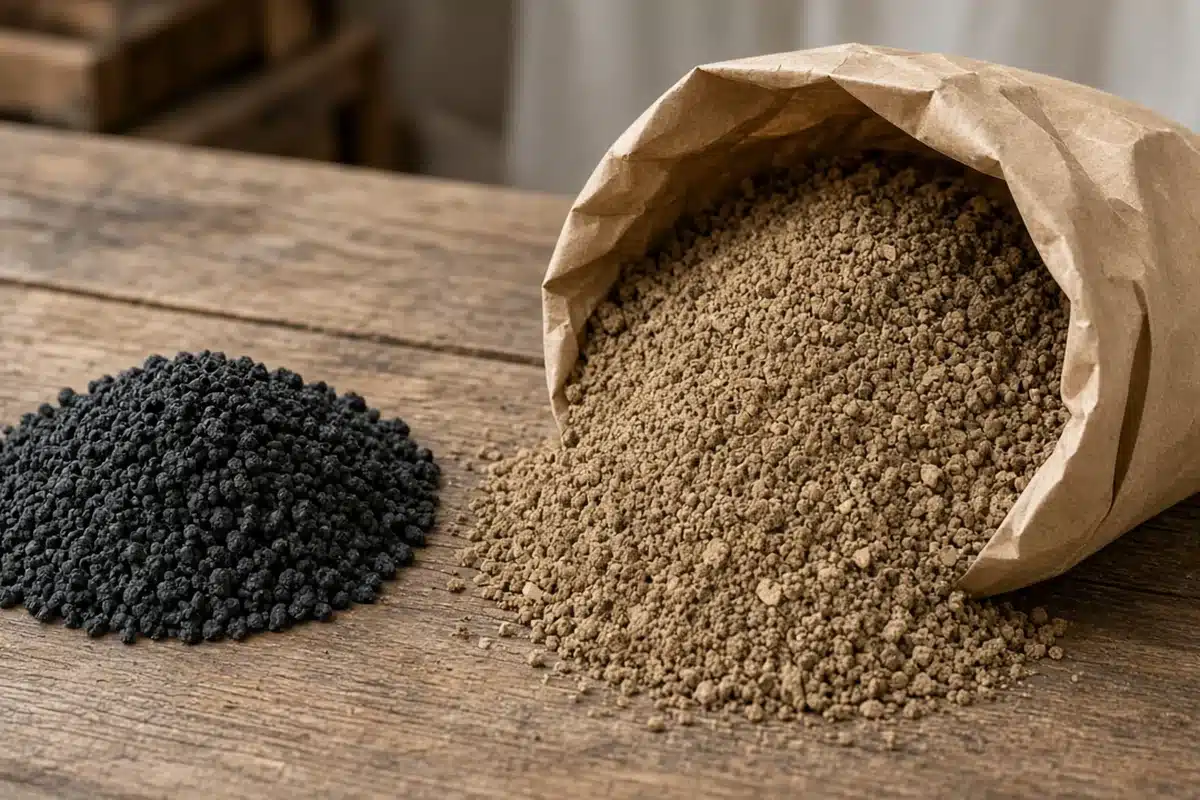
Humus gives rich soil its dark brown to black color. A handful of old forest floor or well aged compost shows what humus looks like, crumbly and almost spongy. Chemists sort the pieces by how they dissolve. Fulvic acids are the smaller, more soluble fraction. Humic acids are larger and dissolve under different conditions. Commercial products are usually extracted from mined deposits such as leonardite, a soft, oxidized form of lignite coal, or from peat and compost.
An Iowa State chart of organic inputs lists humates as an organic matter source with humic acids of variable composition. Pay attention to that word variable. Products sold under the same name can differ a lot from bag to bag.
To see where humic products fit, read how soil amendments differ from fertilizers.
Do Humic Acids Help Plants Grow?
Only in limited cases, according to one Utah State study. Claims for humic products are broad. Labels often mention stronger roots, better nutrient uptake and improved soil life. Research gives a more cautious picture.
A master’s thesis from Utah State University, supervised by crop physiologist Bruce Bugbee, tested several commercial humic and fulvic products. Its abstract on humic and fulvic acids and plant growth points out that iron gets the most research attention among the nutrients humic substances are said to help plants absorb.
The study had two goals. First, it asked whether humic substances could reduce iron shortage yellowing in maize grown in sand at high pH. One dry granular humic acid, applied at a heavy rate mixed into the sand plus a dose in the irrigation water, significantly reduced the yellowing in that maize work.
Second, it asked whether humic products improve growth and yield. In tomato grown in soil columns in a greenhouse, one granular blend gave bigger roots, yet shoots and fruit yield stayed the same. Several liquid products increased tomato fruit number or plant mass when applied at 50 milliliters per liter of irrigation water. The author called that an extremely high rate. At an economical rate, the same products showed no significant benefit.
The thesis concludes that humic products showed some effects on nutrition and growth at high rates and limited effects at low, affordable rates. The author adds that most rates reported in published research are far higher than what farmers actually apply.
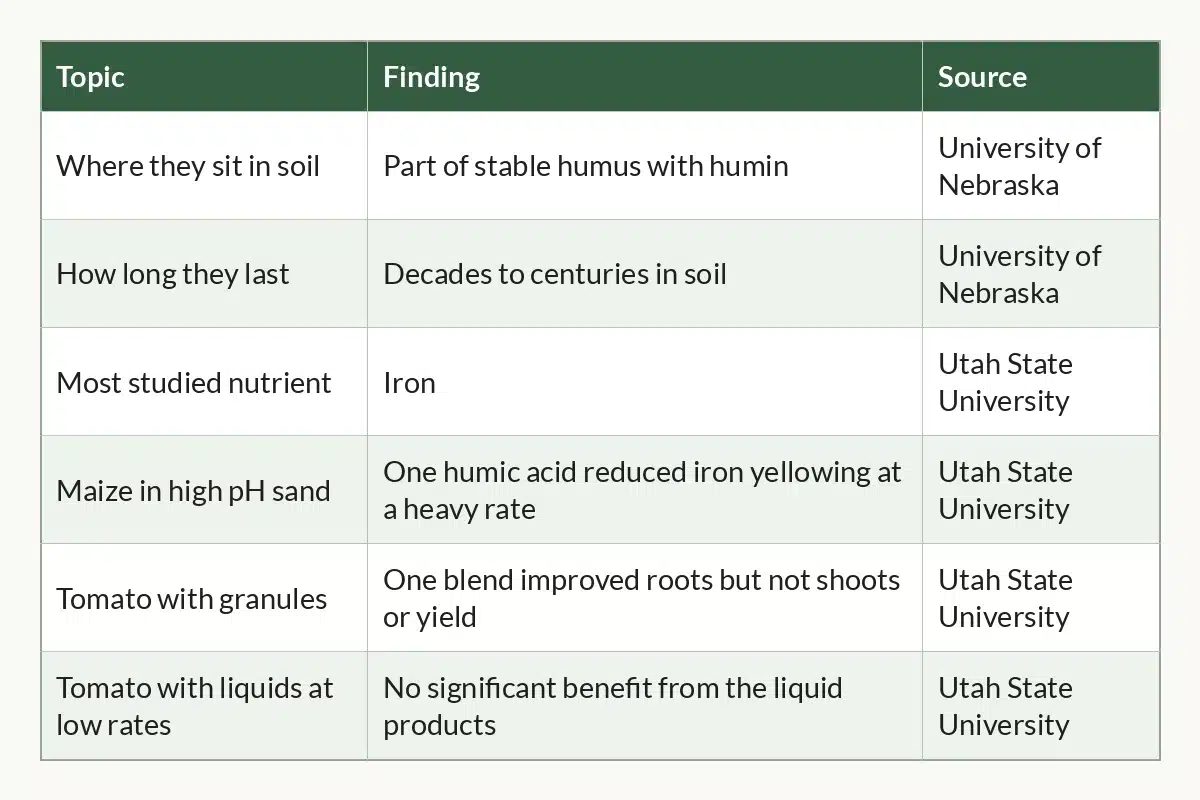
Humic and Fulvic Acids at a Glance
| Topic | Finding | Source |
|---|---|---|
| Where they sit in soil | Part of stable humus with humin | University of Nebraska |
| How long they last | Decades to centuries in soil | University of Nebraska |
| Most studied nutrient | Iron | Utah State University |
| Maize in high pH sand | One humic acid reduced iron yellowing at a heavy rate | Utah State University |
| Tomato with granules | One blend improved roots but not shoots or yield | Utah State University |
| Tomato with liquids at low rates | No significant benefit from the liquid products | Utah State University |
Are Humic Acids Worth Using on Cannabis?
Cannabis has not been tested in the Utah State work, so the results apply to maize and tomato. The pattern still tells you something. Effects showed up mainly at doses most growers would never pay for, and only in some of the products tested. At practical rates, measurable gains faded.
Product claims also run ahead of the science in another way. Many labels cite studies done at strengths far above the label rate, so a strong lab result may not carry over to the dose in the bottle. There are situations where a humic product may be worth a trial. Soilless mixes and inert media hold little natural organic matter. Plants growing at high pH, common in parts of the arid West, can struggle to take up iron, and the maize result hints that a humic acid might help there at enough strength. And some growers just like the idea enough to try it on a few plants. Coco coir, for example, starts with very little humus, so a grower working in coco has more reason to experiment than one using a compost rich bed.
For most soil grown cannabis, compost and other organic matter provide humic substances naturally and add much more besides. Our piece on living soil explains how a biologically active bed builds those compounds over time. Peat also carries humic material. The peat moss guide describes how it behaves in potting mixes.
How Do Humic Acids Compare With Compost?
Compost feeds microbes, improves structure and adds a slow trickle of nutrients. As it ages in soil, part of it becomes humus, including the same humic and fulvic fractions sold in bottles. Nebraska stresses that building organic matter is a long process. Practices such as adding residues, reducing tillage and keeping roots in the soil all contribute.
A humic product adds a small amount of an already processed fraction. It does not feed soil life the way compost does, and it contributes no real nitrogen, phosphorus or potassium. At best it is a supplement, never a replacement for organic matter or a balanced feed. Lean on it alone and you will likely end up with hungry plants in a soil that has not improved.
Price matters here as well. A bag of compost often costs less than a small bottle of concentrated humic liquid and covers far more soil. Before spending money, test your soil. A report that shows good organic matter levels suggests humic products will add little. Our page on soil testing for cannabis explains which numbers on the report matter most.
How to Try Humic Acid on Cannabis
- Check organic matter first. If your soil or mix already has plenty, skip the product.
- Pick one product. Read the label for the source and concentration.
- Follow the label rate. Avoid stacking several humic products at once.
- Run a side by side test. Use the product on a few plants and leave a few untouched for comparison.
- Watch pH. Some liquid products are alkaline or acidic and can shift runoff readings.
- Keep feeding normally. Humic acid does not replace nitrogen, phosphorus or potassium.
- Judge results honestly. If you see no difference after a full cycle, the money may be better spent on compost.
Troubleshooting Humic Acid Problems
No visible effect. That matches the low rate results in the Utah State study. Put resources into organic matter and feeding instead.
Runoff pH changed. The product itself may be shifting pH. Test it in water first and adjust.
Dark staining on pots and floors. Humic liquids stain. Mix and pour over a tray.
Leaves still yellow at high pH. The root cause may be pH. Correct pH rather than relying on humic acid alone.
Clogged drippers. Some granular products leave residue. Dissolve fully and filter before running through irrigation lines.
Sources
- Utah State University, Jason Tew, Humic and Fulvic Acids: https://digitalcommons.usu.edu/etd/6709/
- University of Nebraska Lincoln Extension, Soil Management for Increased Soil Organic Matter (G2283): https://extensionpubs.unl.edu/publication/g2283/2017/html/view
- Iowa State University Extension and Outreach, Selecting and Using Organic Fertilizers: https://yardandgarden.extension.iastate.edu/how-to/selecting-and-using-organic-fertilizers
FAQ
What is the difference between humic and fulvic acid?
Fulvic acids are the smaller, more soluble fraction of humus. Humic acids are larger. Both form as organic matter breaks down.
Do humic acids help cannabis grow?
No cannabis research has tested that. In a Utah State study, liquid products raised tomato fruit number or plant mass only at an extremely high rate and showed no significant benefit at an economical rate.
Can I make humic acid at home?
Not directly, but adding compost builds humic substances in soil over time.
Are humic acids a fertilizer?
No. They add almost no nitrogen, phosphorus or potassium.
Is humic acid useful in coco or hydroponics?
It may be worth a small trial in low organic media, but results vary and label rates should guide use.