Grow Light Heat Management in Small Spaces
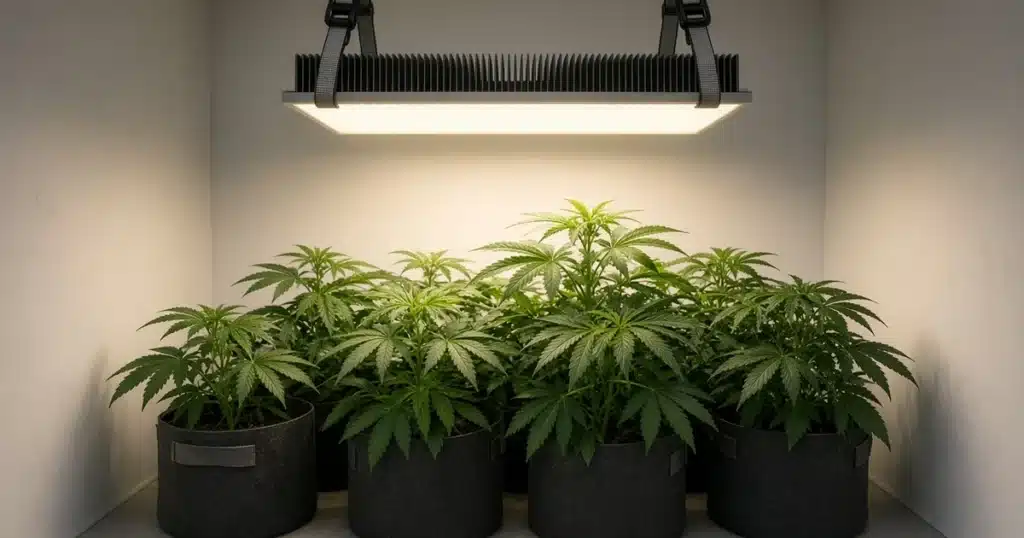
Quick answer: In a small grow space, most light heat builds up around the fixture and in the air, not in the light that reaches the leaves. University of Alaska Fairbanks Extension explains that LEDs produce no heat in the beam itself and that heat is generated at the fixture, where it can be removed more easily. So the job is to carry heat away from the fixture with steady airflow, keep the driver outside the space when the light allows it, and choose LEDs over HPS lamps where headroom is tight. MU Extension warns that HPS radiant heat can scorch plants in low clearance setups.
Where Does Grow Light Heat Come From?
Every grow light turns part of its power into heat. The question is where that heat ends up. Older lamps send much of it forward toward the plants as radiant heat. LEDs keep most of it at the back of the fixture.
The University of Alaska Fairbanks guide to controlling the greenhouse environment explains that an LED makes its light without putting heat into the beam, so the diodes stay cool to the touch. The warmth collects in the fixture body instead, which UAF says makes it simpler to shed. It also notes that LEDs can be placed closer to plants than HID lamps.
The Oklahoma State LED grow light fact sheet agrees. It lists low heat emission among the advantages of LEDs and explains that heat leaves through a heat sink rather than the face of the light, which allows plants and LEDs to sit close together.
Neither source says LEDs add no heat to a room. The watts still end up as warmth in the space. What changes is where that warmth appears and how easy it is to remove.
That difference matters most at the canopy. With a lamp that throws radiant heat forward, the top leaves take the hit even when the air reading looks fine. Our guide to cannabis heat stress shows the signs on the leaves. With an LED, the air around the fixture warms first, so a thermometer near the light and a fan across the heat sink tell you far more than a reading at the floor. Place your sensor at canopy height, under the light, to see what the plants actually feel.
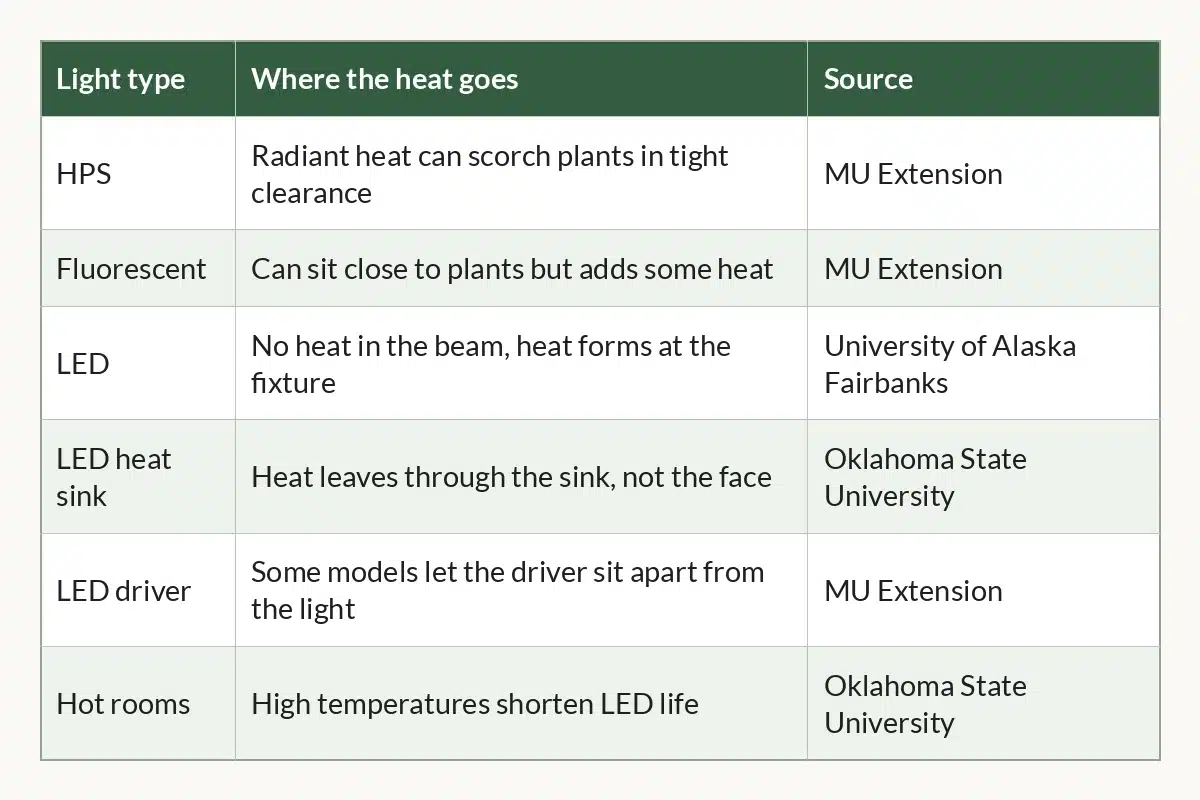
Grow Light Heat at a Glance
| Light type | Where the heat goes | Source |
|---|---|---|
| HPS | Radiant heat can scorch plants in tight clearance | MU Extension |
| Fluorescent | Can sit close to plants but adds some heat | MU Extension |
| LED | No heat in the beam, heat forms at the fixture | University of Alaska Fairbanks |
| LED heat sink | Heat leaves through the sink, not the face | Oklahoma State University |
| LED driver | Some models let the driver sit apart from the light | MU Extension |
| Hot rooms | High temperatures shorten LED life | Oklahoma State University |
Why Do Small Spaces Overheat Faster?
Less air means less room for heat to spread. A closet or small tent has very little air volume, so the same fixture raises its temperature faster than it would in an open room. The canopy also sits closer to the light, which leaves less space for warm air to rise away from the leaves.
The MU Extension guide to understanding grow lights calls heat and space important considerations, especially in stacked or vertical systems where clearance is limited. In that setting, it rules out high pressure sodium lamps, since their radiant heat could scorch the crop and the lamps take up too much room. LEDs and fluorescent tubes can both sit close to plants without that damage, MU adds, though each still warms whatever grows on the next shelf up.
That guidance was written for controlled environment farms with racks of seedlings and greens. A small cannabis grow faces the same squeeze in miniature. Our climate guide for grow rooms lists the temperature ranges to aim for once you know how much heat you are fighting.
How Do You Manage Grow Light Heat?
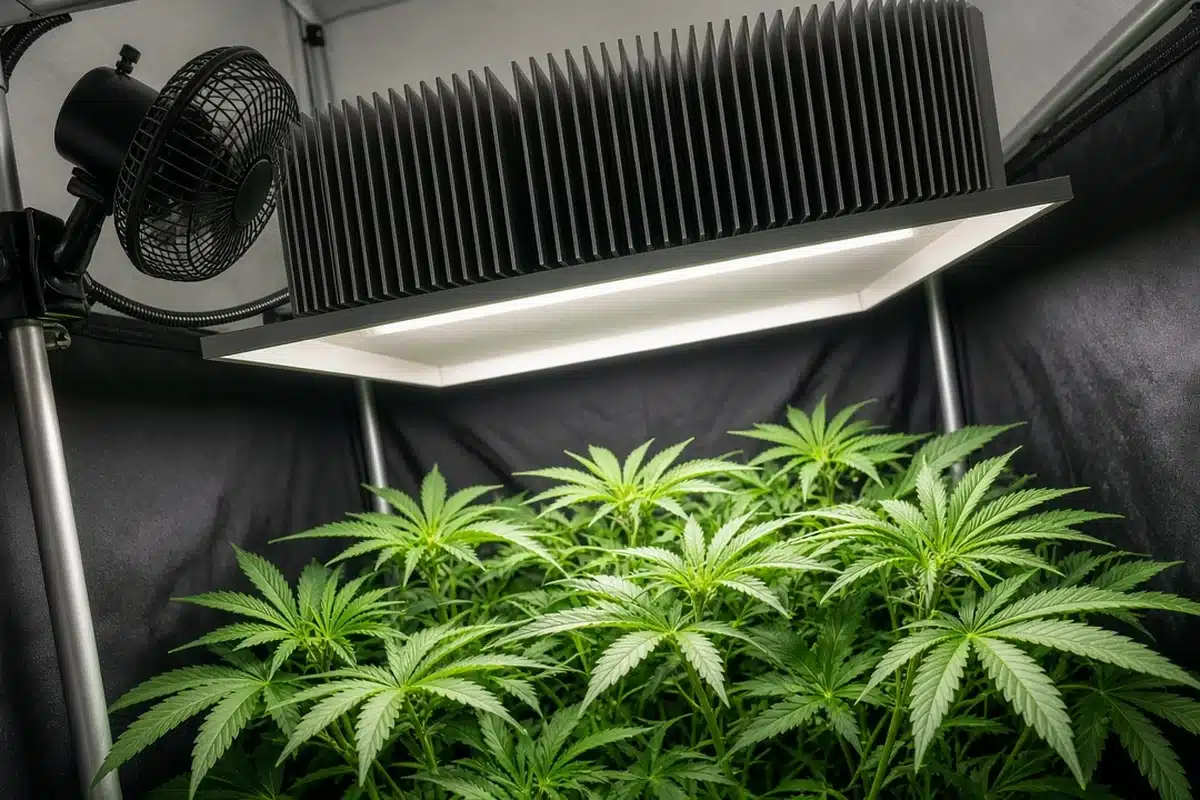
- Move air across the fixture. UAF explains that LED heat forms in the fixture body, which is the easiest place to remove it. Air moving across the heat sink carries it away.
- Exhaust the warm air near the top. Heat rises, so pulling air out high removes the warmest layer first.
- Keep the driver outside if you can. MU Extension notes that some LED lights allow the driver and power supply to be separated from the fixture to balance heat dissipation.
- Choose LEDs in tight spaces. Where clearance is limited, MU Extension rules out HPS lamps because of their radiant heat.
- Keep air moving around young plants. Iowa State Extension tells seedling growers to keep air circulating so fixture heat does not linger around the young plants.
- Clean the heat sink. Oklahoma State links heat release to LED life expectancy, and dusty fins hold heat in.
- Watch for heat building above stacked shelves. MU Extension notes that lights warm the plants on the shelf above them.
Hanging height is a separate topic. Our guide to LED light distance for cannabis covers how far to keep fixtures from the canopy at each stage.
Does Heat Hurt the Light as Well as the Plants?
Yes. Oklahoma State lists high temperatures in the environment among the drawbacks of LEDs, noting that they shorten lifespan and reduce efficiency. The same fact sheet ties heat release to life expectancy. So clearing heat from the fixture protects your investment as well as your plants.
The Iowa State Extension answer on seedling lights offers a reminder from the plant side. Writing about vegetable and flower seedlings rather than cannabis, it tells growers to keep enough air moving around young plants that fixture heat is carried off. The same idea applies to any plant under lights in a small space.
A fixture with clogged fins or a stalled fan will run hotter than it should. Built in fans on LED fixtures are small and run for long hours, so check that they still spin each time you clean. Give the heat sink a dusting while you are at it, every time you clean the tent.
How Do You Move Heat Out of a Small Space?
Exhaust is the main tool. An inline fan pulling warm air out from up near the tent roof replaces it with cooler room air. If the room itself is warm, the tent can only be as cool as the air it draws in.
Our guide to inline fan CFM for tents explains how to size exhaust for the space and the light load. Once exhaust is right, a small circulation fan moving air across the canopy and fixture helps keep hot spots from forming.
If exhaust alone cannot keep up in summer, the room itself needs cooling. A cooler room lowers the starting temperature of every cubic foot of air the fan pulls through.
Intake placement also matters here. Air drawn in low and pushed out high follows the natural rise of warm air, so the coolest air reaches the canopy first. If your tent has openings at several heights, use the lowest ones for intake and keep the warmest layer near the light moving toward the exhaust.
Troubleshooting Grow Light Heat Problems
Upper leaves feel hot. Warm air is pooling under the light. Improve exhaust near the top and add airflow across the fixture.
The tent is fine with lights off but hot with lights on. The lights are putting out more heat than the exhaust can clear. Check fan size and intake openings.
LED output seems to drop over time. Heat may be shortening its life. Oklahoma State notes that high temperatures reduce LED lifespan and efficiency.
Plants on a lower shelf are fine but the top shelf is warm. MU Extension explains that lights on one shelf warm the plants above them. Add airflow between shelves.
The driver is too hot to touch. Move it outside the tent if the light allows. MU Extension notes that some LEDs let the driver sit apart from the fixture.
Sources
- University of Alaska Fairbanks Cooperative Extension Service, Controlling the Greenhouse Environment: https://www.uaf.edu/ces/publications/database/gardening/controlling-greenhouse-environment.php
- Oklahoma State University Extension, LED Grow Lights for Plant Production (HLA-6450): https://pods.okstate.edu/fact-sheets/HLA-6450pod.pdf
- University of Missouri Extension, Controlled Environment Agriculture: Understanding Grow Lights (G6987): https://extension.missouri.edu/publications/g6987
- Iowa State University Extension, How Do I Set Up Supplemental Lights for My Seedlings: https://yardandgarden.extension.iastate.edu/faq/how-do-i-set-supplemental-lights-my-seedlings
FAQ
Do LED grow lights give off heat?
Yes, but UAF explains that the heat forms at the fixture, not in the beam. That makes it easier to remove with airflow.
Are HPS lights too hot for a small tent?
MU Extension rules out HPS lamps where clearance is limited, since their radiant heat could scorch plants.
Should I put the LED driver outside the tent?
If your light allows it, MU Extension notes that separating the driver helps balance heat dissipation.
Does heat shorten LED life?
Oklahoma State lists high temperatures among the factors that shorten LED lifespan and reduce efficiency.
Will a fan on the fixture help?
UAF notes that LED heat collects in the fixture, so air across the heat sink helps carry it off.