Langbeinite for Cannabis: Potassium and Magnesium in One
Quick answer: Langbeinite is a naturally mined mineral made of potassium sulfate and magnesium sulfate. It carries about 22 percent potash plus roughly 11 percent magnesium and a similar share of sulfate. UC Master Gardeners in San Luis Obispo County describe it as pH neutral, and University of Wisconsin Extension gives it a low salt index of 43, far below potassium chloride. For cannabis, langbeinite is a handy single source when a soil test shows both potassium and magnesium running low. Skip it if magnesium is already high or if you are adding dolomite lime.
What Is Langbeinite?
Langbeinite is a crystalline mineral found in ancient evaporated sea beds. The best known United States deposits lie near Carlsbad, New Mexico. Miners extract the ore, wash out impurities and crush it into granules or a fine powder. Chemically it is potassium magnesium sulfate, sometimes written with the formula K2SO4 plus two units of MgSO4.
The naming trips people up, since the same material appears on labels and in charts under different titles. University of Wisconsin Extension lists it as potassium magnesium sulfate in its publication Soil and Applied Potassium. Colorado State University Extension uses potassium magnesium sulfate as well. Garden centers often sell it under trade names, so check the ingredient line rather than the name on the front.
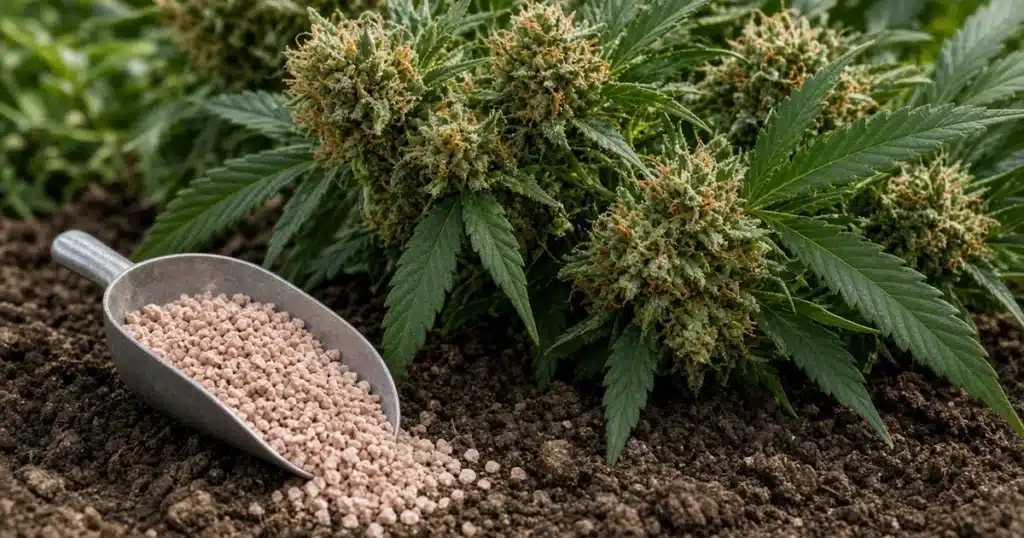
The granules are hard, slightly glassy and often pink, tan or gray depending on trace impurities. They dissolve fully in water over time but more slowly than finely powdered salts. Because it is mined and only washed and crushed, langbeinite is generally accepted in organic production. Growers who sell certified crops should confirm with their certifier.
Langbeinite feeds the plant rather than changing soil structure, which is the split between fertilizers and soil amendments.
What Nutrients Does Langbeinite Supply?
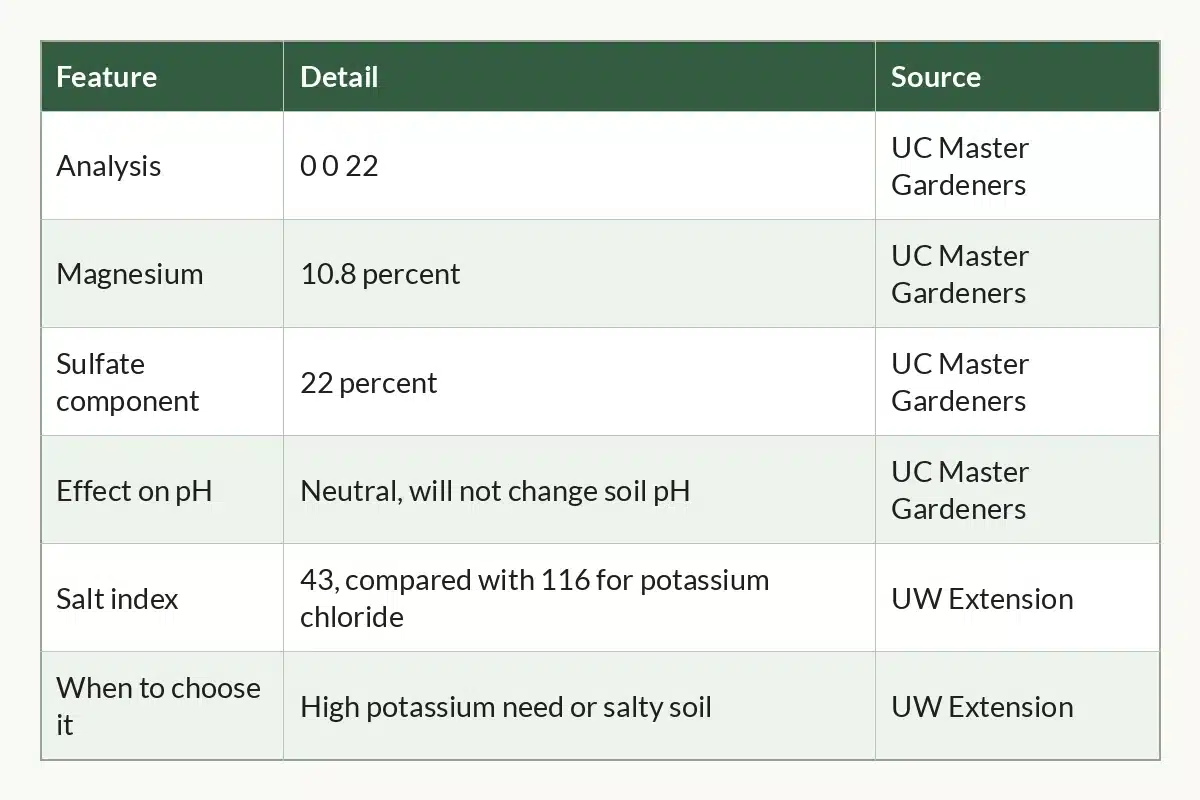
The UC Master Gardeners guide to fertilizers and amendments lists langbeinite with an analysis of 0 nitrogen, 0 phosphate and 22 potash. It credits the mineral with 22 percent soluble potassium, a 22 percent sulfate component and 10.8 percent magnesium. A University of New Hampshire Extension chart gives similar figures, 22 percent potassium and 11 percent magnesium, and rates the release as medium to rapid.
All three nutrients matter for cannabis. Potassium supports water movement and sugar transport, especially during flowering. Magnesium sits at the center of the chlorophyll molecule, so shortages show up as yellowing between the veins of older leaves. Our explainer on why magnesium matters for cannabis plants covers that role in more detail. Iowa State and UNH Extension charts give a similar sulfate share, 22 and 23 percent. Sulfate feeds protein building and many enzymes, and our article on sulfate nutrition and cannabis explains why it is often overlooked.
Growers like the mineral mainly for its balance. Its ratio of potassium to magnesium is roughly two to one, which suits many soils where both run short together. Langbeinite contains no nitrogen or phosphorus, so it fills a specific gap rather than acting as a complete feed.
Langbeinite at a Glance
| Feature | Detail | Source |
|---|---|---|
| Analysis | 0 0 22 | UC Master Gardeners |
| Magnesium | 10.8 percent | UC Master Gardeners |
| Sulfate component | 22 percent | UC Master Gardeners |
| Effect on pH | Neutral, will not change soil pH | UC Master Gardeners |
| Salt index | 43, compared with 116 for potassium chloride | UW Extension |
| When to choose it | High potassium need or salty soil | UW Extension |
Why Does the Salt Index Matter?
Every fertilizer raises the salt content of the soil solution to some degree. The salt index compares products on that scale. Wisconsin lists potassium chloride, the most common potassium fertilizer, at a salt index of 116. Potassium magnesium sulfate, the chemical name for langbeinite, comes in at 43.
Wisconsin advises growers who need heavy potassium rates, or who already face salty soil, to split applications or switch to a lower salt material such as potassium magnesium sulfate. That guidance was written for Wisconsin field crops, yet the chemistry holds anywhere.
A lower salt index does not mean a product cannot cause trouble. It means that for the same amount of potassium, less salt load reaches the roots. Rate still matters. That matters most in containers. A pot holds a small volume of mix, and salts build quickly when fertilizer goes in faster than water flushes it out. A mineral that brings potassium, magnesium and sulfate with a low salt index suits that setting. Langbeinite also avoids chloride, which some sensitive crops dislike.
Is Langbeinite Good for Cannabis?
Langbeinite suits cannabis in a few clear situations. When a soil test shows both potassium and magnesium on the low side, langbeinite covers both with one product. In sandy soils that leach, its moderate release keeps nutrients available longer than a quick soluble salt. In beds that already have a good pH, its neutral reaction means you can add potassium without nudging pH up or down.
Timing works in its favor too. Many growers add it to beds before planting so the potassium is ready by flowering, then top up lightly around the drip line in midseason if a test or the leaves suggest a need. It also has limits. An Iowa State Extension list of organic inputs warns not to use this material when applying dolomitic limestone, and to substitute greensand or another potassium source. Dolomite already adds magnesium, and stacking both can tip the balance between calcium, magnesium and potassium. Too much magnesium relative to potassium can make potassium harder for roots to take up.
Confirm the need before you buy. Our guide to potassium deficiency in cannabis shows the leaf signs that point to a real shortage, and a soil test settles the question.
How Much Langbeinite Should You Use?
Rates depend on your soil test. For each thousand square feet, Iowa State suggests 10 pounds on low fertility ground, 7 on medium and 5 on soil that is already adequate. Those are small amounts compared with organic meals, because the mineral is concentrated.
The University of Maine soil lab offers a nutrient based approach. Its organic nutrient sheet shows about 90 pounds of this mineral per acre to supply 20 pounds of potash. Dividing by 40, as the sheet instructs, gives a little over 2 pounds per thousand square feet for that modest target.
Keep in mind that these figures come from general garden and farm guidance. Cannabis is a hungry crop in flower, yet more potassium than the soil needs brings no extra benefit and can crowd out calcium and magnesium uptake. For containers, scale down sharply. A teaspoon or two mixed through a large pot of soil is plenty to start. Water well afterward and watch the leaves over the next couple of weeks before deciding whether more is needed.
How to Use Langbeinite on Cannabis
- Test the soil. Confirm that potassium and magnesium are both low before using it.
- Check for dolomite. Skip langbeinite in the same season you apply dolomitic lime.
- Measure carefully. Use the low end of the suggested range, especially in pots.
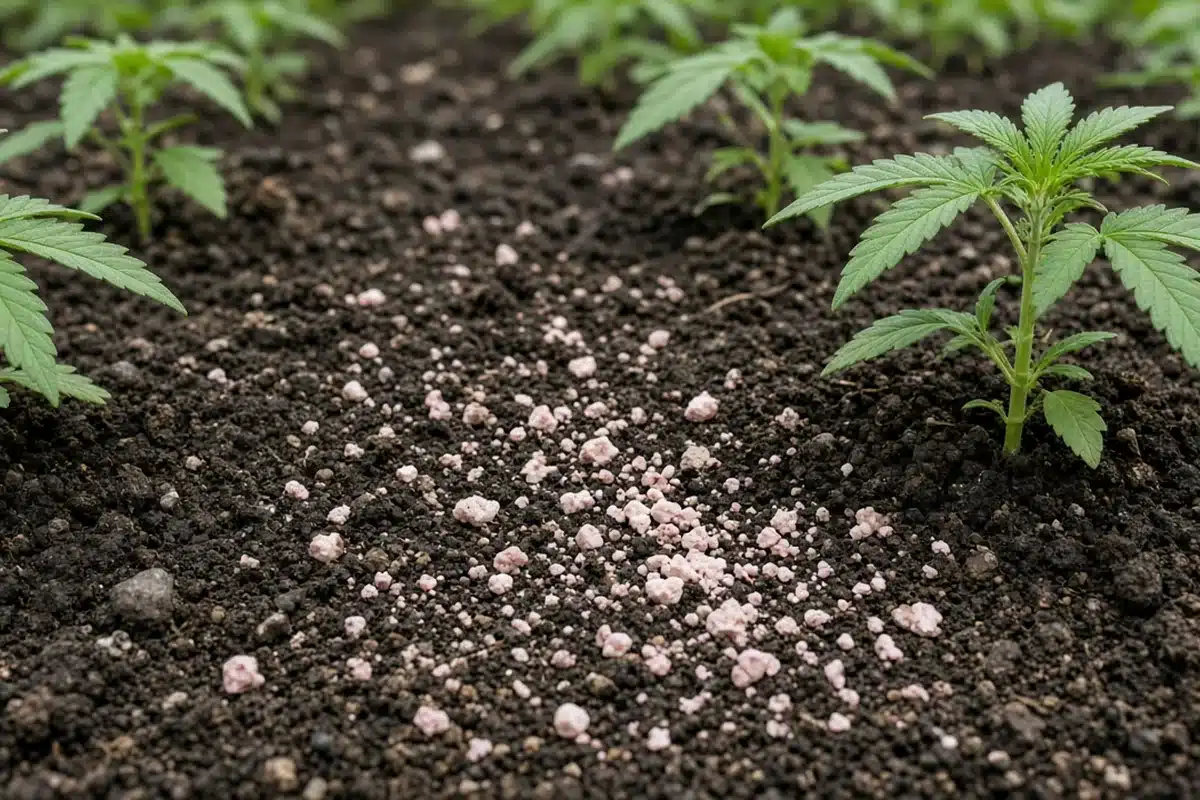
- Blend it into the upper soil. Mix granules through the soil or potting mix before planting.
- Side dress if needed. For established plants, scatter a small amount around the drip line and scratch it in.
- Water thoroughly. The mineral dissolves with moisture and moves to the roots.
- Watch older leaves. Improved color between the veins suggests magnesium is reaching the plant.
- Retest next season. Track potassium and magnesium to avoid buildup.
Troubleshooting Langbeinite Problems
Granules stay visible for weeks. Coarse grades dissolve slowly in dry soil. Keep the soil evenly moist or choose a finer grade.
Yellowing between veins persists. pH or root problems may be blocking uptake. Test pH and check drainage.
Leaf edges brown after use. Too much salt may be present. Flush containers with plain water and reduce the rate.
Potassium looks low despite applications. High magnesium or calcium can compete. Review the soil test balance.
Unsure if a product is langbeinite. Look for potassium magnesium sulfate in the ingredient list.
Sources
- UC Master Gardeners of San Luis Obispo County, Fertilizers and Amendments: https://ucanr.edu/site/uc-master-gardeners-san-luis-obispo-county/fertilizers-and-amendments
- University of Wisconsin Extension, Soil and Applied Potassium (A2521): https://corn.aae.wisc.edu/Management/pdfs/a2521.pdf
- University of New Hampshire Extension, Organic and Natural Fertilizers for the Home Ground and Garden: https://extension.unh.edu/sites/default/files/migrated_unmanaged_files/Resource003737_Rep5330.pdf
- Iowa State University Extension and Outreach, Selecting and Using Organic Fertilizers: https://yardandgarden.extension.iastate.edu/how-to/selecting-and-using-organic-fertilizers
- University of Maine, Maine Soil Testing Service, Commercial Organic Nutrient Recommendations: https://umaine.edu/soiltestinglab/wp-content/uploads/sites/227/2016/07/ORGNUT.pdf
FAQ
What is langbeinite made of?
Potassium sulfate and magnesium sulfate in one mined mineral.
Does langbeinite change soil pH?
UC Master Gardeners describe it as neutral, so it should not shift pH.
Is langbeinite better than Epsom salt for cannabis?
They do different jobs. Epsom salt adds magnesium and sulfate only, while langbeinite also adds potassium.
Can I use langbeinite with dolomite lime?
Iowa State advises against it because both add magnesium.
Is langbeinite fast acting?
It is water soluble with a medium to rapid release, faster than most organic potassium sources.