Sulfate of Potash for Cannabis: A Low Salt Potassium Source
Quick answer: Sulfate of potash, also called potassium sulfate, is a concentrated potassium fertilizer with an analysis of 0 0 50. UW Extension in Wisconsin gives it a salt index of 46, compared with 116 for potassium chloride, and recommends lower salt sources like it when high potassium rates are needed or soil salinity is a concern. A New Hampshire Extension chart rates its release as rapid and suggests it for quick correction of low soil potassium. Cannabis growers can lean on it when a soil test or late season leaf signs point to a potassium shortage, especially in containers where salts build up quickly.
What Is Sulfate of Potash?
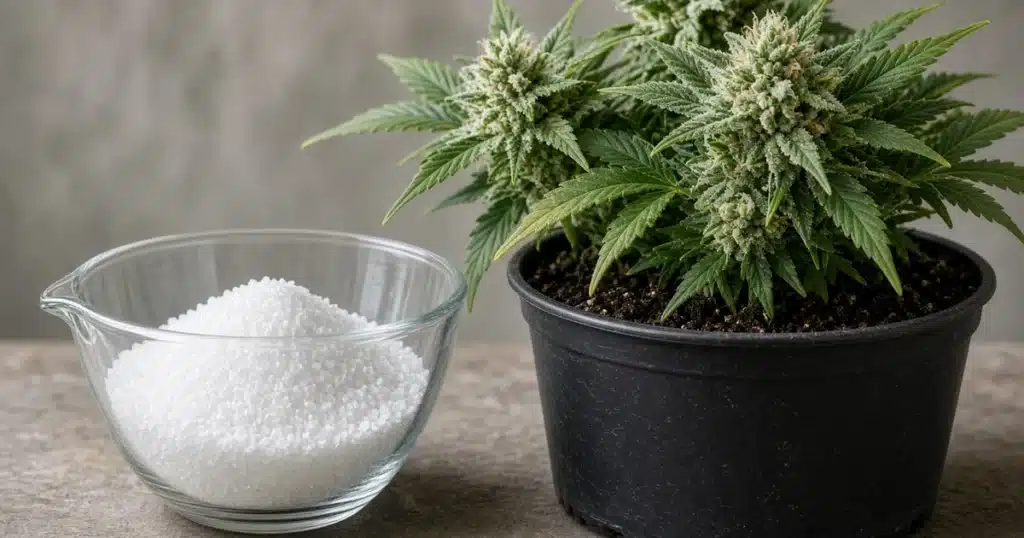
Sulfate of potash is a salt made of potassium and sulfate. It dissolves readily in water, though more slowly than some other potassium salts, and it leaves no residue when fully dissolved. It comes as white crystals, a fine soluble powder or small granules. Some is mined from natural deposits and some is manufactured from other potassium minerals. Gardeners often see it abbreviated as SOP.
Its sibling, muriate of potash, is potassium chloride. Muriate is the cheapest and most common potassium fertilizer for field crops, according to the Wisconsin bulletin Soil and Applied Potassium. Sulfate of potash costs more but brings two advantages. It carries a lower salt load per pound and no chloride.
The UNH Extension fertilizer chart lists potassium sulfate at 50 percent potassium plus 18 percent of a second nutrient that it delivers in sulfate form. A footnote warns that not every source qualifies for certified organic production, so organic growers should check which form they buy.
Sulfate of potash is a fertilizer, not a soil conditioner. Read more on what separates amendments from fertilizers.
Why Does Cannabis Need Potassium?
Potassium regulates water movement, opens and closes leaf pores and helps move sugars through the plant. Demand climbs during flowering, when the plant fills buds and transpires heavily under strong light. Our overview of why potassium matters for cannabis plants covers these roles.
Potassium is very mobile inside the plant. Wisconsin explains that when supply runs short, the plant moves potassium from older leaves to new growth, so signs appear first on lower leaves. In field crops, the edges of older leaves yellow and later brown. Cannabis shows a similar pattern, with scorched looking leaf margins and tips on older fan leaves. Our guide to potassium deficiency in cannabis plants shows how to recognize it and rule out problems that look similar.
Wisconsin also notes that soils commonly hold more than 20,000 parts per million of total potassium, yet almost all of it sits inside minerals that plants cannot use. Only a small exchangeable share is available at any time. That explains why a soil with plenty of total potassium can still leave plants short. Sandy soils hold the least in reserve, while clays and soils rich in organic matter keep more on their exchange sites. Container mixes based on peat, coir or bark start with very little, which is why potted cannabis so often depends on added potassium during flower.
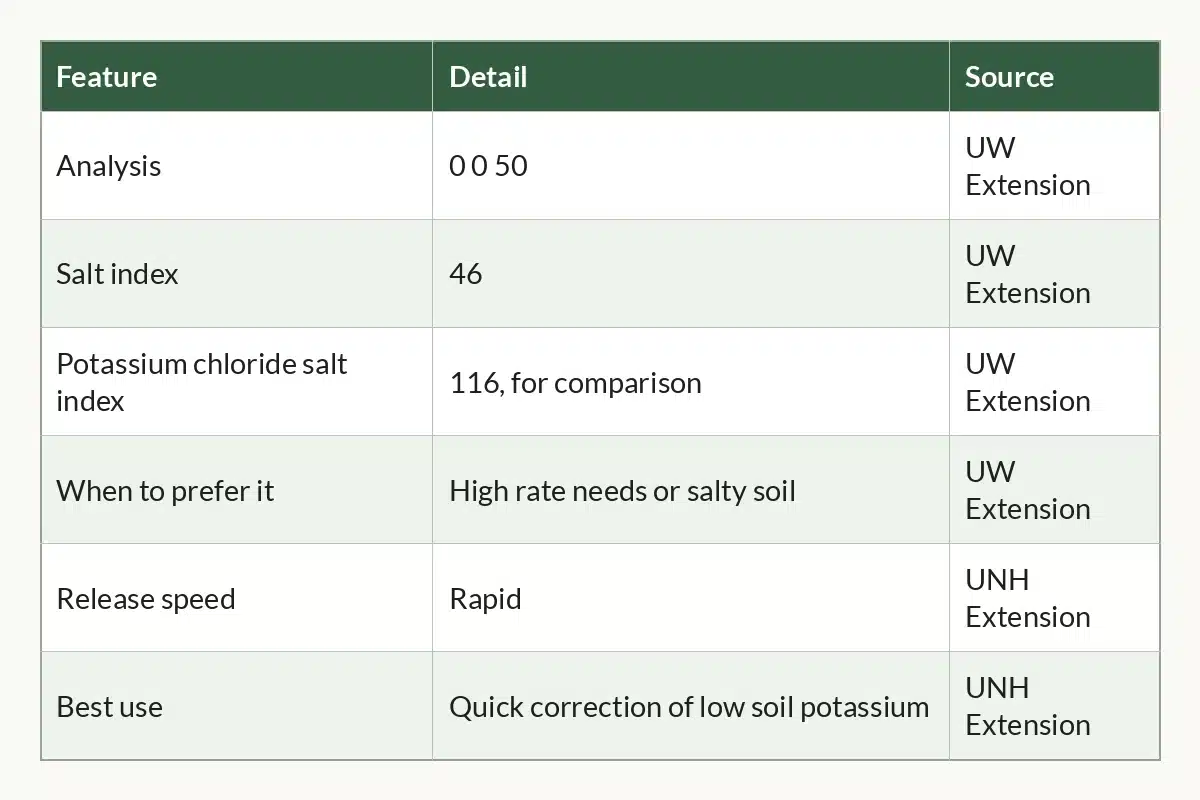
Sulfate of Potash at a Glance
| Feature | Detail | Source |
|---|---|---|
| Analysis | 0 0 50 | UW Extension |
| Salt index | 46 | UW Extension |
| Potassium chloride salt index | 116, for comparison | UW Extension |
| When to prefer it | High rate needs or salty soil | UW Extension |
| Release speed | Rapid | UNH Extension |
| Best use | Quick correction of low soil potassium | UNH Extension |
How Does Sulfate of Potash Compare With Muriate of Potash?
Both supply potassium that plants can use right away, and both carry it as a simple salt that dissolves in soil water. Where they part ways is salt and chloride.
Wisconsin’s potassium table lists potassium chloride at a salt index of 116 and potassium sulfate at 46. A University of Wisconsin soil science presentation on the salt index of fertilizers compares them per unit of nutrient as well. Per 20 pounds of potash, potassium chloride scores about 1.94 and potassium sulfate about 0.85. That means sulfate of potash puts less than half as much salt into the soil solution for the same amount of potassium.
The same presentation lists vegetables among the crops most sensitive to salt and explains that dry soils and sandy, low organic matter soils let salt concentrations stay high. Those conditions describe many container mixes between waterings.
Wisconsin adds that muriate works just as well as the other forms in most field situations. The exceptions it lists include very high rates and crops where chloride affects quality. For cannabis in pots, where every feeding adds salts to a small root zone, the lower salt option is usually worth the extra cost.
When magnesium is short as well, langbeinite for cannabis supplies both nutrients in one mineral.
Can Sulfate of Potash Be Used as a Foliar Feed?
Some growers spray dissolved potassium on leaves as the season winds down. A Missouri produce bulletin addresses this in its bulletin on foliar feeding. Missouri says growers of fruit bearing vegetables like melons and tomatoes use foliar potassium, and it ranks potassium sulfate among the top choices for those sprays.
The same bulletin is cautious about foliar feeding in general. It points out that leaves are not designed to absorb nutrients the way roots are, and it cites an estimate that only 15 to 20 percent of nutrients sprayed on leaves actually enter the plant. Foliar sprays are best seen as a short term supplement, never a substitute for potassium held by the soil. Once cannabis is in flower, most growers skip leaf feeding and add potassium through the soil, the route the Missouri bulletin favors.
How Much Sulfate of Potash Should You Use?
Start with a soil test. CSU Extension in Colorado, in its vegetable garden soil and fertilization guide, gives a standard rate for gardens where potash is believed to be low but no test is available. It suggests one quarter to one half pound of potassium sulfate per hundred square feet.
That is a garden figure for beds. Containers need far less. Dissolve a small amount in water at a weak strength or mix a pinch per gallon of potting soil, then watch the plants.
Sulfate of potash is concentrated and fast, so it is easy to overdo, particularly in small pots that dry out between waterings. Excess potassium can interfere with calcium and magnesium uptake. Split larger needs into several smaller doses, as Wisconsin advises for high rates.
Reading labels helps. Our walkthrough on reading a fertilizer label explains how the potash number is expressed and why it differs from the elemental potassium content.
How to Use Sulfate of Potash on Cannabis
- Confirm the need. Use a soil test or clear lower leaf signs before adding potassium.
- Choose the right grade. Fine soluble grades dissolve easily for watering. Granules suit dry mixing into beds.
- Start at a low rate. Use a quarter of the garden rate for pots and build up only if needed.
- Split the dose. Apply smaller amounts over several weeks rather than one large dose.
- Water thoroughly. Carry the potassium down to the roots and keep salts from concentrating at the surface.
- Focus on flowering. Demand peaks during bud development, so most growers add potassium from early to mid flower.
- Check runoff. In containers, rising runoff readings signal salt buildup. Flush with plain water if needed.
Troubleshooting Sulfate of Potash Problems
Leaf edges still look scorched. The cause may be salt buildup, not low potassium. Flush the pot and test runoff.
New leaves show yellowing between veins. Too much potassium can crowd out magnesium. Reduce the dose and check magnesium.
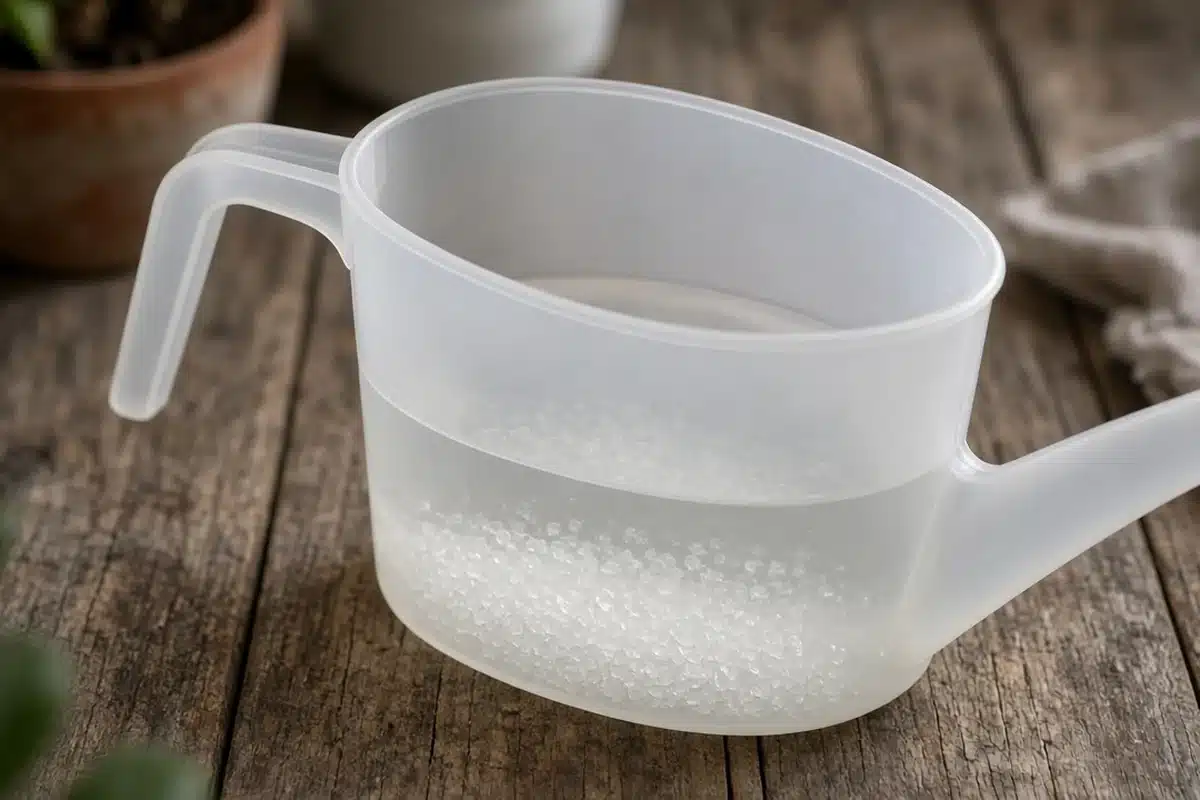
Crystals do not dissolve fully. Use warm water and a fine soluble grade, and stir well.
No improvement after a week. Roots may be stressed or pH off. Check pH and drainage before adding more.
White crust across the soil. Salts are accumulating. Water more deeply and reduce feeding.
Sources
- University of Wisconsin Extension, Soil and Applied Potassium (A2521): https://corn.aae.wisc.edu/Management/pdfs/a2521.pdf
- University of New Hampshire Extension, Organic and Natural Fertilizers for the Home Ground and Garden: https://extension.unh.edu/sites/default/files/migrated_unmanaged_files/Resource003737_Rep5330.pdf
- University of Wisconsin Madison, Carrie Laboski, Understanding Salt Index of Fertilizers: https://extension.soils.wisc.edu/wp-content/uploads/sites/68/2016/07/Laboski_salt2008ppt.pdf
- Colorado State University Extension, Vegetable Gardens: https://extension.colostate.edu/resource/vegetable-gardens-soil-management-and-fertilization/
- University of Missouri Integrated Pest Management, Foliar Feeding Revisited: https://ipm.missouri.edu/MPG/2019/4/foliarFeeding/
FAQ
Is sulfate of potash the same as potassium sulfate?
Yes. Both names refer to the same fertilizer with an analysis of 0 0 50.
Why is sulfate of potash better for containers than muriate of potash?
It adds less salt per unit of potassium and contains no chloride.
When should I add sulfate of potash to cannabis?
Most growers add it during flowering, when potassium demand is highest, and only if a need is confirmed.
Does sulfate of potash change soil pH?
It has little effect on pH in typical garden use.
Can sulfate of potash be applied through irrigation?
Fine soluble grades dissolve in water, so you can feed them at a weak strength.