
Potting Up Seedlings: When and How to Move Cannabis Starts
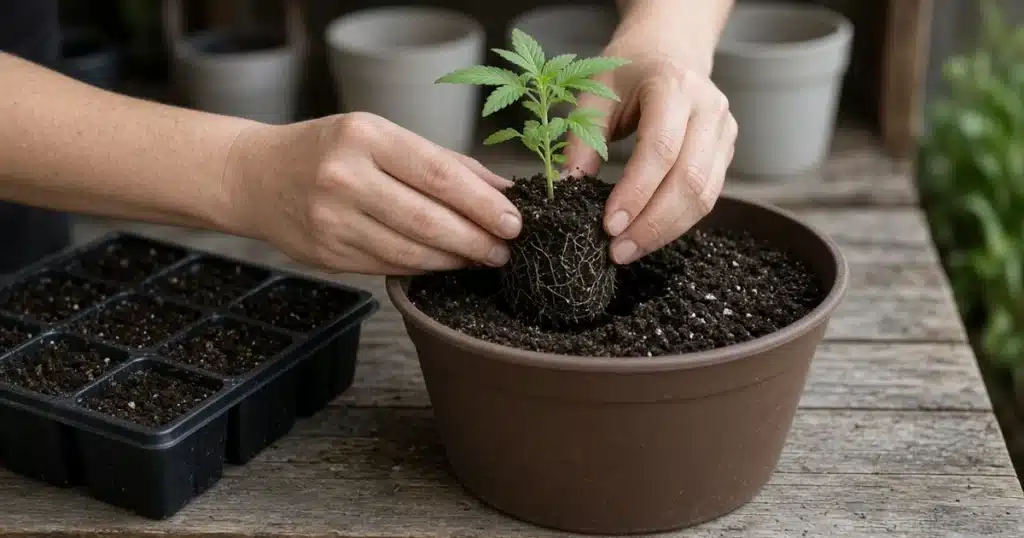
Potting up is the step between a seedling in a small cell and a young plant ready for its final home. It means moving a seedling into a larger container so its roots have room to keep growing. University of Maryland Extension calls this step potting up or pricking out, and it notes that one of the most common mistakes is leaving seedlings in a crowded flat for too long. The steps here start once your seedlings are already up and growing. Still at the seed stage? Germination comes first, with Kind Seed Co’s steps in how to germinate cannabis seeds, so come back here once you have true leaves.
Why potting up matters
A small cell holds only so much mix and so much root. Once roots fill it, growth slows and the seedling becomes harder to move without damage. University of Maryland Extension explains that when seedlings stay in the flat too long, roots of neighboring plants intertwine, and separating them causes more damage. Moving seedlings at the right time gives each one its own root space and a fresh supply of growing mix.
Potting up also gives you a chance to check every seedling. Weak or damaged ones can be set aside, and the strongest go into their new pots with room to grow.
When to pot up cannabis seedlings
Timing is the most important part of potting up. The two sources agree on the general window but describe it a little differently:
- University of Maryland Extension says the ideal time is shortly after the first true leaves appear. The first leaves a seedling shows are seed leaves. True leaves come next and look like the leaves of the mature plant.
- Utah State University Extension says to pot up when the leaves of a seedling begin to overlap its neighbors, or when roots have formed a thick mat around the root ball.
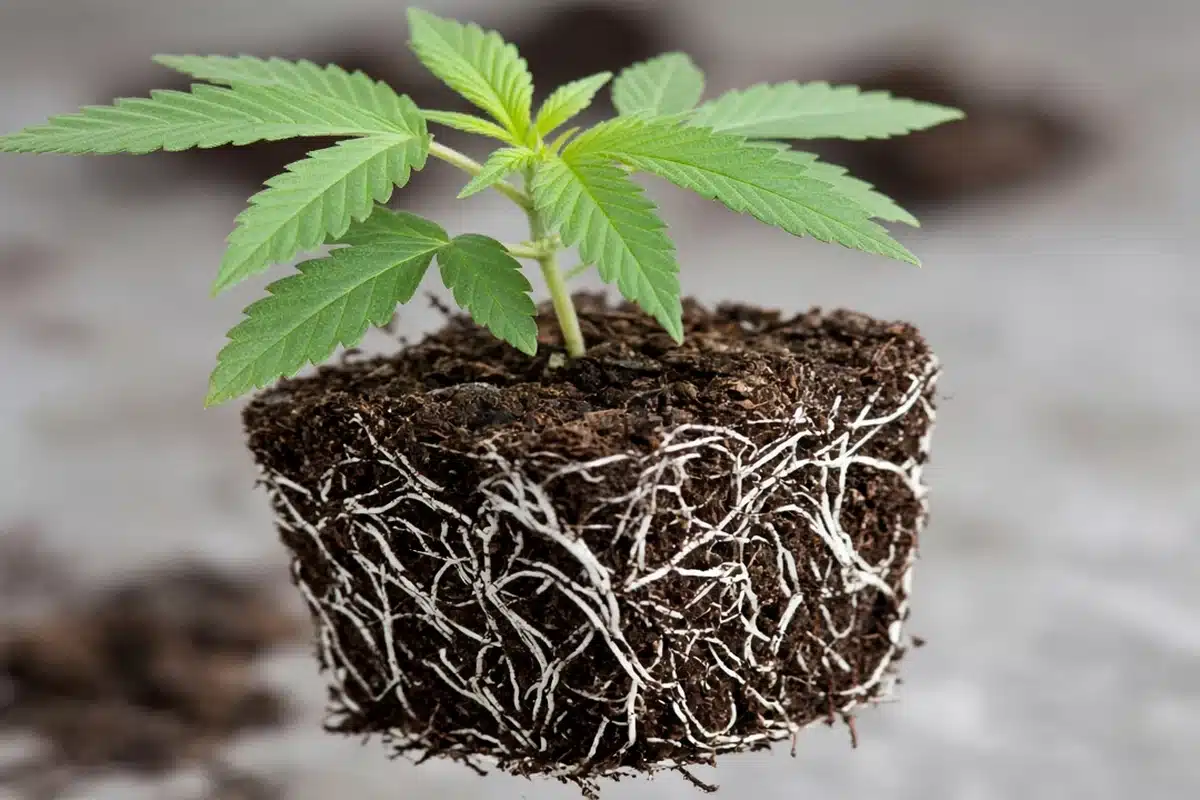
To check the roots, gently lift a seedling by its leaves and look at the outside of the root ball. If white roots are wrapping the outside, it is time to move it. If you see mostly loose mix, the seedling can wait a little longer.
For cannabis, the first set of true leaves is usually easy to spot because the leaflets have serrated edges, unlike the smooth, rounded seed leaves.
What you need
Gather everything before you start so the seedlings spend as little time out of the mix as possible:
- Clean pots a size or two larger than the current cells, with drainage holes.
- Moist soilless growing mix. Utah State Extension recommends moistening the mix before you use it. Choosing a mix gets its own post, seed starting mix for cannabis.
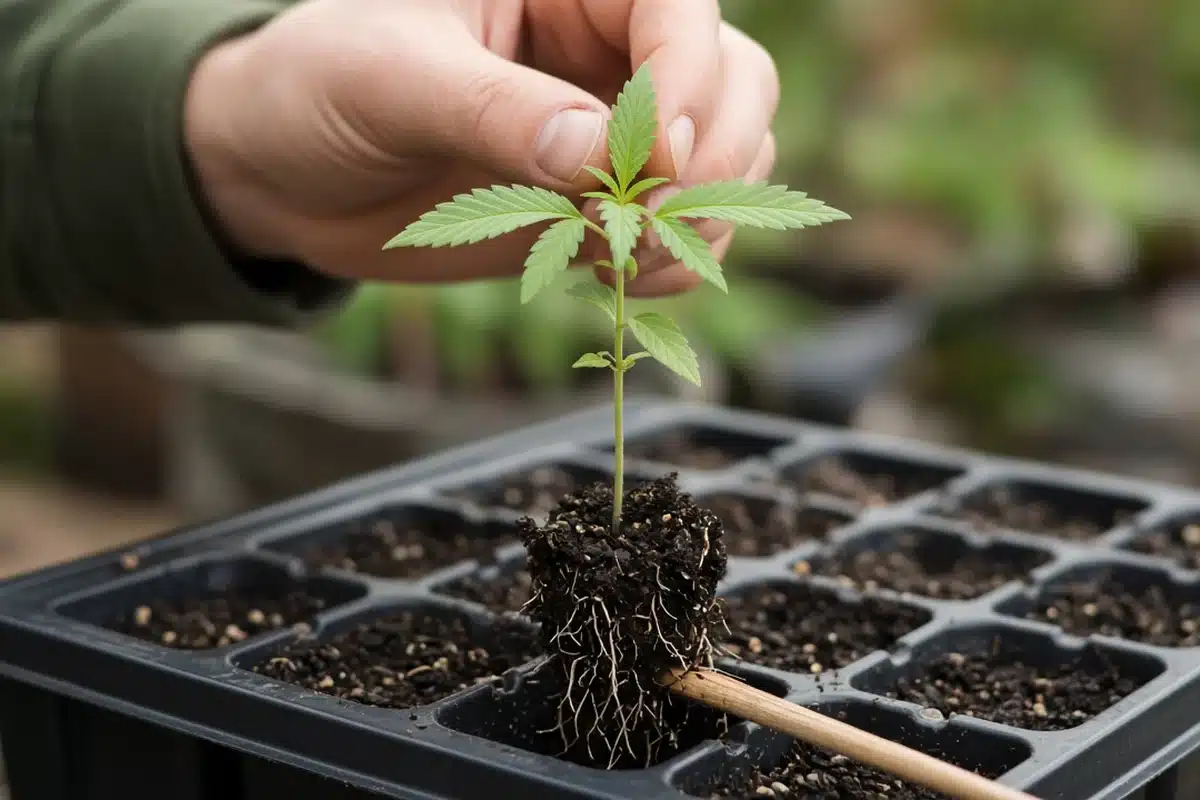
- A small tool for lifting seedlings. University of Maryland Extension suggests a butter knife, chopstick or popsicle stick, and Utah State Extension mentions a pencil or knife.
- A watering can with a gentle rose or a spray bottle.
- Labels, so you know which seedling is which.
How to pot up seedlings, step by step
Work in a shaded spot out of wind, and move one seedling at a time:
- Partly fill the new pot with moist mix and make a hole in the center large enough for the root ball.
- Water the seedlings lightly beforehand so the root ball holds together.
- If seedlings are in individual cells, Utah State Extension suggests pushing the root ball up from the bottom of the cell instead of pulling on the stem.
- If several seedlings share a flat, University of Maryland Extension suggests lifting a small group out with your tool and gently teasing the seedlings apart.
- Always handle seedlings by their leaves, not by the stem. Both sources make this point. A seedling can grow a new leaf, but a crushed stem is hard to recover from.
- Set the seedling into the hole and fill in around it with moist mix.
- Gently firm the mix around the roots so there are no large air pockets.
- Water gently to settle the mix. University of Maryland Extension suggests applying water to the surface and letting it seep fully down and drain out of the bottom holes. Utah State Extension adds that drainage water should be discarded, not left for the pot to soak back up.
- Label the pot.
How deep to plant
The sources give slightly different advice on depth. Utah State Extension says to set seedlings at the same depth they were growing before. University of Maryland Extension notes that the stems of many vegetable seedlings, such as tomatoes, can be buried deeper, keeping the leaves and growing point just above the soil line.
As general guidance for cannabis, planting at the same depth or only slightly deeper is the safer choice. Keep the seed leaves and growing tip well above the mix. If a seedling has grown tall and thin, a little extra depth can help steady it, but avoid burying any leaves.
Choosing the next pot size
Potting up has no one correct pot size, so take this as general guidance. A pot that is only a little larger than the current cell gives roots fresh mix to grow into without leaving a large mass of wet mix around a small root system. Very large pots can stay soggy for days after watering, which young roots do not like. Many home growers move seedlings up one step at a time instead of jumping straight to a large container.
Whatever size you choose, make sure every pot drains freely. Clean pots that held plants last season with soapy water before you reuse them, and let them dry before filling. Pots of the same size also make watering easier, because they dry out at about the same rate.
Caring for seedlings after potting up
The first few days after potting up are when seedlings settle into their new pots. A little care helps them recover:
- Give them strong light. University of Maryland Extension recommends fourteen to sixteen hours of light a day, with the tops of the plants one to two inches below grow lights. Adjust the lights as plants grow.
- Water when the surface of the mix begins to dry, and avoid keeping it soaked.
- Start light feeding. Utah State Extension explains that soilless mixes contain few nutrients, and any starter fertilizer lasts only a few weeks. It suggests a water-soluble fertilizer diluted to half strength once a week. Utah State also warns that overfeeding causes weak, succulent growth.
- Encourage sturdy stems. University of Maryland Extension notes that gently brushing the tops of seedlings helps them grow stockier, and an ideal transplant is about as wide as it is tall.
Some droop right after potting up is common. If it lasts more than a day or two, cannabis transplant shock explains what helps.
What comes after potting up
Potting up is often only one move before the final one. Once your seedlings are growing well in their larger pots, they will need to adjust to outdoor conditions before going outside. Utah State Extension recommends hardening off transplants before moving them into the garden. That process is described in detail in hardening off cannabis seedlings. When they are ready for their final home, move on to transplanting cannabis plants.
Troubleshooting
Seedlings wilt after potting up. Some droop is normal as roots settle. Keep them out of strong sun and wind for a day, water gently and give them time to recover.
Roots tore apart when separating seedlings. The seedlings likely stayed together too long. Next time, pot up sooner, shortly after the first true leaves appear.
Thin, stretched seedlings. They may need more light. Move lights closer and keep them on for fourteen to sixteen hours a day, as University of Maryland Extension suggests.
Leaves turn pale a few weeks after potting up. The mix may be running out of nutrients. Start weekly feeding at half strength, and avoid overdoing it.
Growth is soft and floppy. Overfeeding can cause weak, succulent growth. Cut back on fertilizer and give the plants more light.
The stem snapped while moving a seedling. Handle seedlings only by the leaves and push the root ball up from below instead of pulling.
Sources
- University of Maryland Extension. Starting Vegetable Seeds Indoors. https://www.extension.umd.edu/resource/starting-vegetable-seeds-indoors
- Utah State University Extension. Starting Vegetable Seeds Indoors: Seedling Culture and Transplanting. https://extension.usu.edu/yardandgarden/research/starting-vegetable-seeds-indoors-seeding-culture-and-transplanting
FAQ
When should I pot up cannabis seedlings?
University of Maryland Extension says the ideal time is shortly after the first true leaves appear. Utah State Extension adds that seedlings are ready when their leaves overlap neighbors or roots form a thick mat. Lift one gently by a leaf and check the root ball. White roots wrapping the outside mean it is time.
How do I hold a seedling when potting it up?
Hold it by a leaf, never by the stem. Both University of Maryland and Utah State Extension make this point. A seedling can grow new leaves if one is damaged, but a crushed stem rarely recovers. Use a small tool to lift the root ball and push it up from below.
How deep should I plant a seedling when potting up?
Utah State Extension says to plant at the same depth as before, while University of Maryland Extension notes some vegetable stems can be buried deeper. For cannabis, the same depth or only slightly deeper is the safer choice. Keep seed leaves and the growing tip above the mix.
Should I feed seedlings after potting up?
Usually yes, lightly. Utah State Extension explains that soilless mixes hold few nutrients and starter fertilizer lasts only a few weeks. It suggests a water-soluble fertilizer at half strength once a week. Avoid overfeeding, which Utah State says causes weak, succulent growth that is harder to grow on.


