
Seed Starting Mix for Cannabis: Recipes and What to Avoid
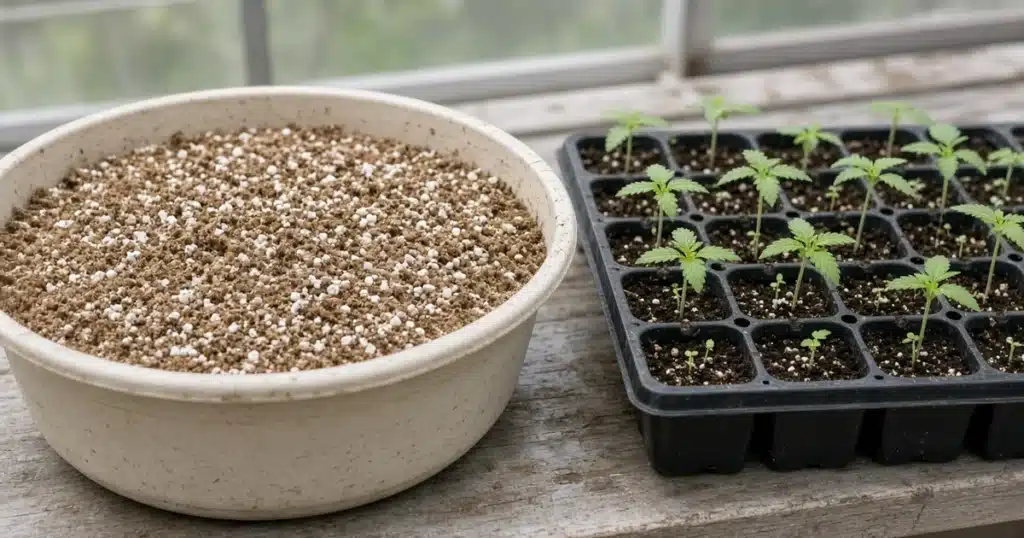
The best seed starting mix for cannabis is a light, fine, soilless blend that holds water but drains freely. A simple recipe is equal parts peat moss or coco coir, vermiculite and fine perlite. Skip garden soil, heavy bagged "planting soil" and mixes with bark or slow release fertilizer beads. A good bag of all purpose soilless mix also works.
What makes a good seed starting mix?
University of Maryland Extension says a growing medium has three jobs. It supplies roots with nutrients, air and water, it allows full root growth and it holds the plant up. For seeds, that means a mix that is:
- Light and loose. Maryland Extension puts soilless media at about 10 pounds per cubic foot, compared with about 75 for garden soil.
- Fine textured. University of Maine Extension recommends a sterile, fine textured soilless mix for germinating seeds.
- Free of weed seeds and disease. Garden soil can carry both, according to Maryland and Maine Extension.
- Balanced for water and air. Peat holds water well while large pores let extra water drain, which Maryland Extension says supports quick root growth.
- Close to the right pH. Maine Extension notes standard seed starting mixes sit at about pH 6.2.
- Low in fertilizer. Seeds and young seedlings need little feeding at first.
Ingredients and what each one does
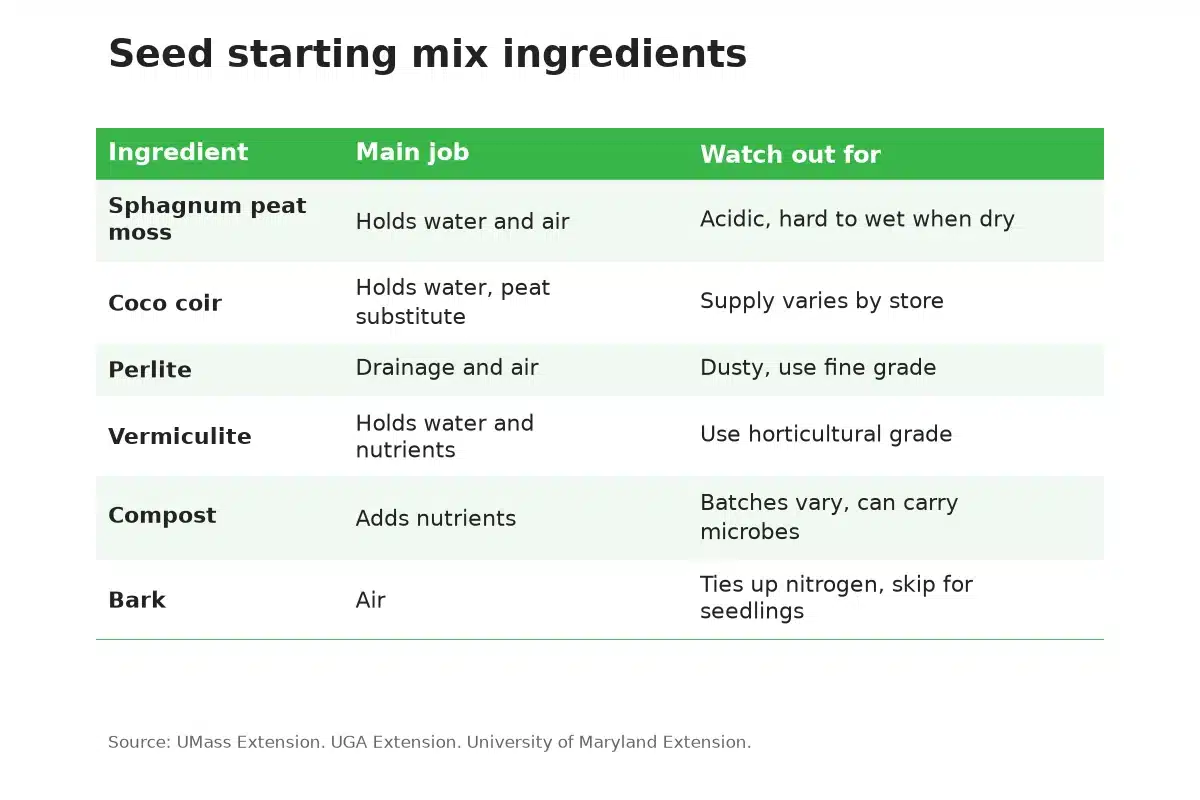
| Ingredient | Main job | Watch out for |
|---|---|---|
| Sphagnum peat moss | Holds water and air | Acidic, hard to wet when dry |
| Coco coir | Holds water, peat substitute | Supply varies by store |
| Perlite | Drainage and air | Dusty, use fine grade |
| Vermiculite | Holds water and nutrients | Use horticultural grade |
| Compost | Adds nutrients | Batches vary, can carry microbes |
| Bark | Air | Ties up nitrogen, skip for seedlings |
Source: UMass Extension. UGA Extension. University of Maryland Extension.
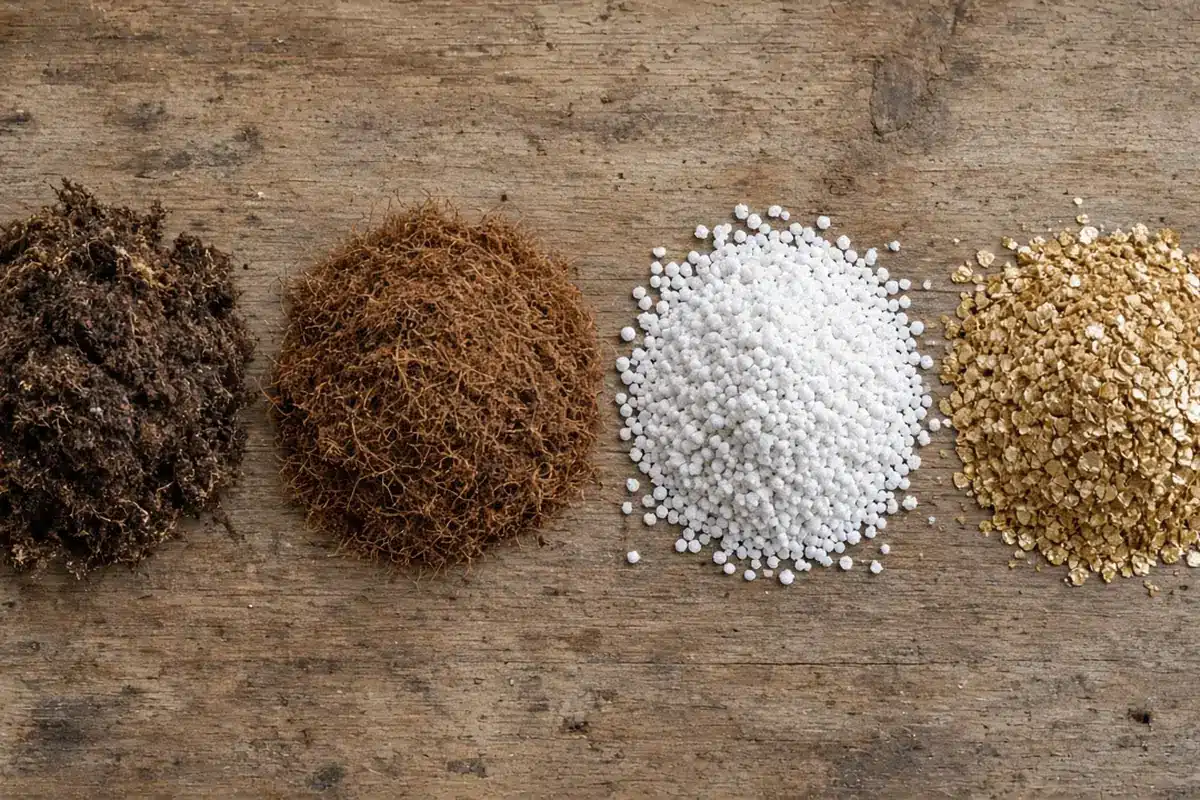
Peat moss. UMass Extension explains that peat breaks down slowly and keeps a balance of air and water around roots. It is acidic, so lime is usually added. Peat by itself is hard to wet, so many mixes add wetting agents. It often makes up 30 to 80% of potting mixes. There is more detail in peat moss for cannabis.
Coco coir. Coir comes from coconut husks and replaces peat in many mixes. UMass Extension notes it is easier to rewet after drying than peat. UGA Extension calls it a more sustainable option that is less common in garden centers. Growers new to it can start with coco coir as a grow medium.
Perlite. Perlite is volcanic rock that puffs up when heated. UMass Extension says it is sterile and improves drainage and air. UGA Extension recommends fine perlite for seed mixes, since coarse pieces can block small roots.
Vermiculite. Vermiculite forms when mica is heated. UMass Extension notes it holds water and nutrients and slowly releases some potassium, magnesium and calcium. UGA Extension adds that it also helps air and drainage because of its shape. When to lean on each one is the question behind perlite vs vermiculite.
Seed starting mix recipes
Recipe 1: equal parts
UGA Extension shares this basic recipe:
- 1 part peat moss or coco coir.
- 1 part vermiculite.
- 1 part fine perlite.
Mix the three in a bucket until evenly spread. Water until moist but not soaking, then fill trays or pots without pressing the mix down.
Recipe 2: peat and vermiculite
Penn State Extension lists a standard soilless seed mix:
- 50 to 75% sphagnum peat.
- 25 to 50% vermiculite.
- 5 pounds of ground or superfine dolomitic lime per cubic yard of mix.
The lime offsets the natural acidity of peat. For small home batches, buy a mix with lime already added or scale the lime with care.
Recipe 3: with compost
Penn State Extension also lists a soilless potting mix of 1 part compost, 1 part vermiculite and 1 part peat moss, screened through a quarter inch screen. Maryland Extension suggests mixing finished, screened compost with commercial soilless media at a ratio of 1 to 2. It notes compost is heavier, at about 25 pounds per cubic foot, but adds nutrients.
UGA Extension points out the tradeoff. Compost microbes may help fight seedling diseases, but compost can also bring in microbes that cause them. If damping off has been a problem before, leave compost out. The reasons are explained in damping off in cannabis seedlings.
Store bought or homemade?
UGA Extension notes that bagged seed starting mixes usually come in small sizes, often 8 to 12 quarts, so mixing your own costs less per tray when you start many seeds. Maryland Extension adds that a large bag or compressed bale of soilless mix is cheaper than many small bags if you also grow in containers.
Conventional mixes have lime and chemical fertilizer added, while organic mixes use organic fertilizers and often contain compost, according to Maryland Extension. Some organic mixes swap in coir and rice hulls for peat and perlite.
Simpler options
UGA Extension notes that many greenhouse growers use vermiculite alone to start seeds, because it holds moisture, drains well and does not bring in pathogens. Rice hulls can stand in for perlite, though they are harder to find.
Can I start cannabis seeds in potting soil?
Yes, if it is a light soilless potting mix. Maryland Extension says a standard all purpose transplanting mix works and a special finer seedling mix is only needed for very small seeds. Check the bag before you buy.
- Read the label. Maryland Extension advises rejecting heavy products, often labeled "planting soil", and mixes with "forest products".
- Skip bark for seedlings. UMass Extension says bark ties up nitrogen.
- Look for fertilizer beads. UMass Extension explains that slow release prills release more nutrients as temperatures rise, and a bag that got wet in storage can have released fertilizer that may burn plants.
- Lift the bag. UMass Extension suggests choosing a bag that feels light and dry.
- Know what a starter charge means. UMass Extension says a label with a fertilizer starter charge has only a small amount, and most of it is gone after two or three waterings.
- Check the wetting agent. Peat mixes often include one to help water soak in. UMass Extension notes organic mixes may use yucca extract instead, and Maryland Extension says certified organic mixes contain no synthetic wetting agents.
- Avoid gritty, dusty or clumped mixes and sedge peat, which Maryland Extension says compacts easily.
Do not use garden soil. Maryland Extension says it is too dense and likely contains weed seeds and plant pathogens.
How to prepare the mix, step by step
- Clean reused containers. Maine Extension suggests one part chlorine bleach to nine parts water.
- Wear a mask when scooping perlite or dry peat, which are dusty, as UGA Extension advises.
- Moisten the mix before filling. Maine Extension says soilless mixes repel water when dry, so mix in warm water until it is evenly moist but not soaked.
- Wet it evenly first. UMass Extension warns that mix potted dry and then watered ends up with uneven moisture in the root zone.
- Fill trays or pots loosely. Do not pack the mix down.
- Keep the mix warm. Clemson Extension gives 65 to 75°F as an ideal soil temperature for germination.
- Keep it moist, not wet. UGA Extension notes that different brands dry at different rates, so check daily.
Stage guidance
Germination. Plain soilless mix carries little or no fertilizer, which is fine for sprouting seeds.
First true leaves. Clemson Extension suggests starting a liquid starter fertilizer at every other watering once the first true leaves appear, when using a plain soilless mix.
Weeks five and six. Maryland Extension notes most potting mixes hold enough fertilizer for about 5 to 6 weeks, and plants kept longer may need a soluble fertilizer. Pale lower leaves at this point can mean food is running low. Other causes are sorted out in the Kind Seed Co post on yellow leaves on cannabis seedlings.
Common mistakes
- Using garden soil or heavy "planting soil".
- Choosing a bark based mix for seedlings.
- Filling trays with dry mix and watering from the top, so it repels water.
- Packing the mix down hard.
- Adding fresh compost to a tray that had damping off before.
- Buying a mix loaded with slow release beads for young seedlings.
- Using coarse perlite in small cells.
Sources
- University of Maryland Extension. Containers and Potting Soil for Indoor Seed Starting. https://www.extension.umd.edu/resource/containers-and-potting-soil-indoor-seed-starting
- University of Maryland Extension. Care of Vegetable Seedlings. https://www.extension.umd.edu/resource/care-vegetable-seedlings
- University of Maryland Extension. Growing Vegetables in Containers and Salad Tables. https://extension.umd.edu/resource/growing-vegetables-containers-and-salad-tables
- University of Maine Cooperative Extension. Bulletin 2751, Starting Seeds at Home. https://extension.umaine.edu/publications/2751e/
- UMass Extension. Bagged Potting Mixes and Garden Soils for Home Gardeners. https://www.umass.edu/agriculture-food-environment/home-lawn-garden/fact-sheets/bagged-potting-mixes-garden-soils-for-home-gardeners
- LaTora, G. 2025. Cut Veggie Garden Costs by Making Your Own Seed Starting Mix. UGA Extension Fulton County. https://site.extension.uga.edu/fultonag/2025/02/cut-veggie-garden-costs-by-making-your-own-seed-starting-mix/
- Penn State Extension. Potting Media and Plant Propagation. https://extension.psu.edu/potting-media-and-plant-propagation
- Clemson Cooperative Extension HGIC. FAQs About Starting Vegetable Seeds Indoors. https://hgic.clemson.edu/faqs-about-starting-vegetable-seeds-indoors/
FAQ
What is the best seed starting mix for cannabis?
A light, fine, soilless mix works best. A simple recipe from UGA Extension is equal parts peat moss or coco coir, vermiculite and fine perlite. It holds water, drains well and is free of weed seeds and soil pests. A good all purpose soilless potting mix without bark or slow release fertilizer also works.
Can I start cannabis seeds in regular potting soil?
You can if it is a light soilless potting mix. Avoid heavy bags labeled planting soil, mixes with bark or forest products, and bags with slow release fertilizer beads. Never use garden soil, which University of Maryland Extension says is too dense and may carry weed seeds and disease.
Is coco coir or peat moss better for seedlings?
Both work. Peat holds water and air well but is acidic and hard to wet when dry, so mixes add lime and wetting agents. Coir is easier to rewet after drying and is seen as more sustainable, but it can be harder to find. Pick the one you can buy easily.
Should seed starting mix have fertilizer?
Only a little. Seeds sprout fine in plain soilless mix. Clemson Extension suggests a liquid starter fertilizer at every other watering once the first true leaves appear. Maryland Extension notes most potting mixes carry enough fertilizer for 5 to 6 weeks, so avoid mixes loaded with slow release beads.


