Russet Mites On Cannabis: Signs, Damage, And Control
Quick answer: Russet mites on cannabis are tiny pale eriophyid mites (Aculops cannabicola) that you can’t see without strong magnification. Their feeding turns leaves dull, bronzed and brittle, curls leaf edges and can shrink buds. Confirm them under a microscope, keep new plants and cuttings apart until they are shown to be mite free, and remove infested plants and debris.
What Are Russet Mites?
The russet mite that feeds on cannabis is Aculops cannabicola, a member of the eriophyid mite family. Colorado State University says cannabis is the only known host. NC State Extension notes that lab attempts to establish it on related plants in the Cannabaceae family have been unsuccessful.
It is also tiny. University of Kentucky entomologists give a length of 110 to 210 microns, and NC State says that is about twice the width of a human hair. The body is yellowish to pale white and wormlike, with only two pairs of legs.
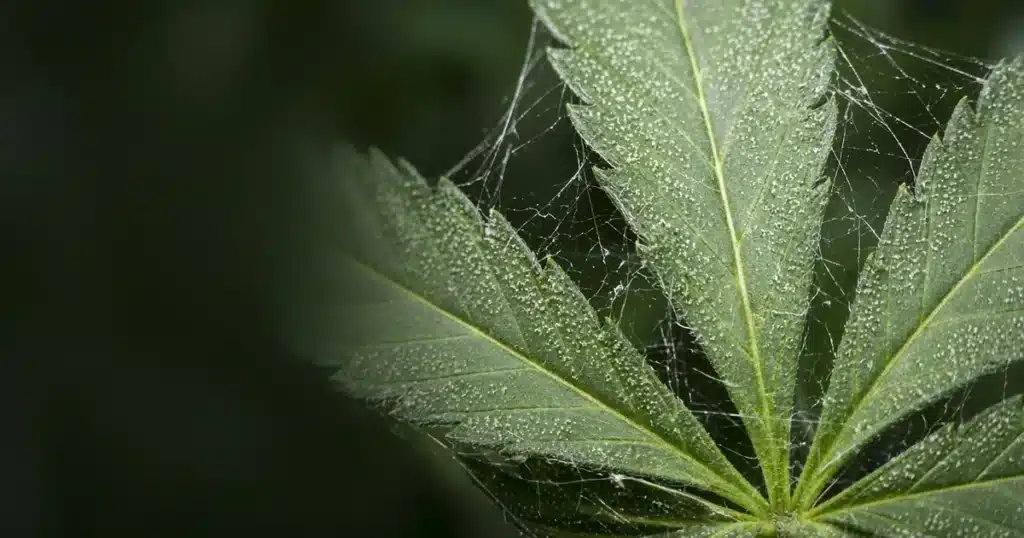
Russet mites do not spin webs, which NC State says makes them easy to tell apart from other mite pests. If you do see webbing, read our guide to preventing and controlling spider mites.
How Russet Mites Spread
Colorado State says russet mites can crawl only very short distances on their own. Adults move to leaf edges, where air currents pick them up, and indoors fans can quickly spread them. CSU adds that some mites may move from plant to plant on hands and clothing.
The main way they get in is on plants. CSU says indoor plantings become infested through the introduction of infested plant material such as live plants and cuttings. NC State notes that mites cannot be sustained on seeds, so plants started from seed begin free of them.
Signs of Russet Mite Damage on Cannabis

Utah State University Extension says there is no visible damage while mite numbers are low, so russet mites usually go unnoticed until symptoms appear. Look for:
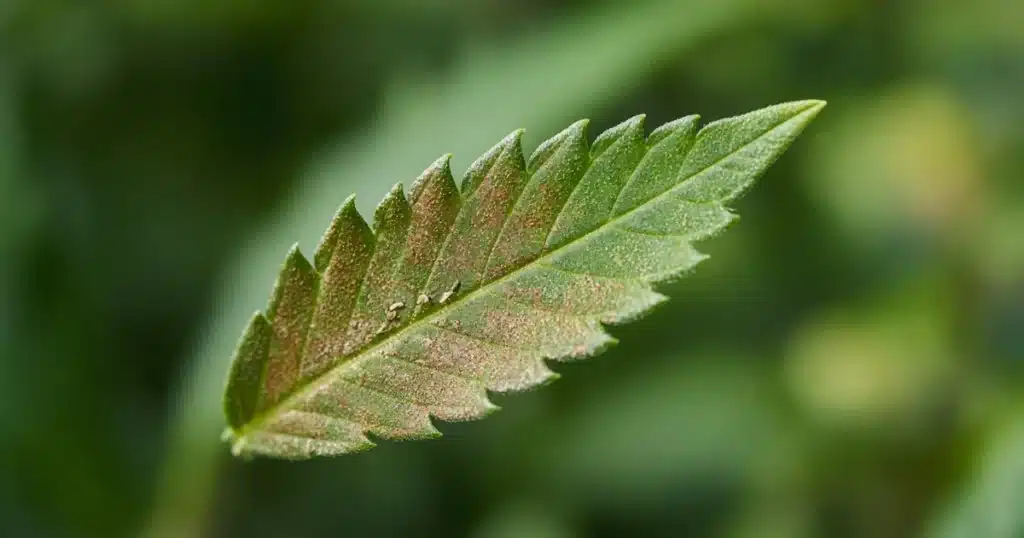
- Dull, bronzed or rusty leaves. CSU calls this general dullness russeting.
- Curled leaf edges. University of Kentucky entomologists describe upward or downward curling of leaf edges.
- Spotting and brittle foliage. CSU says leaves may show yellow or brown spots and break at the leaf stalk.
- Smaller leaves. Utah State lists reduced leaf size with bronzing.
- Bronze or golden stems. CSU and Utah State both describe stem bronzing.
- Stunted tips. UKY says numbers peak at the growing tips, which can stunt growth or kill young seedlings and new clones.
- Brown or tan powder. UKY says heavily damaged plants show a powder of cast skins on leaves and stems.
UKY notes that russet mites prefer the lower leaf surface first. As numbers grow they spread to upper surfaces, leaf stalks, stems and flower buds.
Utah State lists spider mites, thrips and physiological conditions as look alikes. If you see fast moving slender insects and silvery scars, check our guide to thrips on cannabis.
How to Confirm Russet Mites
NC State says russet mite injury can look like disease or abiotic injury, so a microscope is needed to confirm an infestation.
- Pick the right leaves. Utah State says to check damaged leaves and the healthy looking leaves around them.
- Start low. Utah State suggests looking for bronzing on lower leaves and stems, especially in hot, dry conditions.
- Use strong magnification. A strong hand lens helps with scouting, and Utah State says the mites are best identified under a dissecting microscope.
- Wash the leaves. NC State says leaves can be washed in soapy water or 70% ethanol. This wash is for spotting mites, not for control.
- Look at the wash over a dark surface. NC State says mites washed off the leaves can then be seen in the solution.
- Check stems and leaf stalks. UKY says mites spread there as numbers grow.
- Look for cast skins. A brown or tan powder on leaves and stems is a sign of heavy feeding, per UKY.
- Ask for help if unsure. Utah State suggests contacting a plant pest diagnostic lab or your county Extension office.
Quarantine New Plants and Cuttings
Colorado State says strict quarantine is key to keeping russet mites out of an indoor grow. Seeds do not carry them, but cuttings, tools, clothing and fans can. Choosing between seeds and clones is a bigger topic than mites, so here the focus is on keeping mites out.
- Keep new plants apart. CSU says to isolate all new live plants and cuttings from the main grow until they are shown to be mite free.
- Check the mother plant. NC State says to make sure the mother a cutting came from is not infested.
- Inspect before planting. NC State says to thoroughly inspect cuttings before they go in.
- Work clean to dirty. CSU says work with young, clean plants should never follow work among older, infested plants.
- Mind the airflow. CSU says air from rooms with older plants should not flow toward young plants.
- Limit traffic. NC State says to restrict the movement of people and supplies between infested and clean areas.
How to Control Russet Mites on Cannabis
Follow the product label, and check that any pesticide is allowed for cannabis in your state.
Remove Infested Plants and Debris
Utah State says to prune and remove infested plants and to remove and destroy infested plant debris. It also says to clean tools used on infested plants before using them on healthy ones.
Reset the Grow With a Host Free Period
Colorado State says russet mites are extremely hard to clear from a room in continuous production. Because cannabis is the only host and mites survive off the plant for a couple of weeks at most, CSU says a host free period of a month, perhaps less, should be enough to clear an indoor space.
Predatory Mites and Russet Mites
Colorado State’s 2018 sheet says the predatory mite Amblyseius andersoni is known to feed on russet mites. CSU adds that predatory mites normally used for twospotted spider mite, such as Phytoseiulus persimilis and Amblyseius californicus, are not considered effective predators of russet mites. For predators in general, see our guide to the best bugs for a cannabis grow.
Oil and Soap Sprays
NC State says oils have no residual activity and work only on mites they coat, so coverage has to be thorough. CSU warns that oil sprays can injure plants if sulfur residue is present and suggests testing a product on a small area first. Our guide to insecticidal soap for cannabis covers soap sprays.
Troubleshooting
Damage keeps spreading after cleanup. Fans and air currents spread mites indoors, CSU says. Check airflow between rooms and keep inspecting plants under magnification.
Mites come back in the next grow. Utah State says russet mites can survive year round in greenhouses with a constant food source. A host free period between runs is the CSU approach.
Damage but no mites under the lens. Utah State says the mites are not visible with an ordinary magnifying lens. Use the wash method from NC State or ask a diagnostic lab.
You see mites but aren’t sure they are russet mites. Count the legs. UKY says russet mites have two pairs, unlike spider mites.
Beige buds late in flower. CSU says heavily infested flowers can take on a beige look. Check buds under magnification.
New clones stall soon after arriving. UKY says high temperature and humidity during propagation help russet mites multiply. Inspect cuttings closely.
Frequently Asked Questions
Can You See Russet Mites With the Naked Eye?
No. University of Kentucky entomologists say they are only 110 to 210 microns long, and they are pale in color. Utah State University Extension says they are usually noticed only after damage appears. A strong hand lens helps with scouting, but a dissecting microscope is the most reliable way to see them.
What Does Russet Mite Damage Look Like on Cannabis?
Leaves turn dull, bronzed or rusty and leaf edges curl up or down. Colorado State University says leaves may show yellow or brown spots and turn brittle. Stems can bronze, and University of Kentucky entomologists say heavily damaged plants show a brown or tan powder of cast skins on leaves and stems.
Do Russet Mites on Cannabis Live on Other Plants?
No other host is known. Colorado State University says cannabis is the only reported host, and attempts to establish the mite on related plants such as hops and hackberry have failed. Utah State University Extension says russet mites can survive year round in greenhouses with a constant food source.
How Long Is the Russet Mite Life Cycle on Cannabis?
It ranges from about one week to a month, depending on temperature. NC State Extension says it is believed to run from 7 to 10 days up to 30 days. University of Kentucky entomologists say it is completed in about one week. Colorado State University’s 2018 fact sheet puts it at about two weeks at 77°F, based on the related tomato russet mite.
Do Russet Mites Damage Cannabis Buds in Flower?
Yes, they can. University of Kentucky entomologists say severe injury to flower buds can reduce flower size and cannabinoid yields. In Kentucky, high populations were seen outdoors from August to October as flowers develop. Colorado State University says heavily infested flowers may take on a beige look.
Sources
- NC State Extension, Russet Mite fact sheet: https://content.ces.ncsu.edu/hemp-russet-mite-in-industrial-hemp
- University of Kentucky Entomology, ENTFACT 162: https://entomology.mgcafe.uky.edu/ef162
- Utah State University Extension, Russet Mite: https://extension.usu.edu/planthealth/ipm/notes_ag/hemp-hemp-russet-mite-
- Colorado State University, Russet Mite fact sheet (PDF, June 2018): https://webdoc.agsci.colostate.edu/hempinsects/PDFs/Hemp%20Russet%20Mite_New_6-28-18.pdf
- Colorado State University, Russet Mite extra information (PDF): https://webdoc.agsci.colostate.edu/hempinsects/PDFs/Hemp%20Russet%20Mite%20extra%20info.pdf