
How to Lower Soil pH for Cannabis with Sulfur

Lowering soil pH for cannabis is a slow job, and that is the first thing to plan around. Most garden plants grow best in slightly acid soil, and Purdue Extension puts that range at pH 6.0 to 6.5. When a bed tests well above that, University of Maryland Extension notes that many nutrients become less available to roots. Elemental sulfur is the standard fix for outdoor beds. Soil bacteria turn it into acid over weeks to months, so the best time to start is a season before planting, not the week the plants go in. The link between pH and nutrient uptake gets a fuller explanation in understanding pH and cannabis.
When does soil pH need lowering?
Only a soil test can answer that. A home pH meter or strip gives a rough reading, but a lab test also reports organic matter and texture, and both change how much sulfur a bed needs. For how to collect a good sample, start with the Kind Seed Co primer on soil testing for cannabis.
Signs that point toward a high pH problem include:
- Yellowing between the veins of new leaves while the veins stay green.
- A test result above about 7.0 in a bed that has had lime, wood ash or hard irrigation water added over the years.
- Plants that stay pale even after feeding.
These signs overlap with other problems, so treat them as a reason to test, not as proof of a pH issue. Purdue Extension also notes that irrigation water with a high pH and bicarbonate content can push soil pH up over time, and that construction and grading can bring alkaline subsoil to the surface.
Which materials lower soil pH?
Purdue Extension groups acidifying materials by how they work. Elemental sulfur depends on soil bacteria, which turn it into sulfuric acid. Aluminum sulfate and iron sulfate work by chemical reaction, so they act faster and depend less on soil temperature. Ammonium-based fertilizers acidify gradually as bacteria convert the ammonium. Organic matter such as sphagnum peat or pine bark helps as well, but very large amounts are needed to make a real difference.
University of Wisconsin Soil and Plant Analysis Lab adds two cautions. Aluminum sulfate takes about six times as much product as elemental sulfur for the same change, and too much aluminum or iron can harm plants. Fertilizers that contain sulfate sulfur, such as gypsum and potassium sulfate, do not lower pH at all. For a home bed, elemental sulfur is usually the safest and cheapest choice.
Fertilizer choice matters too, mostly as a slow, steady nudge. Purdue Extension’s table rates the acidifying power of common products against sulfur. It takes about 2.8 pounds of ammonium sulfate or 3.9 pounds of urea to match the acidifying effect of 1 pound of elemental sulfur. Purdue adds that ammonium sulfate is two to three times more acid forming per pound of nitrogen than other common ammonium fertilizers, and that calcium nitrate and potassium nitrate raise pH, so they are poor picks for a bed that already tests high. Because these products also add nitrogen, use them only at normal feeding rates and never as the main pH fix.
How much sulfur does a bed need?
The rate depends on where the pH starts, where you want it to end, and the soil texture. Purdue Extension gives these rates for a silt loam, worked into the top 6 inches.
| Present pH | To pH 6.5 | To pH 6.0 |
|---|---|---|
| 8.0 | 3.0 lb | 4.0 lb |
| 7.5 | 2.0 lb | 3.5 lb |
| 7.0 | 1.0 lb | 2.0 lb |
| 6.5 | none | 1.0 lb |
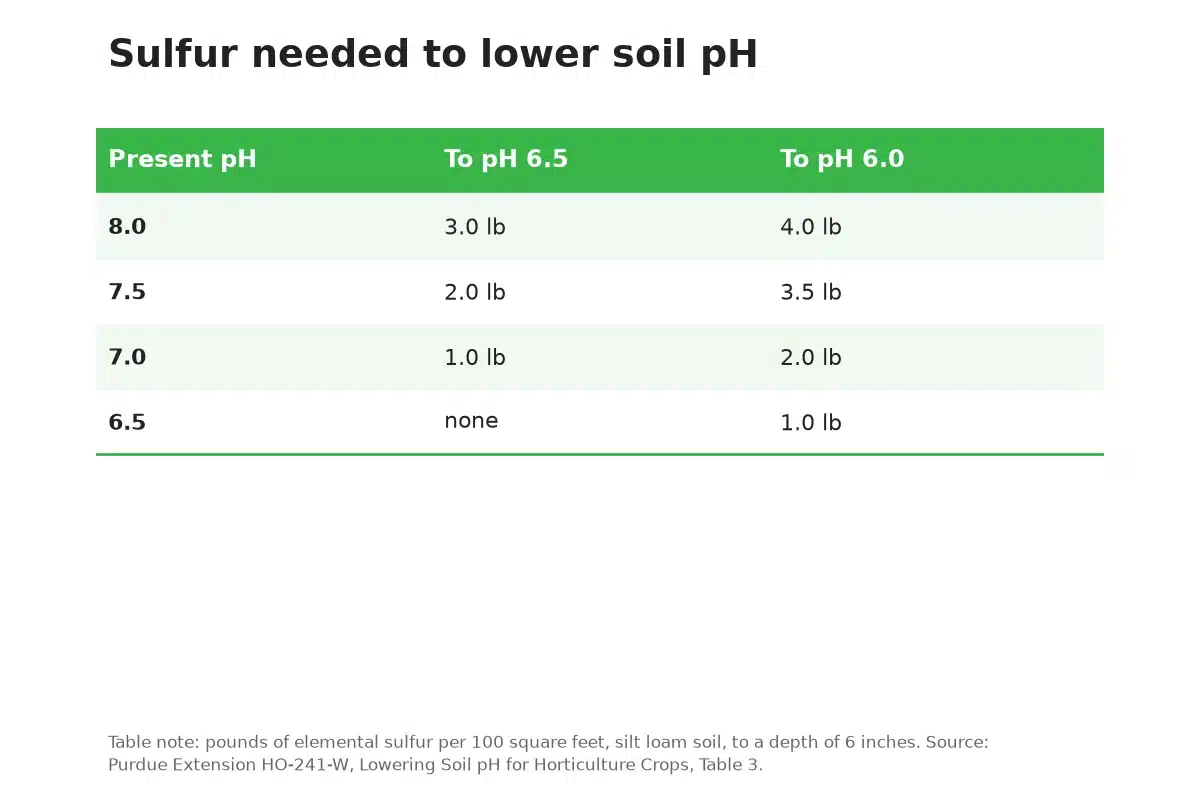
Table note: pounds of elemental sulfur per 100 square feet, silt loam soil, to a depth of 6 inches.
Source: Purdue Extension HO-241-W, Lowering Soil pH for Horticulture Crops, Table 3.
Purdue adjusts the rate for texture. Reduce the amount by one third for sandy soil and increase it by one half for clay soil. On sandy soil, taking a bed from 7.5 to 6.5 works out to about 1.3 pounds per 100 square feet, while a clay bed needs about 3 pounds.
The University of Wisconsin lab ties the rate to organic matter instead, because soils rich in organic matter resist pH change. Its table shows that lowering pH by half a unit takes about 12 pounds of sulfur per 1,000 square feet in soil with 0.5 to 2 percent organic matter, but about 35 pounds where organic matter is 2 to 4 percent. The same lab says not to apply more than 20 pounds per 1,000 square feet in one year, which is 2 pounds per 100 square feet. If a bed needs more, split it across seasons and retest between doses.
How do you lower soil pH, step by step?
- Test the soil and note the pH, organic matter and texture.
- Pick a target. For most beds, aim for the low to middle 6s rather than going lower.
- Measure the bed and work out the rate from the table and the texture adjustment.
- Cap a single year at 2 pounds per 100 square feet, following the University of Wisconsin limit.
- Spread finely ground elemental sulfur evenly over the bed.
- Mix it into the top 6 to 8 inches. Purdue Extension notes that acidification happens faster when sulfur is incorporated than when it is left on the surface.
- Keep the soil moist, since the bacteria that convert sulfur need warm, moist, airy soil.
- Retest about 3 months later, as the University of Wisconsin lab advises, before adding more.
One pound of elemental sulfur is about 2 cups by volume, according to the University of Wisconsin lab. That makes small beds easy to dose without a scale.
How long does it take?
The University of Wisconsin lab says the change usually takes 2 to 3 months, and can take 6 months or more where the soil has few of the bacteria that oxidize sulfur. Purdue Extension notes that sulfur compounds may take up to a year to reach their full effect. Cold soil slows the process further, because microbial activity drops when soil is cool or dry.
That timeline shapes the season:
- Fall before planting. The best window. Sulfur worked in after harvest has the cool months and early spring to act.
- Early spring. Still workable if the bed will not be planted for at least 2 to 3 months.
- At planting. Too late for a large correction. The University of Wisconsin lab warns that poor growth and temporary acid toxicity can follow if sulfur has not finished reacting by planting time.
- During the season. Avoid working sulfur in around established roots. Use gentler options, such as an acidifying nitrogen fertilizer at normal feeding rates, and plan a proper correction after harvest.
When is lowering pH not worth it?
Some soils fight back. Both Purdue Extension and the University of Wisconsin lab explain that soils with free calcium carbonate, such as marl or limestone-derived soils, neutralize the acid as fast as sulfur makes it. The University of Wisconsin lab says that above about pH 7.5 with free carbonate present, reasonable sulfur rates will probably not lower the pH much.
In that case, the practical answer is to grow in raised beds or large containers filled with a mix that starts in the right range. Many growers also choose this route when only a small area needs correcting, because it is faster than waiting a season.
What are the common mistakes?
- Adding sulfur without a soil test, then overshooting into soil that is too acid. Purdue Extension warns this can leave conditions as bad as, or worse than, the original alkaline soil.
- Applying the whole correction at once instead of splitting it across seasons.
- Leaving sulfur on the surface instead of mixing it in.
- Using gypsum and expecting a pH change.
- Adding aluminum sulfate at high rates. The University of Wisconsin lab caps it at 50 pounds per 1,000 square feet per application.
- Retesting too soon and adding more before the first dose has reacted.
- Watering with alkaline water all season and undoing the work. Test irrigation water if beds keep drifting up.
If a bed has gone too acid, the opposite fix applies. Go the other way with garden lime for cannabis, which covers raising pH safely.
Sources
- University of Maryland Extension. Garden Fertilizer Basics. https://extension.umd.edu/resource/garden-fertilizer-basics
- Purdue Extension. Lowering Soil pH for Horticulture Crops (HO-241-W). https://www.extension.purdue.edu/extmedia/ho/ho-241-w.pdf
- University of Wisconsin Soil and Plant Analysis Lab. Lowering soil pH. https://uwlab.webhosting.cals.wisc.edu/wp-content/uploads/sites/17/2010/12/lowering_ph.pdf
FAQ
How fast does sulfur lower soil pH?
Slowly. The University of Wisconsin lab says elemental sulfur usually takes 2 to 3 months to change pH, and longer in cold soil or soil with few sulfur-oxidizing bacteria. Purdue Extension notes full effect can take up to a year. Apply it a season ahead and retest before planting or adding more.
How much sulfur should I add per square foot?
It depends on your starting pH, target and soil type. Purdue Extension's silt loam table calls for 2 pounds per 100 square feet to go from pH 7.5 to 6.5. Use one third less on sand and half again more on clay, and keep any single year at 2 pounds per 100 square feet.
Can I lower soil pH around plants that are already growing?
Not safely by much. Working sulfur into the root zone damages roots, and the change takes months anyway. During the season, keep feeding normally and consider an ammonium-based fertilizer at label rates. Plan the real correction for after harvest, once a soil test confirms how much is needed.
Does gypsum lower soil pH?
No. The University of Wisconsin lab explains that products containing sulfate sulfur, including gypsum and potassium sulfate, do not lower soil pH. Gypsum supplies calcium and sulfur but leaves pH largely unchanged. To acidify a bed, use elemental sulfur, which soil bacteria convert into acid over the following weeks and months.


