
Seedling Heat Mats for Cannabis: Do You Need One?

A heat mat is one of the most common add-ons for indoor seed starting, and also one of the most misunderstood. Some growers treat it as essential, while others never use one. The honest answer from extension horticulturists is that it depends on how warm your seed-starting spot is. Iowa State University Extension notes that most seeds germinate best when the mix stays at a steady 70 to 75 degrees Fahrenheit, and that a warm spot in the house often works fine. Utah State University Extension explains when bottom heat helps and why a thermostat matters. Here is how to decide whether your cannabis seeds need a mat, and how to use one well.
Why mix temperature matters for germination
Seeds respond to the temperature of the mix around them, not the air in the room. Utah State Extension lists temperature first among the basic requirements for germination, along with moisture, humidity and light. It notes that most plants germinate readily at soil temperatures between 65°F and 75°F, while some cool-season crops prefer 55°F to 65°F.
Iowa State Extension gives a slightly narrower target of 70°F to 75°F held consistently. The word that matters is consistently. A tray that is warm by day and cold at night can slow germination even when the daytime number looks right.
No cannabis-specific germination temperature appears in either Extension source. Cannabis is a warm-season plant, so the general 70°F to 75°F range is a sensible starting target, but treat it as general guidance rather than a tested figure for every variety.
Do you actually need a heat mat?
Often you do not. Iowa State Extension notes that placing containers in a warm part of the house, such as near a heat register, usually works fine. Utah State Extension notes that grow lights give off some heat and may be enough if placed within a few inches of the seeds.
A mat earns its place in cooler conditions. Iowa State Extension says electric heating cables or mats can be used to keep the mix warm in cool environments. Utah State Extension recommends a heating mat for seeds that need extra warmth, such as tomatoes and peppers, when germinating in a cool room or where temperatures drop too low at night.
A quick way to decide:
- If the mix stays around 70°F day and night, you may not need a mat.
- If the room drops well below that at night, such as a basement or garage, a mat can help hold the mix steady.
- If you start seeds near a window in late winter, the tray may cool off quickly after dark.
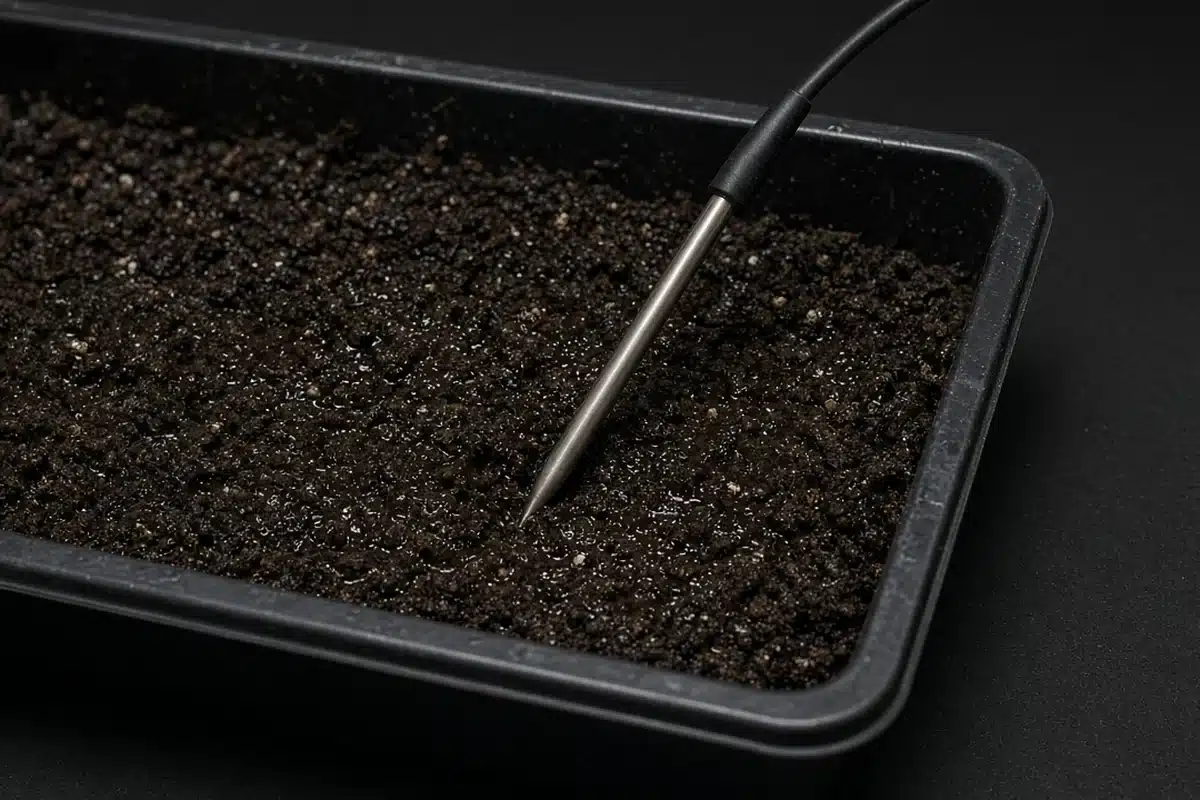
A cheap thermometer pushed into the mix tells you more than the room thermostat does.
Why a thermostat matters
Utah State Extension suggests pairing heat mats with a thermostat to regulate temperature, because this keeps containers from getting too hot. A mat on its own simply heats. Without a controller, the mix can climb well past the range seeds like, especially under a humidity dome or near warm lights.
A thermostat with a probe placed in the mix turns the mat on and off to hold a set temperature. That steady warmth is what Iowa State Extension’s advice points to.
Setting up bottom heat, step by step
- Prepare the mix first. Utah State Extension advises breaking up clumps and pre-wetting the mix until it feels as damp as a wrung-out sponge. It is too wet if you can squeeze water from a handful. Mix choices are compared in seed starting mix for cannabis.
- Fill and settle the containers. Tap them on the table to settle the mix rather than pressing it down by hand.
- Sow at the right depth. Utah State Extension’s general rule is two to three times the seed’s diameter.
- Water from below. Set the tray in shallow water and let the mix wick it up through the drainage holes, then mist the top if needed.
- Place the tray on the mat with the thermostat probe in the mix, and set it to your target.
- Cover with a clear dome or plastic bag to hold humidity, as Utah State Extension suggests.
- Check at least daily. Utah State Extension advises watching for germination and for problems such as a mat or thermostat that has stopped working, or mix that is drying out.
Two small details from Utah State Extension make a difference on a mat. After covering seeds, press lightly on the mix so each seed has good contact with it. Before sowing, label each tray or cell with the variety and planting date. Utah State Extension also notes that seed packets give an average range of days to germination, but seeds can sprout before, during or after that window, so keep checking rather than giving up early.
Domes, light and overheating
Utah State Extension notes that high humidity around seeds helps them take up water and begin germinating. A clear dome over a tray is an easy way to hold moisture, and a large clear plastic bag works too.
Heat can build fast under cover. Utah State Extension warns not to put covered trays in direct sunlight, because the greenhouse effect can create very high temperatures. A dome on a heat mat in a sunny window combines two heat sources, so watch it closely or move it out of the sun.
Keeping moisture right on a heat mat
Bottom heat dries mix faster. Utah State Extension advises keeping the mix evenly moist but not waterlogged, and not letting dry spots form before seeds germinate. Check the surface each day and add water from below or with a fine mist when it starts to lighten in color.
Do not overcorrect with heavy watering. A warm, soggy tray is a good setting for seedling rot. The warning signs are described in damping off in cannabis seedlings.
When to take seedlings off the mat
There is no set day for removing bottom heat in the Extension advice, so treat this as general guidance. Heat mats are a germination tool. Once most seedlings have broken the surface and opened their first leaves, they generally do better with a little less warmth and plenty of light.
Signs it is time to turn the mat down or off:
- Most seeds in the tray have sprouted.
- The mix is drying out faster than you can keep up with.
- Seedlings are stretching tall and thin toward the light.
Stretching usually points to too little light more than too much heat, and fixes for that come from Kind Seed Co in leggy cannabis seedlings. Moving seedlings off the mat is still a good time to check that your light is close enough.
If your room is cold at night, you can step down rather than stopping all at once. Lower the thermostat a few degrees, or run the mat only at night. These are practical habits rather than published figures.
Alternatives to a heat mat
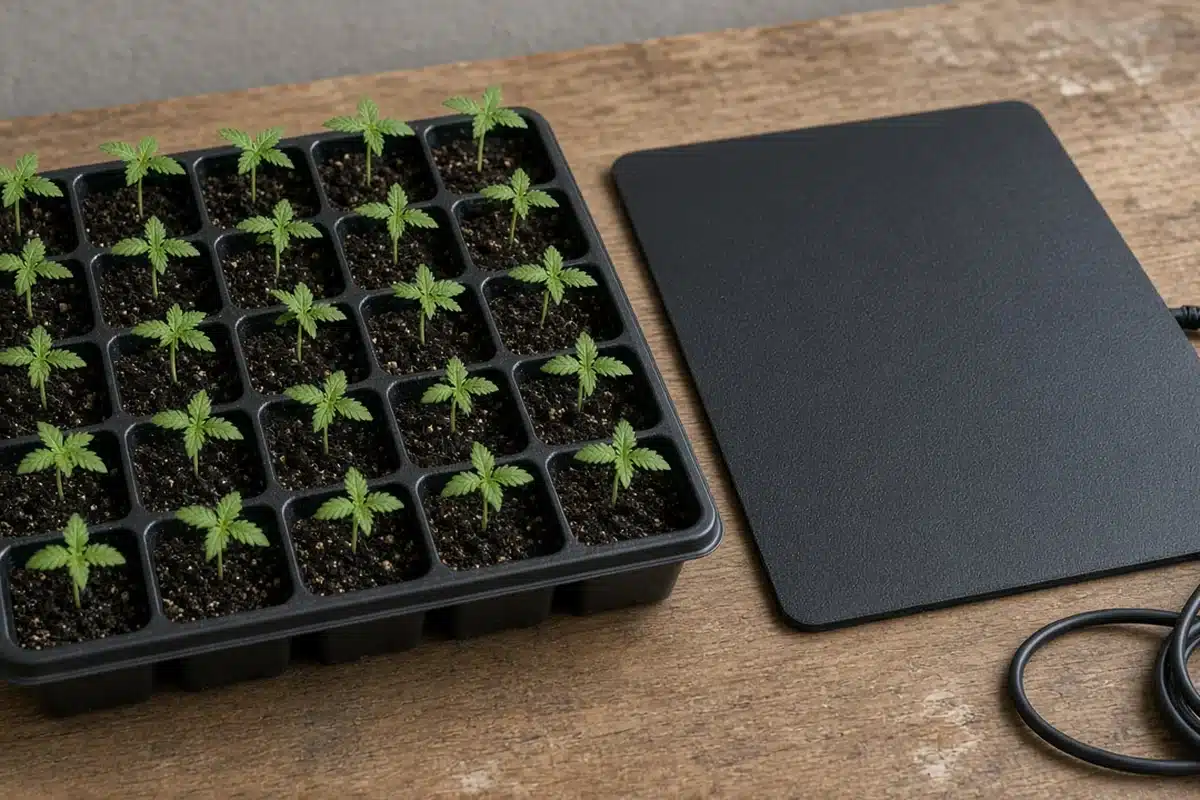
Iowa State Extension notes that a warm location in the house often does the job. Utah State Extension notes that lights placed within a few inches of trays add some heat. In mild rooms, a tray near a warm interior wall, away from cold windows and drafts, may hold temperature well enough.
A spot that runs hot and cold is the thing to avoid. If the only warm place is beside a heater that cycles on and off, the swings may cancel out the benefit.
Troubleshooting heat mat problems
Seeds are slow to sprout. The mix may be too cool. Check the temperature in the mix, not the room, and add bottom heat if it runs cool.
The tray is dry by the next day. Bottom heat speeds drying. Use a dome, water from below and check daily.
Trays feel hot to the touch. The mat may be running without control. Add a thermostat with a probe in the mix.
Condensation drips heavily inside the dome. Humidity is high and the tray may be too warm. Vent the dome and keep trays out of direct sun.
Seedlings are tall and thin. Light is likely too weak or too far away. Improve light and turn the mat down once seeds are up.
Sources
- Iowa State University Extension and Outreach, Yard and Garden. Do I need to purchase a heat mat to successfully germinate seeds indoors? https://yardandgarden.extension.iastate.edu/faq/do-i-need-purchase-heat-mat-successfully-germinate-seeds-indoors
- Utah State University Extension. Starting Vegetable Seeds Indoors: III. Germination. https://extension.usu.edu/yardandgarden/research/starting-vegetable-seeds-indoors-germination
FAQ
Do cannabis seeds need a heat mat to germinate?
Not always. Iowa State Extension notes most seeds germinate best at a steady 70 to 75°F in the mix, and a warm spot in the house often works fine. A heat mat helps in cool rooms or where temperatures drop at night. Measure the mix temperature before deciding you need one.
What temperature should a seedling heat mat be set to?
Utah State Extension notes most plants germinate at soil temperatures of 65 to 75°F, and Iowa State Extension gives 70 to 75°F as the best steady range. Neither lists a cannabis-specific figure. Set a thermostat with a probe in the mix and aim for about 70 to 75°F in the mix.
Can a heat mat overheat seeds?
Yes. A mat without a controller simply heats, and the mix can climb past the ideal range. Utah State Extension recommends pairing heat mats with a thermostat to keep containers from getting too hot. It also warns against placing covered trays in direct sunlight, where temperatures under the dome can climb very high.
When should I remove seedlings from the heat mat?
There is no fixed day. Bottom heat is mainly for germination, so turn it down or off once most seeds have sprouted and opened their first leaves. If the room is cold at night, lower the thermostat gradually instead. Watch moisture closely, since heated trays dry out faster than unheated ones.


