
Septoria Leaf Spot on Cannabis: Yellow Halos and Leaf Drop
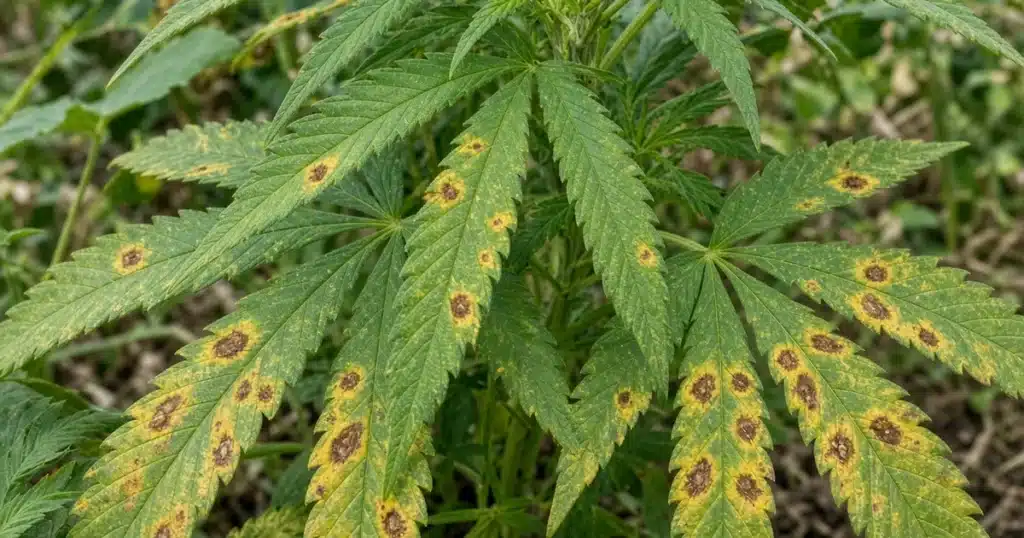
Quick answer: Septoria leaf spot is a fungal disease of field grown hemp that starts as small brown spots with bright yellow halos on the lower, inner leaves. University of Kentucky and Rutgers University report that it spreads fast in rainy, humid weather and can strip much of the lower canopy. Management is mostly cultural: space plants for airflow, remove infected and fallen leaves, mulch to limit splash and bury or remove debris after harvest.
What Is Septoria Leaf Spot?
It is a leaf disease caused by Septoria fungi that have only been seen on hemp so far. Kentucky names Septoria cannabis as the cause and says it is the most commonly reported leaf spot of field hemp in that state. The University of Florida also lists Septoria cannabis as the cause in its field guide to hemp diseases.
Kentucky explains that Septoria species tend to infect a narrow group of hosts. The Septoria that spots tomato leaves, for example, sticks to tomato and its relatives. That means the tomato disease in a nearby bed is a different fungus.
What Does Septoria Leaf Spot Look Like?
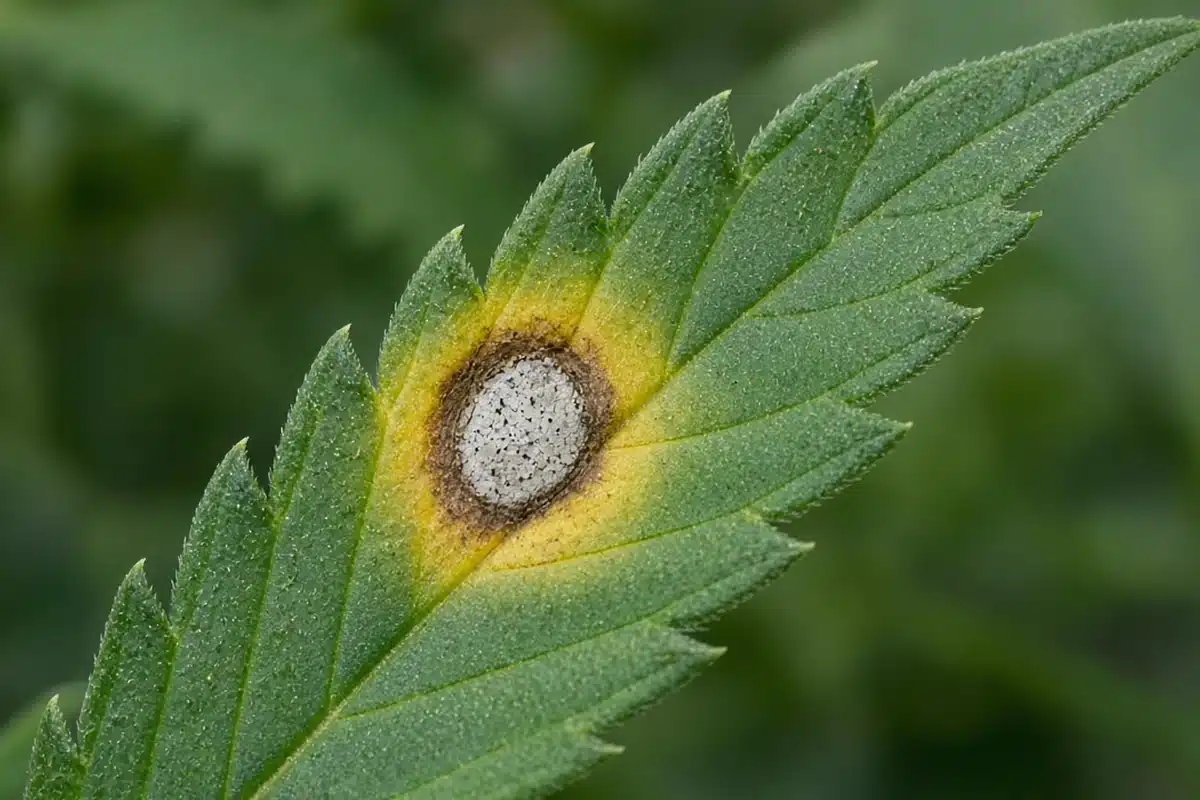
Brown spots with yellow rings, starting low on the plant. Kentucky describes small, irregular spots with bright yellow margins that grow to about 1/4 inch across. As they enlarge, the brown areas lose their shape and their centers fade to gray or white.
Other signs from both sources:
- Tiny black specks inside the spots, which Kentucky compares to pepper flakes
- Yellow halos that spread outward and merge
- Whole leaves that turn yellow and fall off
- Symptoms that start on lower leaves and in the inner canopy
The University of Florida describes the black specks, called pycnidia, as tiny dots about the size of a pinhead, sitting in the center of each spot. Kentucky says that in wet weather they release spores that ooze out in curls.
How Much Damage Can It Do?
Heavy leaf loss in bad years. Kentucky says that in the worst conditions, 50 to 90 percent of the leaves in the lower to middle canopy can be lost. It adds that severe early disease can cause stunting and loss of vigor. In some years, processors have rejected shipments because of the disease.
Kentucky also reports that no direct losses in biomass or cannabinoid yield have been observed. The University of Florida notes that when the disease builds early in the season, leaf loss of up to 90 percent can weaken overall plant vigor.
How Does Septoria Spread?
By spores moved with water and wind. Kentucky explains that each black pycnidium holds several hundred spores. When there is extra moisture, spores ooze out and travel short distances by rain splash and longer distances by wind driven rain. The University of Florida likewise says rain splash and wind carry spores up to the lowest leaves.
Kentucky says new spots develop 7 to 10 days after infection. In humid weather the fungus cycles faster and makes more spores, so disease worsens as the canopy thickens. Rutgers adds that how bad it gets depends on how long leaves stay wet from rain or dew.

Why Does It Start on the Lower Leaves?
That is where leaves stay wet longest. Kentucky says symptoms begin on lower leaves and inside the canopy, the parts of the plant that stay damp and humid. Rutgers agrees that spots first form low in the inner canopy, where leaves stay wet longer and the air is more humid.
The University of Florida says infection is favored by wet leaves. Rutgers adds that dew counts as well as rain, so morning moisture matters too. You do not need a microscope to spot the disease, though. Watching the lowest leaves after wet spells is the simplest early warning.
Kentucky’s note that disease gets worse as canopies grow denser points the same way, so start checking the lowest leaves once plants fill in.
How Does the Fungus Survive Winter?
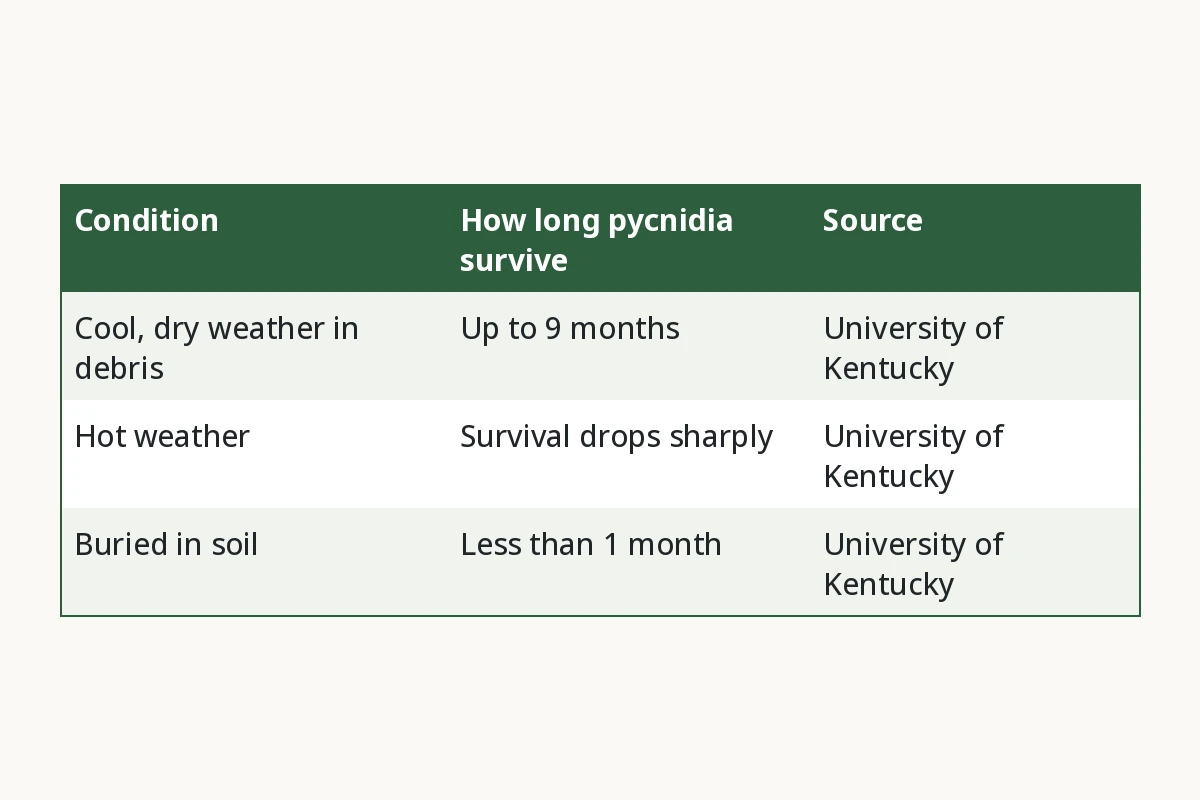
In crop debris. Kentucky says the pycnidia act as survival structures. Under cool, dry conditions they can stay alive in debris for up to 9 months, but survival drops sharply in hot weather and falls to less than 1 month when buried in soil.
Kentucky and Rutgers both suggest that weeds might act as a green bridge that carries the fungus between seasons, though no alternate host has been confirmed. Rutgers adds that the fungus probably survives winter in old debris and possibly in soil.
How to Manage Septoria Leaf Spot on Cannabis
- Space plants widely. Kentucky recommends wider spacing for better airflow and faster drying. Rutgers also advises wider spacing within and between rows so leaves dry fast.
- Thin dense growth. Kentucky suggests thinning plants to improve air movement.
- Keep leaves dry. Rutgers advises against overhead watering and suggests watering in the morning so foliage dries quickly.
- Prune infected leaves. Rutgers advises taking out diseased plant material and destroying or burying it.
- Pick up fallen leaves. Kentucky notes that the fungus survives in debris, so leaves left on the ground keep it close to your plants.
- Mulch the soil. Kentucky recommends mulching so fewer fungal structures move from soil to leaves. Our guide to mulching cannabis beds compares materials.
- Bury or remove debris after harvest. Kentucky and Rutgers both describe deep tilling to bury infected debris, and Rutgers also mentions removing it from the site after harvest. Removal fits a small garden bed well. Our guide to fall garden cleanup after cannabis harvest covers that step.
- Keep plants healthy. Kentucky lists maintaining plant health among its cultural practices. Rutgers also names crop rotation as a cultural step for this disease.
Septoria Survival in Debris
| Condition | How long pycnidia survive | Source |
|---|---|---|
| Cool, dry weather in debris | Up to 9 months | University of Kentucky |
| Hot weather | Survival drops sharply | University of Kentucky |
| Buried in soil | Less than 1 month | University of Kentucky |
Are Fungicides an Option for Septoria?
Very limited. Kentucky said in 2021 that no conventional fungicides were labeled for hemp, and that some biological products had shown suppression only in lab and greenhouse tests with no field data. The University of Florida notes that labeled control options for hemp are close to nonexistent. Use only products labeled for your crop and state, since very few are cleared for hemp. Buds and flowers should never be sprayed.
Rutgers notes that how badly plants suffer also depends on how susceptible the variety is, but cultural steps still carry most of the load.
How Is Septoria Different From Other Leaf Spots?
The black specks are the giveaway. The University of Florida warns that Septoria can be mistaken for Curvularia or Cercospora leaf spots, so look for the black pycnidia. Kentucky’s description of brown spots with gray to white centers and yellow halos adds to the picture. If you are unsure, send a sample to your state’s plant disease clinic. For other leaf problems, our post on common cannabis plant problems is a good starting point.
Troubleshooting Septoria Problems
Spots appeared after a week of rain. Kentucky says rain and humidity drive rapid spread. Remove spotted leaves and open the canopy.
Lower leaves keep falling. That matches the defoliation Kentucky and the University of Florida describe. Pick up fallen leaves so spores do not build up.
The disease came back in the same bed. Kentucky says pycnidia survive in debris. Clear plant debris thoroughly at season’s end.
Plants are packed too close. Kentucky and Rutgers both point to spacing for airflow. Thin or space plants wider next season.
Spots lack black specks. The University of Florida says black pycnidia in the spot centers help identify Septoria. Get a lab diagnosis before deciding on a cause.
Sources
- University of Kentucky Cooperative Extension, Septoria Leaf Spot of Field Hemp (PPFS AG H 01): https://plantpathology.mgcafe.uky.edu/files/ppfs-ag-h-01.pdf
- University of Florida IFAS Extension, Field Guide to Hemp (Cannabis sativa) Diseases (PP379): https://ask.ifas.ufl.edu/publication/PP379
- Rutgers New Jersey Agricultural Experiment Station, Emerging Diseases of Hemp in New Jersey (E374): https://njaes.rutgers.edu/e374/
FAQ
Can Septoria from tomatoes infect cannabis?
Unlikely. Kentucky says the tomato Septoria affects tomato and its relatives, while Septoria cannabis is only known on hemp.
How fast do new spots appear?
In 7 to 10 days. Kentucky says leaf spots develop in that time after infection.
Does Septoria lower cannabinoid levels?
Not that has been seen. Kentucky reports no direct biomass or cannabinoid yield losses, even though bad years can strip many lower leaves.
Are there resistant varieties?
None that our sources name. Rutgers says cultivar susceptibility affects how severe the disease gets and advises weighing resistance when choosing varieties.
When does Septoria show up?
After warm, wet weather. The University of Florida says wet spring weather favors the fungus, and Rutgers saw symptoms by late August in its field trials.


