
Field Bindweed in Cannabis Gardens: Deep Roots and Smothering
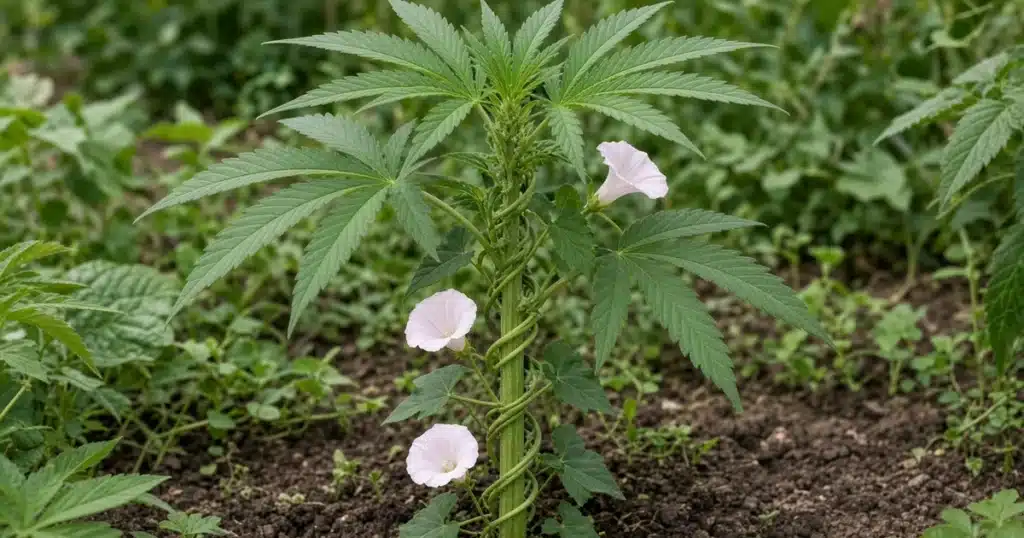
Quick answer: Field bindweed is a perennial vine with arrowhead shaped leaves and white to pink trumpet flowers that climbs any plant it touches. UC IPM, the University of California pest program, and Colorado State’s PlantTalk service agree that no single step kills an established patch in one season. The plan is stopping seed, pulling young seedlings early, cutting top growth again and again, shading it out and covering bare soil with overlapping fabric topped by mulch for several years.
What Does Field Bindweed Look Like?
Look for arrowhead leaves on a twining vine. The UC bindweed guide says mature leaves are arrowhead shaped and 1/2 to 2 inches long, with larger leaves near the base of the stem. Its trumpet shaped flowers are white to pink and roughly 1 to 1 1/2 inches across. Colorado State gives the same leaf and flower description.
The UC bindweed guide explains that bindweed creeps along the ground until it finds something to climb, such as a shrub, a fence or a garden plant. Its seedlings have two nearly square seed leaves with a shallow notch at the tip. Shoots coming up from underground stems have no seed leaves at all.

How Is Bindweed Different From Morning Glory?
The ornamental morning glory is bigger and showier. The UC bindweed guide says the annual morning glory has flowers about 2 inches wide in white, blue or purple, a thicker and sometimes hairy stem, and leaves shaped like a heart. Field bindweed has smaller white to pink flowers and arrowhead leaves. The guide calls the two easy to tell apart.
Field bindweed also goes by plenty of other names, the UC guide notes, including perennial morning glory and creeping jenny.
Why Is Bindweed So Hard to Kill?
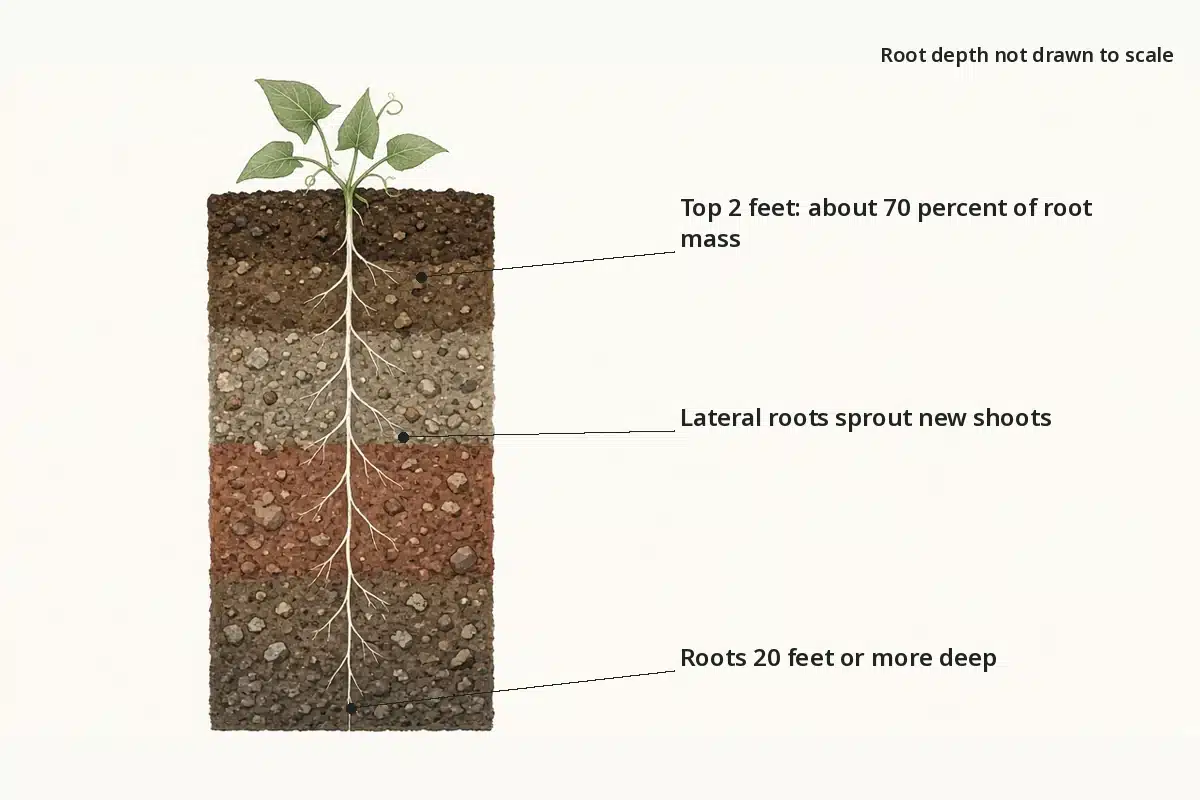
Its roots run deep and wide. The UC bindweed guide says vertical roots can reach 20 feet or more, and Colorado State agrees. The same guide adds that about 70 percent of the root mass sits in the top 2 feet of soil, with most lateral roots no deeper than 1 foot.
The UC bindweed guide explains that a piece of root or underground stem only 2 inches long can grow into a new plant. Lateral roots often turn downward 15 to 30 inches from the parent, starting new roots and shoots, so one plant can spread more than 10 feet across in a season. It also warns that tilling between plants often spreads the patch.
Seeds add to the problem. The UC bindweed guide says an average plant makes about 550 seeds, and seeds 60 years old have been found still alive. Colorado State puts seed survival at 20 years.
Where Does Bindweed Grow Best?
In sunny spots with heavy soil. The UC bindweed guide says that in California it appears to favor heavy clay over sandy soil and grows below about 5,000 feet of elevation. It survives under both sprinkler and drip irrigation in landscapes.
The UC bindweed guide adds that its deep underground network lets it get through winter with no leaves at all and persist in soil for many years. Colorado State notes that it is listed as a noxious weed. A patch that seems gone in winter is usually waiting underground for spring.
How Does Bindweed Hurt a Cannabis Garden?
It competes and climbs. The UC bindweed guide says bindweed often grows up through upright plants with its stems and leaves wrapped throughout. It handles drought well and competes better than most plants when water is short. Even with regular water, the UC guide says, bindweed tends to thrive and twine up plants.
The UC bindweed guide adds that bindweed underground stems can push through fabric, plastic and other barriers, and that infested land can make many vegetable crops impractical to grow.
How to Control Field Bindweed in Cannabis Beds
- Use clean soil and plants. The UC bindweed guide advises buying clean seed and plant stock and making sure any new topsoil is free of bindweed roots and seeds. Our guide to buying topsoil for cannabis beds covers what to check.
- Pull seedlings early. The UC bindweed guide says seedlings are easy to remove for about 3 to 4 weeks after they emerge. After that, perennial buds form and control gets much harder.
- Never let it seed. Both the UC bindweed guide and Colorado State put preventing seed production at the top of the list.
- Cut or hoe top growth often. The UC bindweed guide suggests cultivating every 2 to 3 weeks and repeating as needed. Colorado State says persistent removal of top growth drains energy from the roots.
- Unwind vines from cannabis stems. The UC bindweed guide notes that bindweed twines up nearby plants, so free stems before the vine wraps tightly.
- Shade it out. Colorado State says bindweed loves sun, so shading with cloth or other plants can work. The UC bindweed guide reports that shade from other plants reduced bindweed growth in studies.
- Cover paths with fabric and mulch. The UC bindweed guide says landscape fabric or black plastic works if no light reaches the soil. Overlap the edges and top the fabric with bark or rock.
- Stay with it for years. The UC bindweed guide says complete death under mulch takes 3 to 5 years.
Bindweed Control Methods Compared
| Method | How it works | Time frame from sources |
|---|---|---|
| Pulling seedlings | Removes plants before perennial buds form | Within 3 to 4 weeks of emerging |
| Repeated hoeing | Drains stored root energy | Every 2 to 3 weeks |
| Shade from other plants | Cuts the light bindweed needs | Ongoing through the season |
| Fabric topped with mulch | Blocks all light | 3 to 5 years for complete death |

Our post on weed control in outdoor cannabis covers general weeding methods that pair with these steps.
Does Landscape Fabric Stop Bindweed?
Yes, if it blocks all light and the edges overlap. The UC bindweed guide says landscape fabric made of polypropylene or polyester, black plastic or cardboard has worked when no light reaches the plant. It stresses overlapping the edges so stems cannot slip between sheets.
The UC bindweed guide warns that bindweed will grow through any holes cut for plants, and that killing it by blocking light can take more than 3 years. Once the cover comes off, new plants can appear from seed in the soil, so keep watching. Our guide to mulch for cannabis explains which top layers suit a garden.
Does Withholding Water Help?
Sometimes, during a summer season. The UC bindweed guide says drying the site while cultivating may help reduce bindweed, as long as the roots have not reached deep moisture. Without summer water, it says, bindweed cuts seed output first and then shrinks its growth and leaves, but still flowers. The UC bindweed guide frames this as a summer tactic for the site, so it suits an unplanted bed better than one in active use.
Should You Use Herbicides on Bindweed?
Rarely, and only with great care near cannabis. The UC bindweed guide says herbicides have suppressed bindweed but have rarely eradicated it, and work best combined with prevention and cultural steps. Colorado State warns that spraying desirable plants can kill them. Use only products labeled for your crop and state, and keep any spray away from cannabis buds.
Troubleshooting Bindweed Problems
Bindweed came back after hand pulling. Colorado State says pulling rarely kills established plants but persistence wears down the roots. Keep removing top growth.
Tilling made the patch bigger. The UC bindweed guide says even small root pieces start new plants. Switch to hoeing shoots and covering paths.
Vines are coming through holes in the fabric. The UC bindweed guide says bindweed grows through planting holes. Remove those shoots as soon as they appear.
New seedlings appeared after the fabric came off. The UC bindweed guide says seed in the soil can sprout later. Pull seedlings within the 3 to 4 week window.
Bindweed wraps around cannabis stems. The UC bindweed guide notes it twines up upright plants. Unwind vines early before they wrap the whole plant.
Sources
- UC Statewide IPM Program, University of California, Pest Notes: Field Bindweed: https://ipm.ucanr.edu/home-and-landscape/field-bindweed/
- Colorado State University Extension, PlantTalk Colorado, Controlling Bindweed: https://planttalk.colostate.edu/topics/weeds-cultural-problems/2104-controlling-bindweed/
FAQ
How deep do bindweed roots go?
20 feet or more. The UC bindweed guide and Colorado State both give that depth.
How long do bindweed seeds last?
Decades. The UC bindweed guide reports viable seed 60 years old, while Colorado State says 20 years.
Can a 2 inch root piece regrow?
Yes. The UC bindweed guide says a 2 inch section of root or rhizome is enough to start a new plant.
Does bindweed like shade?
No. Colorado State calls it a sun loving plant that shading can suppress.
How long does smothering take?
3 to 5 years for complete death, the UC bindweed guide reports.


