
Beet Curly Top Virus on Cannabis: Yellowing, Curling and Prevention

Quick answer: Beet curly top virus is a plant virus carried by the beet leafhopper, a tiny pale green insect that picks it up from infected weeds. Researchers at Utah State University Extension and Colorado State University report it in field grown hemp, where it causes stunting, yellow mottled leaves and curled, twisted new growth. Young plants are the most at risk. Prevention rests on covering seedlings, clearing weeds, planting away from beets and tomatoes and scouting for the leafhopper.
What Is Beet Curly Top Virus?
It is a virus that infects many crops and weeds and is spread only through leafhopper feeding. Utah State lists field grown hemp, vegetables, ornamentals and weeds as hosts. Colorado State says the beet leafhopper is the key vector and that hemp appears to be highly susceptible. It notes that the first hemp report came from western Colorado in 2015, with a damaging outbreak in 2019.
Colorado State adds that the virus is much more common in western Colorado than in the eastern part of the state. Utah State reports low incidence in field grown hemp in Utah.
What Are the Symptoms of Curly Top on Cannabis?
Stunting with yellowing and curled leaves. Utah State says infected hemp becomes stunted and shows a yellow mosaic pattern on its leaves, or the leaves turn fully yellow. Colorado State describes symptoms that change with the plant’s age at infection:
- Young plants: light green leaves and yellow new growth
- Older leaves: dark and light green mottling
- Mid growth: stronger yellowing plus curling and twisting of new leaves
- Shoot tips: stunted leaves on shortened stems, a pattern called witch’s broom
- Late stage: severe curling, stunting and dead patches on yellow leaves
Colorado State notes that symptoms often show on single branches, and that healthy branches can grow over the sick ones. Severely dwarfed plants often die later in the season.
How Does the Virus Spread?
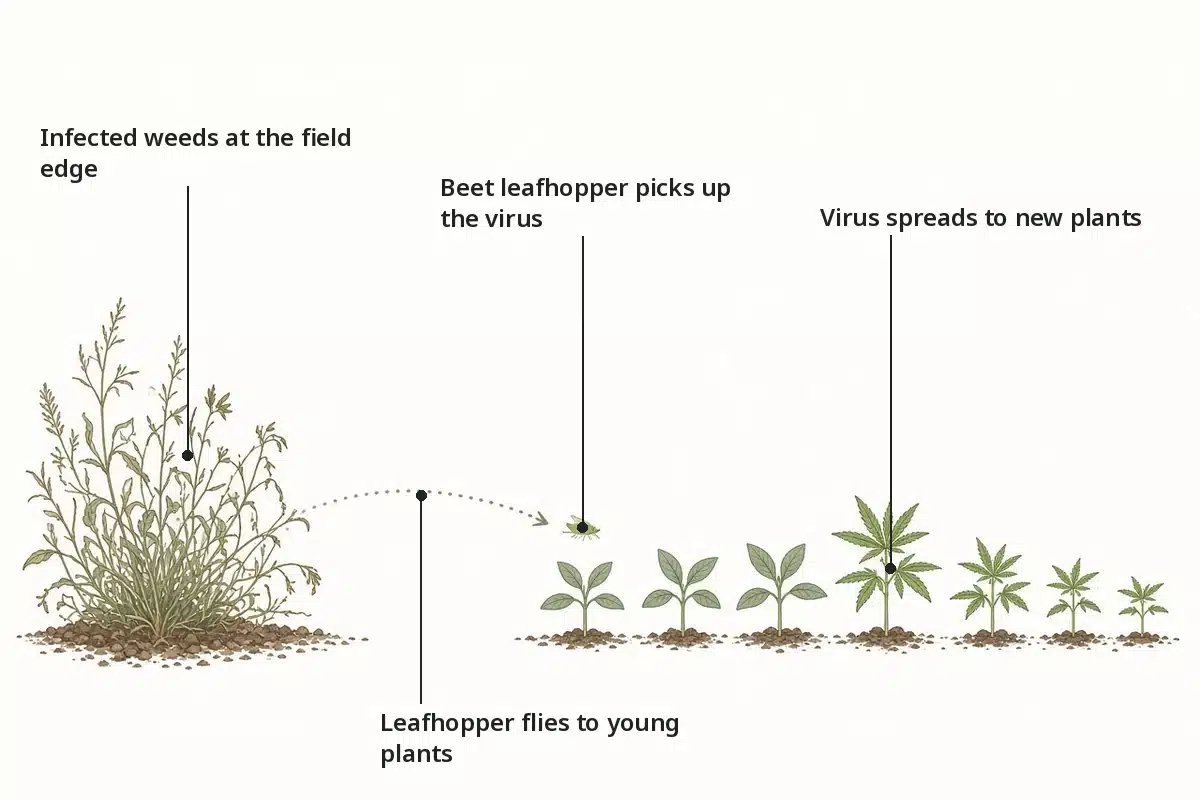
Through the beet leafhopper. Utah State explains that the insect picks up the virus by feeding on infected plants and can then pass it on for the rest of its life. Transmission happens quickly while the leafhopper probes and feeds.
Colorado State says leafhoppers get the virus from infected weeds and carry it to nearby crops. Utah State adds that beet leafhoppers move north in early summer from where they spend the winter. Weeds and volunteer plants from earlier crops can shelter both the insect and the virus over winter, according to Utah State.
Colorado State notes that the feeding itself does little harm. The virus is the real threat.
What Does a Beet Leafhopper Look Like?
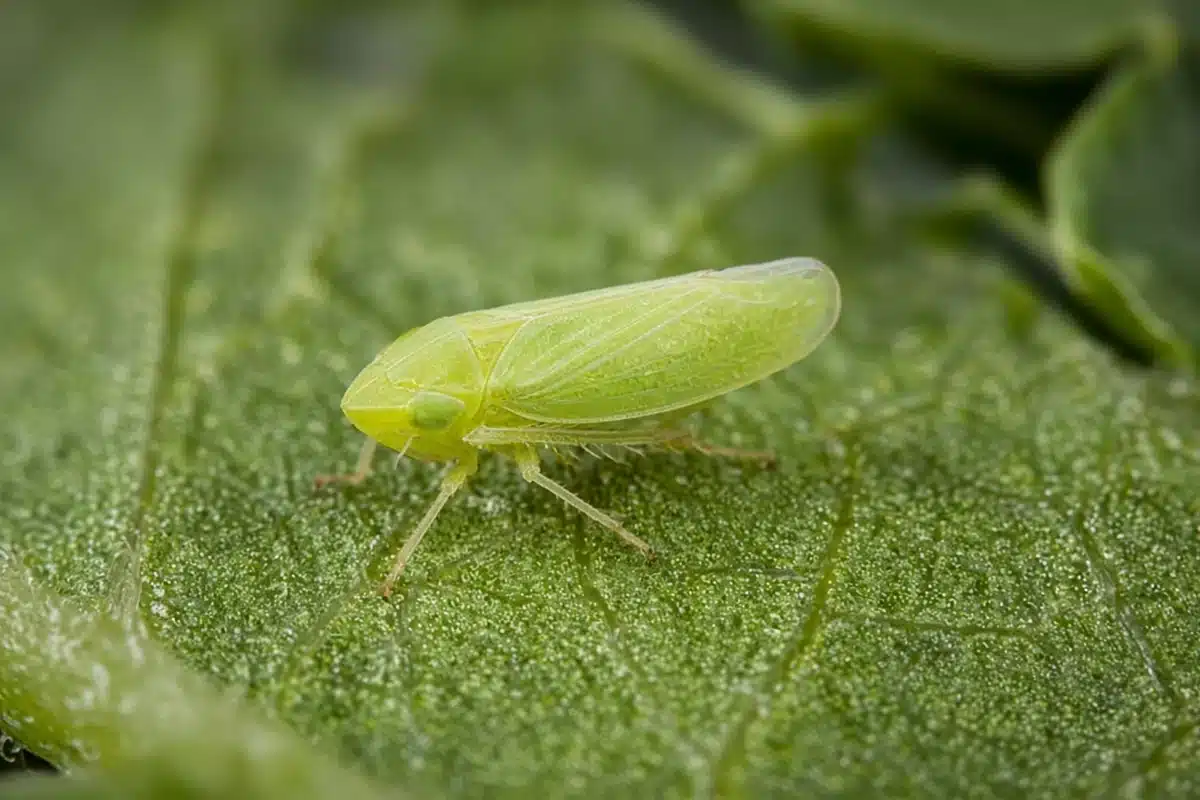
It is tiny and pale with no head markings. Colorado State describes summer adults as pale green and about 0.13 to 0.14 inches long, with no markings on the head. That bare head helps tell it apart from other leafhoppers found in hemp.
Colorado State points out that the most common leafhopper in Colorado hemp is a different species that does not hurt plants. So make sure of the ID before you act. Our post on leafhoppers on cannabis covers the wider group in more detail.
How to Lower Curly Top Risk in a Cannabis Garden
- Cover young plants. Colorado State says a physical barrier over seedlings helps because young plants are the most susceptible. Utah State suggests row covers to keep leafhoppers off. See our guide to row covers for cannabis.
- Clear weeds in and around the garden. Utah State says keeping borders and interiors weed free reduces food for incoming leafhoppers. Our post on weed control in outdoor cannabis covers methods.
- Plant away from beets and tomatoes. Utah State advises planting hemp farther from these susceptible crops.
- Remove old debris and volunteer plants. Utah State says old plant debris and volunteer plants can carry the virus and the insect through winter.
- Scout every two weeks. Utah State recommends checking plants biweekly for stunting and yellow mosaic.
- Hang yellow sticky cards at the edges. Colorado State suggests checking cards weekly and replacing them as needed.
- Protect natural enemies. Colorado State names many natural enemies of the leafhopper, from spiders and green lacewings to assassin bugs, bigeyed bugs and some parasitic flies and wasps.
- Get a diagnosis. Utah State says plants with yellow mosaic can be sent to its diagnostic lab. Contact your state Extension office for a local lab.
How Does the Beet Leafhopper Breed?
Quickly, with several generations a year. Colorado State says females start laying eggs in early spring and that each one can lay hundreds. Each egg is long and a little curved, white or yellow in color, and tucked singly inside a leaf or stem.
Nymphs pass through five stages, Colorado State explains. They start out a clear white, turn yellow or green within hours and later pick up black, brown and red spots. Colorado State notes that both nymphs and adults jump away quickly when disturbed, which makes them easy to miss.
Can a Trap Crop Help?
It can, when planted along field edges or a big garden border. Colorado State says trap crops planted along field edges can draw beet leafhoppers into one area. Sugar beet is the insect’s favorite food and makes an ideal trap crop. It also advises scouting nearby crops and weeds for the insect.
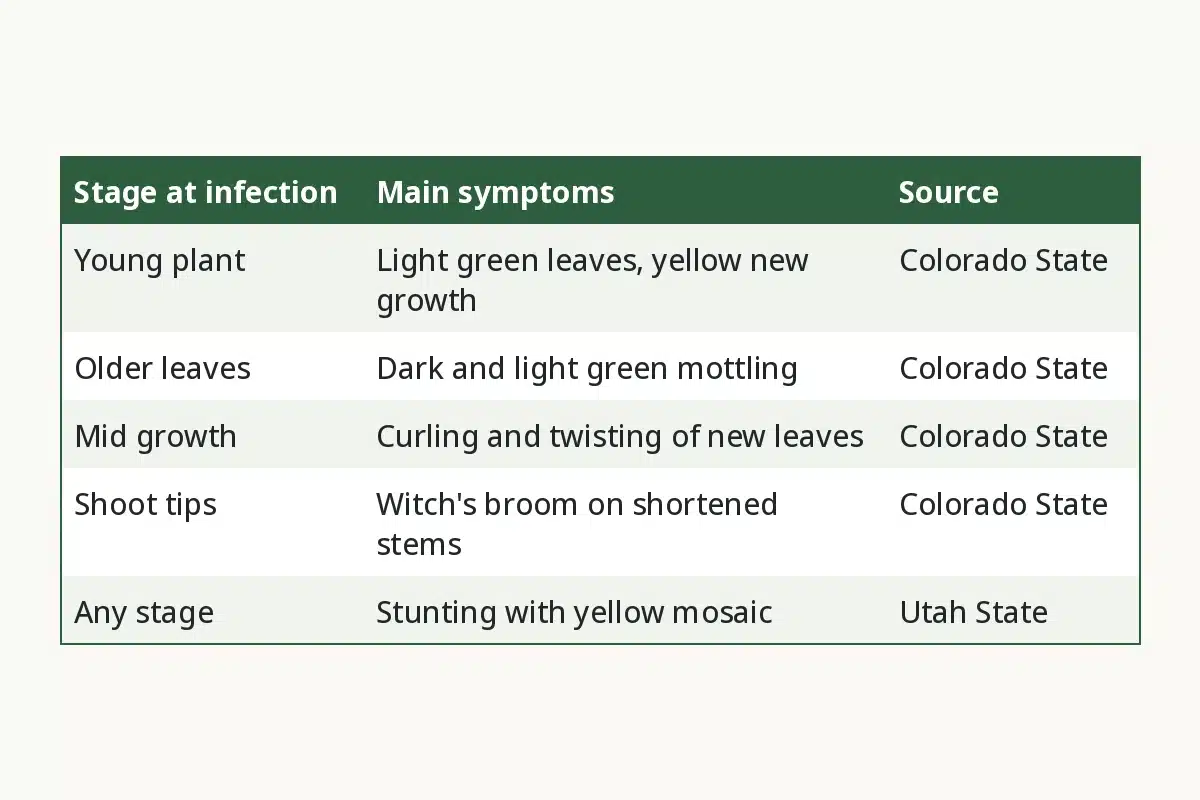
Curly Top Symptoms by Growth Stage
| Stage at infection | Main symptoms | Source |
|---|---|---|
| Young plant | Light green leaves, yellow new growth | Colorado State |
| Older leaves | Dark and light green mottling | Colorado State |
| Mid growth | Curling and twisting of new leaves | Colorado State |
| Shoot tips | Witch’s broom on shortened stems | Colorado State |
| Any stage | Stunting with yellow mosaic | Utah State |
Can an Infected Plant Recover?
Not from the virus itself, as far as the sources say. Neither Utah State nor Colorado State offers a way to clear the virus from a plant once it is infected. Colorado State notes that healthy branches on a partly infected plant can outgrow the sick ones, but severely dwarfed plants often die later in the season.
Colorado State also says action thresholds for the leafhopper in hemp have not been set. That is another reason to lean on covers, weed control and scouting.
What Can Be Mistaken for Curly Top?
Tomato spotted wilt virus is the main look alike. Utah State says tomato spotted wilt virus can look much the same early in the season. Yellow leaves have many other possible causes too. Our guide on how to spot common cannabis deficiencies by leaf symptoms can help you rule those out, but a lab test is the surest answer.
Troubleshooting Curly Top Problems
One branch is yellow and twisted while others look fine. Colorado State says symptoms often appear on single branches. Watch the plant and send a sample for testing.
Seedlings planted near a beet patch got sick. Utah State advises keeping hemp away from beets and tomatoes. Move next year’s planting.
Sticky cards catch many leafhoppers. Colorado State says most leafhoppers in hemp may be a harmless species. Check for the plain head of the beet leafhopper.
Weeds along the fence line are thick. Utah State says weeds shelter infected leafhoppers. Clear them early in the season.
Plants stayed tiny all season. Colorado State notes that severely dwarfed plants often die later. Remove them and clean up debris, as Utah State suggests.
Sources
- Utah State University Extension, Hemp Curly Top Virus: https://extension.usu.edu/planthealth/ipm/notes_ag/hemp-curly-top-virus
- Colorado State University, Agricultural Biology, Beet Leafhopper and Beet Curly Top Virus: https://agsci.colostate.edu/agbio/ipm-pests/beet-leafhopper-beet-curly-top-virus/
FAQ
Does leafhopper feeding hurt the plant?
Very little on its own. Colorado State says the feeding does not significantly injure plants, but the virus it carries does.
When are plants most at risk?
When they are small. Utah State says concern runs all season but peaks while plants are young.
Can the virus spread through seed?
Unknown. Colorado State says it is not yet known whether the virus is seed transmitted.
What is a trap crop for beet leafhoppers?
Sugar beets. Colorado State says sugar beet is the preferred host and makes an ideal trap crop on field edges.
Where does the leafhopper spend winter?
Away from northern fields. Utah State says beet leafhoppers migrate north in early summer from where they overwinter.


