Snow Water for Cannabis: Melting, Salt and Temperature
Quick answer: Melted snow from a clean spot makes good water for cannabis. Missouri Extension lists rainwater and melted snow as excellent water sources for potted plants. Snow from roadsides, driveways or walks is another story. Iowa State Extension warns that deicing salts collect in soil and make it hard for plants to take up water, and that too much sodium and chloride harms plant tissue. Collect snow from untouched areas away from salted surfaces, melt it fully, let it reach room temperature and add a complete fertilizer, since snowmelt carries very few minerals.
Is Melted Snow Good for Watering Plants?
For houseplants and container plants, yes. Missouri Extension advice on caring for houseplants says ordinary tap and well water usually work fine, and it ranks both rain and snowmelt among the best choices.
Snow forms from water vapor high in the air, much like rain, and picks up little on the way down. Fresh snow from an open yard is low in dissolved minerals, so it will not leave the white crusts that hard tap water can. For indoor cannabis growers in cold climates, a few buckets of snow can be a free, soft water supply during winter.
Collected rain is a close cousin, covered in our rainwater for cannabis article.
Why Does Snow Location Matter So Much?
Where you collect snow decides whether it helps or harms. Snow near roads, driveways, sidewalks and parking areas often holds deicing salt.
Iowa State Extension guidance on deicing salts in the home landscape explains that salt builds up in soil near salted surfaces and runoff paths. It describes several effects:
- High salt in soil keeps plants from absorbing enough water even when the soil is moist, a condition called physiological drought.
- Salt limits how well roots take up essential nutrients.
- Too much sodium and chloride in plant tissue harms many plants.
- Sodium breaks down soil structure.
UMass Extension adds that plants also suffer when snow full of salt gets pushed by plows or shovels onto turf and beds. If that snow ends up in a watering can, the salt goes straight into your pots.
What Do Salts Do to Cannabis Plants?
The same processes Iowa State describes for landscape plants apply to potted cannabis, and containers concentrate the problem. Salt cannot drain away into deep soil, so it builds up with each watering.
Signs of salt stress include slow growth, browning leaf edges and wilting even though the mix is damp. A white crust can form on the pot rim or mix surface. For fixes, see our salt buildup in cannabis soil guide.
Iowa State notes that sodium chloride, the common rock salt, does more harm than calcium, potassium or magnesium chloride. You rarely know which salt was used near a given patch of snow, so it is simplest to avoid any snow near salted surfaces.
Snowmelt and Salt at a Glance
| Point | Detail | Source |
|---|---|---|
| Clean snowmelt | An excellent water source for potted plants | MU Extension |
| Softened water | Not for continuous use on potted plants | MU Extension |
| Salted snow | Salt builds up in soil near salted surfaces | ISU Extension |
| Water uptake | High soil salt causes physiological drought | ISU Extension |
| Nutrient uptake | Salt limits root uptake of essential nutrients | ISU Extension |
| Rock salt | More harmful than other deicing salts | ISU Extension |

Where Should You Collect Snow for Cannabis?
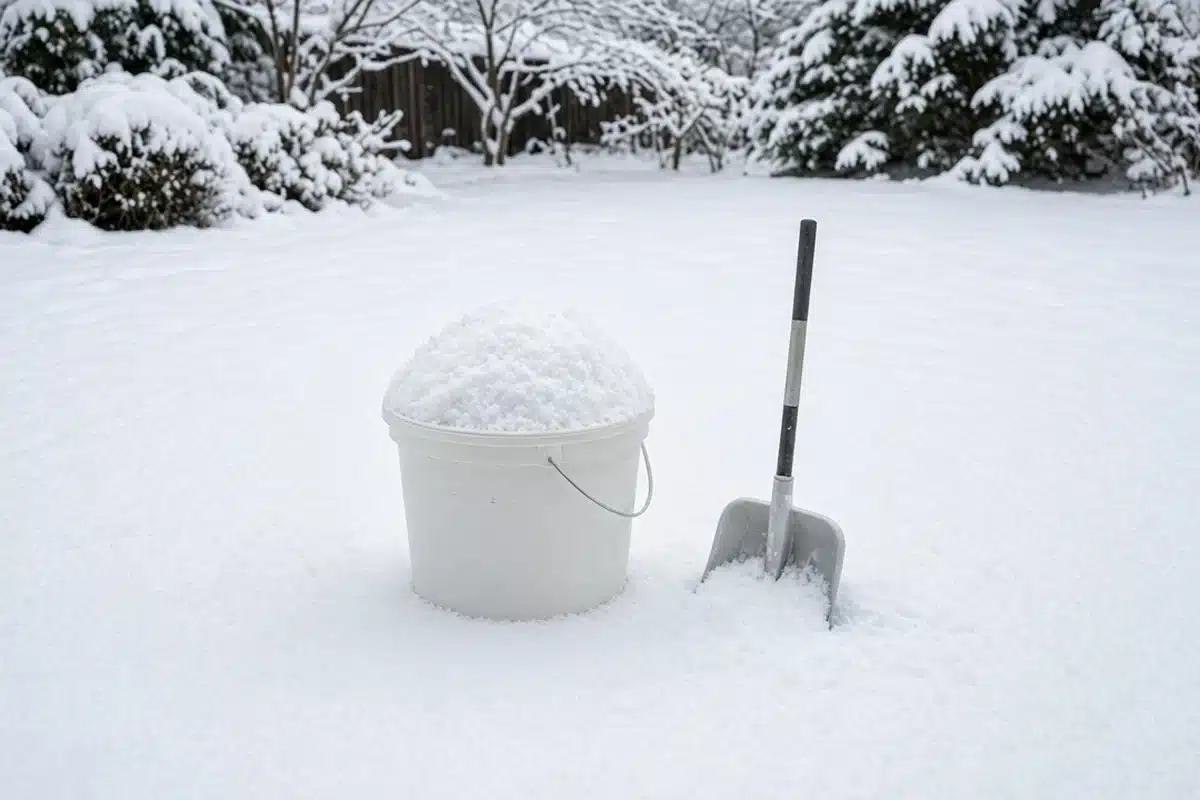
Pick spots that no salt or traffic can reach:
- Open lawns or garden beds well away from driveways and walks.
- Deck rails or patio tables that you never salt.
- The center of a back yard rather than along fences near the street.
- Fresh snowfall rather than old, gray snow that has collected dust and soot.
Skip snow near roads, plow piles, parking areas and anywhere pets frequent. Also skip snow from roofs with old shingles or metal flashing, which can pick up grit and residue.
How Do You Melt and Warm Snow Water?
Snow takes up far more space than the water it makes. A full bucket of fluffy snow may melt into only a few inches of water, so collect more than you think you need.
Melt it indoors at room temperature in a clean, covered container. Avoid heating it on a stove in metal pots you use for other things. Once melted, let the water sit until it reaches room temperature before watering. Cold water straight from the bucket can chill roots and slow growth, especially in a warm indoor grow.
Pour the clear water off the top and leave any grit at the bottom behind. To store snowmelt for later, keep it in a covered, opaque container in a cool spot so algae and dust stay out, and use it within a few weeks.
How Do You Feed Cannabis With Snow Water?
Clean snowmelt is soft and low in minerals, much like rainwater or distilled water. That means it supplies little calcium or magnesium, both of which cannabis needs in good amounts.
Use a complete fertilizer that includes those minerals, or add a calcium and magnesium supplement. A meter that reads dissolved solids shows how little the snowmelt holds and how much your fertilizer adds. Our ppm for cannabis page walks through those numbers.
MU Extension also advises against using water from most softeners continuously on potted plants. Clean snowmelt avoids that problem, since it carries almost no sodium.
How Much Water Does Snow Make?
Some snow holds far more water than other snow. Light, fluffy snow may hold only a small fraction of its volume as water, while wet, heavy spring snow holds much more. As a rough guide, expect a bucket of fresh powder to melt down to a few inches in the bottom.
That means snow works best as a supplement for a small indoor garden. A few plants in medium pots can get by on snowmelt during a snowy stretch, but a larger grow will need another source too.
Does Snow Water Change pH?
Fresh snow tends to be slightly acidic, like rain, because it absorbs carbon dioxide from the air as it falls. It also carries very little buffering, so its pH reading can drift. Once you add fertilizer, the mix takes on the character of the nutrients. Check pH after mixing rather than before, and adjust in small steps, since soft water responds quickly to additions.
Can You Use Snow Water on Outdoor Cannabis?
Outdoor cannabis grows in warm months, so snow water is mainly useful for indoor grows, seedlings started in late winter and stored water for early spring. You can melt snow and store it in covered containers for a few weeks to start the season.
Snow melting right in the garden helps outdoor beds as well. It soaks in slowly and builds up soil moisture ahead of planting. Just keep beds away from areas where salty snow is piled, as UMass warns.
How to Use Snow Water for Cannabis
- Choose a clean spot. Collect from open areas far from salted surfaces.
- Use fresh snow. Avoid old snow with dust and grit.
- Collect plenty. Snow melts down to a small amount of water.
- Melt it indoors. Use a clean, covered container.
- Let it warm. Wait until it reaches room temperature.
- Pour off clear water. Leave grit at the bottom.
- Add nutrients. Include calcium and magnesium.
- Check the mix. Measure dissolved solids and pH after mixing.
Troubleshooting Snow Water Problems
Leaf edges brown after watering. Salt may have been in the snow. Flush with clean water and choose a better spot.
Water looks gray or gritty. The snow was old or near a road. Let it settle and pour off the top, or discard it.
Plants droop after watering. Water may have been too cold. Let it warm first.
Fresh growth turns pale. The snowmelt lacks minerals. Add calcium and magnesium.
Mix stays damp but plants wilt. Built up salt may be keeping roots from taking up water. Flush the pot.
Sources
- University of Missouri Extension, Caring for Houseplants (G6510): https://extension.missouri.edu/publications/g6510
- Iowa State University Extension, Using Deicing Salts in the Home Landscape: https://yardandgarden.extension.iastate.edu/how-to/using-deicing-salts-home-landscape
- UMass Extension, Impact of Salts on Plants: https://www.umass.edu/agriculture-food-environment/landscape/fact-sheets/impact-of-salts-on-plants-how-to-reduce-plant-injury-from-winter-salt-applications
FAQ
Is melted snow good for cannabis?
MU Extension calls melted snow an excellent water source for potted plants. Since it holds few minerals, pair it with a complete fertilizer.
Can I use snow from my driveway?
No. It likely holds deicing salt that harms plants.
Should I use snow water cold?
No. Let it reach room temperature first.
Does snow water have nutrients?
Hardly any, so use a complete fertilizer.
Which deicing salt is worst for plants?
Iowa State notes rock salt does more harm than other common deicers.