Spring Water for Cannabis Plants: Minerals, Cost and Testing
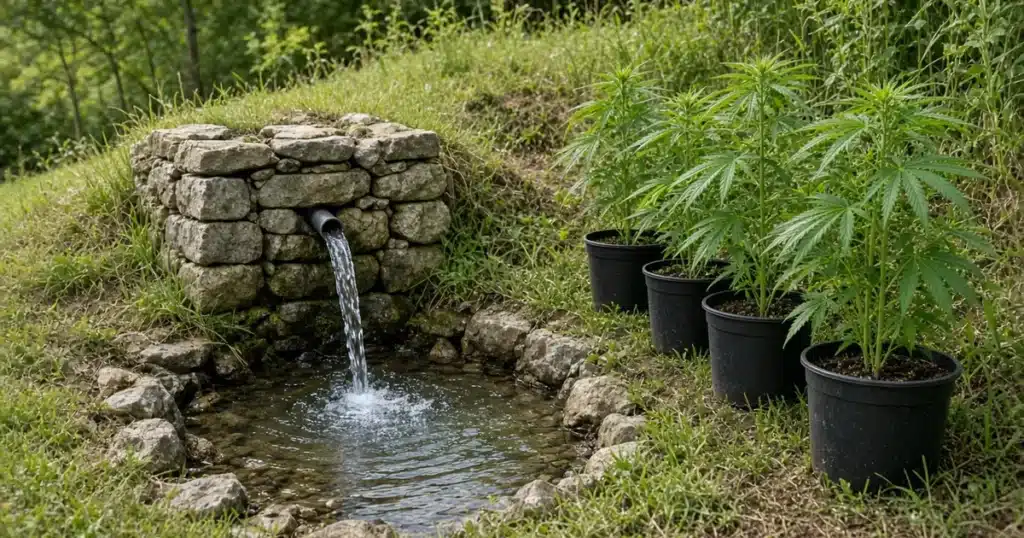
Quick answer: Spring water is groundwater that reaches the surface on its own, and its mineral content changes from one spring to the next. Virginia Tech Extension notes that rain and spring water carry some natural nutrients and minerals, but not enough to support plants over the long term. Penn State Extension urges testing any irrigation source for sodium, chloride, hardness, pH, alkalinity and conductivity before use. Bottled spring water costs too much for most gardens. A private spring can be a fine source for cannabis once you know what is in it, and you will still need a complete fertilizer.
What Is Spring Water?
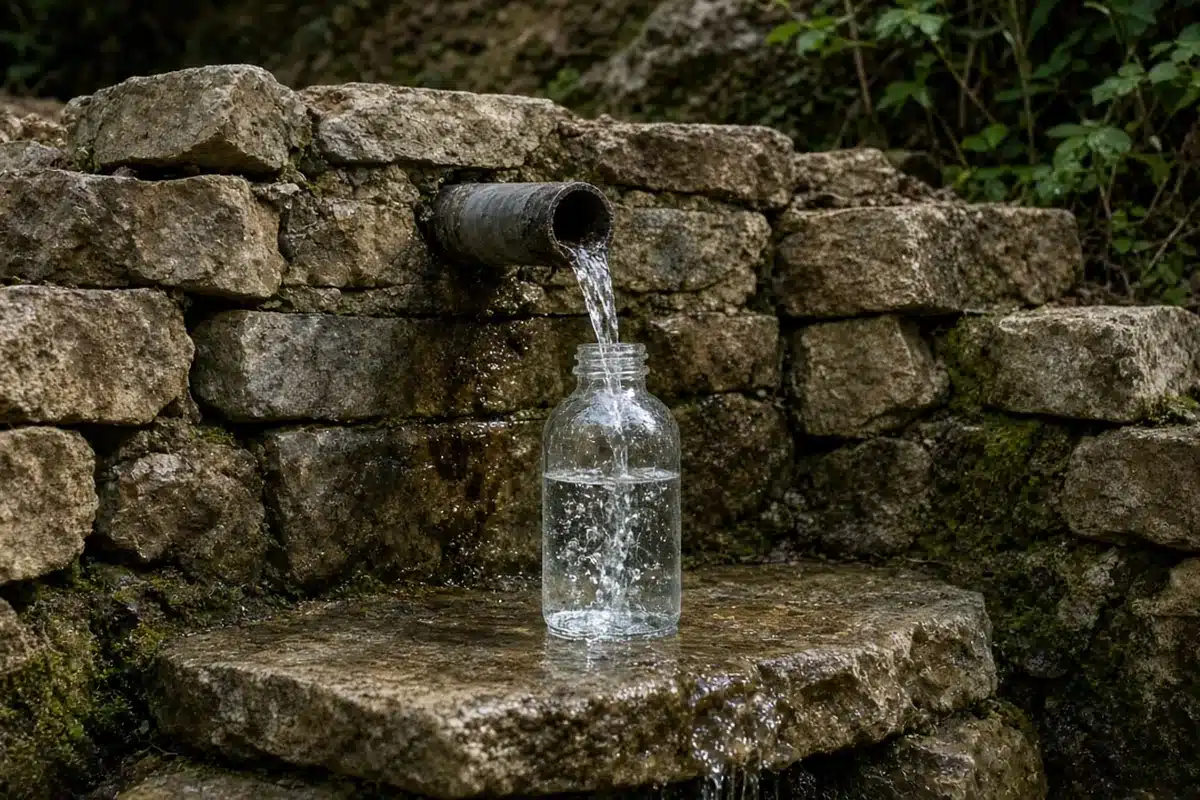
A spring forms where natural pressure pushes groundwater up through the land surface. Springs often appear on hillsides, in low spots or at the base of slopes.
The Penn State Extension guide to spring development and protection explains that springs are fed by shallow groundwater, which moves through the ground for only a short time and may mix with surface water. That makes spring water quality more variable, and more open to contamination, than water from a deep well.
For gardeners, spring water comes in two forms: bottled spring water from the store and water from a spring on your own land. Each raises its own set of questions.
Does Spring Water Have Nutrients for Cannabis?
Some, but not enough to rely on. Virginia Tech Extension advice on watering container houseplants says rain or spring water carry naturally occurring nutrients and minerals, but not in amounts that support plant growth over time.
Spring water picks up calcium, magnesium and other minerals as it moves through rock and soil. The longer it stays underground and the more soluble the rock, the more it collects, so two springs a few miles apart can test very differently. How much it carries depends entirely on the local geology. Water from limestone areas tends to be hard and alkaline, while water from sandstone or granite may be soft and slightly acidic.
That mineral mix can work for you or against you. Moderate calcium and magnesium are useful for cannabis, but high hardness and alkalinity push pH up and can lock out other nutrients. Our article on irrigation water alkalinity for cannabis explains why alkalinity matters so much.
What Should You Test in Spring Water?
The Penn State Extension guide to interpreting irrigation water tests recommends testing every irrigation source for sodium, chloride, hardness, pH, alkalinity and conductivity at a minimum. It adds that water quality matters most for plants in small containers and in greenhouses, where irrigation is the only water they get.
Penn State lists general levels of concern for many readings. A few that matter for cannabis growers:
- pH under 5.0 or over 7.0.
- Alkalinity below 30 or above 100 mg/L.
- Hardness below 50 or above 150 mg/L.
- Magnesium below 25 mg/L, which may call for extra magnesium in fertilizer.
- Conductivity above 1.5 mmhos/cm for most plants, or above 1.0 for young plugs.
- Sodium above 50 mg/L.
Penn State adds that most plants prefer slightly acidic conditions between 5.0 and 7.0, and that pH problems hit harder in soilless mixes and small pots.
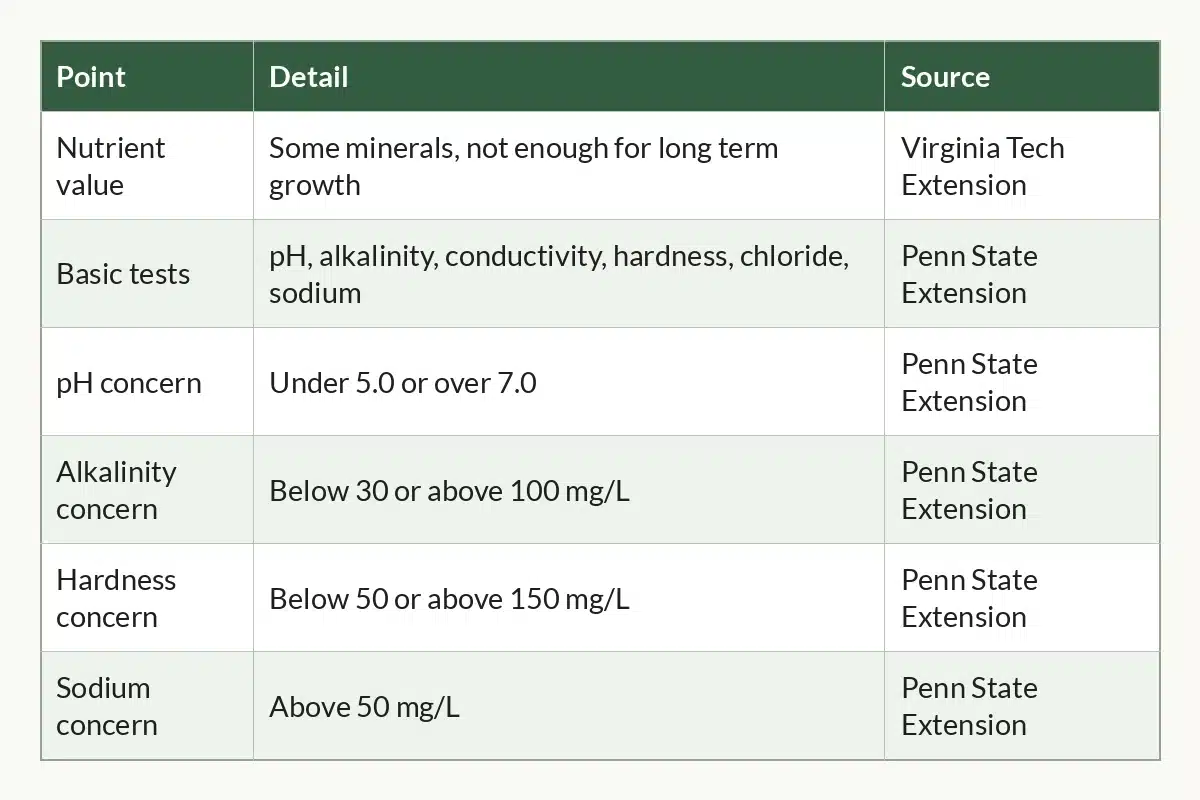
Spring Source Readings at a Glance
| Point | Detail | Source |
|---|---|---|
| Nutrient value | Some minerals, not enough for long term growth | Virginia Tech Extension |
| Basic tests | pH, alkalinity, conductivity, hardness, chloride, sodium | Penn State Extension |
| pH concern | Under 5.0 or over 7.0 | Penn State Extension |
| Alkalinity concern | Below 30 or above 100 mg/L | Penn State Extension |
| Hardness concern | Below 50 or above 150 mg/L | Penn State Extension |
| Sodium concern | Above 50 mg/L | Penn State Extension |
Is Bottled Spring Water Worth Buying for Cannabis?
Usually not. Bottled spring water costs far more than tap water, and its mineral content varies by bottler and by source. A label rarely lists everything a grower would want to know.
For seedlings or a couple of small plants, bottled water can work if your tap water is poor. For larger plants that drink gallons a week, the cost adds up fast. A reverse osmosis filter or rain barrel usually makes more sense. Our guide to how reverse osmosis helps home cannabis growers compares those options.
Can You Water Cannabis From a Private Spring?
Often yes, if the spring is reliable and the water tests well. Penn State’s spring guide raises a few points to weigh:
- Flow changes with the seasons. Penn State advises checking flow through the year, especially in late summer and fall, when groundwater and spring flow are usually lowest. That is exactly when cannabis drinks the most.
- Quality can shift. Penn State says a spring whose flow swings widely through the year may be unreliable or open to contamination.
- Protection matters. Penn State describes spring boxes and diversion ditches that keep surface water out of the source.
Penn State’s irrigation guide also notes that water quality can change across the year, so one test may not tell the whole story. Testing in spring and again in late summer gives a better picture.
How Does Spring Water Compare With Well Water?
Springs and wells both tap groundwater, but they reach it at different depths. Penn State’s spring guide explains that springs draw on shallow water that has spent little time underground, while a drilled well usually pulls from deeper layers. Deeper water tends to be steadier in both flow and quality.
In practice, a spring may change more after heavy rain or drought. A well may carry more dissolved minerals from long contact with rock. Neither is better in every case, which is why testing matters more than the label of the source.
Can Spring Water Be Too Soft?
Yes. Some springs in granite or sandstone country carry very little calcium or magnesium. Penn State lists hardness below 50 mg/L and calcium below 40 mg/L as levels that can leave plants short. Very soft water also has little buffering, so pH can swing when you add fertilizer.
If your test shows soft water, handle it more like rainwater. Add a calcium and magnesium source and check pH after mixing.
How Do You Feed Cannabis Grown With Spring Water?
Start with the test results. If calcium and magnesium are moderate, they count toward plant needs, and you may use less supplement. If magnesium is low, plan to add it. Penn State reports that 64 percent of the Pennsylvania water supplies in its summary were below 25 mg/L.
A meter that reads dissolved solids helps you see what the water brings before you add fertilizer. Subtract the starting reading from your final mix to know how much feed you added. Our article on ppm for cannabis explains those readings.
If alkalinity runs high, the water will keep pushing pH up. Penn State notes high pH can reduce the availability of metals and micronutrients, and that acid injection or acid forming fertilizers can correct it.
How to Use Spring Water for Cannabis
- Test the water. Check pH, alkalinity, hardness, conductivity, chloride and sodium.
- Test more than once. Sample in different seasons.
- Check flow in late summer. Make sure the spring keeps up when plants need the most water.
- Protect the source. Keep surface runoff away from the spring.
- Adjust fertilizer to the test. Count existing calcium and magnesium, and add what is missing.
- Watch pH. Correct high alkalinity with acid forming fertilizer or pH adjustment.
- Measure the final mix. Use a meter after adding nutrients.
- Watch the plants. Pale or spotted new growth can signal an imbalance.
Troubleshooting Spring Water Problems
pH keeps rising in pots. Alkalinity is high. Use an acid forming fertilizer or adjust pH.
White crust on pots. Hardness or salts are high. Flush with low mineral water now and then.
New leaves look pale between veins. Magnesium or iron may be limited. Check the test and adjust feeding.
Spring runs low in August. Flow is seasonal. Store water earlier or add a second source.
Water looks cloudy after rain. Surface water may be entering. Improve spring protection and retest.
Sources
- Penn State Extension, Interpreting Irrigation Water Tests: https://extension.psu.edu/interpreting-irrigation-water-tests
- Virginia Tech Extension, Properly Watering Container Houseplants (SPES 804): https://www.vt.edu/content/dam/pubs_ext_vt_edu/spes/spes-804/SPES-804.pdf
- Penn State Extension, Spring Development and Protection: https://extension.psu.edu/spring-development-and-protection
FAQ
Is spring water better than tap water for cannabis?
Not always. The answer hinges on the minerals in your spring and in your tap water.
Does spring water feed plants?
Virginia Tech notes it carries some minerals, but not enough for long term growth.
What should I test first?
Penn State suggests sodium, chloride, hardness, pH, alkalinity and conductivity.
Is bottled spring water worth it?
For most gardens it costs too much compared with filtered water or rainwater.
Does spring water quality change?
Yes. Flow and quality can shift with the seasons, so test more than once.