
Dodder on Cannabis: Orange Threads, Pruning and Prevention
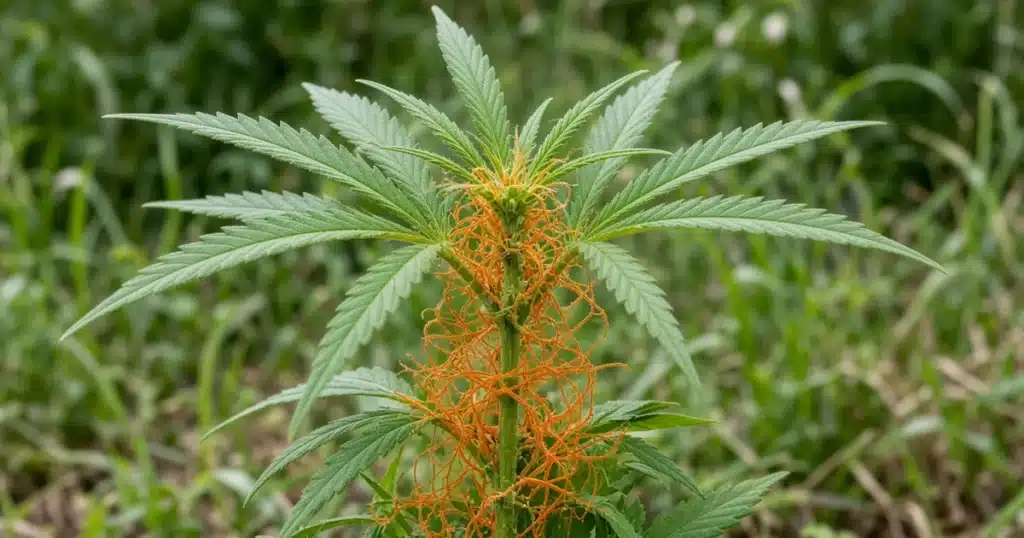
Quick answer: Dodder is a parasitic plant with thin, leafless yellow to orange stems that coil around a host and tap into it for water and food. UC IPM and Washington State University’s Hortsense site say it attacks many broadleaf crops and weeds. Neither names cannabis or hemp as a host, so keep watch when host crops or weeds grow nearby. Remove dodder before it sets seed, prune infected stems just below the attachment point, bag and trash infested material and use seed and soil free of dodder.
What Is Dodder?
A parasitic plant that lives off other plants. The UC dodder guide explains that dodder can make a little of its own food but gets nearly all of its energy from its host. More than 150 species exist worldwide, and dodder is most common in the Americas. Washington State notes other names for it, including love vine.
Washington State says dodder sends modified roots called haustoria into the host to pull out water and nutrients. The UC dodder guide adds that once the stem attaches, its connection to the soil withers. From then on, it lives entirely through the host plant.
What Does Dodder Look Like?
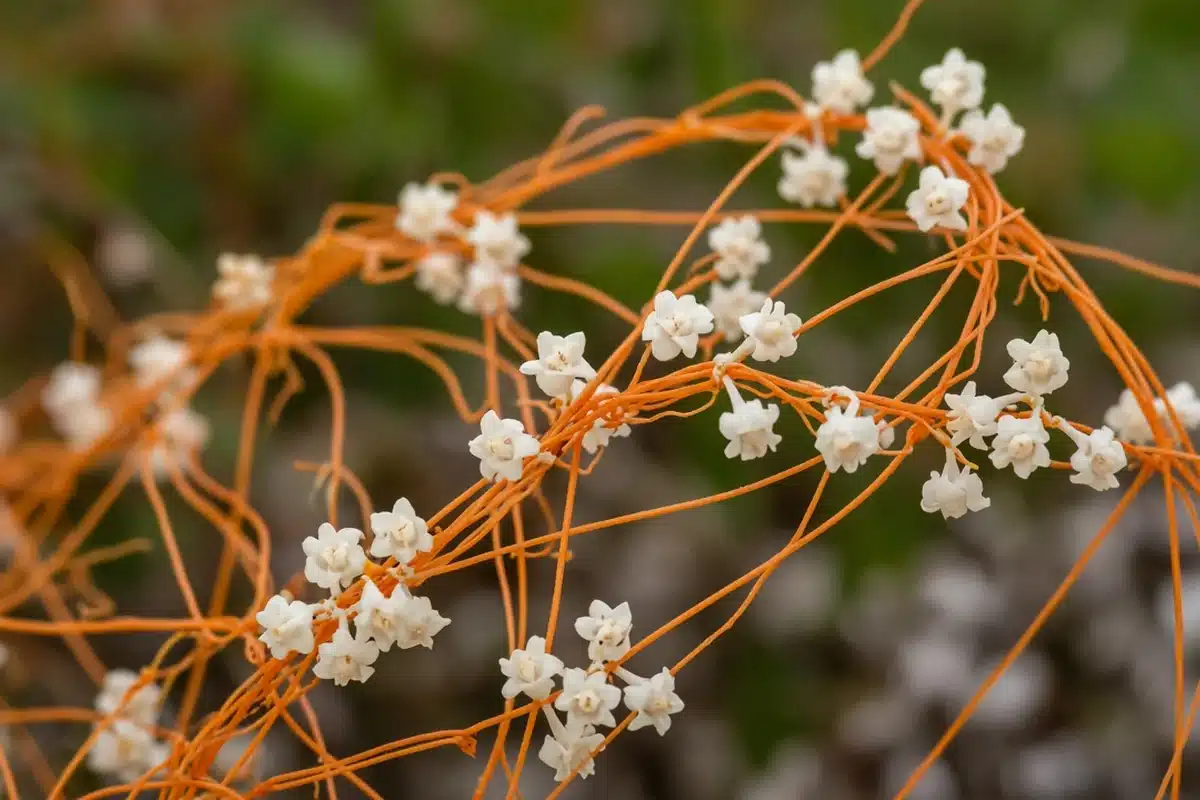
A tangle of bright, threadlike stems. The UC dodder guide describes slender, twining stems colored anywhere from pale green through yellow to vivid orange that stand out against the host’s leaves. Native dodder is leafless or has tiny triangular scales about 1/16 inch long.
More details to look for:
- Bell shaped cream flowers about 1/8 inch long, usually in clusters, per the UC dodder guide
- White, pink or yellowish flower clusters appearing in June, as Washington State describes
- Rough coated seeds about 1/16 inch across, two or three per capsule
- Yellowish, rootless, leafless seedlings
The UC dodder guide describes Japanese dodder separately. Its stems are thicker, like spaghetti, and it mostly attacks trees and shrubs.
Which Plants Does Dodder Attack?
Many broadleaf crops and weeds. Washington State lists alfalfa, clover, tomatoes, potatoes, onions and safflower as especially susceptible. The UC dodder guide adds asparagus, beet, carrot, eggplant, melons, pepper and sweet potato, plus ornamentals such as chrysanthemum, mint and petunia.
Weeds also host it. Both sources name field bindweed, lambsquarters and pigweed among weed hosts. Our post on weed control in outdoor cannabis covers ways to keep those weeds down. The UC dodder guide notes that grasses and many other monocots are not hosts.
How Does Dodder Damage Plants?
It drains them. The UC dodder guide says the impact ranges from moderate growth loss to complete loss of vigor and, sometimes, death. Damage is worst when dodder attaches to seedlings. Established hosts usually survive, the UC dodder guide says, but many attachments on one plant can kill it.
The UC dodder guide adds that weakened hosts become more open to diseases, insects and nematodes. Washington State notes that dodder can also pass along plant viruses, such as cucumber mosaic and beet yellows.
How Does Dodder Spread?
By seed and by moving stems. The UC dodder guide says each plant can produce several thousand seeds. Only about 5 percent sprout the following year, but the rest can stay alive in soil for more than 20 years. Washington State also gives 20 years.
Washington State says seed may spread in irrigation water, manure and on people or animals. The UC dodder guide adds soil and equipment, mud on shoes and tires and contaminated crop seed. Once established, dodder shoots spread from plant to plant, forming a dense mat, the UC dodder guide explains.
How to Remove Dodder From a Cannabis Garden
- Act right away. The UC dodder guide advises immediate action when dodder shows up on garden plants.
- Pull seedlings early. The UC dodder guide and Washington State both say to remove seedlings by hand or cultivation before they attach. The UC dodder guide notes that a seedling dies if it finds no host within 5 to 10 days.
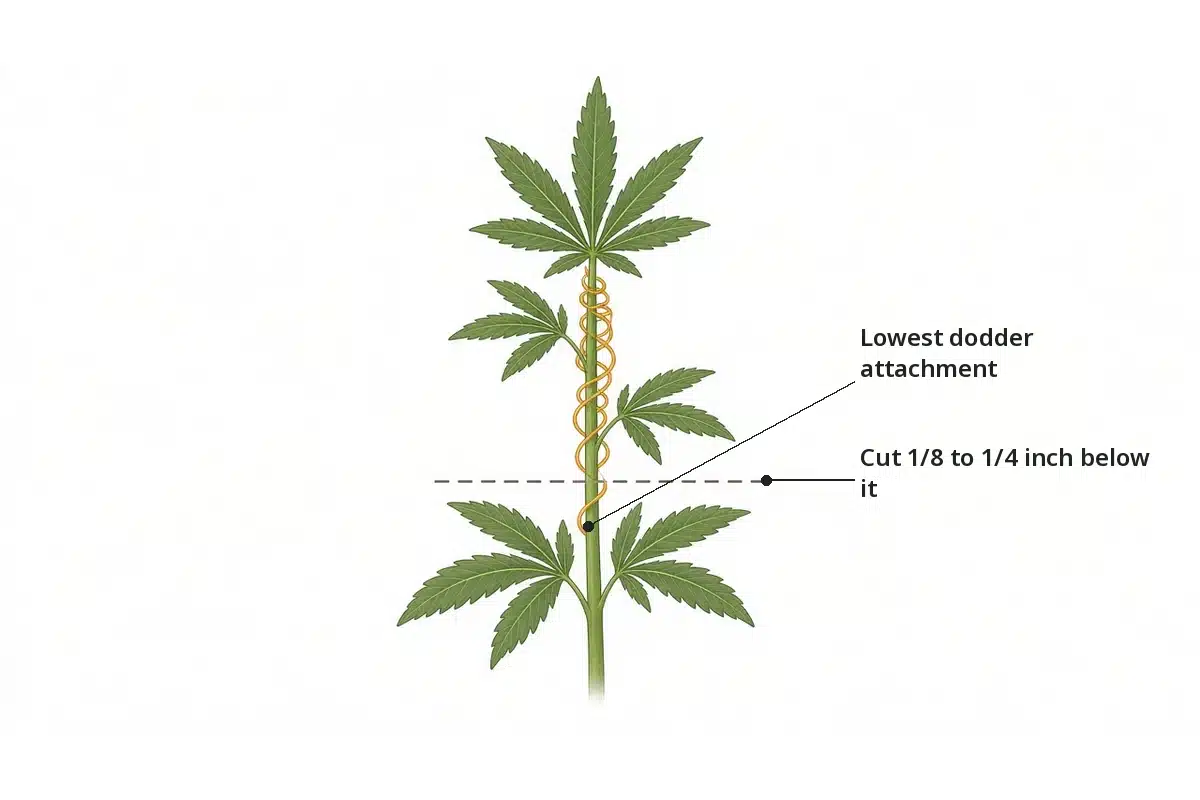
- Prune below the attachment. Both sources say to cut the host stem 1/8 to 1/4 inch beneath the lowest spot where dodder clings. Otherwise it can regrow from the haustoria left inside.
- Pull and destroy badly infected plants. Washington State advises removing infected plants before dodder sets seed.
- Bag seeded material. The UC dodder guide says to put plants that have set seed in a plastic bag for the trash.
- Keep it out of compost. Washington State says not to compost infested plant material.
- Clean shoes, clothes and tools. The UC dodder guide advises cleaning gear before moving from infested to clean areas.
- Rotate or replant with nonhosts. The UC dodder guide suggests rotating vegetable beds to nonhost crops for several years. Our guide to crop rotation for cannabis beds covers planning.
Dodder Facts at a Glance
| Topic | Detail | Source |
|---|---|---|
| Seed survival in soil | 20 years or more | UC IPM and Washington State |
| Seedling survival without a host | 5 to 10 days | UC IPM |
| Pruning cut | 1/8 to 1/4 inch below attachment | UC IPM and Washington State |
| Nonhost plants | Grasses and many monocots | UC IPM and Washington State |

Does Solarizing Kill Dodder Seed?
No. The UC dodder guide says dodder seed can survive soil solarization, probably because of its hard seed coat. It notes that composting might kill most seed due to higher temperatures, though no studies have confirmed this. Washington State advises against composting infested material at all.
What About Japanese Dodder?
Report it rather than handling it yourself, at least in California. The UC dodder guide says Japanese dodder is under an eradication program there and has reached more than a dozen counties. It advises contacting your county agricultural commissioner for identification and help.
The UC dodder guide explains that Japanese dodder has not produced viable seed in California. Instead, small stem pieces spread it, carried by birds and other animals or moved through pruning, composting and careless disposal of infested plants. It grows much faster than native dodders, up to 6 inches a day, and can cover and kill large shrubs and small trees.
Why Does Clean Seed Matter?
It is one of the oldest ways to stop dodder. The UC dodder guide says sowing seed free of dodder has long been a main way to stop its spread, and that many countries and states have seed laws banning dodder seed in planting seed. Washington State also advises planting seed free of dodder and avoiding manure or hay that contains it.
Does Shade or Sun Matter?
Yes. Washington State says high temperatures and full sun favor dodder growth. The UC dodder guide notes that shaded areas greatly reduce twining and attachment. It also explains that native dodder sprouts at or near the soil surface in spring when soil reaches about 60 degrees F.
Are Chemical Controls an Option?
Not for home gardens in Washington. Washington State recommends no chemical controls for home gardeners and lists no products for landscapes. Its first choice is nonchemical management, and the UC dodder guide also centers its advice on removal, pruning and prevention.
Troubleshooting Dodder Problems
Dodder came back after pulling it off. The UC dodder guide says it can regrow from haustoria left in the host. Prune just under the attachment point.
Pulled dodder reattached. The UC dodder guide warns that fresh dodder touching a healthy host can reconnect. Bag it right away.
Dodder appears in the same bed every year. The UC dodder guide says seed lasts more than 20 years. Rotate to nonhosts and remove new seedlings quickly.
It arrived with manure. Washington State lists manure and hay as carriers. Use sources free of dodder.
A thick, spaghetti like dodder covers a shrub. The UC dodder guide says this may be Japanese dodder, which is under an eradication program in California. Contact your county agricultural commissioner instead of handling it yourself.
Sources
- UC Statewide IPM Program, University of California, Pest Notes: Dodder: https://ipm.ucanr.edu/home-and-landscape/dodder/
- Washington State University Extension, Hortsense, Weeds: Dodder: https://hortsense.cahnrs.wsu.edu/fact-sheet/weeds-dodder-cuscuta-spp/
FAQ
Does dodder have roots?
Not once it attaches. The UC dodder guide says its link to the soil withers after it taps into a host.
Can dodder kill a plant?
Sometimes. The UC dodder guide says many attachments on one host can kill it.
How long does dodder seed last?
More than 20 years in soil, the UC dodder guide says.
What plants resist dodder?
Grasses and many monocots, the UC dodder guide and Washington State say.
Can dodder spread plant viruses?
Yes. Washington State says it can transmit beet yellows and cucumber mosaic viruses.


