
Crop Rotation in the Garden for Outdoor Cannabis Beds
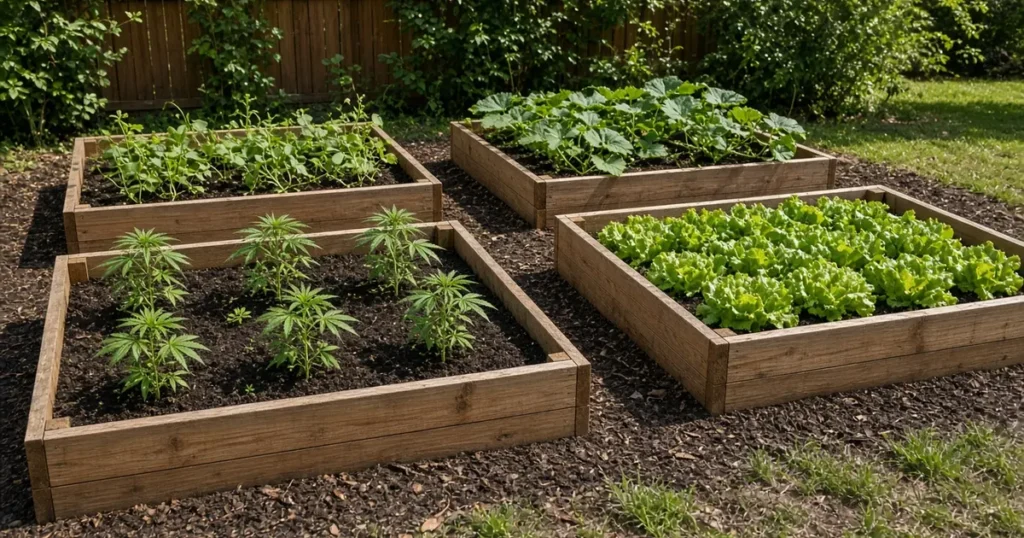
If you grow cannabis outdoors in the same bed every summer, the soil in that spot can slowly turn against you. Clemson Cooperative Extension explains that growing the same plants in the same places year after year leads to a buildup of soilborne pathogens, insects and nematodes in the garden. Crop rotation is the simple answer. University of Wisconsin-Madison Extension describes it as changing the planting location within the garden each season, and Clemson calls it a simple cultural practice that can help manage many of these issues. Here you will learn why rotation works, how long to wait before returning to a spot, how to set up beds that make rotation easy, how to keep soil from spreading problems and what rotation cannot do.
Why the same spot builds up soilborne disease
According to Iowa State University Extension, many disease organisms are soilborne and may persist in the soil for several years. It adds that disease problems often increase when the same crop is planted in the same area in successive years.
UW-Madison Extension explains the reason. When the same kind of plant grows in the same area year after year, it gives disease-causing organisms a continual source of host plants they can infect. Over time, pathogen numbers build in that area and damage to the crop increases.
Clemson Extension names the kinds of problems involved. Soilborne pathogens cause diseases such as Southern blight, bacterial wilt and Sclerotinia stem rot, and the same buildup happens with nematodes. One of these diseases on hemp gets a closer look in Kind Seed Co’s post on Southern blight on hemp.
How rotation breaks the cycle
Clemson Extension states the principle plainly. Plant a crop in a different location each year. Rotating crops disrupts pathogens and nematodes by removing the host they need to complete their life cycle.
Iowa State Extension says the same thing in different words. By rotating annually, you disrupt the disease’s life cycle by removing the host plant it needs. UW-Madison Extension adds that rotation helps keep pathogen numbers at low levels, which can lead to a healthier, more productive garden.
Outdoors, that means the cannabis bed itself should move. Instead of planting in the same patch every spring, you shift the planting site and let that ground grow something else for a while.
How long to wait before returning to a spot
The waiting period is the heart of a good rotation. Clemson Extension says a crop should only be grown in the same spot a maximum of once every three years. It treats a three year rotation as the minimum and notes that a four or five year rotation will be even better at reducing the buildup of soilborne pests.
Iowa State Extension gives a similar range of three to four years, or five years or more if possible. UW-Madison Extension also recommends returning to an area no more than once every three to four years.
Here is how that works out in practice:
- Three years is the shortest rotation the sources recommend.
- Four or five years gives better results against soilborne problems.
- Even a shorter rotation helps. UW-Madison Extension notes that a full rotation can be hard to achieve in small gardens, but even changing what grows in an area from year to year is helpful.
Set up separate beds
Rotation is much easier when you have more than one place to plant. Clemson Extension says the best way to keep a proper rotation is to have multiple separated garden plots or beds. Iowa State Extension agrees, using the example of four raised beds that let you move plants around so the same kind of crop returns to each bed only once every four years.
Some gardeners divide a single plot into zones instead. Both Clemson and Iowa State point out a major flaw in that approach. The whole plot is usually tilled or cultivated at once, which mixes soil between the zones. Clemson notes that moving the soil around in this way also moves nematodes and pathogens, which cancels out the benefit of rotation.
If you are planning a new growing area, think about rotation from the start. Siting and mapping beds are explained in planning an outdoor cannabis garden layout.
How to plan a rotation, step by step
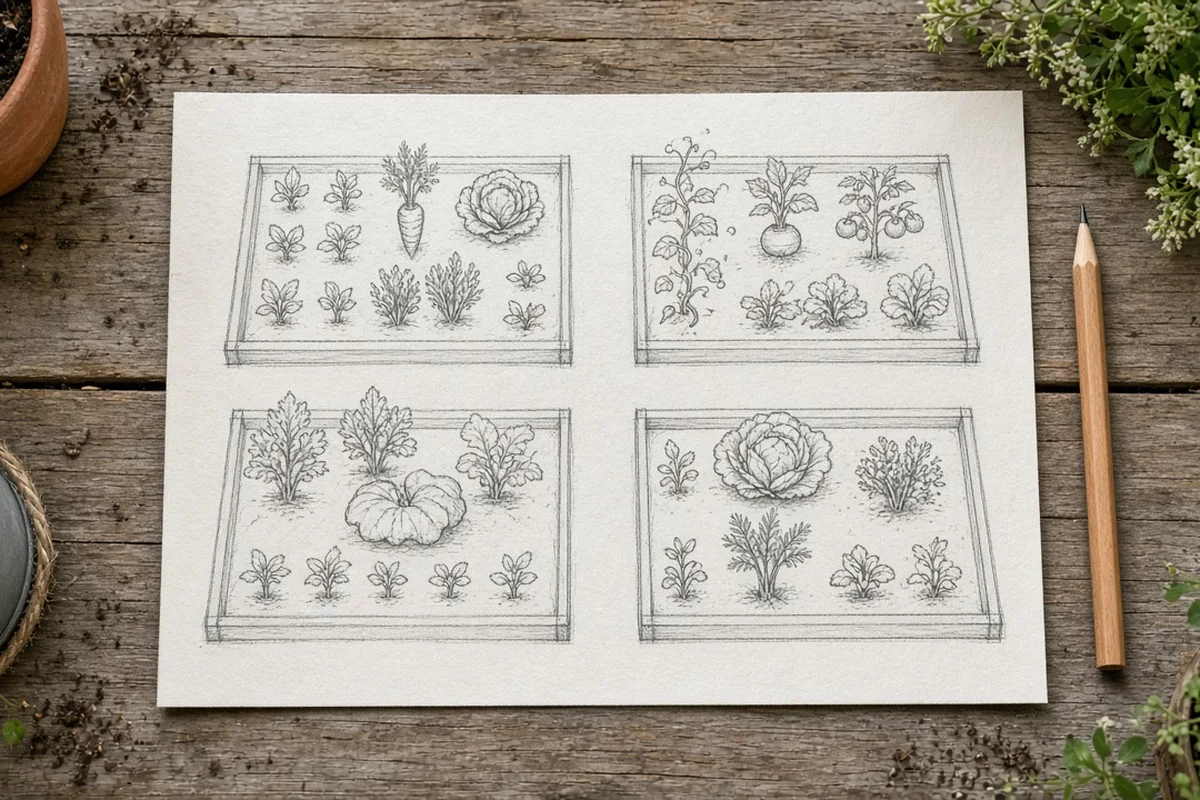
Clemson Extension recommends planning all four years of a four year rotation ahead of time. One easy way to map it out:
- Count your beds or plots and give each one a simple label. Clemson suggests numbers, letters or names, so long as they are easy to remember.
- Draw a diagram of the garden with each bed labeled.
- Write the year beside each bed and note what will grow there.
- Plan the cannabis bed so it moves to a new bed each year and does not return to the first bed until the full rotation has passed.
- Fill the other beds with plants that are not the same kind of crop.
- If you change the plan later, check what grew in each bed in earlier years before you decide, as Clemson advises.
Iowa State Extension suggests keeping a garden log, drawing a map, creating a diagram or taking a photo so you remember where plants grew each year. UW-Madison Extension also recommends keeping a log or map as a reminder.
Keep good records
Clemson Extension notes that it is often difficult to remember important details of the garden from year to year, so keeping records helps. It suggests noting which crops were planted, where and when they were planted, and any pest events you noticed during the season.
That last point matters for disease. Clemson explains that rotation works only for problems that live mostly in the soil, and it recommends keeping records of pest events so you can learn their life cycles and manage them better in the future. Iowa State Extension notes that a log, a map, a diagram or a photo all work as a record.
Keep soil from moving between beds
Rotation only works if the soil from an old bed stays put. Clemson Extension warns that soil movement between beds may spread pathogens and nematodes and cancel out the effects of rotation. It notes that soil can travel on shovels, hoes, tillers, wheelbarrow tires and even shoes.
To avoid that:
- Wash all soil off tools before you move from one bed to another.
- Rinse wheelbarrow tires and tiller tines between beds.
- Clean your shoes or boots when you move from one bed to another.
This is the same reason Iowa State and Clemson caution against zones within a single plot that gets tilled all at once.

Rotating in a small garden
Many home growers do not have room for four separate beds. Iowa State Extension notes that many home gardens lack the space to rotate fully, but it says gardeners should still rotate as best they can, because it still helps manage disease. It offers several ideas:
- Build three or four raised beds. Iowa State notes that this creates a physical barrier between each area, even when the beds sit close together.
- Use containers. Iowa State suggests containers as a way to rotate a disease-prone crop out of the main garden plot. Container choices are compared in cannabis growing containers.
- Set up small plots in other sunny spots around your yard, which Iowa State notes makes it easy to move plants to different locations each year.
- Work with neighbors or friends. Iowa State suggests having each garden focus on different crops and switching the next year.
What rotation cannot do
Rotation is a strong tool, but Clemson Extension is clear that it is not perfect. Some diseases have an extensive host range and can affect many different kinds of plants. Clemson gives Southern blight as an example, noting that it has been reported on over 500 plant species. If a disease like that is in your soil, choose rotation plants that are not hosts. Clemson recommends researching the other host plants of the diseases that affect the crops you grow.
Clemson also notes that rotation only helps against pests that are mostly confined to the soil. Pathogens spread by wind-blown spores are largely unaffected by rotation.
Iowa State Extension adds that weeds in and around the garden can serve as other hosts for diseases, which is one reason good weed control matters when you rotate.
Troubleshooting
The same problem came back in a new bed. Soil may have moved on tools, tires or shoes. Clemson Extension recommends washing all soil off equipment and shoes when moving between beds.
Rotation is not helping at all. The disease may not be soilborne. Clemson notes that problems spread by wind-blown spores are largely unaffected by rotation. Keep records of what you see so you can learn its life cycle.
A disease shows up on many different plants. It may have a wide host range. Clemson suggests researching other host plants and choosing rotation plants that are not hosts.
You only have one garden plot. Avoid tilling it as one unit if you divide it into zones, since Iowa State and Clemson note this mixes soil between zones. Containers or a second small plot elsewhere can help.
You cannot remember where the cannabis grew two years ago. Start a garden map now. Iowa State suggests a log, map, diagram or photo each season.
Sources
- Clemson Cooperative Extension, Home and Garden Information Center. Crop Rotation (HGIC 1330). https://hgic.clemson.edu/factsheet/crop-rotation/
- Iowa State University Extension and Outreach. Crop Rotation in the Vegetable Garden. https://yardandgarden.extension.iastate.edu/how-to/crop-rotation-vegetable-garden
- University of Wisconsin-Madison Extension. Using Crop Rotation in Home Vegetable Garden. https://hort.extension.wisc.edu/articles/using-crop-rotation-home-vegetable-garden-0/
FAQ
How long should I wait before planting cannabis in the same bed again?
Clemson Extension says a crop should be grown in the same spot no more than once every three years. It treats three years as the minimum and notes that a four or five year rotation is even better at reducing the buildup of soilborne problems. Iowa State Extension gives a similar three to four year range.
Does crop rotation work in a small garden?
It helps even when space is tight. Iowa State Extension says home gardeners should still rotate as best they can. It suggests building three or four raised beds, using containers for disease-prone crops, setting up small plots in other sunny spots or working with neighbors to share growing space and switch plants each year.
Can I rotate by dividing one bed into zones?
You can, but it has a major flaw. Clemson and Iowa State Extension both note that a single plot is usually tilled or cultivated all at once, which mixes soil between zones. Clemson explains that moving soil this way also moves pathogens and nematodes and cancels out the benefit of rotation.
Does crop rotation stop all plant diseases?
No. Clemson Extension notes that rotation is only effective against problems mostly confined to the soil. Pathogens spread by wind-blown spores are largely unaffected. Some soilborne diseases also have a wide host range. Clemson gives Southern blight as an example, reported on over 500 plant species, so choose rotation plants that are not hosts.


