
Goosegrass in Cannabis Beds: Spotting and Pulling It
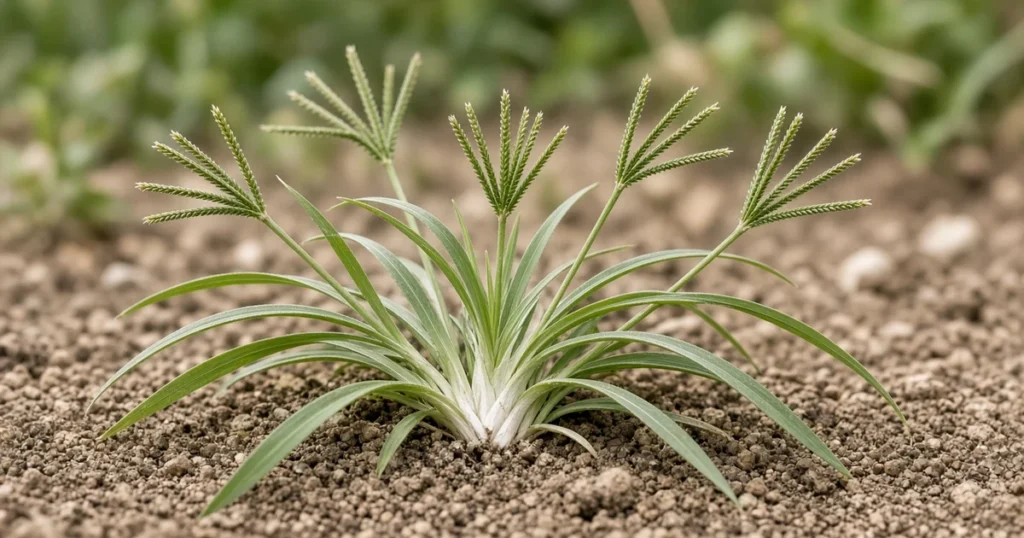
Quick answer: Goosegrass is a summer annual grass with flat stems and a silvery white center that grows in compacted, heavily walked soil. Kansas State University Research and Extension says to hand pull it, improve drainage and limit traffic on wet soil. Pull plants before their zipper shaped seed spikes appear in midsummer, then mulch.
What Is Goosegrass?
A low summer annual grass that favors packed ground. The University of California Statewide IPM Program (UC IPM) calls goosegrass, also known as wiregrass, an annual summer grass that is occasionally perennial. It is normally found in compacted areas or areas of heavy wear, including gardens and landscaped areas, especially places that get some summer water. UC IPM also notes that it does not survive frost.
Iowa State University Extension lists goosegrass as an introduced annual of turf and waste areas, often found on compacted soils, and says it is a bigger problem in the southern US than in Iowa. Our overview of weed control in outdoor cannabis covers the wider picture.
How Do You Identify Goosegrass?
Look closely at the center of the clump. Iowa State says the leaf sheaths at the crown are white to silver, which is why goosegrass is also called silver crabgrass. Other traits:
- Stems. Flat, because the leaves are folded in the bud, Iowa State says. Tillers spread outward parallel to the soil.
- Clump. UC IPM describes a pale green, matlike clump in a low rosette that can spread to about 2 1/2 feet wide.
- Leaves. Kansas State says leaves are dark green, hairy near the base and up to 12 inches long and 1/3 inch wide.
- Roots. Fibrous, and Kansas State notes the stems do not root at their joints.
- Collar. UC IPM says the ligule is short and membranous with a jagged top, often split in the center, with no auricles.
How Is Goosegrass Different From Crabgrass?
Look for flat stems and thicker spikes. Iowa State says the growth habit and seed heads of goosegrass resemble crabgrass, but the flat stems and larger flower heads make it easier to identify. The individual spikes of goosegrass are much thicker and coarser than those of crabgrass.
Timing helps here too. Kansas State says goosegrass usually emerges a few weeks after crabgrass, once soil temperatures have stayed above 65°F for several weeks. A second flush of grass in early summer is a good clue.
What Do Goosegrass Seed Heads Look Like?
Like zippers on a windmill. Kansas State describes 2 to 10 flattened spikes, each resembling a zipper, that all spread from one point, appearing from July to September. UC IPM gives a bloom window of July through October and says two to six spikes usually radiate from the end of each flower stem.
UC IPM adds one detail that matters in a garden: seeds are produced even when plants are closely mowed. Cutting the tops does not stop seed.
Why Does Goosegrass Grow in Wet, Packed Spots?
It tolerates what other plants cannot. Kansas State says goosegrass usually grows in full sun, often in poorly drained or compacted soil. UC IPM ties it to compacted, heavy wear areas. In a cannabis garden that means walkways, the edges where you kneel, and low spots that stay wet after watering. Our guide to soil compaction in cannabis beds explains how to loosen those areas.
Does Frost Kill Goosegrass?
Yes. UC IPM says goosegrass tolerates a broad range of conditions but does not survive frost. That makes it a warm season problem. Plants killed by frost do not come back, so new plants the next year grow from seed already in the soil. Pulling clumps before they flower keeps more seed from being added.
How to Control Goosegrass in a Cannabis Bed
- Watch for the second grass flush. Kansas State says goosegrass emerges a few weeks after crabgrass, after soil warms above 65°F for several weeks.
- Hand pull young clumps. Kansas State recommends mechanically removing or hand pulling goosegrass.
- Pull before the spikes form. Kansas State and UC IPM place flowering from July into fall. Clear plants before then.
- Do not rely on cutting. UC IPM says goosegrass still sets seed when closely mowed. Remove the whole plant.
- Fix drainage and watering. Kansas State says to increase drainage and avoid light, frequent irrigation. Our guide to drip irrigation for cannabis shows how to set that up.
- Limit traffic on wet soil. Kansas State says to reduce compaction by limiting traffic, especially when soil is wet.
- Mulch the open ground. UC IPM’s landscape guide recommends a medium mulch kept 3 to 4 inches deep to block light. Our guide to mulch for cannabis compares materials.
Goosegrass at a Glance
| Subject | Extension finding | Attribution |
|---|---|---|
| Life cycle | Summer annual, occasionally perennial | UC IPM |
| Emergence | A few weeks after crabgrass, soil above 65°F | Kansas State |
| Key trait | Flat stems with a white to silver crown | Iowa State |
| Clump size | Up to about 2 1/2 feet wide | UC IPM |
| Seed heads | 2 to 10 zipper shaped spikes from one point | Kansas State |
| Frost | Does not survive frost | UC IPM |
Should You Use Herbicides Near Cannabis?
No. Pull it, fix the soil and mulch. No EPA registered herbicide label lists cannabis as a use site, and state rules vary, so check your state agriculture department. UC IPM says herbicides should not normally be needed by home gardeners.
Troubleshooting Goosegrass
It shows up after the crabgrass is gone. Kansas State says goosegrass emerges a few weeks later. Keep scouting into early summer.
Clumps return in the same low spot. Kansas State links it to poorly drained, compacted soil. Improve drainage there.
Cut plants still made seed. UC IPM says seed forms even under close mowing. Pull the whole plant.
It thrives along the walkway. UC IPM ties it to heavy wear areas. Limit foot traffic, especially on wet soil, as Kansas State advises.
It is hard to tell from crabgrass. Iowa State says to look for flat stems and a silver crown.
Hand pulling, better drainage and mulch keep goosegrass down in most cannabis beds, and the other Kind Seed Co weed guides are a good place to read on.
Sources
- UC Statewide IPM Program, Goosegrass, Weed Gallery: https://ipm.ucanr.edu/weeds-identification-gallery/goosegrass/
- Iowa State University Extension, Goosegrass: https://crops.extension.iastate.edu/encyclopedia/goosegrass
- Kansas State University Research and Extension, Lawn Problem Solver, Goosegrass: https://www.k-state.edu/turf/resources/lawn-problem-solver/problem-solver/weeds/grassy/goosegrass/
- UC Statewide IPM Program, Weed Management in Landscapes: https://ipm.ucanr.edu/home-and-landscape/weed-management-in-landscapes/
FAQ
Is goosegrass the same as crabgrass?
No. Iowa State Extension says goosegrass looks similar in growth habit and seed heads, but it has flat stems, a white to silver crown and thicker, coarser spikes. It is sometimes called silver crabgrass because of that light colored center. Kansas State adds that it usually emerges a few weeks later than crabgrass in spring.
When does goosegrass start growing?
Kansas State says goosegrass emerges a few weeks after crabgrass, once soil temperatures have stayed above 65°F for several weeks. UC IPM calls it a summer annual that does not survive frost. In most US gardens, that means watching for new grassy clumps in late spring and early summer, then pulling them as soon as you see them.
Why does goosegrass keep growing in the same wet spot?
Kansas State says goosegrass often grows in poorly drained or compacted soil, and UC IPM links it to heavy wear areas that get summer water. A low spot that stays wet and gets walked on suits it well. Improving drainage, avoiding light frequent watering and keeping foot traffic off wet soil all help.
Can I just cut goosegrass down?
Cutting will not stop it. UC IPM says goosegrass produces seed even when plants are closely mowed. Kansas State recommends hand pulling or mechanical removal instead. Pull the whole plant from moist soil before its zipper shaped seed spikes form from July into early fall.


