
Drain to Waste vs Recirculating Hydroponics: Feed Control and Water Use

The short answer
Drain to waste hydroponics feeds fresh solution to each plant and lets the runoff leave the system. Recirculating systems catch the runoff and send it back to the reservoir. Drain to waste gives tight feed control with less monitoring. Recirculating saves water and nutrients but needs closer tracking of EC, pH and root zone cleanliness.
The choice shapes how you mix, how you clean and how much water you use. Neither style is better for everyone.

How do drain to waste and recirculating systems differ?
In a drain to waste setup, every feeding is fresh. You mix solution, deliver it to the media and let a small share run out the bottom. That runoff is not reused. Each plant always sees the same mix you made.
In a recirculating setup, solution flows past roots and drains back to the tank. The same water cycles many times. Plants change it as they feed, so the mix drifts over time.
The UMass Amherst fact sheet on hydroponic systems describes both open and closed systems. Open systems are drain to waste. Closed systems recirculate. The sheet lays out how each handles water and nutrients.
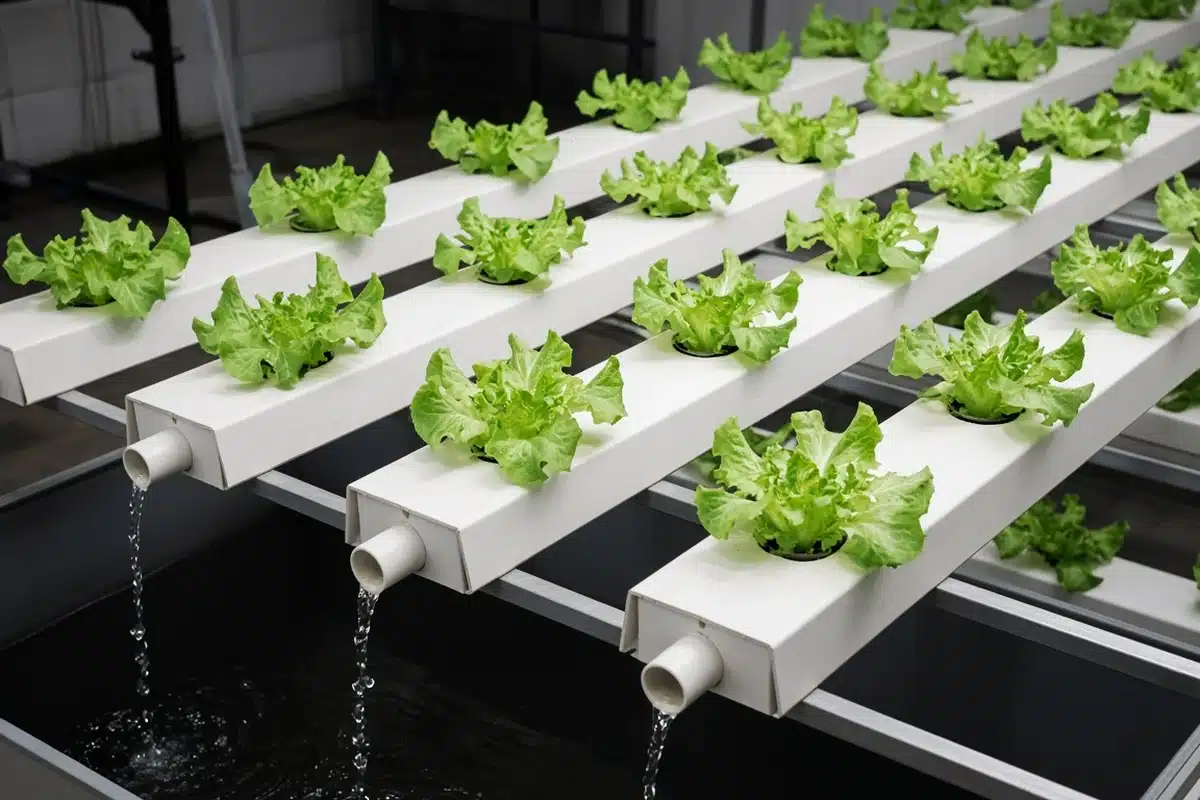
The Virginia Cooperative Extension guide to NFT systems explains a classic recirculating design. A thin film of solution flows down channels and returns to the tank. Growers monitor and adjust the tank between full changes.
| Feature | Drain to waste | Recirculating |
|---|---|---|
| Solution | Fresh mix each feeding | Same solution reused |
| Feed control | Very steady | Drifts and needs adjustment |
| Water and nutrient use | Higher | Lower |
| Monitoring | Less frequent | Frequent EC and pH checks |
| Root zone spread | Each plant separate | Shared solution links all plants |
Sources: UMass Amherst, Virginia Cooperative Extension.
Which saves more water?
Recirculating systems can reduce water and fertilizer use by reusing solution. Runoff goes back into use instead of leaving the system.
Researchers at Kansas State University studied how well reused nutrient solution works. Their Kansas State University report on nutrient solution reuse looked at what happens to crops and solution when growers reuse it. Reuse can save resources, but the solution needs monitoring so imbalances don’t build up.
Drain to waste uses more, but the loss can be small with good habits. Feed enough that a modest share runs out. That runoff flushes extra salts from the media. Without any runoff, salts can build up around roots.
Our post on salt buildup in cannabis soil explains how salts collect in a root zone and how runoff clears them. The same idea applies in soilless media.
Which is easier to manage?
Drain to waste is easier to understand. You mix one solution, check it once and feed it. You do not chase drift. Many beginners find it forgiving.
Recirculating needs more attention. You check EC and pH often, top off, adjust and change the tank on a schedule. In return, you save water and nutrients.
There’s also a root zone factor. In a recirculating system, all plants share one solution. A problem in one root zone can move to others. Drain to waste holds each plant separate.
Your media matters. Our post on hydroponic in different mediums compares coco, rockwool and others. Coco and rockwool are common in drain to waste setups. Clay pebbles and NFT channels are common in recirculating ones.
How do you handle runoff?
Plan where runoff will go before you start. Indoors, a catch tray under each pot or a gutter under a row leads runoff to a bucket.
Measure the runoff now and then. Its EC tells you whether salts are building up in the media. If runoff EC climbs well above your feed EC, increase runoff or flush with plain water.
Used runoff can water outdoor beds, shrubs or a lawn in many places.
How do costs compare over a season?
Drain to waste costs more in water and fertilizer each week. A big share of what you mix leaves as runoff. Over a long crop, that adds up.
Recirculating costs more in time and gear. You need a meter you trust, calibration fluid, a filter and a tank sized for the crop. You spend time each day on readings and adjustments.
For a few plants, the difference in water and fertilizer is small. Time is often the bigger cost. For a bigger system, saved inputs can pay for the extra gear in a season.
Write down what you spend on water, nutrients and time for one crop. Use that record to compare costs before the next crop.
How to: step by step
- List your crop and system size.
- Decide how much monitoring you can do.
- Estimate water and nutrient use for each style.
- Plan where runoff will go.
- Add filtration if you recirculate.
- Track EC and pH in either system.
If you can check readings every day, recirculating saves inputs. If you check less often, drain to waste may suit you.
For recirculating, add a screen filter and clean it often. Clean tanks, lines and pumps between crops. Our post on caring for your hydroponic system covers that routine.
Troubleshooting
Salt buildup in media. There’s no runoff. Feed enough that some drains out.
Root problems spread. Plants share one solution. Clean the system, filter and change solution.
High water use. Drain to waste sends runoff out. Reuse it on outdoor plants.
EC drifts fast. The recirculating tank is small. Change it more often or use a bigger tank.
Runoff EC climbing. Salts are building in media. Flush with plain water.
Pick the style that fits your time and your space, then take good notes. Kind Seed Co shares more garden projects in outdoor growing.
Sources
- Evaluating the efficacy of nutrient solution reuse in hydroponics, Kansas State University (K-REx), Evaluating the efficacy of nutrient solution reuse in hydroponics
- Hydroponic systems, UMass Amherst Center for Agriculture, Food, and the Environment, Hydroponic systems
- Hydroponic production of edible crops: nutrient film technique (NFT) systems (SPES-463), Virginia Cooperative Extension, Hydroponic production of edible crops
FAQ
Is recirculating better for beginners?
Not always. Drain to waste is simpler to manage because every feeding is fresh. Recirculating saves water but needs more frequent checks.
Where does drain to waste runoff go?
Into a catch tray, gutter or bucket. Many growers reuse it on outdoor beds or lawns.
Can I switch systems later?
Often yes. Many pots and media work either way. You mainly change how runoff is collected and whether it returns to the tank.
Do both use the same nutrients?
Yes. The same hydroponic mixes work in both. Recirculating systems need more adjustment as the mix drifts.
How much runoff is enough?
Enough that some solution drains from every pot. That flushes extra salts. Measure runoff EC to fine tune it.



