Wheelbarrow vs Garden Cart for Hauling Soil and Amendments

The short answer
In the wheelbarrow vs garden cart choice, load type decides. For heavy, dense loads like soil, sand and wet compost on narrow paths and ramps, a wheelbarrow is the better fit. A large garden cart suits bulky, light loads like straw, leaves and dry compost over open ground.
A wheelbarrow puts more of the weight on you but goes where carts cannot. A cart carries more of the weight on its wheels and holds more volume. But it should not be filled to the top with soil. Plenty of growers with large outdoor plots end up with both.

How each one works
LSU AgCenter explains the basic designs in its guide listed under the table below. The classic wheelbarrow has a hopper, one tire and two handles. The hopper sits between the tire and the handles, so the operator lifts much of the weight. The single wheel lets it roll along a board over a muddy spot or up a narrow ramp. But it also makes it somewhat unsteady.
Large garden carts ride on two big tires, often 20 or 26 inches. Because the hopper sits over the axle, the tires carry more of the weight. LSU notes that stability is excellent and that many carts tip forward so you can rake material straight in.
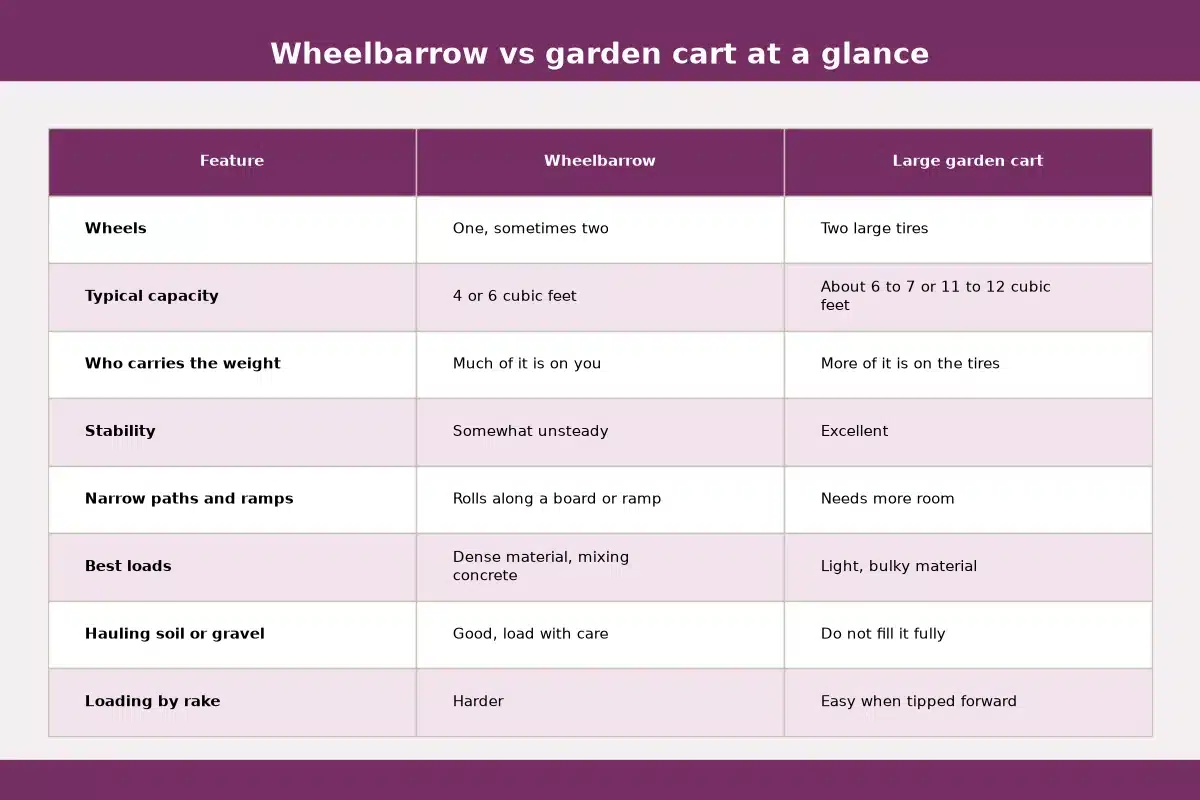
Wheelbarrow vs garden cart at a glance
| Feature | Wheelbarrow | Large garden cart |
|---|---|---|
| Wheels | One, sometimes two | Two large tires |
| Typical capacity | 4 or 6 cubic feet | About 6 to 7 or 11 to 12 cubic feet |
| Who carries the weight | Much of it is on you | More of it is on the tires |
| Stability | Somewhat unsteady | Excellent |
| Narrow paths and ramps | Rolls along a board or ramp | Needs more room |
| Best loads | Dense material, mixing concrete | Light, bulky material |
| Hauling soil or gravel | Good, load with care | Do not fill it fully |
| Loading by rake | Harder | Easy when tipped forward |
Source: Wheelbarrows and Garden Carts, LSU AgCenter, design, capacity, stability and best uses.
When a wheelbarrow is the better choice
Heavy, dense material is where a wheelbarrow shines. Soil, sand, gravel and wet compost pack a lot of weight into a small space. The deep sloped hopper dumps cleanly in one spot. That helps when you fill a raised bed or a large pot.
- Narrow paths between raised beds.
- Ramps and boards over soft ground.
- Mixing soil blends or concrete right in the hopper.
- Dumping into a precise spot.
LSU notes that a wheelbarrow is the better tool for mixing concrete. The same shape works for blending soil and amendments before filling beds.
When a garden cart is the better choice
A large cart holds about twice what a wheelbarrow does and rolls easily on its big tires. LSU says carts are best for light, bulky material such as leaves, pine straw and compost. That makes a cart handy for spreading mulch, hauling bags of amendments and moving plants in pots.
- Open ground and wide paths.
- Bulky, light loads like straw and dry leaves.
- Several bags of amendment at once.
- Users who want less lifting.
LSU warns that a large cart should not be fully loaded with soil, sand or gravel, since the weight becomes too much. Fill it part way with dense material.
Choosing for a cannabis grow
Think about what you move most often and where you move it.
- For filling raised beds or large fabric pots with soil, a wheelbarrow is often faster.
- For spreading mulch across outdoor rows, a cart holds more per trip.
- For hauling bags of soil from the car, a cart carries several bags with less lifting.
- For tight gaps between beds, a wheelbarrow fits where a cart will not.
Our guide to mulch for cannabis covers what to spread once you have it on site. Our guide to soil amendments vs fertilizers helps you plan what to haul.
Loading and lifting safely
The USDA Forest Service guide on hand tools for trail work gives simple advice for wheelbarrows. Lift a loaded wheelbarrow with your legs, not your back. Keep your back straight, bend at the knees and grasp the handles firmly. Keep the center of gravity low to avoid tipping.
The same guide notes that several light loads are easier to manage than one large one. Start light and work up to heavier loads.
How to haul soil and amendments
- Pick the tool that fits the load and the path.
- Clear the route of hoses, tools and loose stones.
- Load dense material toward the front of a wheelbarrow, over the wheel.
- Fill a cart only part way with soil, sand or gravel.
- Lift with your legs and keep your back straight.
- Walk slowly and keep the load balanced.
- Tip and unload in one smooth motion at the spot you want.
- Rinse the hopper and turn it over when you are done.
Care and storage
The Forest Service guide advises lightly oiling the wheel and axle now and then unless it has sealed bearings. It also suggests checking handle bolts for tightness and keeping the hopper clean, since standing dirt and water speed up rust. Turn the tool over after each use or store it out of the weather.
- Check tire pressure on pneumatic tires.
- Tighten loose bolts on handles and frames.
- Rinse out soil and amendments after each use.
- Store under cover or turned upside down.
Moving bags versus loose material
Bagged soil and amendments load differently from loose material. In a cart, bags stack flat and stay put. In a wheelbarrow, two or three bags fit at most, and they can shift as you go. If you buy soil by the bag, a cart often saves trips.
Loose material from a bulk pile works differently. A shovel fits a wheelbarrow hopper well, and the sloped front dumps material where you want it. Carts with a removable front panel also unload loose material easily.
Budget and space
LSU AgCenter notes that a small cart or small wheelbarrow can cost less than 50 dollars, while large carts cost more. Large carts also need more floor space in a shed or garage. If storage is tight, a wheelbarrow that hangs on a wall or stands on its nose may suit you better.
Tire choice
LSU notes that smaller wheelbarrows often have hard rubber tires. Meanwhile, larger ones have wider air filled tires that roll more easily. The Forest Service guide recommends air filled tires on uneven ground, since you can adjust inflation. For soft garden soil, a wide air filled tire sinks less.
Troubleshooting
- The wheelbarrow keeps tipping. Load lower and closer to the wheel.
- The cart is too heavy to pull. Fill it only part way with soil.
- The tire keeps going flat. Check for punctures or switch to a solid tire.
- Handles feel loose. Tighten the bolts.
- The hopper is rusting. Rinse it after use and store it dry.
- The cart will not fit between beds. Use a wheelbarrow for those paths.
Final thoughts
The wheelbarrow vs garden cart choice comes down to load and path. A wheelbarrow handles dense soil and tight paths. A cart moves bulky, light material with less lifting. Load either one with care and keep it clean and dry. Kind Seed Co has more outdoor growing guides to help you plan.
Sources
- LSU AgCenter, Wheelbarrows and Garden Carts
- USDA Forest Service, Handtools for Trail Work
FAQ
Is a wheelbarrow or a garden cart better for soil?
A wheelbarrow handles dense soil well, while a cart should only be filled part way with soil.
How much does a garden cart hold?
Large carts hold about 6 to 7 or 11 to 12 cubic feet, depending on tire size.
How much does a wheelbarrow hold?
Most wheelbarrows come in 4 or 6 cubic foot sizes.
Which is more stable?
A large two wheeled garden cart is more stable than a single wheel wheelbarrow.
How should I lift a loaded wheelbarrow?
Bend at the knees, keep your back straight and lift with your legs.