
Hose Splitters for Watering Several Garden Beds
The short answer
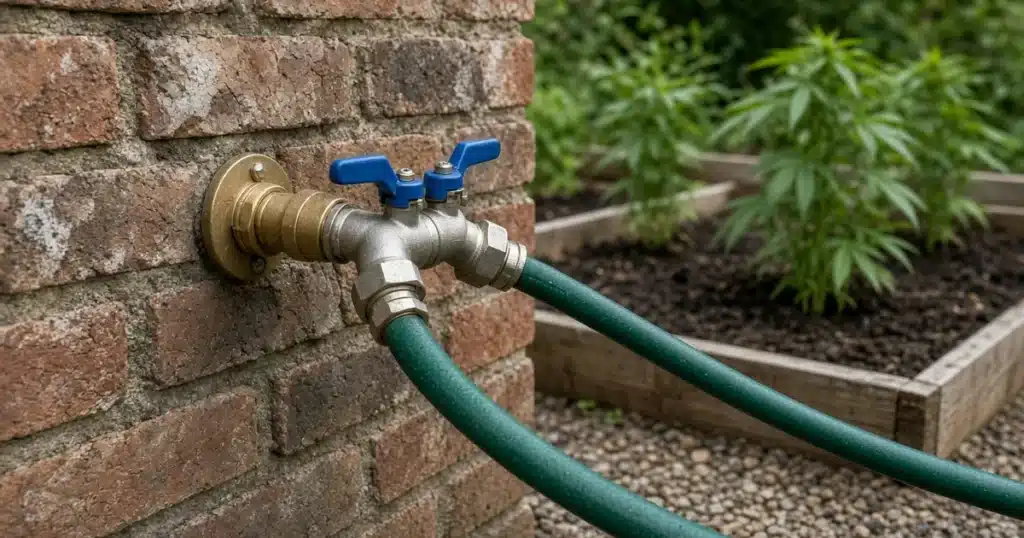
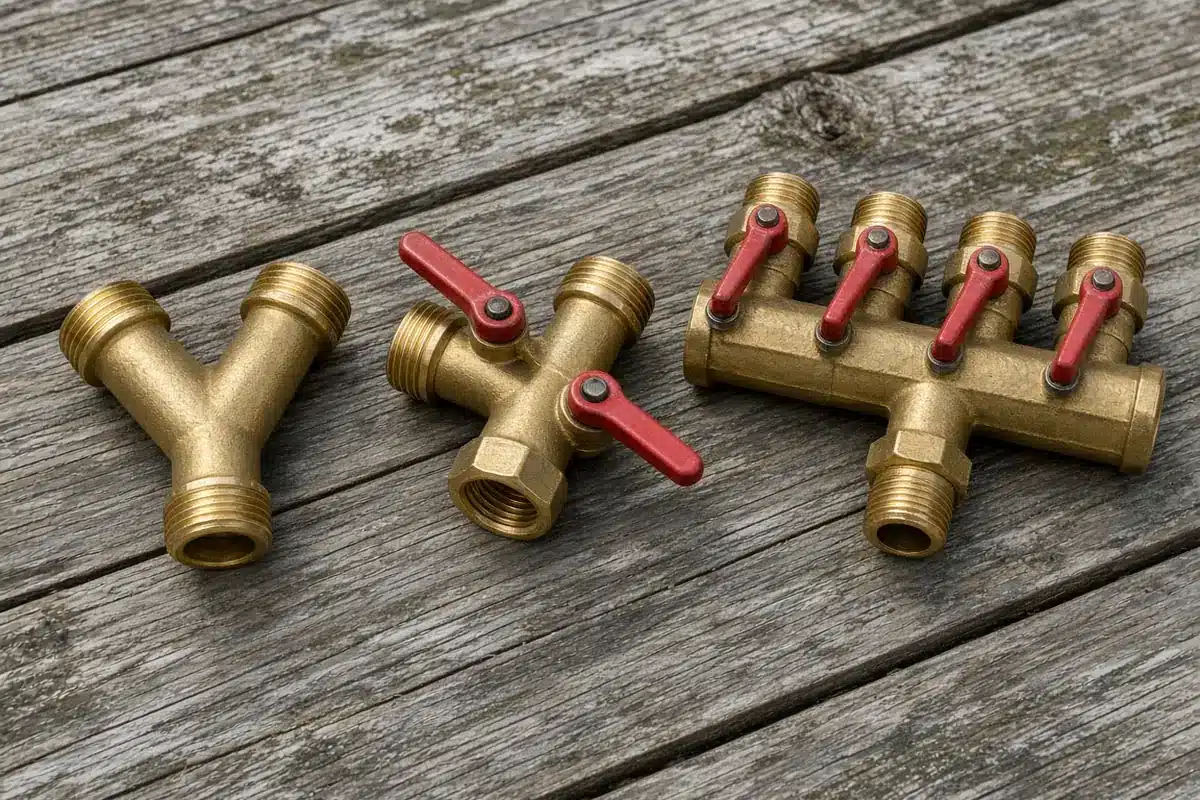
A hose splitter screws onto a spigot and gives you two or more outlets, each with its own shutoff valve. You can run a soaker line to one bed, a drip line to another and keep a hand hose ready on a third.
Pick a splitter with metal threads and lever valves that turn smoothly. Leave the backflow device on the spigot. Fit the splitter after it. Check your flow before you split it so each bed still gets enough water.
Why use a hose splitter
Most homes have only one or two outdoor spigots. Many cannabis gardens have several beds spread around a yard. Without a splitter, you swap hoses back and forth all day.
- Run two or more watering lines from one spigot.
- Keep a hand hose ready while drip lines run.
- Turn each line on or off on its own.
- Water beds with different needs from one spot.
Colorado State University Extension describes using a Y connector at the hose bib so one side can feed drip lines while the other stays free for a garden hose.
Splitter types
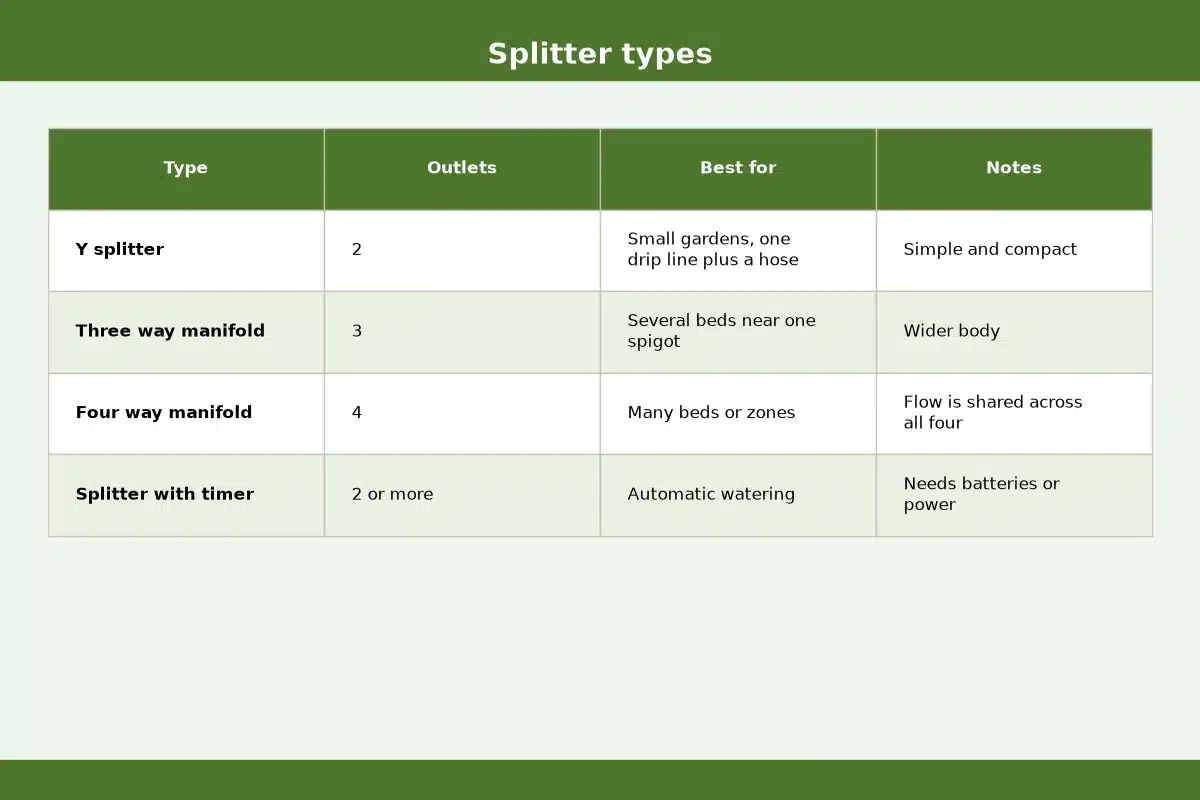
| Type | Outlets | Best for | Notes |
|---|---|---|---|
| Y splitter | 2 | Small gardens, one drip line plus a hose | Simple and compact |
| Three way manifold | 3 | Several beds near one spigot | Wider body |
| Four way manifold | 4 | Many beds or zones | Flow is shared across all four |
| Splitter with timer | 2 or more | Automatic watering | Needs batteries or power |
Source: Drip Irrigation for Home Gardens, Colorado State University Extension, Y connector at the hose bib, filters, regulators and flow limits.
What to look for
Threads
Metal threads outlast plastic and give a better seal. Plastic threads can strip if overtightened.
Valves
Each outlet should have its own valve. Lever valves that turn a quarter turn are easy to use. Make sure they turn smoothly and close all the way.
Washers
Every inlet and outlet needs a good rubber washer. Keep spares.
Shutoff feel
If you can, turn each valve a few times in the store. A valve that is stiff when new will be harder to turn after a season of sun and grit.
Spacing
Wide spacing between outlets lets hose ends, timers and filters sit side by side.
Check your flow first
Splitting a spigot does not create more water. All outlets share the same flow. CSU explains how to measure your source flow. Run the spigot full and time how long it takes to fill a bucket. Divide the bucket size in gallons by the seconds, then multiply by 3,600 to get gallons per hour.
CSU suggests planning for no more than 75 percent of that number at one time. It also notes that 1/2 inch drip mainline in a single zone is usually kept to about 200 gallons per hour.
Example
If a 5 gallon bucket fills in 30 seconds, your flow is 600 gallons per hour. Plan for about 450 gallons per hour at once. A drip line using 200 gallons per hour and a soaker line using 150 would fit within that.
How to set up a hose splitter
- Turn off the spigot.
- Make sure the backflow device on the spigot is in place.
- Screw the splitter onto the spigot or backflow device with a washer.
- Close all splitter valves.
- Attach hoses, drip lines or soaker lines to each outlet.
- Add a filter and pressure regulator on any drip line outlet.
- Turn the spigot on fully.
- Open each splitter valve one at a time.
- Check for leaks at every joint.
- Watch the far end of each line to see that water reaches it.
Backflow, filters and pressure
CSU lists three parts to fit at the start of a drip system: a backflow preventer, a filter of about 150 to 200 mesh and a pressure regulator. On a splitter, these go on each drip outlet. A hand hose does not need a filter or regulator.
Do not take the backflow device off the spigot to make room for a splitter. It protects your home drinking water.
Pressure is the reason the regulator matters. CSU notes that typical household water pressure is 50 to 60 psi. Most drip systems are designed to run at around 20 to 30 psi. Raised beds uphill from the spigot need a little more. CSU suggests adding 5 psi for every 10 foot rise above the water source.
Water wisely
EPA WaterSense notes that a lot of outdoor water is wasted through overwatering and inefficient systems. With a splitter, each bed can run on its own schedule rather than all at once.
CSU points out that drip irrigation can exceed 90 percent efficiency while sprinklers are often 50 to 70 percent efficient. Running drip lines from a splitter puts water at the roots.
- Water early in the day.
- Shut off lines for beds that are still moist.
- Use mulch to slow evaporation.
- Check for leaks each week.
Our guide to mulch for cannabis covers keeping soil moist longer. For off season beds, our guide to cover crops for cannabis explains keeping soil covered.
Planning lines to each bed
Sketch your yard before you buy hose. Label the spigot, each bed and the path between them. Short, direct runs keep pressure up and cut tripping hazards.
- Group beds with similar water needs on the same outlet.
- Give large beds their own outlet.
- Keep one outlet free for a hand hose.
- Run hoses along edges and paths, not across them.
- Use hose guides at corners so lines do not drag across plants.
CSU suggests limiting a single drip zone to about 200 feet of mainline. A bed far from the spigot does better with its own outlet and a wider hose.
Watering beds in turns
You do not have to run every outlet at once. If your flow is limited, water one or two beds, then switch. This is easy with a splitter because you only flip valves. Many growers water the beds that dry fastest first, such as those in full sun or with sandy soil.
Keep a simple note of how long each bed runs. Over a few weeks you will learn how much each bed needs and can adjust times with the weather.
Splitters and rain barrels
A splitter can also go on a rain barrel outlet. Gravity flow from a barrel is low, so use only one or two outlets and short hoses. Our guide to rainwater for cannabis covers using barrel water.
Care and storage
Before the first watering each spring, CSU advises flushing the drip mainline to clear out dirt and cleaning the filter. Check emitters during the season and clean any that clog. In fall, detach the head assembly with its backflow device, filter and pressure regulator. Store those parts indoors over winter. Uncap the line ends so water can drain, then cap them again.
- Drain the splitter before freezing weather.
- Store it indoors over winter.
- Replace washers that crack or flatten.
- Work each valve a few times at the start of the season.
Troubleshooting
- Water drips at the spigot. Replace the washer and retighten.
- One line has weak flow. Too many outlets are open, or flow is over your limit.
- A valve will not shut. Grit is stuck inside. Flush it or replace the splitter.
- Drip emitters clog. Add or clean the filter on that outlet.
- Lines burst at the joints. Add a pressure regulator to drip outlets.
- The splitter leaks at the body. Plastic may have cracked. Switch to metal.
Final thoughts
A hose splitter lets one spigot water several cannabis beds and keeps a hand hose ready. Choose one with metal threads and good valves, check your flow before you split it and add filters and regulators on drip outlets. Kind Seed Co has more watering guides for home growers.
Sources
- Colorado State University Extension, Drip Irrigation for Home Gardens
- EPA WaterSense, Outdoors
FAQ
What is a hose splitter?
A fitting that turns one spigot into two or more outlets, each with its own valve.
Does a hose splitter reduce water pressure?
All outlets share the same flow, so opening more lines lowers flow to each one.
Can I use a hose splitter with drip irrigation?
Yes. Add a filter and pressure regulator on each drip outlet.
Where does the backflow device go?
On the spigot, before the splitter. Never remove it.
How many beds can one splitter water?
It depends on your flow. Measure it with a bucket and plan for about 75 percent of it at once.


