
Hydroponic Gang Valve: Splitting Air from One Pump to Several Air Stones
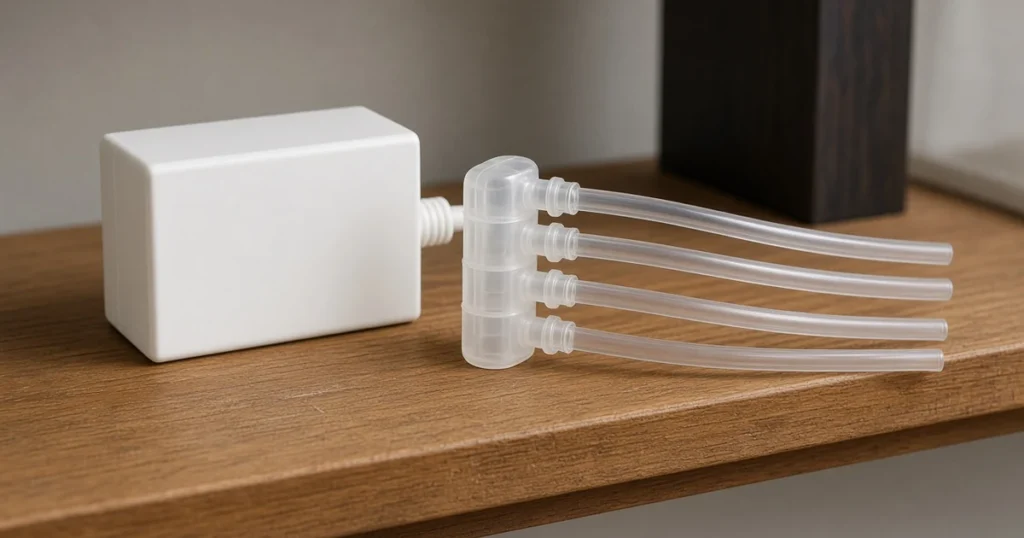
A hydroponic gang valve is a small manifold that takes air from one pump and splits it into several air lines, each with its own valve. One pump can then feed air stones in several reservoirs or across a large one, with each valve setting its line’s air.
The short answer
Run the pump into the gang valve, then run one line from each outlet to an air stone. Open each valve and watch. Turn down lines that bubble hard and open the weak ones until the flow looks even. If every valve is open and the stones still look weak, the pump is too small.

How does a gang valve work?
A gang valve is a manifold with valves on each outlet. Virginia Cooperative Extension explains for NFT systems that shut off valves can be added to delivery lines or manifolds to adjust the flow into each channel. A gang valve does that for air. Oregon State University Extension says deep water culture needs effective aeration because there is little water movement and low air exchange. Air pumps and stones usually supply it.
The University of Minnesota Extension describes the air stone as a porous synthetic stone connected through tubing to an outside pump. Air pushed through the stone leaves as tiny bubbles. Minnesota suggests an airstone when you grow several plants with different root lengths. Read caring for your hydroponic system for routine upkeep.
How do you balance air between lines?
Start with every valve fully open, then close the valve a little on any line that bubbles much harder than the rest. Recheck after a day. Oregon State lists regular checks on aeration equipment among routine tasks, along with pH and nutrient levels.
When do you need a bigger pump?
When every valve is open and the stones still give weak bubbles, the pump cannot supply all the lines. Virginia Cooperative Extension notes that in smaller systems an air pump with an attached air line and diffuser helps move the nutrient solution. Many stones may call for one larger pump or two smaller ones. Compare system types in indoor marijuana grow systems.
Gang valve setup
| Need | What to do | Why |
|---|---|---|
| Split air | One pump into a gang valve | One source, several lines |
| Set flow | Adjust each valve | Valves on manifolds set flow |
| Even bubbles | Close hard bubbling lines a little | Weak lines get more air |
| Upkeep | Check aeration gear often | OSU routine |
Sources: Virginia Cooperative Extension, Oregon State University Extension, University of Minnesota Extension.

How to: step by step
- Mount the gang valve close to the pump.
- Run a short line from the pump to the valve inlet.
- Run one line from each outlet to an air stone.
- Open all valves and start the pump.
- Close the valve a little on any line that bubbles too hard.
- Recheck the bubbles every few days.
Troubleshooting
One stone barely bubbles: its line is long or the stone is clogged. Open that valve wider or swap the stone.
Weak bubbles at every stone: the pump is too small, so close unused outlets or add a pump.
Air leaks at the outlets: loose tubing. Push the lines fully onto the barbs. More room setup notes are in hydro setup environment, and media options are in hydroponic in different mediums.
Kind Seed Co shares these notes for growers who run more than one reservoir.
Sources
- Hydroponic production of edible crops: deep water culture (DWC) systems (SPES 464), Virginia Cooperative Extension
- Hydro hints: deep water culture (EM 9455), Oregon State University Extension
- Small scale hydroponics, University of Minnesota Extension
- Hydroponic production of edible crops: nutrient film technique (SPES 463), Virginia Cooperative Extension
FAQ
What is a hydroponic gang valve?
A small manifold that splits air from one pump into several lines. Each outlet has its own valve so you can set the flow to each air stone.
Why use air stones at all?
Oregon State University Extension says deep water culture needs effective aeration because there is little water movement. Air pumps and air stones supply it.
How do you know the lines are balanced?
Look at the bubbles. When each stone gives a similar stream, the lines are balanced. Close any valve that bubbles much harder than the others.
What if all valves are open and bubbles are weak?
The pump cannot supply every line. Close unused outlets or add a second pump.
How often should you check the air gear?
Often. Oregon State lists regular checks on aeration equipment as routine upkeep, along with pH and nutrient levels.



