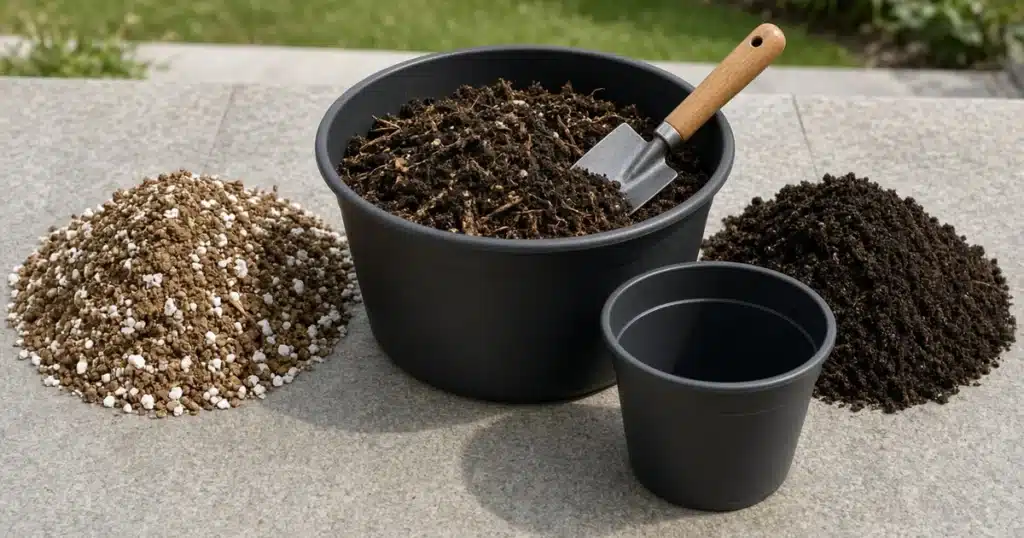
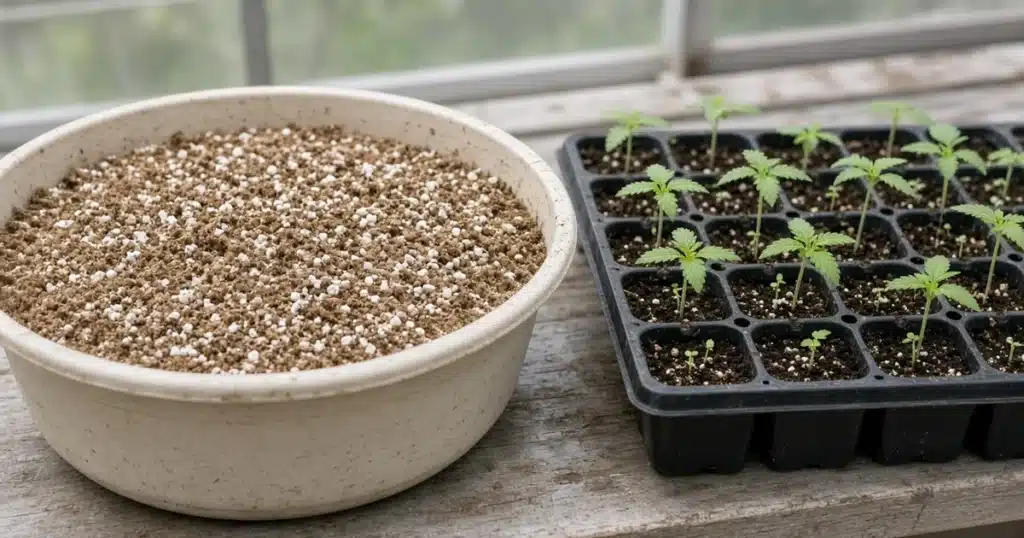
Rice Hulls for Cannabis Soil: A Perlite Alternative
Quick answer: Rice hulls are the papery outer shells left after rice is milled. Parboiled rice hulls are steamed to kill any rice or weed seeds, and Purdue Extension says their large particles raise drainage and air space in peat based mixes. University of Arkansas Extension reports that hulls break down slowly because they are rich in lignin and silica, and that pine bark mixes with up to 40 percent hulls grew plants as well as bark alone. For cannabis, parboiled hulls are a renewable stand in for perlite at roughly 20 to 30 percent of a potting mix.
What Are Rice Hulls?
Every grain of rice grows inside a tough husk. Mills strip that husk away, leaving huge volumes of light, golden hulls as a byproduct. Rice growing states such as Arkansas, Louisiana and California produce most of the United States supply.
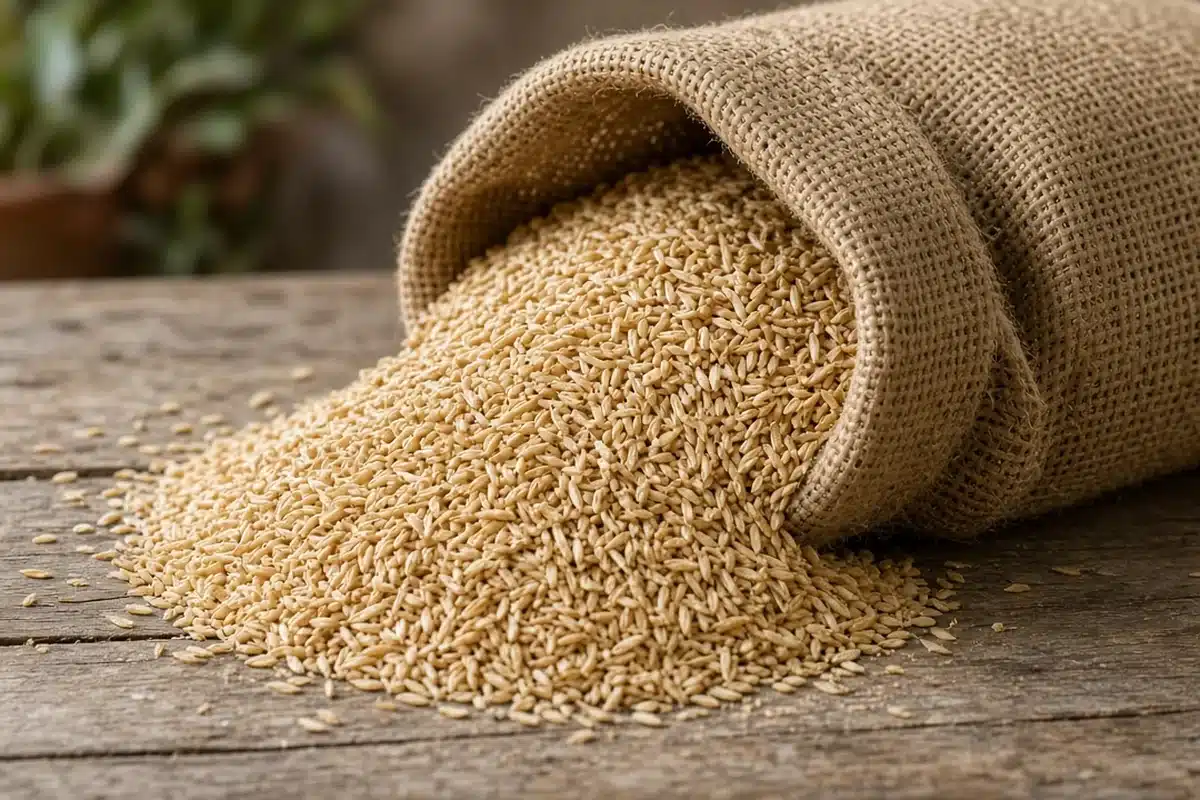
A single hull is about the size of a grain of rice, curved and boat shaped, with a rough, ridged surface. That shape is what makes hulls useful in potting soil. They do not pack flat, so they leave gaps for air and water to move. Hulls come in several forms. An Arkansas Cooperative Extension fact sheet Growing Media for Container Production lists fresh, aged, carbonized, composted and parboiled hulls. Fresh hulls are usually avoided for containers because they can carry leftover rice or weed seeds. Parboiled hulls are steamed and dried after milling, which leaves a product free of viable seed.
Purdue University Extension agrees in Evaluating Container Substrates and Their Components. Processors parboil the hulls to stop any rice from sprouting in the pot, so the steamed product should be free of viable weed seed.
Hulls condition a mix instead of feeding it, and our page on what separates an amendment from a fertilizer goes further.
How Do Rice Hulls Compare With Perlite?
Both add coarse particles that open up a mix. Purdue explains that whole parboiled hulls, with their large particles, improve drainage and add air space to peat mixes without tying up much nitrogen. The nitrogen point matters most. Some organic materials, like fresh wood, pull nitrogen from the mix as microbes break them down. Hulls largely avoid that problem.
Iowa State horticulture staff, writing about potting media components and handling, notes that rice hulls have gained ground as perlite prices have risen. It says hulls have been used to provide air filled pores as perlite costs rose.
Weight counts in their favor as well. Arkansas lists fresh hulls at a bulk density of about 6 to 7 pounds per cubic foot, light enough to keep large pots easy to move. The two are not identical, though. Perlite is mined and heat expanded rock, so it never decays. Hulls are plant material, so they do decompose, if slowly. Purdue notes that perlite tends to drift to the top of a mix. Hulls are also renewable and give off no mineral dust.
Our comparison of perlite vs vermiculite for cannabis covers the two traditional additives that hulls are often meant to replace.
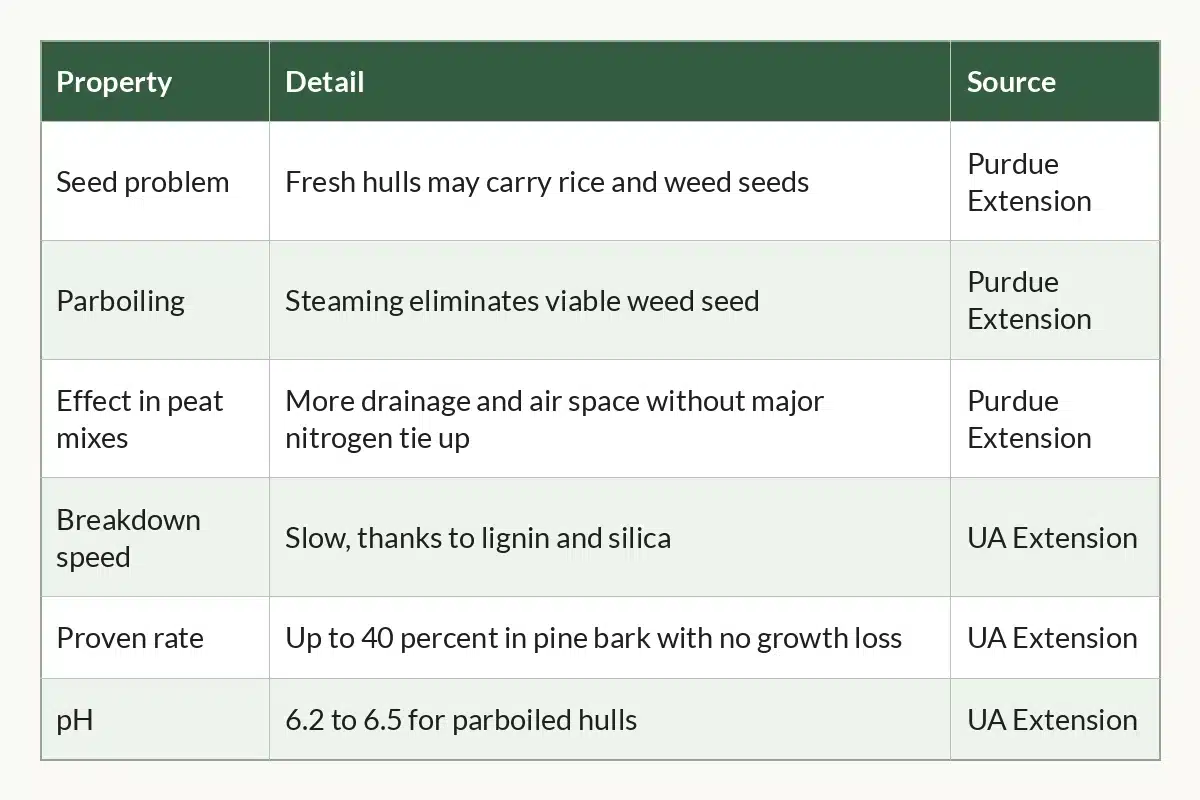
Rice Hulls at a Glance
| Property | Detail | Source |
|---|---|---|
| Seed problem | Fresh hulls may carry rice and weed seeds | Purdue Extension |
| Parboiling | Steaming eliminates viable weed seed | Purdue Extension |
| Effect in peat mixes | More drainage and air space without major nitrogen tie up | Purdue Extension |
| Breakdown speed | Slow, thanks to lignin and silica | UA Extension |
| Proven rate | Up to 40 percent in pine bark with no growth loss | UA Extension |
| pH | 6.2 to 6.5 for parboiled hulls | UA Extension |
How Long Do Rice Hulls Last in a Pot?
Sources differ, and the reason is worth knowing. Arkansas says that despite being organic, hulls are made largely of lignin, cutin and silica that does not dissolve. Those tough compounds slow breakdown and make hulls suitable for long term crops. Purdue agrees that the natural silicon in hulls reduces degradation, so mixes keep a stable structure during production.
Iowa State takes a more cautious view for very long crops. It suggests hulls work for short term plants such as seedlings grown for transplant, but says they decompose too quickly for long term plants such as houseplants kept for years. Our guide to seed starting mix for cannabis has recipes for that early stage.
Composting changes the picture too. Arkansas notes that fully composted hulls hold more water than unprocessed ones, so a composted product behaves more like a peat substitute than an aggregate. Parboiled whole hulls keep the coarse structure that makes them useful for drainage. Cannabis sits comfortably in between on that timeline. Most plants spend a few months in their final container. Parboiled hulls hold their structure well over that span. Growers who reuse soil for several cycles may notice the hulls softening and shrinking, and can top up the mix with fresh hulls or a mineral aggregate.
For a mineral that does not break down, see pumice for cannabis soil mixes.
How Much Rice Hull Should You Use in Cannabis Mix?
Arkansas reports that work at its own campus found pine bark amended with up to 40 percent parboiled hulls did not significantly reduce plant growth. Irrigation volume and frequency also stayed the same after one and two growing seasons. It adds that several researchers consider hulls a suitable substitute for perlite in mixes containing 20 to 30 percent hulls.
An Oklahoma State Extension overview of soilless growing mediums mentions mixes of about 30 to 40 percent hulls with pine bark and calls parboiled hulls superior to other hull types.
These figures come from nursery and greenhouse crops, not cannabis, yet the physical role of an aggregate is the same in any container. For a peat or coir based cannabis mix, a quarter of the volume is a reasonable starting point. Increase toward a third if the mix stays too wet.
Purdue flags a chemical detail as well. Salt levels and nitrogen forms in hull products fall within normal ranges for greenhouse aggregates, but pH, phosphorus and potassium can run above recommended levels in some products. Purdue suggests testing the mix and checking leaf nutrition if growth looks off. Cannabis growers can take that as a good reason to buy from a consistent source and start with a modest share. Arkansas adds two useful details. Parboiled hulls have a pH of about 6.2 to 6.5, which suits cannabis. Hulls are also naturally high in manganese, so the fact sheet advises keeping media pH above 5 to avoid excess manganese uptake.
Can You Use Rice Hulls as Mulch?
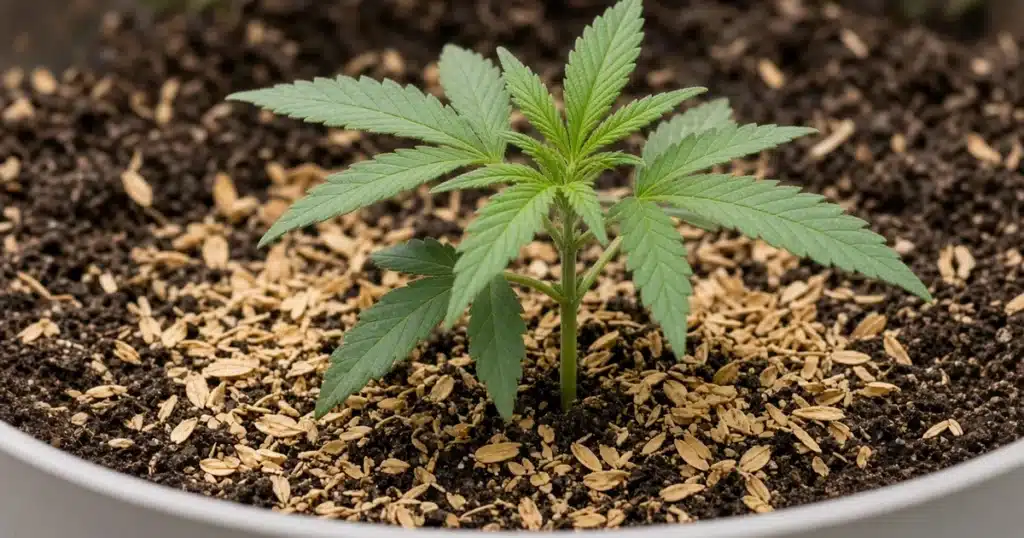
Some gardeners spread hulls on top of pots or beds as a light mulch. They are easy to handle and break down slowly. In windy outdoor spots, though, the light hulls can blow away, so a heavier material often works better there.
If you are deciding between a bagged mix and a homemade blend, our article on garden soil vs potting mix for cannabis explains why containers need lighter ingredients like hulls.
How to Use Rice Hulls in Cannabis Potting Mix
- Buy parboiled hulls. Avoid fresh hulls that may sprout rice or weeds.
- Moisten them first. Dry hulls are springy and resist water. Dampen them before mixing.
- Start at a quarter of the mix. Blend about 25 percent hulls with peat or coir, then adjust.
- Mix evenly. Stir until hulls are spread throughout without clumps.
- Check pH. Aim to keep the mix above pH 5 to avoid manganese issues.
- Water and observe. Watch how quickly pots dry and adjust the hull share in future mixes.
- Refresh when reusing. Add fresh hulls to old mix that has broken down over several cycles.
Troubleshooting Rice Hull Problems
Rice or grass sprouts in the pot. The hulls were not parboiled. Pull sprouts and switch to a parboiled product.
Mix stays soggy. Add more hulls or a coarse mineral aggregate to open up air space.
Mix dries too fast. Reduce the hull share and add more peat or coir.
Hulls float when first watered. Dry hulls can rise. Moisten them before potting and water gently at first.
Pale new leaves in a very acidic mix. pH may be too low. Raise pH above 5 and check feeding.
Sources
- Purdue University Extension, Evaluating Container Substrates and Their Components (HO 255 W): https://www.extension.purdue.edu/extmedia/ho/ho-255-w.pdf
- University of Arkansas Cooperative Extension Service, Growing Media for Container Production Part I (FSA6097): https://www.uaex.uada.edu/publications/pdf/FSA-6097.pdf
- Iowa State University Extension and Outreach, Potting Media: https://yardandgarden.extension.iastate.edu/article/2025/03/potting-media-components-and-handling
- Oklahoma State University Extension, Soilless Growing Mediums: https://extension.okstate.edu/fact-sheets/soilless-growing-mediums
FAQ
Can rice hulls fully replace perlite for cannabis?
In many mixes, yes. Research cited by Arkansas found hulls a suitable perlite substitute at 20 to 30 percent of the mix.
Do rice hulls tie up nitrogen?
Purdue reports whole parboiled hulls do not cause significant nitrogen tie up in peat mixes.
What is the difference between fresh and parboiled hulls?
Parboiled hulls are steamed to kill seeds. Fresh hulls may sprout rice or weeds.
How long do rice hulls last?
Long enough for a cannabis crop, since lignin and silica slow their breakdown.
Do rice hulls change pH?
Parboiled hulls sit near pH 6.2 to 6.5, so their effect is mild.