Lava Rock in Cannabis Containers: Pros, Cons and Use
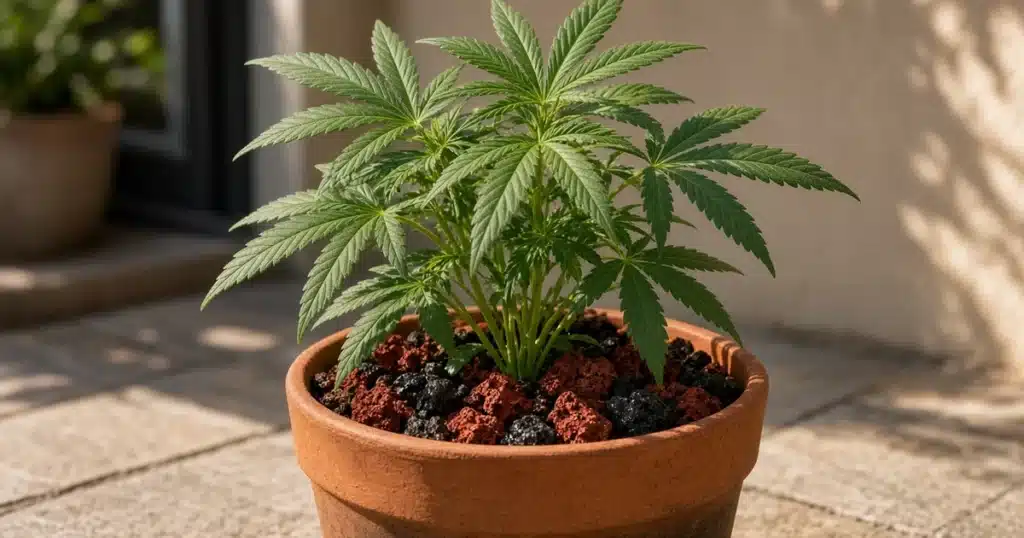
Quick answer: Lava rock, also called volcanic cinder or scoria, is a porous rock that forms when lava cools quickly and traps gas bubbles. An Oklahoma State Extension fact sheet lists it as a low cost, reusable, pH neutral growing medium widely used in aquaponics. University of Hawaii Extension calls volcanic cinders an excellent container amendment because they are relatively heavy and porous, as long as they are screened to a quarter inch or smaller and washed before use. For cannabis, small lava rock can replace part of the perlite in a mix. A layer of rock at the bottom of a pot does not improve drainage.
What Is Lava Rock?
Lava rock is a catchall name for volcanic rock full of internal holes. Scoria and cinders are the most common types sold for gardens, usually in red, brown or black. They are heavier than pumice and much heavier than perlite, but still lighter than ordinary gravel.
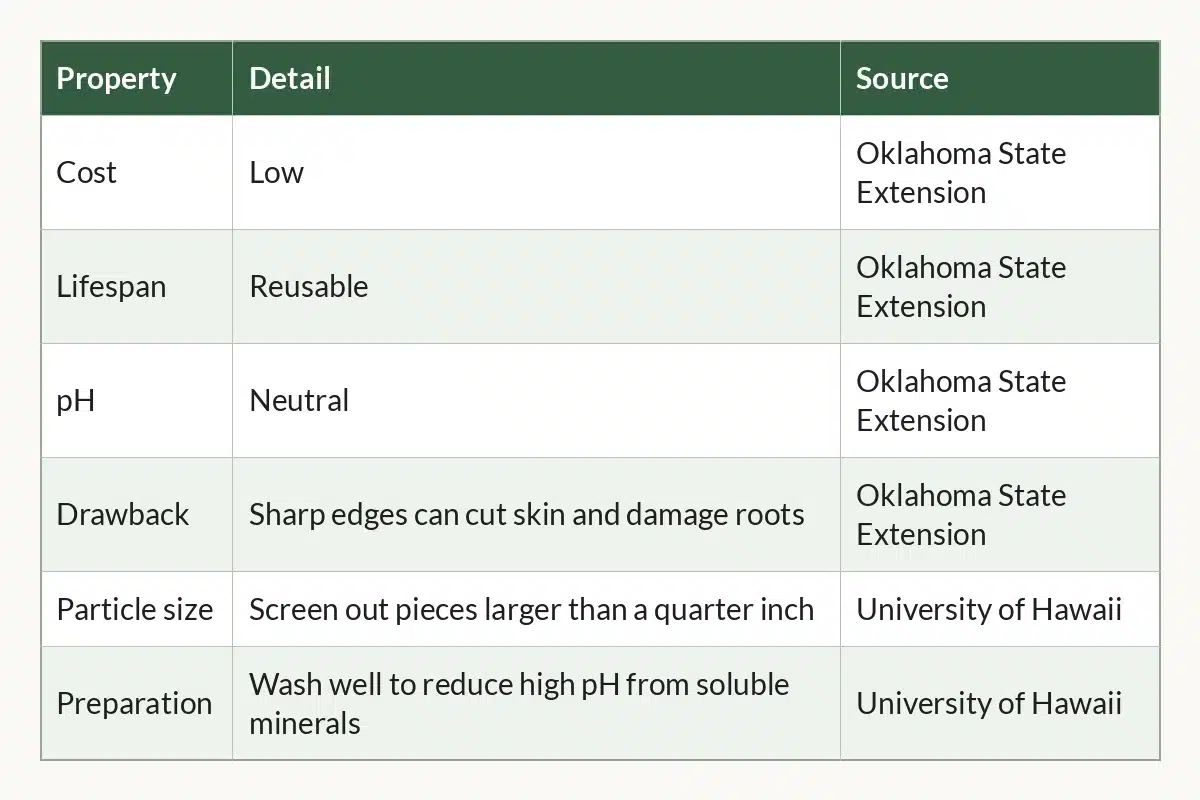
Oklahoma State Extension covers lava rock in an overview of hydroponic and soilless media. It explains that these rocks form when hot lava cools quickly, leaving air pockets inside that give beneficial bacteria extra surface area. It presents lava rock as a cheaper option than expanded shale or clay pellets. Its comparison table rates lava rock as low in cost, reusable and neutral in pH.
The same publication notes a downside. Lava rock has a jagged texture, and its sharp edges can cut skin during handling and may damage plant roots. Keep that in mind when you choose a grade and when you repot. Bags labeled for landscaping often contain chunks an inch or more across, which are far too large for potting soil. Look for products sold as scoria fines, cinder grit or bonsai grade lava, which come in smaller, more even sizes.
Cinders act as a structural amendment, not a feed, a difference our hub page lays out.
Why Use Lava Rock in Cannabis Containers?
In Hawaii, where volcanic material is abundant, cinders have long been a standard potting ingredient. A University of Hawaii Cooperative Extension leaflet on container media lists volcanic cinders alongside sand, vermiculite and perlite as inert materials that improve drainage and aeration. It calls cinders an excellent amendment, since each particle is fairly heavy yet riddled with pores.
Cinders do not hold nutrients or release any meaningful amount, so a mix with lava rock still depends on peat, coir, compost or feeding for nutrition. All the rock provides is structure. Weight is a real advantage for tall cannabis plants. The Hawaii leaflet notes that bulk density matters because heavier media reduce breakage and damage from tipping. It adds that perlite, while porous, is limited by its light weight. Lava rock gives a pot more ballast without sealing up air space.
Outdoor growers in windy areas often notice the difference first. A plant in flower can carry a lot of top weight, and a light peat and perlite mix in a plastic pot tips over easily. Replacing part of the perlite with cinder lowers the center of gravity without making the pot impossibly heavy. Roots care a great deal about drainage and air. The leaflet states that if a medium stays waterlogged for 24 hours, most plants can lose about half of their growth potential. A mix with some coarse, porous rock drains faster and refills its pores with air after watering.
Color does not affect performance much. Red scoria gets its hue from oxidized iron, while black cinder has less oxidation. Both behave about the same in a pot. Lava rock also suits hydroponic and aquaponic setups, which is where Oklahoma State sees it used most. In those systems the rock anchors roots while water carries the nutrients. Lava rock also lasts. It does not decompose, so it holds structure over many seasons. That makes it attractive for growers who reuse soil or run long outdoor containers.
Lava Rock at a Glance
| Property | Detail | Source |
|---|---|---|
| Cost | Low | Oklahoma State Extension |
| Lifespan | Reusable | Oklahoma State Extension |
| pH | Neutral | Oklahoma State Extension |
| Drawback | Sharp edges can cut skin and damage roots | Oklahoma State Extension |
| Particle size | Screen out pieces larger than a quarter inch | University of Hawaii |
| Preparation | Wash well to reduce high pH from soluble minerals | University of Hawaii |
How Should You Prepare Lava Rock?
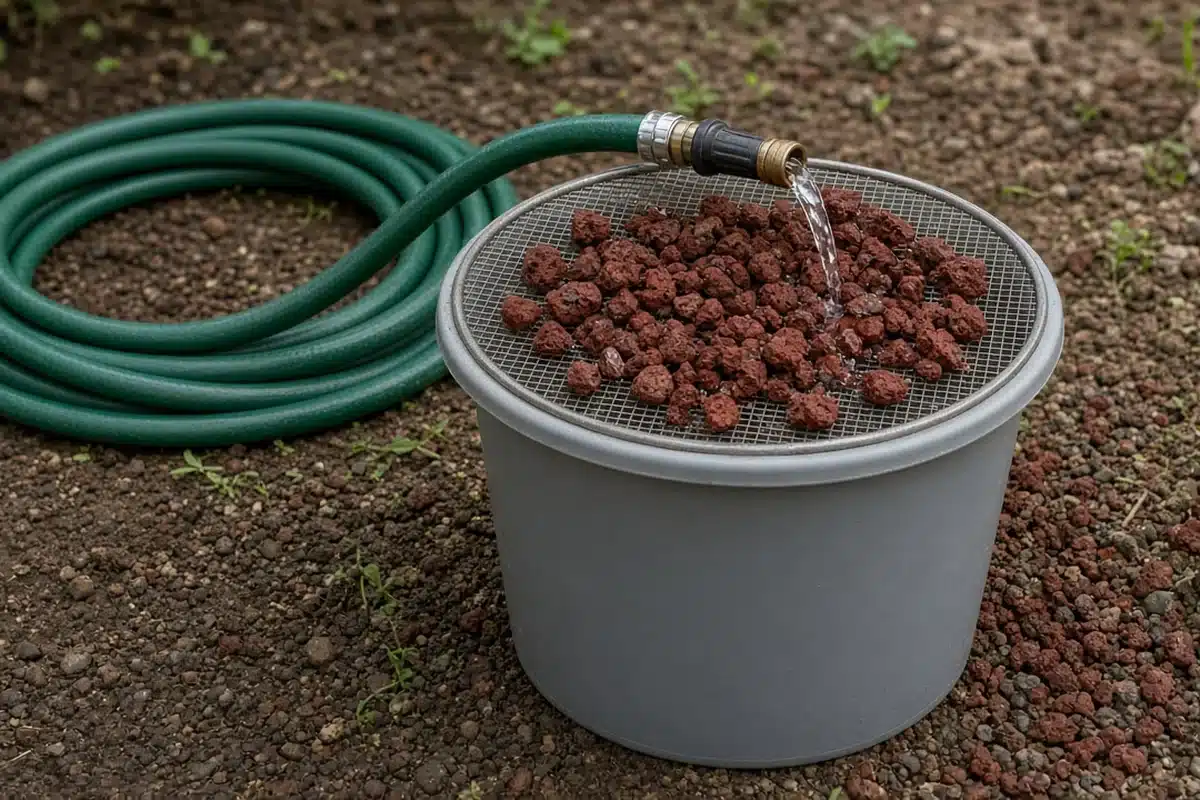
The University of Hawaii gives clear instructions. Screen out cinders larger than a quarter inch in diameter, since bigger pieces cause excessive drainage. Wash cinders thoroughly before use, because soluble calcium, magnesium and sodium on their surfaces can push pH too high.
The leaflet also warns about fines. Large amounts of fine material, including pumice dust mixed in with the cinders, fill the big pore spaces and reduce drainage. Rinsing in a screen or bucket removes much of that dust.
A Hawaii horticulture digest on a standardized potting mix for Manoa notes that screened black cinders have served in place of perlite in a peat based research mix. That gives a simple model. Swap part or all of the perlite in a recipe for screened, washed cinder of similar size.
Rinsing is tempting to skip, but do not. A quick soak and stir in a bucket, followed by a rinse through a screen, takes a few minutes and removes most of the dust and loose minerals. For cannabis, small red or black scoria roughly 3 to 6 millimeters across blends well. Larger landscape rock is too coarse for potting soil.
Does Lava Rock at the Bottom of a Pot Help Drainage?
No. Few container myths have lasted as long. Washington State University horticulturist Linda Chalker Scott takes it apart in a short paper on drainage layers in containers. She explains that soil scientists showed nearly a century ago that water does not move easily from a finer layer into a coarser one.
Water stays in the finer soil above the rock until that soil is saturated. A layer of gravel, shards or lava rock at the bottom actually raises the wet zone and makes waterlogging more likely, the very problem it is meant to prevent. Her bottom line is simple. Containers need drainage holes, and the growing medium should be uniform from top to bottom.
Some growers still put a few pieces of rock over the drain hole to keep soil from washing out. A square of mesh does that job without creating a separate layer. If you use lava rock at all, mix it evenly through the soil. Our article on gravel in the bottom of cannabis pots covers the drainage layer myth in more depth.
How to Use Lava Rock in Cannabis Mix
- Choose small grades. Look for scoria or cinder about pea size or smaller.
- Screen it. Remove pieces larger than a quarter inch, as Hawaii advises.
- Rinse well. Wash away dust and soluble minerals that raise pH.
- Wear gloves. Sharp edges are hard on bare hands.
- Blend evenly. Mix lava rock through the potting soil in place of some or all of the perlite.
- Skip the bottom layer. Keep the mix uniform from top to bottom and rely on drainage holes.
- Repot gently. Ease roots apart to limit damage from sharp fragments.
Our guide to perlite and vermiculite for cannabis explains the lighter aggregates that lava rock often replaces, and the soil drainage test for cannabis beds shows how to check whether water moves through soil fast enough.
Troubleshooting Lava Rock Problems
Runoff pH reads high. The rock may not have been rinsed. Wash new batches thoroughly and retest.
Mix drains too fast. Pieces are too large or too plentiful. Screen out large chunks and add more peat or coir.
Water pools on top. Fine dust is clogging pores. Rinse before mixing.
Roots look torn after repotting. Sharp fragments can scrape roots. Use smaller, rounded grades and handle root balls gently.
Pots are too heavy to move. Lava rock adds weight. Use a smaller share or pair it with a lighter aggregate.
Sources
- Oklahoma State University Extension, Soilless Growing Mediums: https://extension.okstate.edu/fact-sheets/soilless-growing-mediums
- University of Hawaii Cooperative Extension Service, Basic Characteristics of Media for Container Grown Plants (GHGS 10): https://www3.ctahr.hawaii.edu/oc/freepubs/pdf/GHGS-10.pdf
- University of Hawaii, Horticulture Digest 109, Standardized Potting Mix for Manoa: https://www3.ctahr.hawaii.edu/tpss/digest/hd109/hd109_4.html
- Washington State University Extension, Linda Chalker Scott, The Myth of Drainage Material in Container Plantings: https://wpcdn.web.wsu.edu/wp-puyallup/uploads/sites/403/2015/03/container-drainage.pdf
FAQ
Is lava rock good for cannabis?
In small, screened and rinsed grades, it adds air, drainage and weight to potting mixes.
Should I put lava rock in the bottom of a pot?
No. Research summarized by Washington State University shows a coarse bottom layer keeps soil above it wetter.
Does lava rock change pH?
Oklahoma State lists it as neutral, but unwashed cinders can raise pH until rinsed.
Can I reuse lava rock?
Yes, since it does not break down. Rinse and sterilize it between crops.
Is lava rock the same as pumice?
Both are volcanic, but lava rock is usually heavier and more jagged than pumice.