Rock Dust for Cannabis: What It Can and Cannot Do
Quick answer: Rock dust is stone that has been crushed into a fine powder and spread on soil to add minerals. Colorado State University Extension notes that rock powders can supply certain minerals, yet it also says many soils already hold plenty of calcium and potassium, so the powder adds little. University of Maine Extension goes a step further and recommends soil amendments only after a soil test shows a need. For most cannabis growers, rock dust is an optional extra, not a core input. Test first, and use it only when the results point to a real gap.
What Is Rock Dust?
Rock dust is a loose label, not a single product. Almost any stone ground fine enough to mix into soil can carry the name. Quarries produce much of it as a byproduct of crushing gravel. Common types include basalt, granite, glacial silt and various mineral blends.
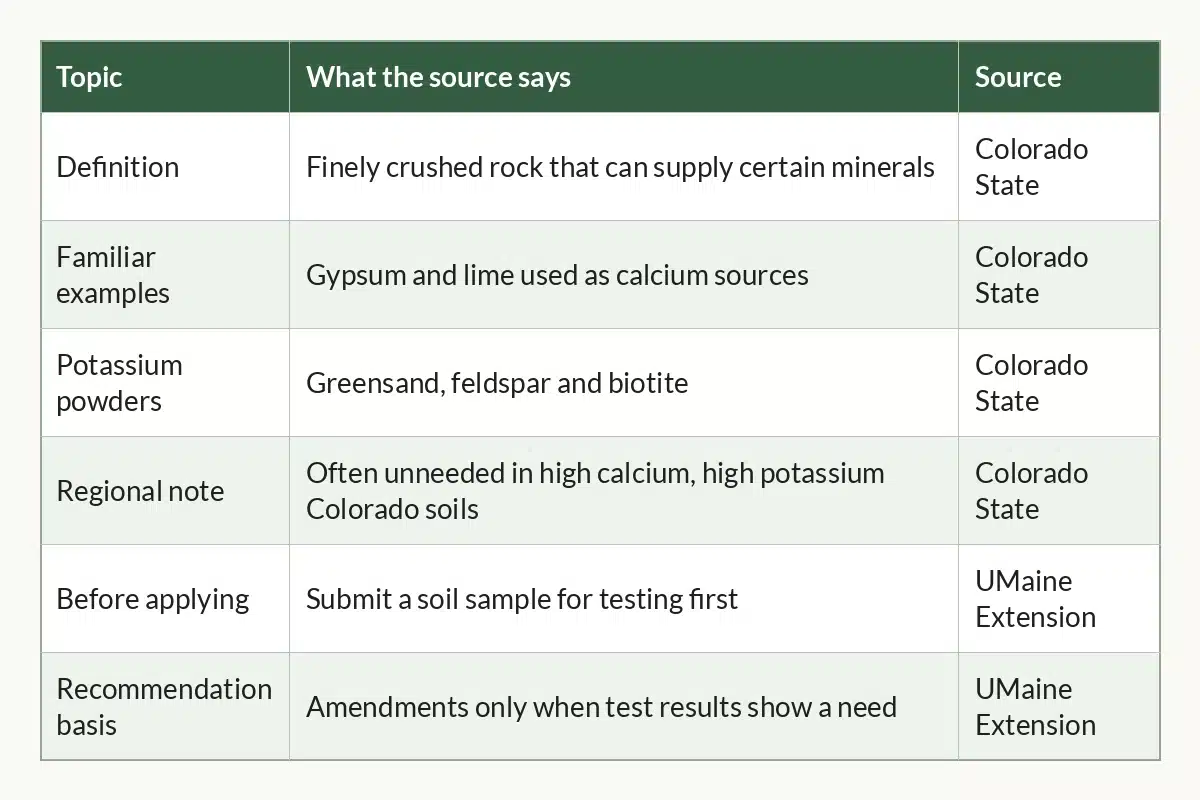
In its fact sheet on organic fertilizers, Colorado State University Extension groups rock dust and rock powders together and describes them as finely crushed rock that can supply the soil with certain minerals. It points out that gypsum and lime, both very familiar garden materials, are actually examples of rock dust used as calcium sources. It also lists several powders that serve as potassium sources, including greensand, feldspar and biotite.
The idea behind rock dust is that plants and microbes slowly weather the tiny particles, freeing elements such as potassium, calcium, magnesium and trace minerals over time. Fans of the practice often call it remineralizing the soil. The key word is slowly. Hard silicate stone does not dissolve quickly in a garden bed, so any benefit tends to arrive over seasons, not weeks.
Our page on amendments versus fertilizers explains the two roles in plain terms.
Does Rock Dust Help Cannabis Grow?
Whether it helps depends almost entirely on the soil you start with. Where a mineral is truly scarce, a slow source of it can help. Where soil already holds plenty, extra stone powder simply sits there.
Colorado State gives a regional example. In its view, most Colorado gardens can skip gypsum and lime because local soils tend to carry plenty of calcium already. Potassium rock powders are usually unnecessary there as well, since many Colorado soils carry abundant potassium. That advice is tied to Colorado, but the logic travels. Adding a mineral the soil already has in good supply does not make plants grow better.
A Colorado gardener raised the topic with Ask Extension, the national Cooperative Extension question service. The volunteer passed the question to a local soil expert, who said rock dust might help but that the gardener’s own habit of adding compost and leaf litter was a much better bet. The reply also mentioned cost and the equipment needed to spread fine powder evenly. The gardener added that rock dust may matter more in high rainfall areas where minerals leach away. That was the gardener’s view, not the expert reply.
Particle size also matters. A coarse grit weathers far more slowly than a flour fine powder, because less surface area meets water and roots. Bags rarely list particle size, so two products made from the same stone can behave quite differently once they are in the ground. Cannabis has no special need for rock dust beyond what other leafy crops have. It wants adequate potassium, calcium and magnesium along with nitrogen and phosphorus. If a soil test shows those are present, the plant will not notice an extra layer of powdered basalt.
If phosphorus is the gap, read about rock phosphate as a slow phosphorus source.
Rock Dust at a Glance
| Topic | What the source says | Source |
|---|---|---|
| Definition | Finely crushed rock that can supply certain minerals | Colorado State |
| Familiar examples | Gypsum and lime used as calcium sources | Colorado State |
| Potassium powders | Greensand, feldspar and biotite | Colorado State |
| Regional note | Often unneeded in high calcium, high potassium Colorado soils | Colorado State |
| Before applying | Submit a soil sample for testing first | UMaine Extension |
| Recommendation basis | Amendments only when test results show a need | UMaine Extension |
Why Test Your Soil Before Adding Rock Dust?
A gardener writing to University of Maine Cooperative Extension asked whether to add rock dust and how it compared with greensand. In its Ask the Expert answer on rock dust, the Maine team asked the gardener and a family member to send soil samples for testing first. It noted that greensand is a good potassium source but said it only recommends amendments based on soil test results.
That is solid advice for cannabis beds too. A standard soil test reports pH, organic matter and the main nutrients. Low potassium, calcium or magnesium readings give you a real reason to add a mineral source, and you can pick one that matches the shortage. If they come back adequate, rock dust adds cost and labor without a clear return. Our walkthrough on soil testing for cannabis covers how to take a sample and read the report.
Testing also guards against the wrong fix, and it saves money. A basic lab test usually costs less than a single large bag of specialty powder. A pale plant might look mineral starved when the real problem is pH, poor drainage or low nitrogen. Rock dust fixes none of those.
How Does Rock Dust Compare With Compost?
Compost and rock dust run on different clocks and do different jobs. Compost adds organic matter, feeds soil life and improves structure within a single season. Rock dust adds stone particles that break down over years and contribute little organic matter.
The Iowa State Yard and Garden team, in its table of organic fertilizers, lists granite meal as a potash source with about 4 percent total potash and a high silica content. That concentration is low next to true fertilizers, which means large amounts are needed for a meaningful effect.
Many organic growers already lean on compost based mixes, sometimes called super soil, and rock dust often appears in those recipes. Our recipe for making super soil for cannabis plants shows where mineral powders fit alongside compost and organic meals. Keep the rock dust share small and let compost serve as the foundation. In a living soil approach, rock dust is one minor ingredient rather than a main driver. Our post on living soil and cannabis explains how organic matter and soil biology carry most of that system.
How to Use Rock Dust on Cannabis
- Get a soil test. Confirm a mineral shortage before buying anything.
- Match the stone to the gap. Choose a powder that supplies the nutrient your test shows is low, such as a potassium rich type for low potassium.
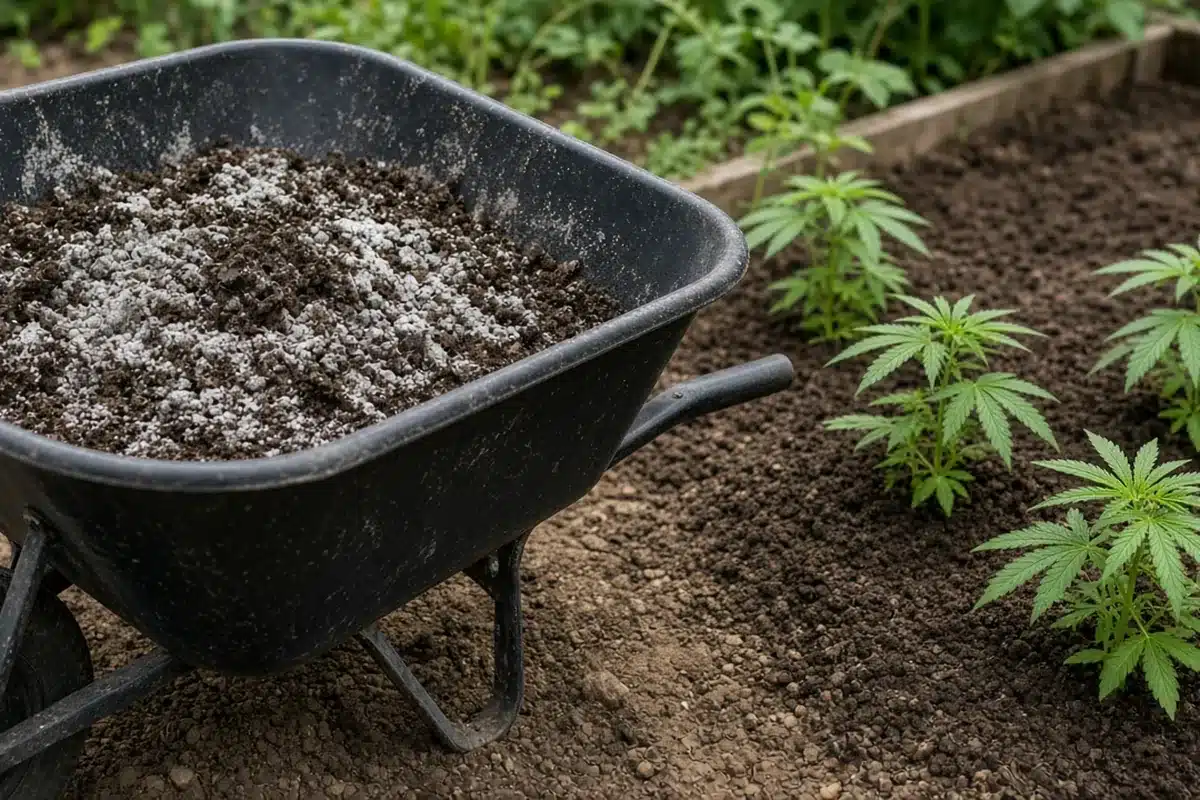
- Work on a calm day. Dampen the soil first so the powder settles in place.
- Use a modest amount. Follow the bag directions and lean toward the low end. More powder does not mean faster results.
- Blend it in. Mix the dust into the top few inches of soil or into compost before it goes into the bed.
- Add it ahead of time. Because release is slow, apply it in fall or several weeks before planting.
- Keep building organic matter. Compost and mulch feed the soil life that helps weather the stone.
- Retest every year or two. Track whether levels actually change before adding more.
Troubleshooting Rock Dust Problems
No visible change after a season. That is common. Stone weathers slowly, and a soil that was not short on minerals will show no response.
Soil pH crept upward. Some powders, especially those with lime or carbonate content, raise pH. Check the label and test pH before the next application.
Powder blows away or forms a crust. Apply to moist soil and work it in right away rather than leaving it on the surface.
Plants still look pale. Look at nitrogen, pH and watering first. Rock dust supplies little nitrogen.
The cost adds up. Large beds need a lot of powder for a small effect. Put the money toward compost unless a test shows a clear mineral need.
Sources
- Colorado State University Extension, Organic Fertilizers: https://extension.colostate.edu/resource/organic-fertilizers/
- University of Maine Cooperative Extension, Do you recommend adding rock dust to organic home gardens?: https://extension.umaine.edu/gardening/2020/05/19/adding-rock-dust-to-organic-home-gardens/
- Iowa State University Extension and Outreach, Selecting and Using Organic Fertilizers: https://yardandgarden.extension.iastate.edu/how-to/selecting-and-using-organic-fertilizers
- Ask Extension, Rock Dust?: https://ask.extension.org/kb/faq.php?id=609143
FAQ
Is rock dust a fertilizer?
Not in the usual sense. It supplies minerals slowly and in small amounts, and most types carry little or no nitrogen.
How long does rock dust take to work?
Often several seasons, since hard stone breaks down only gradually in soil.
Can I use rock dust in containers?
You can mix a small amount into potting soil, but container plants usually get their minerals from fertilizer and the mix itself.
Is greensand a type of rock dust?
Colorado State lists greensand among rock powders that serve as potassium sources.
Do I need rock dust for organic cannabis?
No. A soil test, compost and a balanced organic feed cover most needs.