Rock Phosphate for Cannabis: A Slow Phosphorus Source for Acidic Soil
Quick answer: Rock phosphate is finely ground phosphate ore that releases phosphorus very slowly. Iowa State horticulture staff list it at 0 3 0 with 32 percent total phosphate and 32 percent calcium. UNH Extension notes that only about 3 percent of its phosphorus is available right away and that release is slow, especially in high pH soil, so it serves as a phosphorus supply over several years. For cannabis, rock phosphate fits acidic outdoor beds that test low in phosphorus. In alkaline soil it barely moves, so a quicker phosphorus source is the better buy.
What Is Rock Phosphate?
Rock phosphate is mined from natural phosphate deposits and ground into a fine powder. Farmers have relied on it for phosphorus for a long time. UNH Extension lists it among organic fertilizers but notes that not every source is certified, so certified growers should check with their certifier.
Two forms appear on garden shelves. Hard rock phosphate is the mined ore itself. Soft rock phosphate, sometimes called colloidal phosphate, is a clay based byproduct from washing phosphate ore. A Central Coast Master Gardener fertilizer table describes soft rock phosphate as 0 3 0 with about 18 percent calcium, with 3 percent of the phosphorus available at once and the rest released over three to five years.
Both forms behave the same way underground. Most of their phosphorus is locked in a mineral that dissolves only slowly in soil water.
Our explainer on how a soil amendment differs from a fertilizer shows where slow minerals like this one fit.
How Much Phosphorus Does Rock Phosphate Contain?
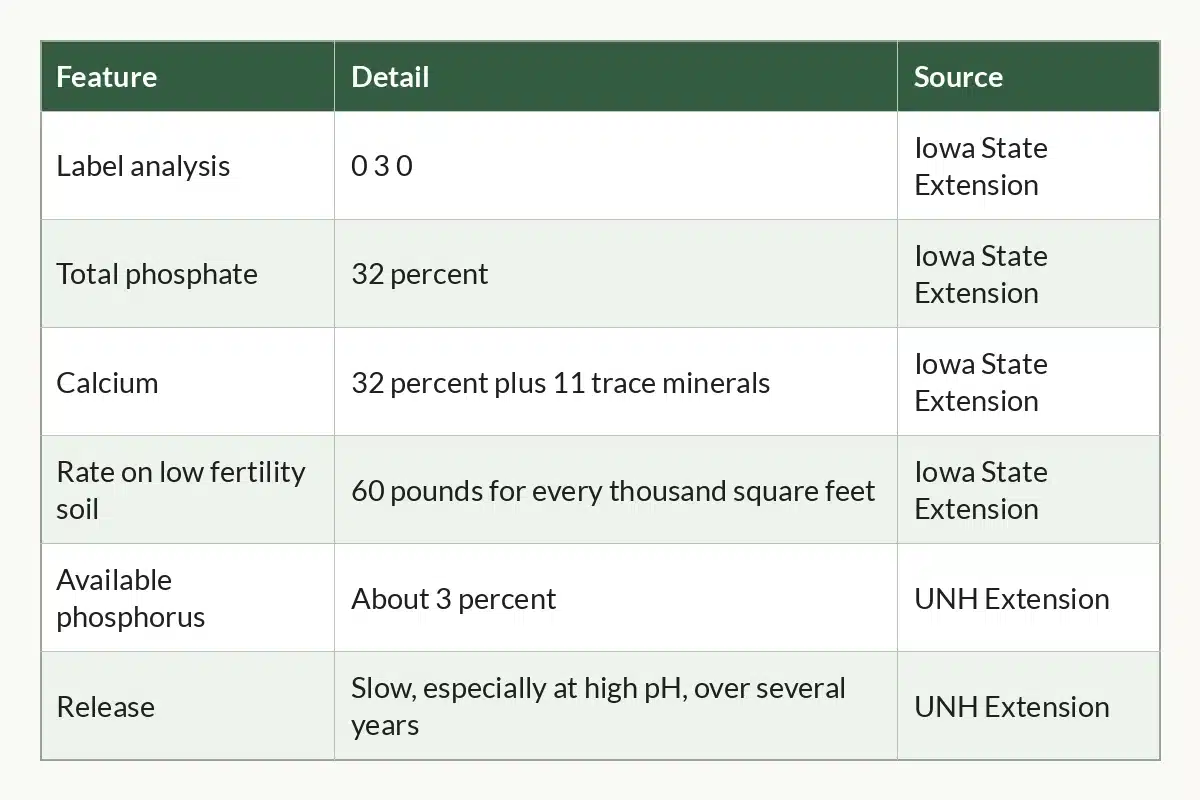
The label numbers look low, yet the total content is high. Iowa State, in a yard guide to organic fertilizers, lists rock phosphate at 0 3 0 while noting 32 percent total phosphate and 32 percent calcium plus 11 trace minerals.
The gap between 3 and 32 is the key. The middle number on a fertilizer label reports available phosphate. The total includes phosphorus that becomes available only as the mineral breaks down over years.
The New Hampshire organic fertilizer table puts total phosphorus somewhere between 20 and 30 percent, with about 3 percent available. It rates release as slow and lists the best use as a long term phosphorus supply lasting several years.
Phosphorus supports root growth and flower formation in cannabis. Our article on the role of phosphorus in cannabis covers how demand rises in bloom.
Rock Phosphate at a Glance
| Feature | Detail | Source |
|---|---|---|
| Label analysis | 0 3 0 | Iowa State Extension |
| Total phosphate | 32 percent | Iowa State Extension |
| Calcium | 32 percent plus 11 trace minerals | Iowa State Extension |
| Rate on low fertility soil | 60 pounds for every thousand square feet | Iowa State Extension |
| Available phosphorus | About 3 percent | UNH Extension |
| Release | Slow, especially at high pH, over several years | UNH Extension |
Why Does Soil pH Matter So Much?
Put plainly, rock phosphate releases slowly and works best in acidic soil, which is what its Extension sources state. The mineral dissolves through contact with acid in the soil. In acidic soil, that reaction runs steadily and phosphorus becomes available over time. In neutral and alkaline soil, it nearly stops.
CSU Extension states this bluntly on its organic fertilizer resource page. Its research found that rock phosphorus, whatever the grind size, is not available to plants unless soil pH is below 7.0. For that reason Colorado State advises most gardeners in that state to use plant or animal sources of phosphorus instead. UNH also notes that release slows especially at high pH.
This makes rock phosphate a regional product. Rock phosphate can build phosphorus over several seasons in the acidic soils common in the Southeast, the Northeast and the Pacific Northwest. Across the arid West and on limestone soils, it may sit nearly inert.
Before buying, test your soil. Our cannabis soil testing guide walks through reading pH and phosphorus results.
Is Rock Phosphate Fast Enough for Cannabis?
Not if you need results this season. A cannabis season runs only a few months, while rock phosphate releases most of its phosphorus over several years.
The Maine soil testing service adjusts its organic recommendations for this. Its organic nutrient sheet multiplies rock phosphate rates by four to account for slow release when the goal is correcting a deficiency in the first season. It also advises cutting back after several years of use.
In an outdoor cannabis bed you plant every year, that slow build becomes an advantage. Each application adds to a reserve that later crops draw on. For containers that are replaced every grow, much of the phosphorus never gets used.
If plants already show signs of low phosphorus, rock phosphate will not help in time. Our guide to phosphorus deficiency in cannabis covers faster options.
How Does Rock Phosphate Compare With Bone Meal?
Bone meal is the other common organic phosphorus source, and the comparison helps explain when each makes sense. Iowa State lists steamed bone meal at 1 11 0 with 20 percent total phosphate and 24 percent calcium. Rock phosphate carries more total phosphate, at 32 percent, but far less of it shows up as available on the label.
The Maine nutrient sheet shows the practical effect. It lists bone meal as a 15 percent phosphate source with no adjustment, while rock phosphate gets its rate multiplied by four because it releases so slowly. You need much more rock phosphate to get the same first season result.
Bone meal has a pH limit of its own. Colorado State reports that in its research, bone meal phosphorus became available to plants only in soil below pH 7. Rock phosphate wins on longevity in acidic ground, where one application can keep feeding for years.
Many organic cannabis growers use both. Bone meal covers the current season, while a modest dose of rock phosphate builds a reserve in beds that will be planted again. Fish meal is a third option on the Maine sheet, adding 6 percent phosphate alongside 9 percent nitrogen.
For potassium on a similarly slow schedule, look at greensand, another slow mineral.
How Much Rock Phosphate Should You Use?
For a low fertility soil, Iowa State suggests 60 pounds over an area of a thousand square feet, dropping to 25 for medium fertility and 10 where levels are already adequate. A small bed of a hundred square feet would get 6, 2.5 or 1 pound. Iowa State ties these rates to a soil test.
UC Master Gardeners in the Sierra foothills list rock phosphate alongside bone meal and superphosphate as options for soils low in phosphorus, in their guide to improving soil in fall and winter. Fall application gives acidic soil time to start the slow release before spring planting. Working it in during fall bed cleanup also saves a step later, so the bed is ready for planting as soon as the soil warms.
If your test shows adequate phosphorus, skip it. Colorado State notes that gardens receiving yearly compost or manure often already have enough.
How to Apply Rock Phosphate to Cannabis Beds
- Test pH and phosphorus. Use rock phosphate only where pH is below 7 and phosphorus tests low.
- Choose a fine grind. Finer powder offers more surface for the slow reaction.
- Measure by the soil test. Use Iowa State fertility rates as a starting range.
- Apply in fall when possible. This gives the mineral months to begin releasing.
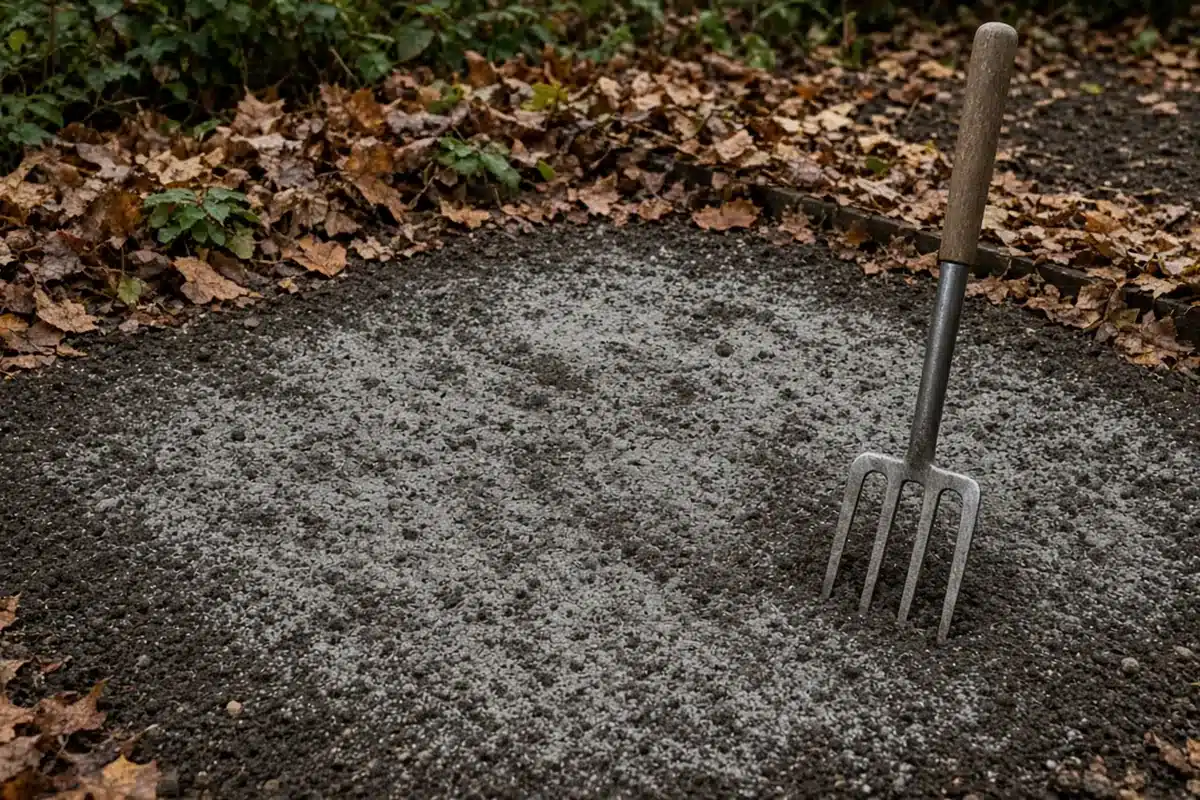
- Mix it through the bed. Blend it evenly into the soil rather than leaving it on top.
- Add compost. Organic matter and soil life help the release along.
- Retest every few years. Avoid building phosphorus far beyond what crops need.
Troubleshooting Rock Phosphate Problems
No response after a season. The soil pH may be too high. Retest, then choose a phosphorus source that still works at that pH.
Purple stems and dark leaves early. Plants may need phosphorus now. Use a faster source while the rock phosphate builds.
Dust when spreading. Fine powder blows easily. Apply on a calm day.
Phosphorus test very high. Repeated applications add up. Stop adding phosphorus for several seasons.
Soil pH creeping up. The calcium content may be nudging pH. Monitor and adjust with a soil test.
Sources
- Iowa State University Extension and Outreach, Selecting and Using Organic Fertilizers: https://yardandgarden.extension.iastate.edu/how-to/selecting-and-using-organic-fertilizers
- University of New Hampshire Extension, Organic and Natural Fertilizers for the Home Ground and Garden: https://extension.unh.edu/sites/default/files/migrated_unmanaged_files/Resource003737_Rep5330.pdf
- Colorado State University Extension, Organic Fertilizers: https://extension.colostate.edu/resource/organic-fertilizers/
- UC Master Gardeners of San Luis Obispo County, Fertilizers and Amendments: https://ucanr.edu/site/uc-master-gardeners-san-luis-obispo-county/fertilizers-and-amendments
- University of Maine, Maine Soil Testing Service, Commercial Organic Nutrient Recommendations: https://umaine.edu/soiltestinglab/wp-content/uploads/sites/227/2016/07/ORGNUT.pdf
- University of California Master Gardeners, How to Improve Your Soil in Fall and Winter: https://ucanr.edu/sites/default/files/2023-12/391635.pdf
FAQ
Does rock phosphate work for cannabis?
It can, given acidic soil and several seasons. In alkaline soil it releases very little phosphorus.
How do hard and soft rock phosphate differ?
Soft rock phosphate, also called colloidal phosphate, is a clay based form. Both release phosphorus slowly.
How long does rock phosphate last?
Sources describe release over several years, with UC Master Gardeners citing three to five years.
Can I use rock phosphate in pots?
Not well. Most of its phosphorus comes out after the grow ends, so a potted plant sees little of it.
When should I apply rock phosphate?
Fall is ideal, after a soil test confirms low phosphorus and a pH below 7.