
Watering a Garden With a Sprinkler: A Cannabis Guide
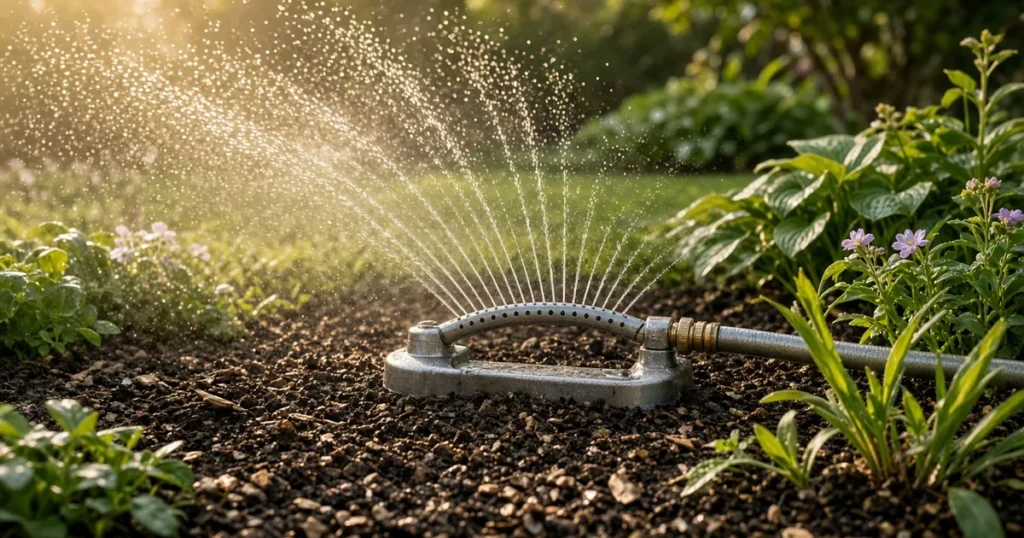
A portable sprinkler is one of the easiest ways to water a large outdoor cannabis garden. Iowa State University Extension and Outreach calls the portable sprinkler a common watering tool for gardens and lawns, and notes that sprinklers can water vegetable gardens as well as lawns, perennial beds, trees and shrubs. Clemson Cooperative Extension says overhead sprinklers offer a wide range of watering patterns and coverage areas, and that they are convenient but not very water efficient. Here you will learn the main types of sprinklers, how to measure their output with cans, how to overlap coverage, why morning watering matters and how to cut losses to wind and evaporation.
Pros and cons of overhead watering
Iowa State Extension gives the main trade-offs:
- Cost and convenience. Portable sprinklers are inexpensive and easy to find.
- Wide coverage. Used properly, they do a good job of watering wide areas.
- Whole-area wetting. Iowa State says sprinklers wet entire areas efficiently, which can help on lawns but can be a disadvantage in a vegetable garden.
- Weeds. Because they wet the whole area, they water the soil between plants, which promotes weed growth.
- Evaporation. Sprinklers usually spray water high into the air, and any water that evaporates is not available to plants.
- Disease. Sprinklers wet the foliage, which can encourage more disease problems, something Iowa State says is particularly important in vegetable gardens.
Clemson Extension adds that a considerable amount of water can be lost to evaporation on hot, windy days, especially when droplets are small. It notes that drip or trickle irrigation is the best method for conserving water in a vegetable garden. If water use is your main concern, the post on drip irrigation for cannabis walks through that option.
Types of sprinklers
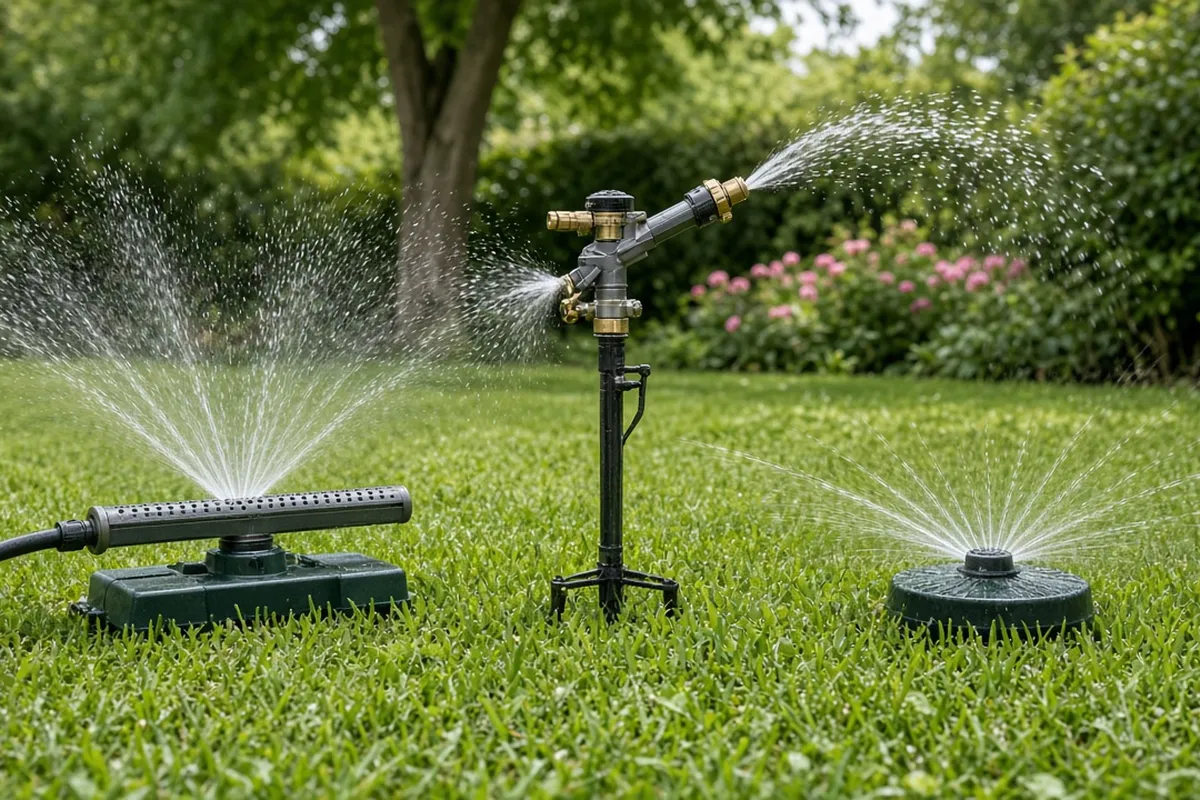
Iowa State Extension says each type of sprinkler produces its own spray pattern. Here are the main types it describes.
Oscillating sprinklers:
- The most commonly used portable sprinkler.
- A horizontal tube with several outlets turns slowly back and forth, watering a rectangular area.
- Suited to medium-sized areas, and many models have an adjustable pattern.
- Iowa State notes they tend to put more water at the outer edge of the pattern than near the center.
Clemson Extension adds that oscillating sprinklers apply water more evenly than other overhead sprinklers and can be easily adjusted to cover square or rectangular areas.
Impulse sprinklers:
- Send out a stream of water that strikes a pin or hammer, breaking it into droplets and turning the head in a full or partial circle.
- Often set on stands so low plants do not block the spray and the sprinkler can cover a wider area.
- Iowa State notes they often put more water near the center than at the outer edge, and that the water comes out with considerable force.
Fixed sprinklers:
- Sometimes called spot sprinklers, they water small areas and do not move while running.
- Many have several heads, with patterns such as a circle, semicircle, square or rectangle.
Sprinkler hoses:
- A plastic hose that sprays water from tiny holes along its length.
- Iowa State says they can help water irregular areas, but their water distribution can be hard to predict.
- Turned upside down with the holes facing the ground and run slowly, Iowa State says they can be used much like a soaker hose.
Iowa State also mentions traveling sprinklers, which follow a cord along a path, but notes they are generally used to water lawns.
Measure output with cans
Every sprinkler waters unevenly. Iowa State Extension says that regardless of the type, the spray pattern and distribution of water will vary, so it is best to test your sprinkler to learn the size of its pattern and how much water it puts out. Clemson Extension notes that many sprinklers deposit less water the farther you get from the sprinkler.
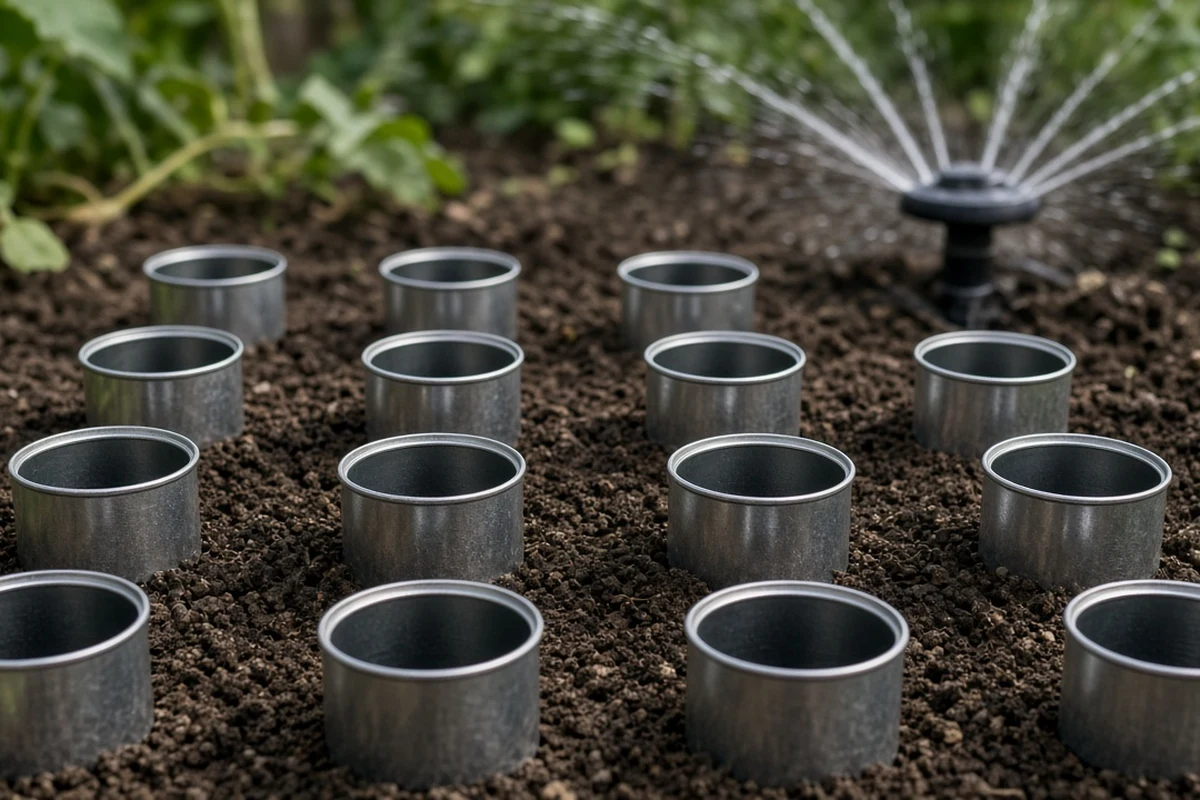
Iowa State describes a simple can test:
- Place several small, straight-sided cans on the ground within the spray pattern.
- Attach the sprinkler to the same length and size of hose you will use when watering.
- Turn the sprinkler on at the pressure you would normally use.
- After a set amount of time, measure the water in each can.
Iowa State says this gives you a good idea of how much water falls in different parts of the pattern. Expect the amounts to vary considerably from can to can.
How much water is enough? Iowa State Extension says that a vegetable garden typically needs about one inch of water per week, from rain or irrigation, and suggests a rain gauge to track rainfall. If rain provides at least an inch in a week, extra watering is not needed. The can test tells you how long your sprinkler takes to put down that inch. Iowa State adds that soil type, root depth, air temperature, humidity and plant age all influence watering schedules. Tracking rainfall is explained in rain gauges for cannabis gardens.
Overlap the coverage
Because a single sprinkler waters unevenly, both sources recommend overlapping. Iowa State Extension says that while the amounts in the cans may vary considerably, uniform water amounts can be achieved by overlapping the spray patterns.
Clemson Extension explains that the sprinkler needs to be placed at staggered locations to give adequate overlap. It also warns that this usually results in applying more water than plants need.
A few more placement tips from Iowa State:
- Remember that tall plants can block or change the spray pattern.
- Aim the sprinkler so it does not wet sidewalks or driveways, where the water simply runs off.
Water in the morning
Timing is one of the easiest ways to reduce problems. Iowa State Extension says to water in the morning so wet foliage can dry quickly in the morning sun. It adds that morning watering makes sure the plant is fully hydrated as it heads into the hottest part of the day.
Clemson Extension agrees that wetting foliage with a sprinkler may increase disease problems, but says watering in early morning should reduce the chances of disease outbreaks. Timing is explained further in Kind Seed Co’s post on the best time to water outdoor cannabis.
Cut losses to wind and evaporation
Water that blows away or evaporates never reaches the roots. Iowa State also notes in its drip irrigation guide that hand watering and sprinklers often deliver water faster than some soils can absorb, which leads to runoff. Clemson Extension says a considerable amount of water is lost to evaporation on hot, windy days, especially with small droplets.
Iowa State Extension offers two fixes:
- If evaporation is a concern, avoid sprinklers that spray a lot of water high into the air. Use ones that keep water lower to the ground.
- Water during the cooler part of the day to limit evaporation.
Iowa State also suggests a simple habit. Set an alarm or timer on your phone so you remember to turn off the sprinkler, or use a water timer to avoid running water unnecessarily. Timers get their own post in hose timers for cannabis gardens.
When water matters most
According to Clemson Extension, gardeners should know the periods when plants most need enough water. It says the first few weeks after planting and transplanting, and the stage when fruit or storage organs develop, are times when plants may be harmed by water shortages.
Troubleshooting
Some plants look dry while others are soaked. The pattern is uneven. Iowa State says oscillating sprinklers tend to put more water at the edges and impulse sprinklers more near the center. Run the can test and overlap the patterns.
The driveway or path gets wet. Re-aim the sprinkler. Iowa State says to orient it so it does not wet sidewalks or driveways.
Leaf disease shows up after you start using a sprinkler. Wet foliage may be the cause. Iowa State and Clemson both recommend watering in the morning so leaves dry quickly.
Little water seems to reach the soil on windy days. Evaporation and drift are likely. Clemson says much water is lost on hot, windy days, and Iowa State suggests sprinklers that keep water low.
Tall plants block the spray. Iowa State notes tall vegetation can disrupt the spray pattern. Move or raise the sprinkler and test again.
Sources
- Iowa State University Extension and Outreach, Yard and Garden. Using sprinklers in the landscape and garden. https://yardandgarden.extension.iastate.edu/how-to/using-sprinklers-landscape-and-garden
- Clemson Cooperative Extension, Home and Garden Information Center. Watering the vegetable garden (HGIC 1260). https://hgic.clemson.edu/factsheet/watering-the-vegetable-garden/
- Iowa State University Extension and Outreach, Yard and Garden. Using drip irrigation in the garden. https://yardandgarden.extension.iastate.edu/how-to/using-drip-irrigation-garden
FAQ
Is it okay to water a garden with a sprinkler?
Yes, with care. Iowa State University Extension says portable sprinklers are inexpensive and water wide areas well when used properly. They do wet foliage and the soil between plants, which can encourage disease and weeds, and Clemson Extension notes they are convenient but not very water efficient.
What is the best time to water with a sprinkler?
Morning. Iowa State Extension says morning watering lets wet foliage dry quickly in the sun and keeps plants fully hydrated going into the hottest part of the day. Clemson Extension says early morning watering should reduce the chances of disease outbreaks from wet leaves.
How do I know how much water my sprinkler puts out?
Do a can test. Iowa State Extension says to set several small, straight-sided cans in the spray pattern, run the sprinkler on its usual hose and pressure for a set time, then measure the water in each can. Expect amounts to vary, and overlap the patterns to even them out.
Which sprinkler type waters most evenly?
Clemson Extension says oscillating sprinklers apply water more evenly than other overhead sprinklers and adjust easily to square or rectangular areas. Iowa State Extension notes that oscillating sprinklers still put more water at the edges and impulse sprinklers more near the center, so test and overlap either type.


