
Yellow Nutsedge in Cannabis Gardens: Tubers, Digging and Drainage
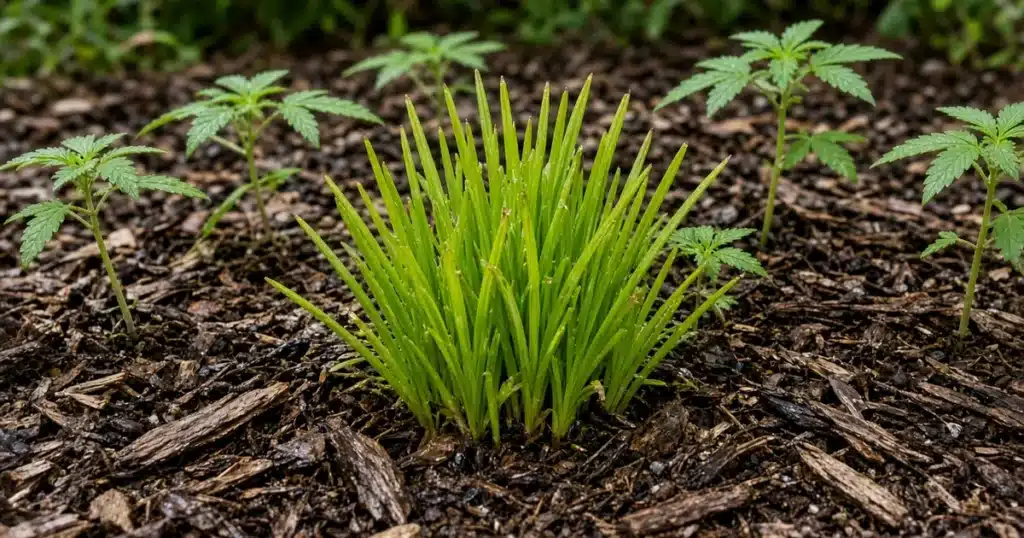
Quick answer: Yellow nutsedge is a grasslike perennial sedge with triangular stems that spreads mainly by small underground tubers. UC IPM and Clemson University Extension say it thrives in wet soil, and Iowa State University Extension ties it to wet years. It is hard to get rid of once established. The keys are pulling or digging young plants before they reach 5 to 6 leaves, digging out whole plants with their tubers, fixing poor drainage and overwatering and keeping tubers out of new soil.
What Is Yellow Nutsedge?
It is a sedge, not a grass. The UC nutsedge guide explains that nutsedges are often called nutgrass because they resemble grass, but they are sedges, a separate plant family. Iowa State describes yellow nutsedge as a warm season perennial that is neither a grass nor a broadleaf weed.
The common name comes from the tubers. The UC nutsedge guide notes that the small tubers are often wrongly called nuts or nutlets. Clemson says the yellow species is found over a wider area than the purple one because it tolerates cold better, though the two often grow together.
How Can You Tell Nutsedge From Grass?
Roll the stem between your fingers. The UC nutsedge guide says nutsedge stems are solid with three sides when cut, whereas a grass stem is round and hollow. Iowa State agrees that the stem near ground level is triangular.
What else to check:
- Leaves arranged in sets of three at the base, unlike the paired leaves of grasses
- Thick, stiff leaves that look creased with a strong midvein, as Clemson describes
- Light green to yellowish green color with a shiny surface, according to Iowa State
- A yellowish seedhead, which Clemson contrasts with the purple seedhead of purple nutsedge
- A long, tapered leaf tip, while purple nutsedge leaves end bluntly
Clemson adds that mature yellow nutsedge stands 12 to 16 inches tall.
How Does Yellow Nutsedge Spread?
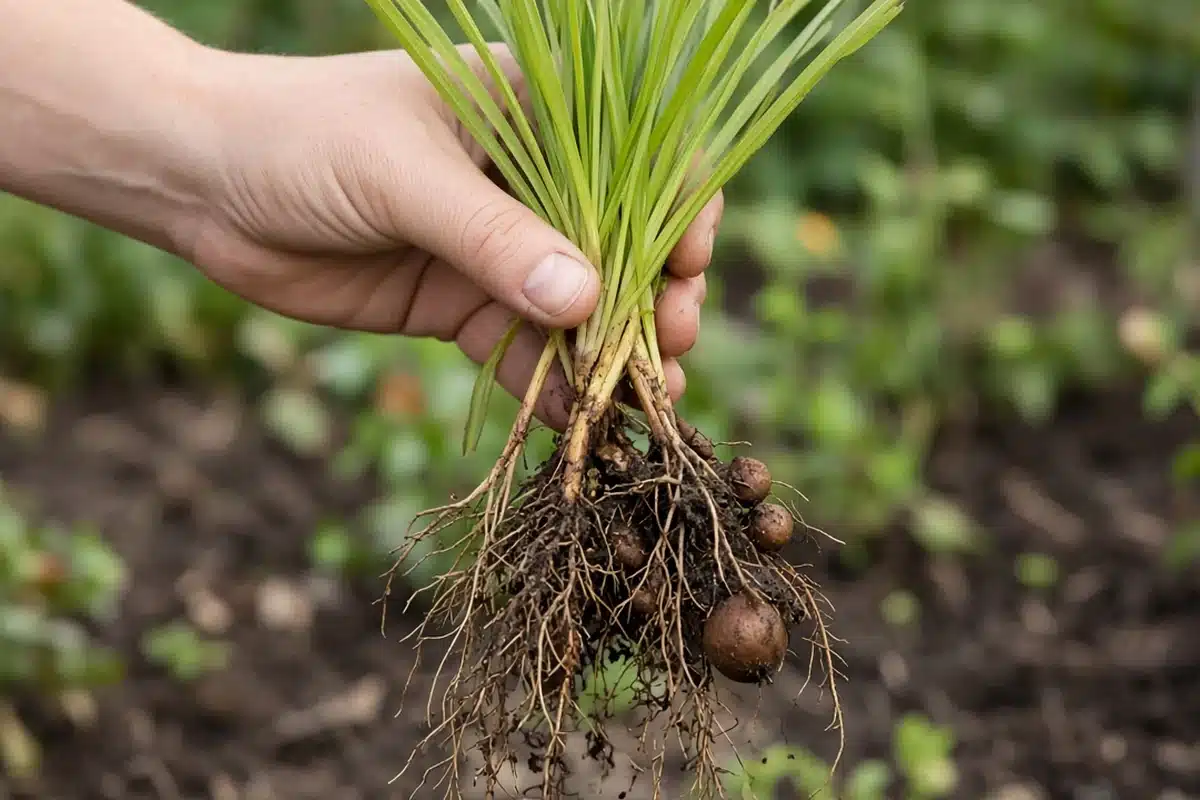
Mostly through tubers, with rhizomes and seed adding to it. The UC nutsedge guide says nutsedge forms tubers on underground stems that reach 8 to 14 inches deep. Buds on the tubers sprout into new plants, and patches can grow to 10 feet or more across. Clemson says new tubers start forming 4 to 6 weeks after a shoot comes up.
The UC nutsedge guide describes yellow nutsedge tubers as round, smooth and brown or black, up to 7/16 inch wide, with one tuber at the end of each underground stem. Most tubers lie within 6 inches of the surface and live 1 to 3 years. That guide also says yellow nutsedge seeds have very low viability, so tubers drive most of the spread.
Why Does Nutsedge Show Up in Wet Spots?
It thrives in waterlogged soil. The UC nutsedge guide and Clemson both say a nutsedge patch often signals poor drainage, watering too often or leaky sprinklers. Iowa State notes that it is especially common in wet years and in poorly drained soil.
Once established, though, the UC nutsedge guide and Clemson both warn that it tolerates normal watering and even drought. Fixing drainage helps prevent new patches but will not clear an old one by itself. Our guide to a soil drainage test for cannabis beds shows how to check a bed.
How to Control Yellow Nutsedge in Cannabis Beds
- Pull young plants early. The UC nutsedge guide says to remove small plants while they still have fewer than 5 or 6 leaves, which in summer means about every 2 to 3 weeks. Until then, the plant has not formed new tubers.
- Pull small plants, dig out established ones. The UC nutsedge guide says small plants can be pulled by hand, but older plants should be dug out so the tubers come with them. Iowa State adds that pulled mature plants leave tubers that sprout again in a few weeks.
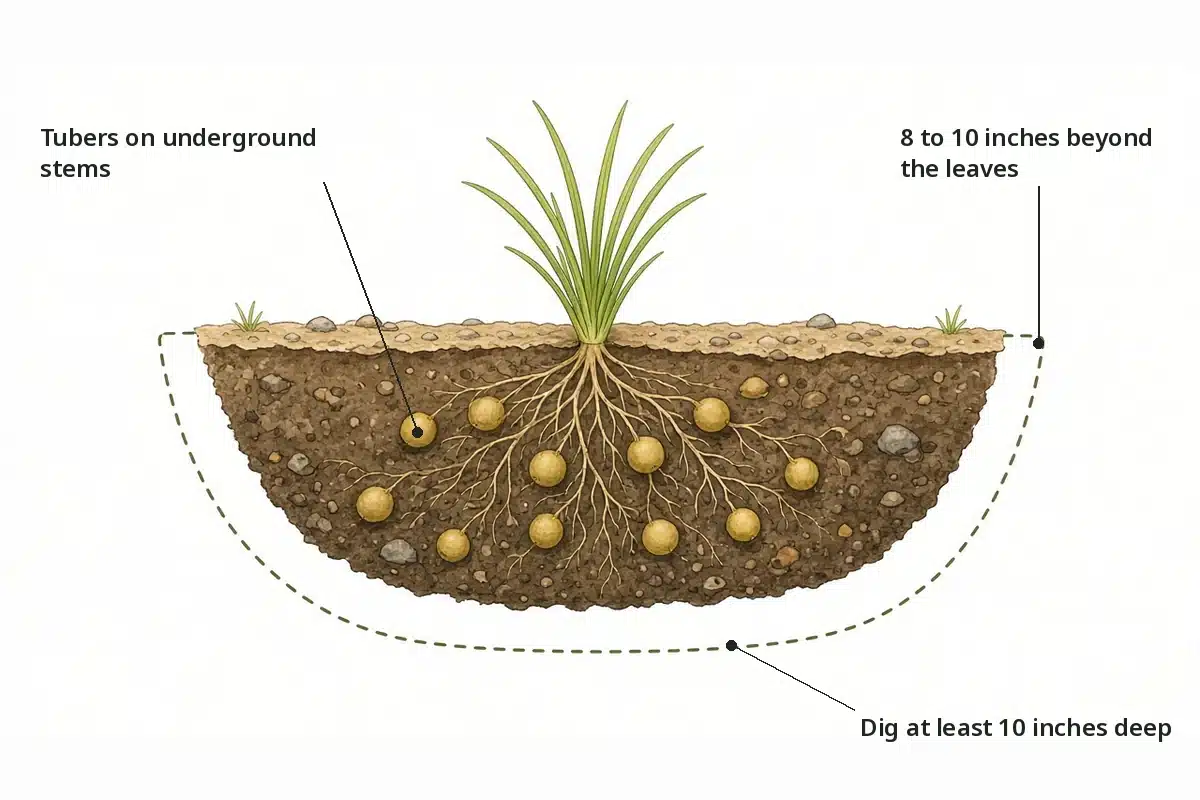
- Go deep enough. The UC nutsedge guide advises digging 8 to 14 inches deep when hoeing out whole plants.
- Dig wide around small patches. Clemson advises digging at least 10 inches deep and 8 to 10 inches beyond the leafy part of the plant, ideally in early spring.
- Keep removing new shoots. The UC nutsedge guide explains that each removal forces the tuber to spend its reserves, though a mature tuber can send up new shoots more than three times.
- Do not till mature patches. The UC nutsedge guide warns that tilling mature plants spreads tubers through the soil.
- Fix drainage and watering. The UC nutsedge guide and Clemson both point to wet soil as the main driver.
- Clean tools and check new soil. Clemson says tubers spread on tillers and tools and arrive in topsoil and nursery stock. See our guide to buying topsoil for cannabis beds.
Why Does Repeated Pulling Work?
Each new shoot drains the tuber. The UC nutsedge guide explains that a tuber spends about 60 percent of its stored energy on the first plant and about 20 percent on the second. Removing shoots over and over forces it to keep drawing on those reserves instead of making new tubers.
The UC nutsedge guide cautions that older tubers can sprout again three or more times, and that later sprouts, while weaker, can still grow into plants that make tubers. Iowa State says patience and persistence are needed. Plan on checking beds every couple of weeks through the warm season.
Yellow vs Purple Nutsedge
| Feature | Yellow nutsedge | Purple nutsedge |
|---|---|---|
| Leaf tip | Long and tapered | Blunt point |
| Seedhead | Yellow | Purple |
| Tubers | Single at rhizome tips | In chains on rhizomes |
| Height when mature | 12 to 16 inches | Usually under 6 inches |
| Leaf color | Light green | Darker green |
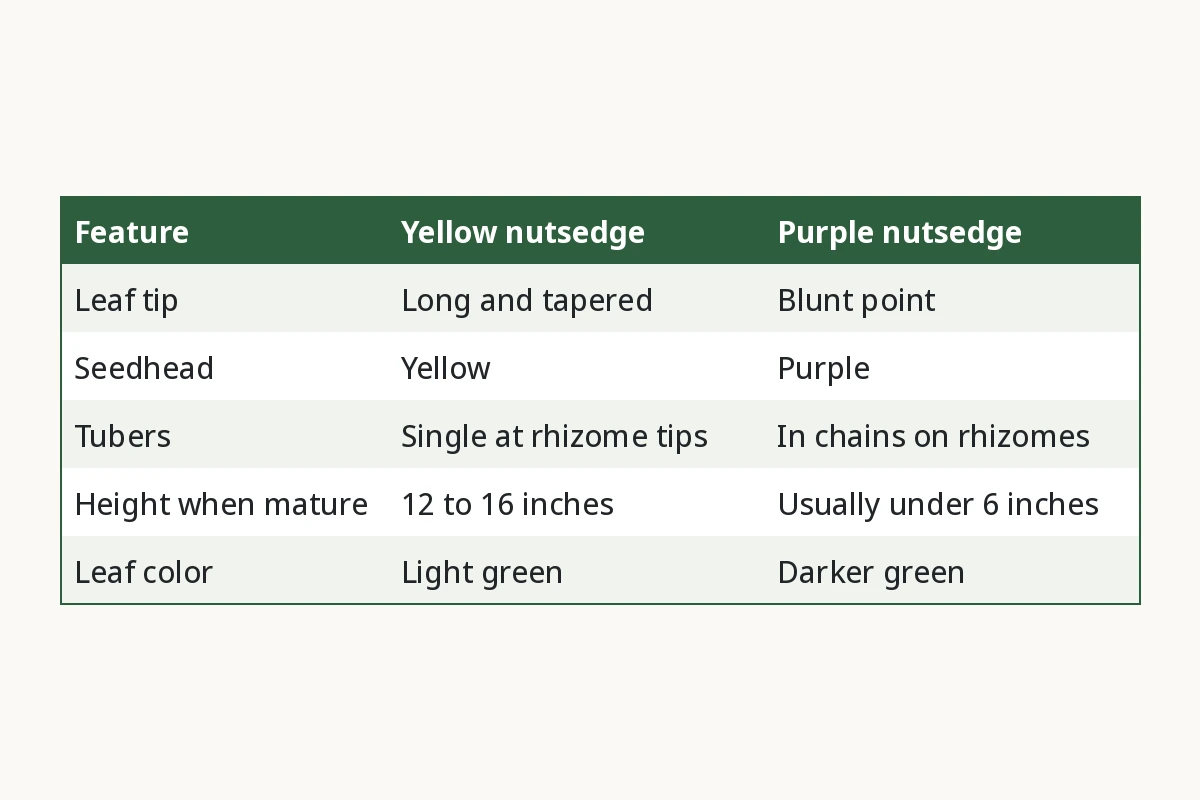
The table follows Clemson’s identification chart. The UC nutsedge guide adds that purple nutsedge tubers taste bitter, while yellow nutsedge tubers have a pleasant almond taste.
Does Mulch Stop Nutsedge?
Only certain kinds. The UC nutsedge guide says black or clear plastic mulch does not control nutsedge because the sharp leaf tips poke through it. It notes that landscape fabrics made from polypropylene can suppress nutsedge and also let air and water pass.
The UC nutsedge guide suggests a thick, nonwoven fabric covered with bark or gravel where the planting allows, but says you will still need to pull any shoots that emerge. It also notes that nutsedge pushes up through many kinds of mulch in vegetable and flower beds. Our cannabis mulch overview covers top layers.
Does Shade or Drying Help?
Shade helps, drying does not for this species. The UC nutsedge guide says nutsedge grows poorly in shade, so tall, dense plantings can reduce it, while low ground covers do not cast enough shade. It describes drying tubers in summer by tilling and withholding water but says that method works for purple nutsedge, not yellow.
When Does Yellow Nutsedge Come Up?
In spring, once soil warms. The UC nutsedge guide says tubers sprout when soil stays above 43 degrees F for yellow nutsedge, compared with 59 degrees F for purple nutsedge. Clemson notes that yellow nutsedge emerges earlier than purple. Iowa State adds that it grows fastest in warm summer months. Leaves die back in fall, but tubers survive in the soil.
Troubleshooting Nutsedge Problems
Pulled plants came back within weeks. Iowa State says pulling leaves tubers behind. Dig with a trowel and remove the tubers.
The patch got bigger after tilling. The UC nutsedge guide warns that tilling mature plants spreads tubers. Switch to digging.
Nutsedge pokes through black plastic. The UC nutsedge guide says the sharp tips pierce plastic. Use a polypropylene landscape fabric instead.
It keeps returning in one low spot. The UC nutsedge guide and Clemson link nutsedge to wet soil. Fix drainage and check for leaks.
You are not sure it is nutsedge. The UC nutsedge guide names tall flatsedge and green kyllinga as similar looking plants that lack tubers. Check the stem and dig for tubers.
Sources
- UC Statewide IPM Program, University of California, Pest Notes: Nutsedge: https://ipm.ucanr.edu/home-and-landscape/nutsedge/pest-notes/
- Clemson Cooperative Extension, Home and Garden Information Center, Nutsedge (HGIC 2312): https://hgic.clemson.edu/factsheet/nutsedge/
- Iowa State University Extension and Outreach, How Do I Control Yellow Nutsedge in My Lawn and Garden?: https://yardandgarden.extension.iastate.edu/faq/how-do-i-control-yellow-nutsedge-my-lawn-and-garden
FAQ
Is nutsedge a grass?
No. The UC nutsedge guide, Clemson and Iowa State all say it is a sedge.
How deep do nutsedge tubers go?
The underground stems reach 8 to 14 inches deep, per the UC nutsedge guide and Clemson, though most tubers are in the top 6 inches.
How long do tubers last in soil?
1 to 3 years, the UC nutsedge guide says.
When should I start pulling?
As soon as shoots appear. The UC nutsedge guide says to remove plants before 5 to 6 leaves.
Does yellow nutsedge spread by seed?
Very little. The UC nutsedge guide says its seeds have very low viability.


