Insect Frass for Cannabis: What Growers Should Know
Quick answer: Insect frass is the mix of manure, shed skins and leftover feed that remains after insects are raised, most often black soldier fly larvae. Researchers at the University of Arkansas found that frass worked about as well as poultry litter in soybean and switchgrass field trials, even at lower rates. Purdue Extension describes the similar material from home larvae bins as a soil amendment that adds organic matter and some nutrients but does not replace fertilizer. For cannabis, frass fits best as a light top dressing or a small share of a potting mix, alongside a regular feeding plan.
What Is Insect Frass?
Frass is the word for insect droppings, but the commercial product contains more than that. According to the Arkansas Agricultural Experiment Station report on frass, frass includes manure as well as molted skins and any food the insects left behind. Insect farms raise larvae for poultry feed, fish feed and pet food, and frass piles up quickly. The Arkansas lead author noted that each pound of insect meal can come with up to four times as much frass.
Black soldier fly larvae are the main source. They will eat a wide range of food scraps and farm byproducts, which is a big reason the industry is growing fast. Most commercial frass is dried and heat processed to reduce microbe loads before it is bagged. The Arkansas researchers used frass that had received this heat step.
The product looks like a fine, dark, slightly gritty powder, a bit like dry coffee grounds. It has a mild earthy smell when dry and a stronger one when wet. Home growers can make a version too. Purdue University Extension Entomology publishes a black soldier fly composting guide, and it calls the leftover material digestate. That residue is the backyard cousin of commercial frass.
Is Insect Frass a Fertilizer or a Soil Amendment?
Mostly an amendment. The Arkansas article draws the line clearly. Fertilizers feed plants directly with concentrated nutrients, while amendments condition the soil and improve its physical properties. A few organic materials land somewhere in between.
Gerson Drescher, a soil fertility professor on the Arkansas team, explained that organic sources like frass usually carry nutrient levels too low to count as fertilizer. They do bring more organic carbon, which supports soil structure and microbial activity. The Frass Institute, a nonprofit linked to the North American insect farming industry, also classifies frass as a soil amendment.
Purdue reaches the same conclusion for home digestate. The guide says the material is high in organic matter and can help soil hold water. It contains nitrogen, phosphorus and potassium, yet it does not replace fertilizers. Purdue encourages growers to test what their bins produce before using it, since quality varies.
For cannabis, that means frass is not a complete feed. It can enrich a mix and give microbes something to work with, but plants in flower still need a reliable source of potassium and phosphorus. Some growers steep frass in water along with compost for a mild brew. Our walkthrough on compost tea for cannabis describes how those brews are made and what they can realistically supply.
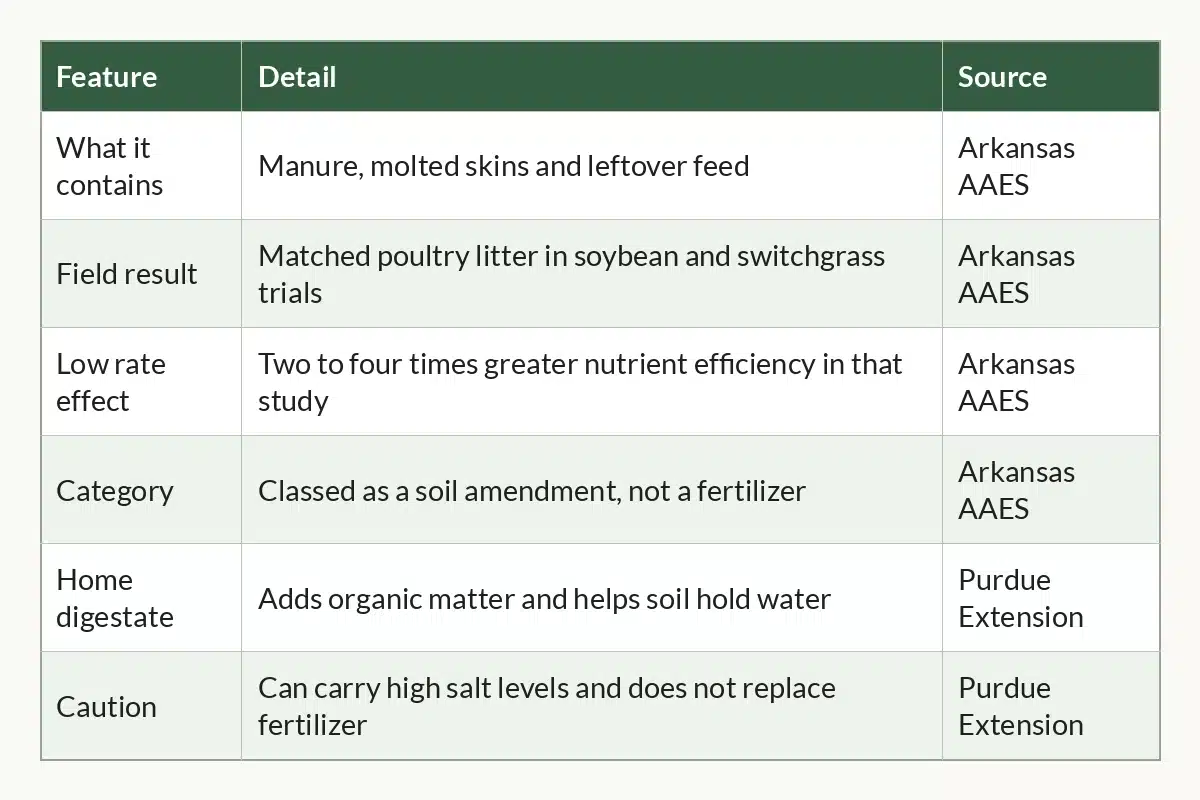
Insect Frass at a Glance
| Feature | Detail | Source |
|---|---|---|
| What it contains | Manure, molted skins and leftover feed | Arkansas AAES |
| Field result | Matched poultry litter in soybean and switchgrass trials | Arkansas AAES |
| Low rate effect | Two to four times greater nutrient efficiency in that study | Arkansas AAES |
| Category | Classed as a soil amendment, not a fertilizer | Arkansas AAES |
| Home digestate | Adds organic matter and helps soil hold water | Purdue Extension |
| Caution | Can carry high salt levels and does not replace fertilizer | Purdue Extension |
What Did the Arkansas Frass Study Find?
The Arkansas team compared black soldier fly frass with poultry litter in field plots of soybean and switchgrass. Some plots got nothing. Others got poultry litter at a normal rate, frass at a light rate carrying the same nitrogen as the litter, or frass at a heavy rate carrying twice that nitrogen.
In that soybean and switchgrass study, frass performed as well as poultry litter for yields. At the light rate, frass used nutrients two to four times more efficiently than the heavy rate or the litter, in both the organic soybean and the switchgrass plots. Less frass did the same job. The researchers also saw 38 to 45 percent less leaf damage from feeding insects in frass plots of soybeans, a result they called a first under field conditions. They suspect frass carries beneficial microbes that poultry litter lacks, though they have not confirmed it.
The field plots also showed some differences in soil nitrate. In irrigated soybeans, the poultry litter plots held 37 percent less nitrate nitrogen than the frass plots, a reminder that results shifted with watering. These figures belong to field crops in Arkansas. Cannabis has not been tested in that work, so read the numbers as a sign of potential rather than a forecast. The authors themselves say much remains unknown about how frass releases nutrients and how it behaves in other crops.
Is Insect Frass Good for Cannabis?
It can be, as a mild amendment rather than a main feed. Frass suits growers who like organic, biologically active inputs. It is light, spreads easily and blends well into potting soil. Its organic matter helps containers hold moisture, and the small nutrient charge gives seedlings and young plants a gentle start.
Indoor growers often like that frass is dry and fairly tidy compared with manure. It does not need months of composting before use when it has been heat processed, and a small bag goes a long way in a few containers. It has drawbacks too. Purdue warns that digestate can contain high salt levels that some plants dislike. Container cannabis is especially sensitive, since salts build up in a confined root zone. Start with a small amount and watch new growth. Commercial frass varies by feedstock, so check the label analysis.
Supply is another factor. The Arkansas team noted that even with rapid growth in insect farming, frass output will stay limited, so it is likely to remain a niche input for small farms and organic growers. Frass also works alongside other biological amendments. Many growers combine it with earthworm castings, which play a similar role. Our post on worm castings for cannabis covers that material and how much to use. The article on living soil and cannabis explains how inputs like these feed an active community of soil organisms that slowly releases nutrients to roots.
For a more concentrated animal based nitrogen source, read about feather meal for cannabis.
How to Use Insect Frass on Cannabis
- Check the label or test your batch. Note the nutrient analysis and any salt warnings. Purdue advises testing homemade digestate.
- Use it as an amendment. Plan a separate feeding program for the main nutrients, especially in flower.
- Mix a small share into potting soil. Blend a modest portion through the mix before planting rather than filling pots with it.
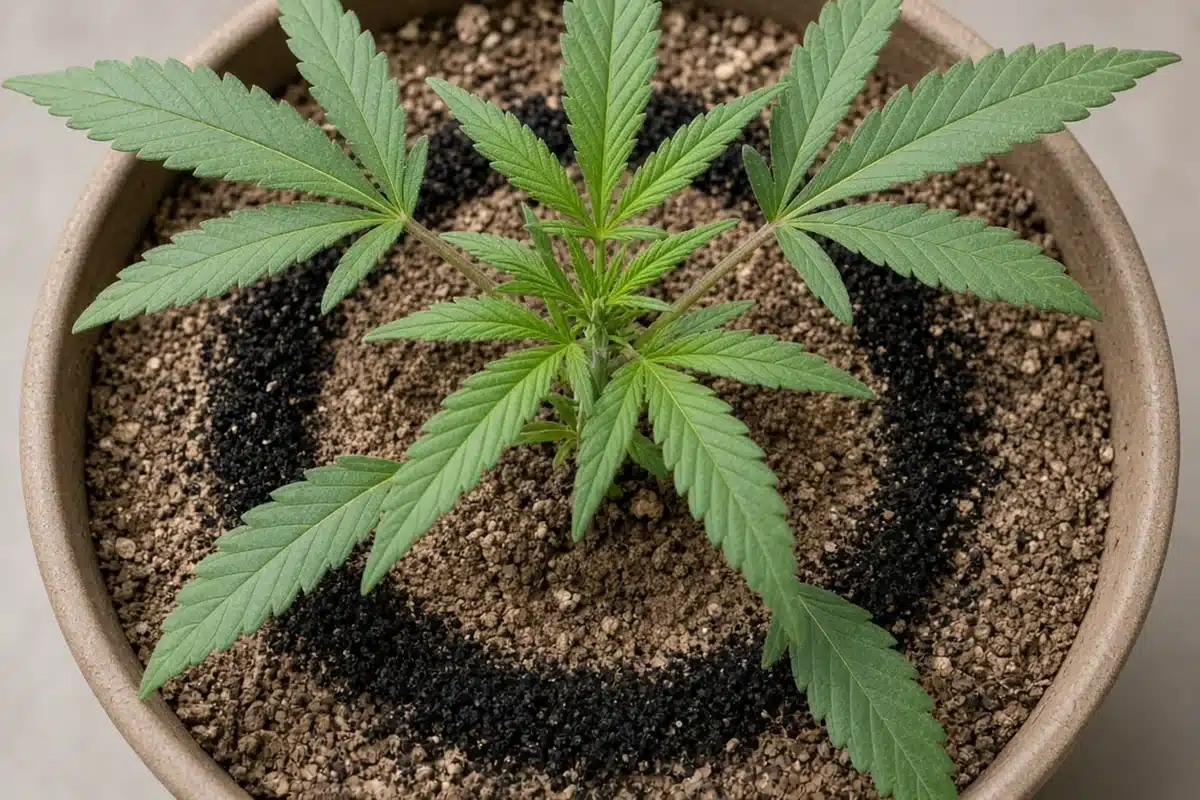
- Top dress lightly. Scatter a thin layer on the soil surface and scratch it in, then water well.
- Water thoroughly afterward. Even moisture helps microbes break it down and moves nutrients into the root zone.
- Watch for salt signs. Brown leaf edges or slow growth after adding frass may mean too much. Flush with plain water and cut back.
- Store it dry. Keep frass in a sealed container so it stays crumbly and does not mold.
Troubleshooting Insect Frass Problems
Leaf edges turn brown after a dose. Salt may be building up. Water heavily with plain water and use less next time.
Small flies appear around the pot. Damp organic matter can attract fungus gnats. Let the top inch dry between waterings and keep frass mixed in rather than piled on top.
No visible response. Frass is low in nutrients, so a quick green up is unlikely. Pair it with a proper feed.
Musty smell from the bag. Moisture got in. Spread it out to dry or discard the clumped portion.
Homemade digestate looks wet and sour. It may need more drying or composting before use. Purdue suggests testing it first.
Sources
- University of Arkansas Division of Agriculture, Arkansas Agricultural Experiment Station, news report on insect frass as a soil amendment: https://aaes.uada.edu/news/insect-frass-soil-amendment/
- Purdue University Extension Entomology, Black Soldier Fly Composting Guide (E 276): https://www.extension.entm.purdue.edu/publications/E-276/E-276.html
FAQ
Is insect frass a complete fertilizer for cannabis?
No. It works mainly as a soil amendment with modest nutrient levels, so plants still need a separate feed.
How much frass should I add to potting soil?
Start with a small share of the mix and follow the label. Too much can raise salt levels in containers.
Does frass help with insects on cannabis?
One Arkansas soybean study saw less leaf feeding damage, but cannabis has not been tested.
Can I make my own frass?
Yes. Purdue explains how to raise black soldier fly larvae at home and use the leftover digestate.
Is frass the same as worm castings?
No. Castings come from earthworms and frass from insects, though both add organic matter.